
Your board asks how the company shows up in ChatGPT, and the dashboard answers with a share-of-voice number that climbed last month. That number cannot support a spending decision, because mention counts move with query wording and model settings while telling you nothing about whether a buyer was persuaded, or even shown your site.
The measurement design we use with growth-stage B2B teams splits llm visibility into six stages, reports two of them to the executive team, and leaves the other four in the working file. It runs for 30 days before any content budget moves, and it ends with a holdout cohort that can tell you whether citations touch pipeline or only touch citations.
Table of Contents
- Why Mentions Are Not Enough to Report
- How to Build a Prompt Panel Across Platforms
- Why Pipeline Attribution Breaks for LLM Visibility
- What Does Not Work and Where Approaches Fail
- Content Changes That Lift Citation Rates
- Choosing the First Fix by Failure Stage
- Run a 30-Day Baseline Before Spending on Content
Why Mentions Are Not Enough to Report
A monthly share-of-voice score built from brand mentions tells a CMO very little about whether buyers see the company. An answer engine can name a brand in every prompt in the panel and send it no visit, no trial and no discovery call. The score measures how often a model's output contains a string. It says nothing about selection, accuracy or persuasion.
Split the funnel into stages before you measure anything. Candidate retrieval asks whether your pages enter the model's evidence set for a prompt. Citation asks whether the model then displays your page as a source. Accuracy asks whether the answer describes your pricing, category and capability correctly. Recommendation asks whether the answer proposes you for the buyer's scenario. Assisted demand asks whether branded search and direct traffic move with citation share.
Those stages diverge because answer engines run on a narrow source pool. A comparative study of LLM and traditional search, covering 55,936 queries, 124,287 domains and 1,418,733 citation hyperlinks, found that LLM systems cite an average of 4.3 URLs across 3.4 domains per query, against 10.3 URLs and 7.3 domains for traditional search. When a response exposes four sources, a page that ranks well on Google can still miss every run in your panel. That study frames the problem correctly, as a selection problem rather than a position-one ranking problem.
| Measure | What it tells you | How to capture it | What it cannot prove |
|---|---|---|---|
| Candidate retrieval rate | Whether your pages enter the model's evidence set for a prompt | Repeated runs of fixed prompts, logging retrieved URLs where the platform exposes them | Does not show the page was used in the answer |
| Cited-source rate | How often your domain appears as a source across repeated runs | Date-stamped captures of each answer and its citation list | Does not show that buyers clicked or believed the source |
| Citation position | Where your source sits in the citation list | Record citation order for each capture | No public study links citation order to pipeline |
| Answer accuracy | Whether pricing, category and capabilities are described correctly | Manual review of each captured answer against your product facts | Does not show that a corrected description changed buyer behavior |
| Recommendation rate | Whether the answer recommends you for the buyer scenario | Scenario prompts by intent and market, scored yes or no | Does not show that the recommendation reached the buyer |
| Assisted branded demand | Whether branded search and direct traffic move with citation share | Compare against control periods or query cohorts | Does not prove causation, and the size of any lift stays unknown until the holdout runs |
Two of those measures belong on the executive slide this quarter: cited-source rate by platform, and assisted branded demand against a holdout. The other four stay in the working file because they tell the team which fix to make, not whether the channel deserves budget. Brand tracking guidance from TheContentMap is a useful companion for the second measure, since it sets up the control-period comparison that makes a movement in branded search readable at all.
Reporting rule: if a measure cannot change a spending decision this quarter, it belongs in an appendix.
Reporting pressure arrives before the measurement is ready. In SEOFOMO's 2025 State of AI Search Optimization survey, 91% of SEO professionals said decision-makers or clients had asked about their company's AI-search visibility during the preceding year. Answer that request with two rates, a stated capture method and a confidence level, and the conversation moves to what to fix.
How to Build a Prompt Panel Across Platforms
Everything downstream depends on the instrument. A prompt panel is a fixed set of buyer questions run on a schedule against several models, stored so two captures a month apart can be compared line by line.
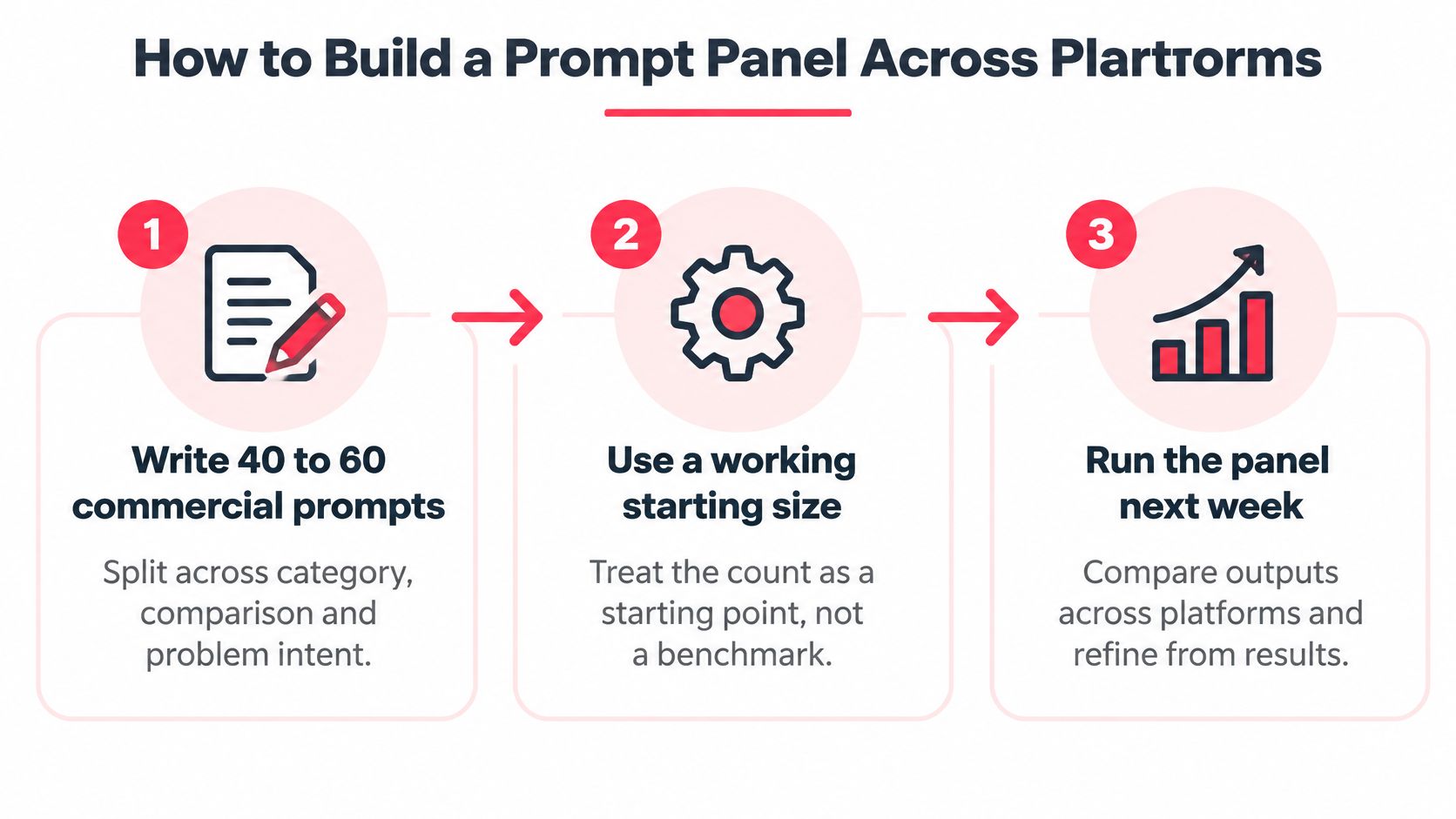
- Write 40 to 60 commercial prompts split across category, comparison and problem intent. That range is a working starting size, not a published benchmark. Fewer than 40 lets one odd answer swing a rate, and more than 60 outgrows what a two-person team can run every week.
- Vary wording, market, language and buyer role. A brand recommended for a US English query about procurement software can be omitted from the German or healthcare version of the same question, and the panel should surface that before a sales team does.
- Fix a competitor set of five to eight names. Share is only comparable across captures if the roster stays still, so change it at quarter boundaries and never mid-test.
- Run every prompt on ChatGPT, Claude, Gemini and Perplexity, and log Google AI Overviews as a separate condition. Overviews trigger unpredictably and their citation lists behave nothing like SearchGPT's, so folding them into the same rate hides both.
- Repeat each prompt at least three times on different days. A study of production web search inside ChatGPT found retrieval behavior varies across model settings, and that candidates retrieved repeatedly are more likely to be cited. A single run is an anecdote.
- Store the full answer, the cited URLs, the date and the model setting. Record the runs where no AI answer appeared, because a missing overview is a coverage condition, not a zero.
- Score every capture for citation, position, accuracy and named competitors. Unscored captures turn into screenshots nobody can aggregate.
The two largest answer surfaces need separate readings, and one comparative analysis of answer-engine sources measured how far apart they sit.
| Platform | Observed behavior | What it means for the panel |
|---|---|---|
| SearchGPT | Top-100 cited domains overlap Google results by 24% to 25%; median of three sources per answer; at least one citation in 97% of queries | Read its citations as a separate source pool, not a copy of Google results |
| Google AI Overviews | Appeared on 57.8% of tested queries; averaged 7.0 references when triggered | Log non-trigger runs as coverage gaps, not as zero rankings |
A usable result is a rate, not a screenshot: twelve of fifteen captures in one platform's column, up from five, with the competitor names beside it. The work of getting into those answers at all is covered in our guide to getting recommended by ChatGPT, Claude or Gemini.
Why Pipeline Attribution Breaks for LLM Visibility
Attribution breaks in two places. The tagged volume is small, and the influence that matters happens in sessions analytics never sees.
Search Engine Journal's assessment of AI visibility measurement reports a 12-month analysis of 100 sites in which ChatGPT generated 0.62% of Google organic traffic, and a separate study across 12 sites that found no reliable relationship between AI visibility and later branded search or direct traffic. A rising citation count can sit beside flat demand.
That is the stage where executive reporting gets sloppy. Of the six measurements worth tracking, the two to put in front of the executive team are answer presence on the prompt panel and a demand proxy built from branded search, direct traffic and assisted opportunities. Citation count belongs in the diagnostic layer, because it can climb while qualified pipeline stays flat.
Zero-click behavior explains part of the gap. When an AI summary resolves the query, the buyer can leave with the shortlist already shaped and no session reaches analytics. Referral traffic is real but concentrated. Nieman Lab's reading of ChatGPT referral data says traffic to publisher sites has nearly doubled this year, which is not the same thing as material B2B pipeline. Pull your own referral logs for the last two quarters before treating the channel as more than a signal.
A citation nobody clicks is worth measuring. It is not yet worth budgeting against.
So run the test. Pick two matched query cohorts, improve visibility on one and leave the other untouched, then compare branded search, direct traffic and assisted opportunities across the same weeks. That is the cohort logic we describe in how to measure marketing effectiveness, aimed at prompts instead of channels. No public study yet shows that citation share lifts qualified pipeline, and a recommendation inside buyer research can shape a shortlist months before a form fill without ever naming the answer engine as a referrer. Say that plainly to the board and let the holdout settle it.
What Does Not Work and Where Approaches Fail
Most of what gets sold as llm visibility optimization fails for one reason. It works on the answer instead of the evidence the answer is built from.
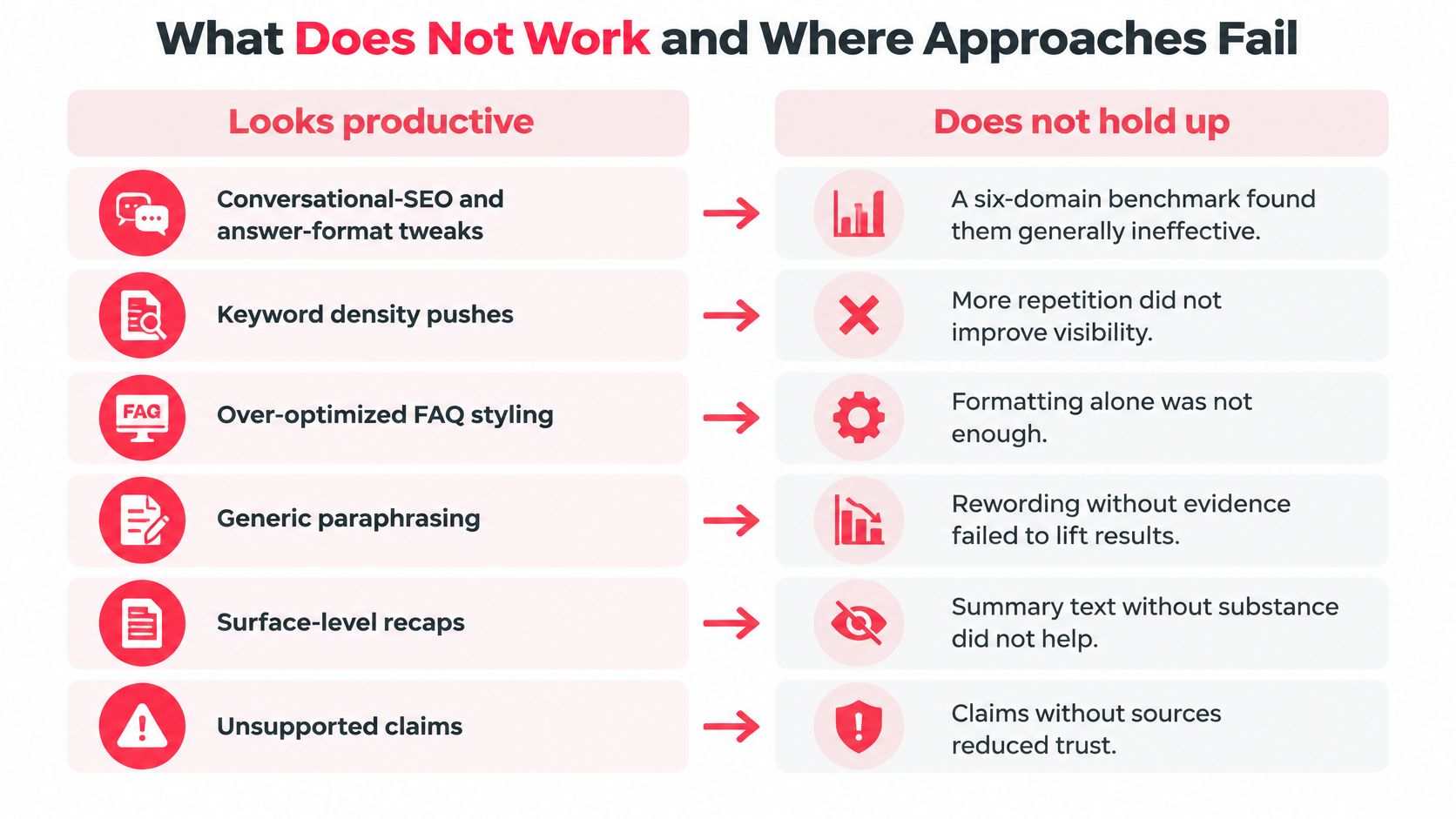
Answer-format tinkering is the clearest case. A benchmark spanning six conversational-search domains found conversational-SEO techniques were generally ineffective and could reduce a document's ranking, while the search engine's initial document ranking had a much stronger effect on whether a source became important to the model. The same work cites a 252,000-trial citation study in which topic match, price, recency and retrieved position dominated, with formatting close to irrelevant. Rewriting headings and adding FAQ blocks to a page that retrieval never selects changes nothing.
A short list of the other failures, with the reason each one wastes a quarter.
- Invented statistics. The research on generative engine optimization rewarded attributable figures, but it measured visibility, not factual accuracy. A fabricated number buys liability and no verified gain.
- Citation counts as the goal. Counts can climb while commercial effect sits at zero, and the count is the easiest number for a vendor to move.
- One monthly share-of-voice score. Results shift with wording, market and time, so a single figure hides which platform moved and which question broke.
- More generic pages. Volume does not produce the independently corroborated facts that models repeat. That is our read of the work, not a measured result.
- One platform treated as the market. Answer engines cite few sources per query and overlap little with Google, so a win inside ChatGPT says nothing about Gemini.
Where the approach fails outright
Three conditions make the whole exercise premature. Your category has almost no buyers putting questions to AI tools yet, so the panel measures a conversation that isn't happening. Your product facts contradict each other across the site, the docs and the pricing page, so every capture returns a different wrong answer. Your core claims have no source you can point to, so adding citations means inventing them.
In those cases, fix the facts and the coverage of buyer questions first. Do not stand up a prompt panel until the team can state each claim in one verified version.
Content Changes That Lift Citation Rates
The work itself is unglamorous. Put evidence on the page, in the form a model can lift and attribute.

The generative engine optimization research published through ACM SIGKDD tested three mechanics: citing relevant sources, adding quotations, and adding statistics. Together they produced more than 40% aggregate improvement in visibility, and the strongest individual methods delivered roughly 30% to 40% relative improvement on the study's position-adjusted word-count metric.
On a B2B page, that translates into three edits. Every claim about buyer behavior or market size gets a named source with a link. One genuine expert or primary-source line appears where such a line exists, in the speaker's own words. And each assertion carries a figure a reader can check, not a rounded number with no origin.
Work the retrieval side as well
Citations are the downstream half of the problem. Align each page to one question and one entity, state current facts such as price scope and plan limits in plain text rather than behind a demo request, and earn corroboration in product documentation, review sites and third-party datasets.
Then test one change at a time. Take ten prompts where the brand is absent, change a single page, rerun the fixed prompts across two or three platforms over several days, and compare citation rate and citation order against the baseline. Scale only what moves.
The study behind that benchmark also found performance varied by domain, as the published version of the GEO research reports, so a tactic that lifts citation in one category can't be assumed to transfer to yours. And the finding covers visibility only. It measured no conversion rate and no sales acceptance, which is why the pipeline question stays open.
Here is the practical walkthrough of turning a page into a citable source.
For the page-level restructuring sequence, our guide to optimizing content for large language models sets out the order of edits.
Choosing the First Fix by Failure Stage
The right first move is the earliest stage where the brand fails, not the loudest complaint from the sales floor.
Absence is common enough that it carries little signal on its own. Ahrefs' analysis of AI-search visibility found that 26% of brands had zero mentions in Google AI Overviews in 2025, so a blank result in your own panel says more about the category than about your standing.
Three rules hold across every row below. Fix the earliest failing stage first. Change one thing at a time. Do not scale content until a test moves citation rate or branded demand.
| Situation | Start with | Defer |
|---|---|---|
| Absent from category prompts | Align core pages to one question and one entity each | Brand-mention campaigns |
| Retrieved but not cited | Add attributed statistics and quotable sources to existing pages | New thought-leadership posts |
| Cited but described inaccurately | Correct product facts in your documentation and in the third-party sources that repeat them | Adding more citations |
| Cited with no movement in branded demand | Run a holdout test on pipeline before adding content | Scaling content volume |
Read the baseline stage by stage and match it to a row. A team that starts in the wrong row spends a quarter on activity the baseline already told them wouldn't help.
Run a 30-Day Baseline Before Spending on Content
Thirty days of disciplined capture buys something no content sprint can: a known starting point. Four weeks, owned by one marketing operations analyst, with CRO sign-off on the holdout cohort.
- Week one. Build the panel. Forty to sixty prompts, a fixed competitor set of five to eight names, and a stored copy of every question so the wording never drifts mid-test.
- Week two. Capture repeatedly. Run ChatGPT, Claude, Gemini and Perplexity on different days, and log how often Google AI Overviews trigger for the same queries.
- Week three. Score and audit. Mark citation, position, accuracy and named competitors, then list every factual error the answers contain about your product.
- Week four. Decide three things. Which two measures go to the executive team, which page cluster gets the first test, and which query cohort stays untouched as the holdout.
Capture cost depends on the logging method, from a manual spreadsheet through a scripted runner to a commercial tracker, so the budget line stays open until that choice is made.
If the baseline shows the brand absent or misdescribed, our AI opportunity audit covers conversion, search visibility, sales process and data readiness, and it can recommend holding off. Teams selling online can review AI Overviews impact on e-commerce brands before extending the same panel to product queries. The monitoring setup behind this baseline is described in our AI search optimization guide.
No content budget should move until the three week-four decisions are written down.
Once the numbers exist, the tracking tool matters less than the ownership questions: who runs the panel, which two rates go on the next board slide, and which cohort stays untouched so you can tell a real lift from a lucky month. If you want that baseline built with your team rather than handed to it, our AI Search and AEO engagement opens with a gap analysis across ChatGPT, Claude, Gemini and Perplexity.
