
Google reported in May 2025 that AI Overviews had reached more than 1.5 billion users each month across more than 200 countries and territories (Google's own account of the shift). That figure is why almost every agency now sells a generative engine optimization page. It is also why a large share of the contracts signed this year will be judged on the wrong thing.
Reach doesn't tell you whether your brand gets cited. A citation doesn't tell you whether a qualified buyer arrived. The buying decision isn't how many pages an agency will rewrite, it's whether the baseline, the crawler rules and the attribution model are in place before anyone touches content. Get that order wrong and you'll pay for twelve months of output you can't evaluate.
Table of Contents
- GEO Agency Service Lines and What Each Delivers
- Technical Eligibility Checks Before Any Content Work
- Measuring AI Visibility With a Fixed Query Panel
- Content Changes That Move Citation Rates
- Attribution When AI Visits Hide in Analytics
- Where GEO Tactics Fail and When to Hold Back
- Criteria for Choosing a GEO Agency
- Run a Two-Week Visibility Audit Before Signing
GEO Agency Service Lines and What Each Delivers
Pay for the measurement and eligibility baseline first. Pay for content volume only after the baseline shows which pages are missing from generated answers. Most agencies sell it the other way around, because a stack of rewritten pages invoices more easily than a prompt panel nobody wants to read.
The buyers exist now because AI answers reached mass scale on the dominant search platform. Reach isn't citation. The work that changes whether your brand appears, and whether the description is accurate, splits into five lines, and each one should hand you a document you can forward to a CFO and check again in three months.
| Service line | What it covers | What you should receive |
|---|---|---|
| Technical eligibility audit | Indexing, snippet controls, crawler rules, structured data matching visible content | Priority page list with indexed and snippet-eligible status |
| Answer gap analysis | Category and brand prompts run across ChatGPT, Claude, Gemini and Perplexity | Prompt panel record showing mention, citation or omission per engine |
| Content restructuring | Quotable claims, dated statistics, entity clarity on key pages | Rewritten page sections with a change log and a baseline |
| Citation and mention building | Third-party sources, expert quotes, digital PR placements | Target source list with placement status |
| Monitoring and attribution | Scheduled prompt sampling, referral reconciliation, CRM source fields | Dashboard with sampling variance and a documented holdout test |
Two scopes cover those lines in most proposals. A focused AI search and answer engine optimization scope runs the gap analysis across ChatGPT, Claude, Gemini and Perplexity, restructures content for LLM discoverability, builds citations and mentions, and handles schema, structured data and machine readability. A broader partnership opens with a full AI opportunity audit across conversion, search, sales and data, converts it into a prioritized roadmap with KPIs and implementation playbooks, then holds direction across parallel workstreams with implementation-level specs, including agent commerce readiness. The second model suits companies that already have teams and agencies.
Before a first call, read how the category describes itself. CitationOS's collection of generative engine optimization articles is a useful reference set, and worth reading for the claims that repeat across every provider.
Pricing is where comparisons collapse. Our research turned up no reliable public benchmark for these lines, which means any range quoted at you is either a scope assumption or a guess. Insist on the deliverables in the right-hand column, in writing, with a price, before you compare two providers on anything else. Treat AI search as a distribution layer with its own mechanics rather than a second SEO channel; our guide to AI search optimization sets out that framing for executive teams.
One line usually stays in-house. Content production, once the rewrite order is specified, is work your existing writers can do with a change log. Measurement and crawler governance shouldn't sit with the team being measured.
Technical Eligibility Checks Before Any Content Work
Run these checks before approving a single answer-targeted page. A page that fails them can't be rescued by better writing, and Google's documentation on AI features in Search sets the sequence. AI Overviews and AI Mode need no separate AI sitemap, no AI text file and no special schema.org vocabulary, but the page must first be indexed and eligible to appear in ordinary Search with a snippet.
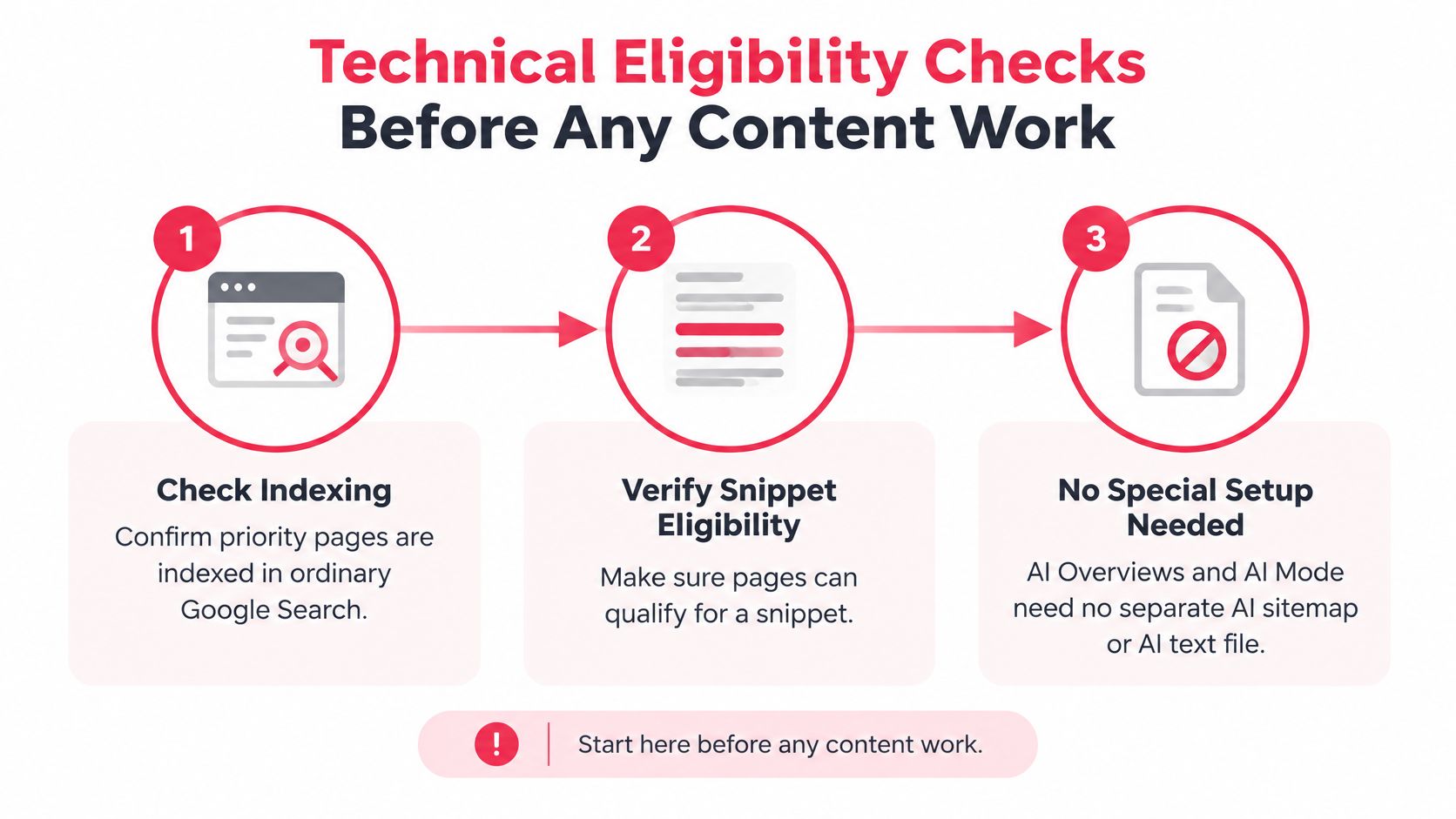
- Confirm indexing on your priority pages. Check coverage for the ten pages carrying your highest-value claims. If they aren't indexed and snippet-eligible, apparent content underperformance is a technical exclusion.
- Audit robots directives, canonicals and rendering. A noindex left from a staging launch, or a canonical pointing at a dead URL, removes a page from generative results no matter how quotable it is.
- Record each OpenAI crawler on its own line. OAI-SearchBot governs inclusion in ChatGPT search features, while GPTBot governs crawling for foundation-model training, and the two settings are independent (OpenAI's bot documentation). A site that disallows OAI-SearchBot won't be shown in ChatGPT search answers, though it may still appear as a navigational link.
- Check PerplexityBot, then check the firewall. Perplexity recommends allowing the bot and permitting requests from its published IP ranges (Perplexity's crawler documentation). Disallow it and you lose full and partial text, but the domain, headline and a brief factual summary can still be indexed, which leaves a thin representation you don't control.
- Validate structured data against the visible page. Markup claiming capabilities, pricing or customer types the page doesn't substantiate creates compliance exposure, not visibility.
- Get legal and executive sign-off per crawler, then retest after migrations. Record whether access is global or path-limited, whether staging is exposed, and whether a WAF change overrides the rule.
If your team is preparing for agent-driven traffic at the same time, the eligibility work overlaps; our checklist on preparing your website for AI agents covers the extra pieces. For the engineer who owns the fix, how AI crawlers interpret your pages is a useful briefing document.
The number to report before any claim of AI-search progress is the share of priority pages that are indexed and snippet-eligible. If that share is 60%, you have an access problem.
Measuring AI Visibility With a Fixed Query Panel
One AI visibility score hides the answer. A mention is not an endorsement, a citation is not a recommendation, and neither is revenue. Report the four separately or you will spend a year buying whichever one is cheapest to produce.
Build the panel before you build the retest. A survey of 4,706 queries found only 18% page overlap across two months for Google AI Overviews, against 45% for organic Google, and repeated runs changed 9% to 28% of decisions on some surfaces (the analysis on arXiv). A single run is a screenshot, and a screenshot is what a vendor shows you in a pitch.
Panel design is unglamorous and specific. Fix 40 to 60 buyer prompts across category, comparison and problem intents. Hold engine, country, language and the observation window constant. Run the panel twice before reporting a rate, and print the variance beside every number. Then separate source selection, whether an engine retrieves or cites your page, from source absorption, whether the answer text uses it. A domain can sit in the source rail while the generated answer ignores it entirely.
Share of answers is uneven across brands before any GEO work begins, so set targets against your own baseline rather than a market average. A niche brand chasing a global incumbent's citation rate will read honest progress as failure, and a strong first quarter can be churn in the index rather than anything you did.
| Metric | What it shows | Main limit |
|---|---|---|
| Brand mention rate | Share of sampled answers that name the brand | A mention is not an endorsement |
| Citation rate | Share of answers that link to the brand's domain | A citation may not be used in the answer text |
| Answer accuracy | Share of brand descriptions that are correct | Needs human review on every sample |
| Recommendation share | Share of answers that put the brand on a shortlist | Depends heavily on prompt wording |
| Referral sessions | Visits tagged as coming from AI engines | Undercounted when referrers are stripped |
| Qualified pipeline from AI sources | Opportunities whose source field names an AI engine | Requires CRM source fields to be set at lead capture |
If you want a worked method for the sampling side, NanoPIM's GEO measurement guide goes deeper on instrumentation than most agency decks.
Timing is the honest gap. No reliable benchmark tells you how many weeks a content change takes to appear in answers. Fix the read window before launch, keep it identical across runs, and do not move it because a chart looks flat. Connect sampled visibility to branded search, qualified visits and pipeline, then say plainly that a citation count is not a revenue figure.
Content Changes That Move Citation Rates
Evidence edits beat volume. In a summary of the Princeton GEO-bench experiments, adding quotations lifted visibility by about 41%, statistics by about 31%, cited sources by about 27% and technical terms by about 18%, while keyword stuffing reduced it by roughly 8% (the write-up of the benchmark results).
The mechanism is retrieval cost. Quotations, dated statistics and named sources give an engine compact spans it can lift without interpretation, and that is what a citation is.
None of these edits register if an engine's crawler never fetches the page. Confirm access first, then rewrite.
On one page, the rewrite order goes like this. Pick the three claims buyers care about most. Attach a named source and a date to each. Rewrite each as a self-contained sentence that survives being lifted out of context. Define your category terms precisely where a buyer would stumble.
| Tactic | Reported visibility effect | How to apply on a B2B page |
|---|---|---|
| Quotations | about +41% | Attribute each key quote to a named person or source |
| Statistics | about +31% | Add dated figures with the population and a link to the source |
| Citing sources | about +27% | Link each claim to primary research rather than a summary |
| Technical terms | about +18% | Define category terms precisely where a buyer would stumble |
| Keyword stuffing | about -8% | Remove repeated phrasing and replace it with the evidence above |
Princeton researchers built GEO-bench and reported visibility gains of up to 40% under controlled optimization (the GEO-bench publication). Those results come from general queries rather than B2B pipeline outcomes, so treat the figures as directional and retest them on your own panel before changing more pages. The page-level process in this guide to optimizing content for LLMs follows the same order, with one addition: keep a copy of each page's prior version so an accuracy regression can be traced.
Remove keyword repetition first. It is the only tactic in the research with a reported loss, and it costs nothing to cut. Run the retest on the panel you already built, not on a fresh set of prompts. A new prompt set measures a different thing and tells you nothing about whether the edit worked.
Attribution When AI Visits Hide in Analytics
Report AI referrals as small and undercounted, and build the number you can defend. The alternative is waiting for attribution that never becomes perfect, and waiting is the more expensive choice.
Start with the conversion evidence. Microsoft Clarity's analysis of publisher and news sites found LLM-referred visitors converting to sign-ups at a markedly higher rate than traditional search referrals. A channel that outperforms search on sign-ups is easy to misfile as direct traffic, and then it gets cut in the next budget round.

The scale is small and moving fast. AI referrals still average a small share of total site traffic, even though the same analysis showed that share growing sharply year over year while average search traffic declined over the same period. Set guardrails for product and category pages before any rewrite, because extraction-friendly text can pull clicks away from the pages that convert.
The reconciliation stack, in the order to build it:
- Reconcile server logs against analytics. Referrer stripping hides engines that do send a value, and log files are the only record you own.
- Add a self-reported field at lead capture listing the AI engines alongside the usual options.
- Monitor branded search as a proxy for answer exposure you can't tag.
- Normalize CRM source values so an engine name is a picklist value, not free text.
- Hold out a page group or region to test whether the visibility is incremental.
The first two items decide whether the rest produce a number you can trust. Server logs tell you what arrived. The self-reported field tells you what analytics dropped. Everything after that is calibration.
Alignment comes before reporting. The same analysis found a large share of publishers had not changed their strategy for GEO or AEO, and some did not know what the terms meant, which is the state of the room you'll be presenting to. The line a CFO can check is AI-influenced pipeline, the method behind it, and the holdout result.
Treat the attribution gap as part of the buying decision. An agency that promises clean, complete AI attribution is describing a system that does not exist. The defensible offer is a range, a named method, and a holdout that proves incrementality. A proposal that skips those three is selling you a guess with a dashboard.
Where GEO Tactics Fail and When to Hold Back
Some programs spend budget and produce nothing readable. Recognizing the conditions before signature is cheaper than discovering them at month four.
Three conditions that stop a program
Your brand barely appears for category prompts. If the panel shows single-digit presence before any work, third-party citation building moves faster than page rewrites, because engines lean on sources you don't own. Test a small placement budget first and watch whether anything shifts.
Legal has blocked every AI crawler. Blocking to protect training rights is a legitimate position. Applying it as a blanket rule across search and training bots removes you from answer surfaces too, and the executive who signs that should see the visibility consequence in writing before the rule ships.
The pages in scope are gated, priced or regulated. Google's guidance on succeeding in AI search treats snippet controls such as nosnippet, data-nosnippet, max-snippet and noindex as legitimate ways to manage display. For a company whose knowledge base is the product, restricting the extract is the correct call, and a page-level control decision belongs in the roadmap next to the content plan.
Two more failure modes cost budget without producing a failure report. Buying content by the article turns a GEO program into a content contract with a new label on the invoice. And extraction-friendly rewrites that lower clicks to product pages without raising qualified demand should be paused, not defended, while you check the panel for demand that moved.
A GEO program without a baseline isn't a program. It's an invoice with a chart attached.
The effect sizes that make this category persuasive come from benchmark queries. None of them promises pipeline. Don't let a proposal convert a 41% visibility lift into a revenue forecast, and don't accept one that does.
Criteria for Choosing a GEO Agency
Judge a generative engine optimization agency on how it measures and governs, not on how many pages it promises. Five criteria cover the difference, and each is testable on a first call.
| Criterion | Strong answer | Red flag |
|---|---|---|
| Measurement design | Fixed prompt panel, repeated runs, reported variance per metric | One visibility score or a monthly screenshot |
| Crawler governance | Separate decisions for search, training and fetch bots, signed by an owner | Blanket advice to allow or block all AI bots |
| Attribution plan | Log reconciliation, CRM source fields, a holdout test | Claims that citation counts equal revenue |
| Technical prerequisite | Indexing and snippet audit before any content work | Starts with an AI text file or special schema |
| Scope and exit | Written deliverables, price, who builds, and measurement handover at exit | Retainers with no defined deliverables or data ownership |
Put these on the call. How is the prompt panel built, and who owns the wording? How many runs per prompt, and what confidence gets reported? Which crawler decisions are recommended, and who signs them? Which attribution fields are required before reporting starts? Who writes the code and the content? What does the client keep at exit?
We're a fractional Chief AI Officer advisory firm, which puts us in a specific seat. We set direction, decide which tools are production-ready, and write the specifications your existing team and agencies build from, and we're paid for strategy and outcomes rather than for building. That fits established businesses with teams and agencies already in place. If you need one vendor to produce content and links with no strategy owner above them, a content-led GEO agency is the better buy, and we'll say so on the call.
There's no independent benchmark of named GEO agencies in anything we read for this piece. Ranked lists published by agencies tend to place the publisher near the top, which is exactly what a generative engine optimization agency should be able to do for itself, and exactly why the ranking isn't evidence. Compare providers on the criteria above.
Run a Two-Week Visibility Audit Before Signing
Buy an audit before you buy a retainer. Two weeks of measurement costs less than six months of the wrong program, and it produces the baseline every later claim depends on.
- Build a panel of 40 to 60 buyer prompts across category, comparison and problem queries, and freeze the wording.
- Run it twice, a week apart, on ChatGPT, Claude, Gemini and Perplexity, logging mention, citation, accuracy and omission for every answer.
- Check indexing and snippet status for your ten highest-value pages in ordinary Google Search.
- Record robots.txt and CDN rules for OAI-SearchBot, GPTBot and PerplexityBot, and name the person who approved each.
- Pull 90 days of referral sessions, self-reported attribution answers and CRM source values, then flag the share of pipeline with no source at all.
- Score the result against the five criteria and decide.

An AI opportunity audit is the deeper version of the same exercise, running across conversion, search visibility, sales process and data readiness to show where AI produces measurable gain and where it currently doesn't. The AI Growth Partnership starts there, produces a prioritized roadmap with KPIs, and continues as a fractional CAIO retainer only if the client chooses it. Our AI visibility audit follows this sequence, with the prompt panel and the crawler findings delivered as separate documents.
If the panel already shows strong visibility on your main prompts, measure what those appearances convert before buying more content. If it shows nothing, you've found the cheapest argument for a program. If you can't tell either way, run the panel in-house and decide with the result. Three options, and one of them is to wait a quarter.
Book an AI opportunity audit with Stimulead and you'll get the prompt panel results, the crawler and eligibility findings, and a prioritized roadmap with the KPIs attached, priced before anyone discusses a retainer. If the audit shows that GEO shouldn't start this quarter, that's the answer you'll get, in writing, with the reasons. Email us with your ten highest-value pages and we'll tell you what the engines currently say about them.
