
Most leadership teams I meet are in the same spot. AI is already in the room. Someone in marketing is using it for content. Sales wants better lead scoring. RevOps is looking at automation. The board wants a plan. Finance wants proof. What they don't want is another slide deck full of tools with no path to revenue.
That's where most AI roadmap work falls apart. The conversation starts with models, vendors, and prompts. It should start with pipeline, conversion, CAC, and speed to revenue. If your AI roadmap for marketing can't survive a CFO review, it isn't a roadmap. It's a shopping list.
A practical roadmap ties AI to the parts of go-to-market that move money. Conversion rate optimization. GTM engineering. Predictive qualification. AI search optimization. Agent commerce readiness. The point isn't to “use AI more.” The point is to use it where a leadership team can see the business result.
Table of Contents
- Your AI Roadmap Starts with Revenue Not Tech
- Find Your Wins with an Opportunity Scoring Matrix
- Design AI Marketing KPIs That Survive Board Meetings
- How to Structure a 90-Day AI Pilot Program
- Resourcing Your Roadmap with GTM Engineering
- Your Next Move AI Search and Agent Commerce
Your AI Roadmap Starts with Revenue Not Tech
The first mistake I see is simple. Teams try to pick tools before they've picked outcomes.
That approach feels productive because demos are easy. Revenue planning is harder. But the board doesn't fund “AI adoption.” It funds growth, margin, and efficiency. Your AI roadmap for marketing has to begin with the line items leadership already cares about: more qualified pipeline, faster sales cycles, better conversion rates, lower acquisition cost, and cleaner handoff between marketing and sales.
The market already made this a timing issue. The global AI marketing market is projected to reach $107.5 billion by 2028, up from $12.05 billion in 2020, and 69.1% of marketers had fully incorporated AI into their strategies as of 2025, according to Jony Studios' AI marketing statistics roundup. If your team is still treating AI like a side project, your competitors probably aren't.
Most roadmaps fail because they skip the P&L
Generic AI guides usually walk through phases. Audit. Pilot. Rollout. Training. Governance. That's fine as an operations document. It's weak as a leadership document because it doesn't answer the first question a CEO or CFO asks: where does this hit revenue?
A better starting point is your current GTM math. Look at:
- Pipeline creation: Which channels produce qualified demand today
- Conversion points: Where leads stall, bounce, or drop out
- Sales efficiency: Where reps waste time on low-fit accounts or manual prep
- Expansion motion: Where retention, upsell, or reactivation depends on faster insight
If you want a useful outside perspective on practical AI use in channels and campaigns, Sprints & Sneakers on AI marketing is worth reviewing alongside your own planning process.
Practical rule: Don't approve an AI initiative until someone can point to the metric it should move and the team that owns that metric.
Board-ready means operationally specific
I'd rather see one AI project tied to CRO velocity or sales qualification than ten disconnected experiments across content, design, and admin work. Small wins are fine. Unowned wins aren't.
This is also why readiness matters before procurement. If your CRM is full of duplicates, lifecycle stages are inconsistent, and attribution is disputed every quarter, AI will make the confusion faster. A proper AI readiness assessment for marketing and sales teams should test your data, workflow ownership, and reporting discipline before anyone buys another platform.
The leadership shift is straightforward. Stop asking, “Which AI tools should we use?” Start asking, “Which revenue constraint should we remove first?”
Find Your Wins with an Opportunity Scoring Matrix
A roadmap gets real when you force trade-offs. Every company has more possible AI use cases than budget, time, or change capacity. You don't need a bigger idea list. You need a way to rank what matters.
Start with your funnel not your vendor shortlist
Map the funnel from traffic to closed revenue. Use the version your revenue team currently uses, not the one on an old strategy slide. For most growth-stage teams, that means:
- Demand capture: paid search, organic, outbound, partner, referral
- Qualification: form triage, account fit, enrichment, routing
- Pipeline progression: meeting booked to opportunity creation
- Sales execution: research, personalization, follow-up, deal inspection
- Expansion: onboarding, usage signals, renewal and upsell triggers
Then list friction at each stage. You're looking for work that's repetitive, slow, inconsistent, or dependent on manual judgment with weak data.
Here are common examples:
- Lead qualification: AI scoring based on fit, behavior, and intent
- Lead routing: assignment logic based on territory, capacity, and expertise
- CRO workflow: faster test ideation, hypothesis generation, and experiment analysis
- Outbound personalization: account research and customized messaging at scale
- Deal inspection: transcript analysis for risk, next steps, and stakeholder gaps
- AEO prep: content structuring for machine-readable answers and recommendations
Use a simple scoring model that leadership can defend
The best model is easy enough to use in one meeting. I use three scoring dimensions and one forced output.
Helium42 notes that successful AI projects start by scoring 3–5 use cases on a 5-point scale across business impact, data readiness, and technical feasibility before choosing 1–2 for pilot implementation, and that purchased AI solutions succeed approximately 67% of the time compared with about one-third for custom builds when teams define measurable KPIs upfront, as described in their AI implementation roadmap guide.
For a revenue team, I translate that into this working matrix:
| AI Initiative | Revenue Impact | Data Feasibility | Implementation Effort (Inversed) | Total Score |
|---|---|---|---|---|
| AI lead scoring in CRM | 5 | 4 | 4 | 13 |
| AI lead routing by rep capacity and segment | 4 | 4 | 4 | 12 |
| CRO test analysis and hypothesis support | 5 | 3 | 3 | 11 |
| Account research for outbound personalization | 4 | 3 | 3 | 10 |
| AI-generated social posts | 2 | 5 | 4 | 11 |
That table is only an example. Your scores should come from your funnel economics.
A use case with lower novelty and higher operational fit usually beats a flashy use case that lacks clean data and clear ownership.
A few practical rules improve the exercise fast:
- Score revenue impact hard: If the initiative won't affect pipeline, conversion, retention, or CAC, give it a lower score.
- Be honest about data: If inputs are scattered across spreadsheets, Slack, and rep notes, feasibility drops.
- Invert effort: Quick deployment matters. A good-enough solution this quarter often beats a perfect system next year.
- Force a short list: Stop at 3–5 serious candidates, then pick 1–2 for pilot work.
What usually wins
In growth-stage companies, the strongest early candidates usually sit close to revenue operations. Lead scoring. Routing. Outbound research. Personalization. CRO workflows. Deal inspection. Those are boring in the best possible way. They connect to money quickly.
Content generation often looks attractive because it's easy to demo. It usually loses once leadership asks harder questions. Did it improve conversion? Did it lower CAC? Did it move qualified pipeline? If the answer is vague, it shouldn't be first in line.
Design AI Marketing KPIs That Survive Board Meetings
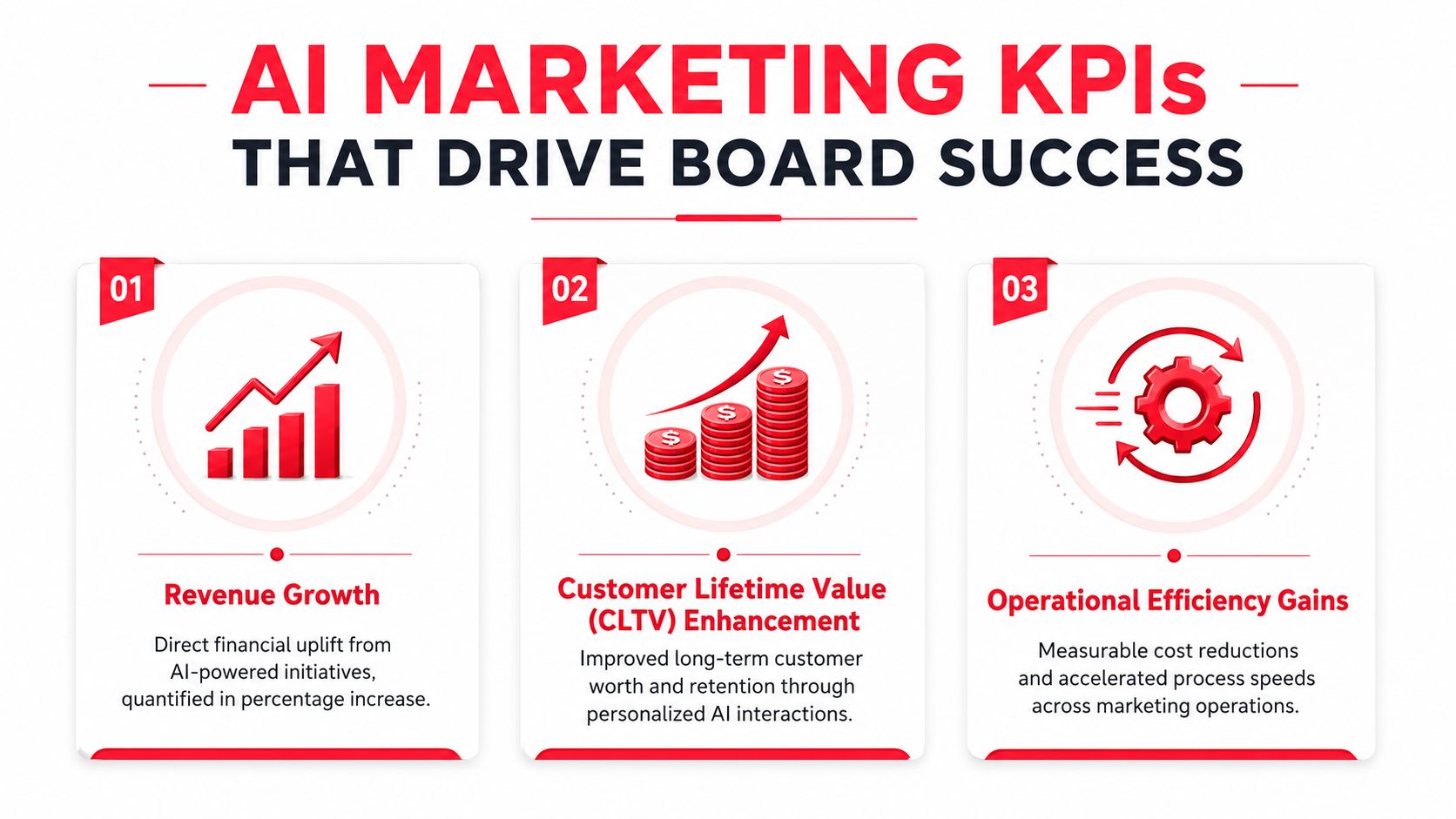
If your metrics sound like marketing metrics, expect resistance. If they sound like finance and revenue metrics, expect attention.
Use financial KPIs first
A board-ready AI roadmap starts with outputs the business already tracks. You can still monitor model accuracy, prompt quality, and workflow adoption inside the team. Those aren't the headline metrics.
The headline metrics are the ones that survive scrutiny:
- Pipeline velocity
- Lead-to-opportunity conversion
- Opportunity-to-close conversion
- Customer acquisition cost
- Revenue per campaign or segment
- Customer lifetime value
- Time to launch tests or campaigns
- Sales cycle friction by stage
The financial case for using AI is strong when it's tied to operating outcomes. Organizations deploying AI report a median ROI of 300% within six months, and AI-driven personalization can generate 40% more revenue than slower methods while reducing customer acquisition costs by up to 50%, according to Zigment's marketing ROI data.
Translate AI activity into operating metrics
Many teams lose credibility when they describe the AI task, not the business result.
Weak KPI:
- AI generates landing page copy
Board-ready KPI:
- Increase landing page testing throughput and improve lead-to-demo conversion on high-intent pages
Weak KPI:
- AI supports outbound writing
Board-ready KPI:
- Reduce rep prep time per target account and increase meeting conversion within named accounts
Weak KPI:
- AI improves content performance
Board-ready KPI:
- Lower production cost per asset while increasing qualified inbound influenced by that asset set
If you need a stronger measurement discipline, this guide for connecting marketing spend to revenue is a useful complement to executive reporting design.
Boards don't care that the team used AI. They care that the team produced more revenue, more efficiently, with clearer visibility.
A practical KPI stack for AI roadmap work
I usually put KPIs into three layers so leadership can see both outcome and control.
| KPI Layer | What to Track | Why It Matters |
|---|---|---|
| Commercial outcome | Pipeline, conversion, CAC, CLTV | This is what finance and the board review |
| Operating metric | Test velocity, speed to lead, routing time, rep research time | This shows whether the workflow changed |
| Adoption metric | Team usage, workflow completion, handoff compliance | This shows whether the process will stick |
For marketing leaders focused on conversion rate optimization, one of the strongest operating metrics is CRO testing velocity. If AI helps your team generate hypotheses faster, prepare test variants faster, and analyze results faster, you can run more high-quality experiments within the same quarter. That creates more shots on goal across revenue pages, pricing pages, signup flows, and demo funnels.
A clean marketing effectiveness measurement framework should connect those operating gains to the commercial result. Otherwise you'll end up defending activity again.
How to Structure a 90-Day AI Pilot Program
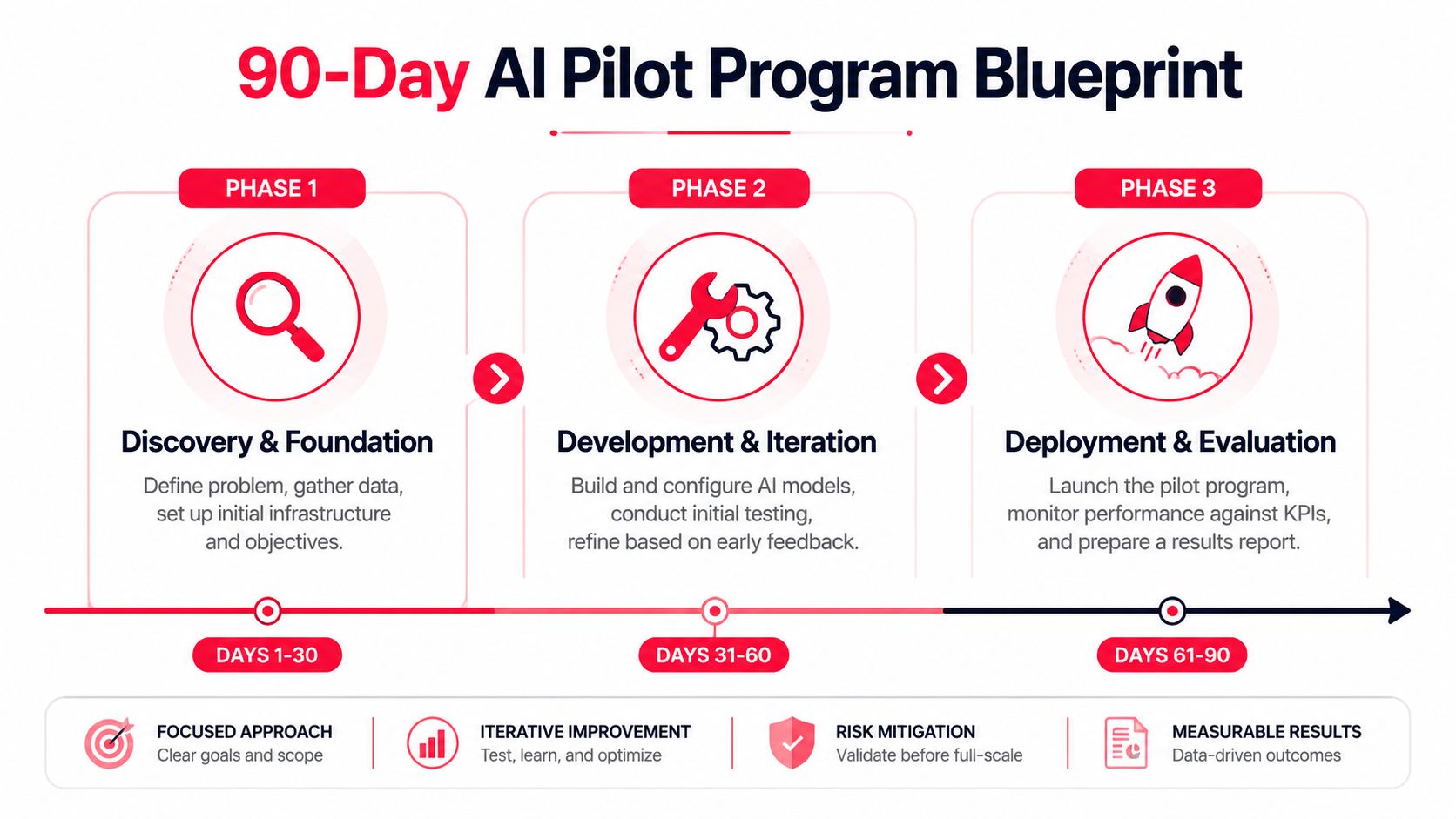
Most pilots fail because the scope is too wide and the success criteria are too soft. A pilot should prove one commercial case, inside one bounded workflow, with one owner.
A structured program matters because roadmaps with defined phases reduce project failure rates from over 70% to under 10%, and successful pilots target user adoption above 70% and process efficiency gains of 20–30% within the pilot period, according to Growexx's AI implementation roadmap guide.
Here's the visual version of the operating cadence.
Build one pilot around one commercial problem
Good pilot:
- AI-assisted lead qualification for inbound demo requests
Bad pilot:
- Full marketing transformation with content, ads, chatbot, analytics, and CRM automation
A clean pilot has a hard edge. It states what the system will do, what it won't do, and which team members are in the loop. For a growth-stage B2B company, a strong first pilot might be AI-assisted qualification and routing tied to faster speed-to-lead and better meeting quality. For an e-commerce team, it might be AI-assisted CRO workflow tied to faster testing on product and checkout pages.
After the scope is fixed, assign a small team:
- Executive sponsor: CEO, CMO, or CRO
- Business owner: the leader responsible for the workflow
- Operator: RevOps, growth lead, or GTM engineer
- User group: reps, SDRs, lifecycle marketers, or growth marketers
- Compliance reviewer: legal or data owner if sensitive workflows are involved
A quick walkthrough helps align expectations before the build starts.
What goes in the pilot document
I keep the pilot plan short. If it takes 40 pages to explain, the team won't use it.
Use this structure:
- Objective
- One sentence tied to revenue or efficiency
- Scope
- Included workflow, excluded workflow, systems touched
- Inputs
- CRM fields, call transcripts, website events, email engagement, product data
- Outputs
- Score, recommendation, route, draft, summary, alert
- KPIs
- Commercial, operating, and adoption metrics
- Timeline
- Weekly milestones and decision gates
- Owners
- Named people, not departments
- Risk controls
- Human review, escalation path, data checks
Keep human review in the loop until the team trusts the output and the workflow is stable.
A practical 90-day rhythm often looks like this:
- Days 1–30: data checks, process mapping, baseline metrics, workflow design
- Days 31–60: build, integrate, test with a small user group, refine prompts and logic
- Days 61–90: launch into live workflow, track weekly, document wins and misses, decide scale or stop
The best pilot updates are short. Baseline. Current result. Blocker. Next decision. That's enough for leadership.
Resourcing Your Roadmap with GTM Engineering
Roadmaps don't fail because the strategy was bad. They fail because nobody owns the plumbing.
Build versus buy is an execution decision
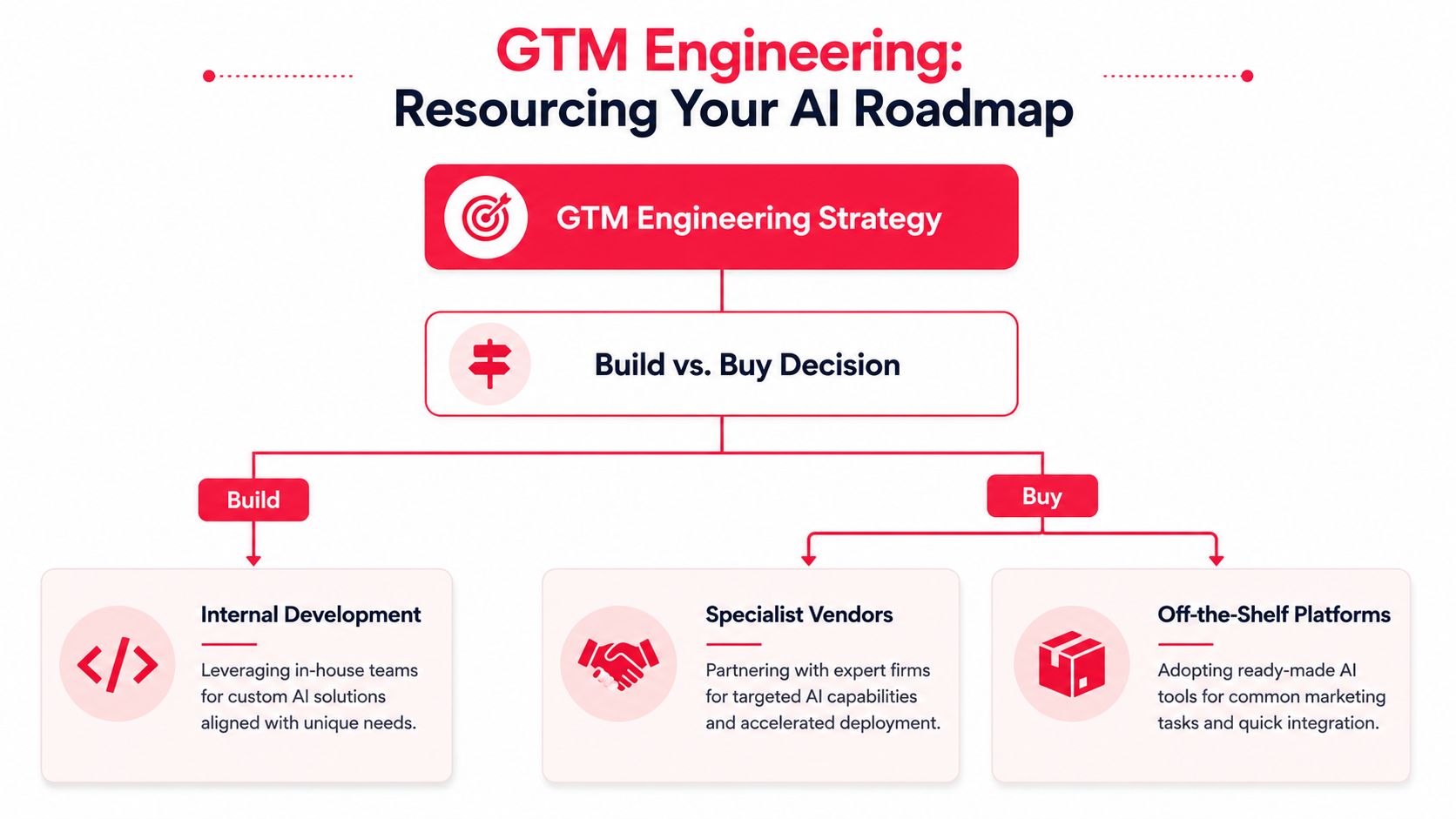
Leadership teams often make build-versus-buy too philosophical. It's usually simpler than that. If the workflow is common and the vendor category is mature, buy. If the workflow is a real differentiator and you have the technical depth to support it, build selectively.
In practice, most growth-stage companies should buy more than they build. Purchased solutions from specialist vendors tend to succeed more often than custom builds when KPIs are defined upfront, as noted earlier. The mistake isn't buying software. The mistake is buying software without the operator who can wire it into CRM, lifecycle automation, reporting, and rep behavior.
That operator is increasingly the GTM Engineer.
Scale Venture Partners describes the GTM Engineer as a hybrid of software engineer, RevOps architect, and GTM strategist who builds the infrastructure behind AI agents and system integrations, creating the efficiency that drives revenue growth in lean teams, in their GTM Engineer overview.
What the GTM Engineer actually does
This role matters because AI in go-to-market lives or dies on integration. Models don't create value sitting in a chat window. They create value when they sit inside the flow of work.
A GTM Engineer typically handles work like this:
- Data foundation: CRM cleanup, enrichment flow, field mapping, deduplication
- Qualification logic: scoring rules, account ranking, buying group signals
- Routing and orchestration: assignment logic by segment, geography, or rep bandwidth
- Workflow integration: passing outputs into CRM, sales engagement, and reporting systems
- Agent support: prompt structure, guardrails, review steps, feedback loops
RevGenius notes that GTM engineers build lead scoring algorithms and routing rules that assign opportunities based on rep capacity and expertise, which helps prospects reach the right representative quickly, in their GTM engineering guide. Apollo also points out that a mid-market GTM engineering roadmap starts with data foundation work such as TAM unification and CRM deduplication before intelligence and automation layers, in its six-month GTM engineering roadmap.
That order is right. Messaging won't save dirty data.
If you can't trust the account record, you can't trust the AI output tied to it.
For teams that don't have this role in-house, options include training a strong RevOps or growth operator, using a specialist implementation partner, or working with an advisory firm that covers roadmap, vendor evaluation, and execution oversight. Stimulead's AI growth partnership is one example of that model for companies building around CRO, GTM engineering, AEO, and agent-commerce readiness.
Training also needs to stay practical. Don't try to turn marketers into ML engineers. Train them on workflows they'll use weekly: account research, personalization review, test design, funnel analysis, transcript summarization, and prompt refinement inside approved systems.
Your Next Move AI Search and Agent Commerce
Your current funnel was probably built for humans searching, clicking, comparing, and then converting. That won't be the whole story much longer.

Duval Union notes that 59% of marketers prioritize AI for personalization, yet few roadmaps deal seriously with AI Engine Optimization and agent-commerce readiness, leaving companies exposed as AI agents start to mediate buying decisions, in their AI marketing strategy playbook.
Prepare your funnel for machine-mediated discovery
SEO thinking begins to broaden into AEO. Your site still needs strong human messaging. It also needs clean machine-readable structure, direct answers, product and service clarity, and content that helps language models interpret your authority correctly.
If you sell into complex B2B categories, this matters even more. AI systems need unambiguous signals about what you do, who you serve, what outcomes you produce, and how your offering differs. Vague websites lose here.
Three parts of the funnel usually need work first:
- Structured content: pages with clear entities, services, categories, FAQs, and supporting proof
- Commercial clarity: messaging that states use case, buyer, and expected business outcome plainly
- First-party knowledge assets: proprietary insight from your customer data, product data, and sales calls
Three actions to take now
Start with actions your current team can own this quarter.
Audit machine readability
Review key pages for structure, schema, answer clarity, and page-level intent. Product pages, solution pages, comparison pages, and FAQ content matter most.Rewrite for conversational retrieval
Build content around the natural language prompts a buyer would give an AI assistant. That usually means longer-tail, specific queries tied to use case, industry, and constraints.Build for agent-commerce readiness
Map where an AI agent would struggle in your current journey. Hidden pricing, weak product detail, poor categorization, inconsistent naming, and broken metadata are common blockers. If you're planning for this shift, a practical starting point is understanding how AI agents change digital buying workflows.
For leadership teams, the next step is simple. Pick one revenue bottleneck. Score the AI opportunities around it. Define board-level KPIs. Launch one 90-day pilot with a named owner. Then fix the infrastructure that lets the result scale.
If you want your AI roadmap for marketing approved quickly, bring four things to the next leadership meeting: the ranked use case list, the KPI stack, the 90-day pilot document, and the owner responsible for execution. That's the version a CFO can sign off on.