
Most AI advice for operators is built for committees, not companies that need revenue movement this quarter. The standard playbook says to form a steering group, map a long transformation, buy a stack, and wait. That's how teams spend months in workshops and still can't point to pipeline, conversion, or cash impact.
A useful AI implementation roadmap starts smaller and moves faster. The hard truth is that AI use is already widespread, yet business impact still lags. 88% of organizations use AI, but only about 39% report measurable enterprise-level EBIT impact, and nearly two-thirds haven't begun scaling AI across the whole business according to this 2025 analysis of McKinsey survey findings. That gap matters more than adoption headlines.
For CEOs, CMOs, and CROs, the question isn't whether to “do AI.” It's where AI can move revenue in weeks with the team you already have. In growth-stage companies, that usually means one of four places first: CRO with AI, GTM engineering, AI search optimization, or agent commerce readiness. Pick one workflow. Put a number on success. Ship a pilot fast. Keep what pays. Remove what doesn't.
Table of Contents
- Forget the 18-Month Plan Your AI Roadmap Needs 90-Day Sprints
- Phase 1 Align Objectives and Audit Reality
- Phase 2 Prioritize Use Cases and Select Your Pilot
- Phase 3 Execute and Measure Your 90-Day Sprint
- Build Governance and Scale Your Wins
- A Sample GTM AI Roadmap Template
Forget the 18-Month Plan Your AI Roadmap Needs 90-Day Sprints
The long AI transformation plan is usually a stall tactic dressed up as strategy. It creates the appearance of control while pushing value far into the future. Growth-stage companies don't have that luxury.
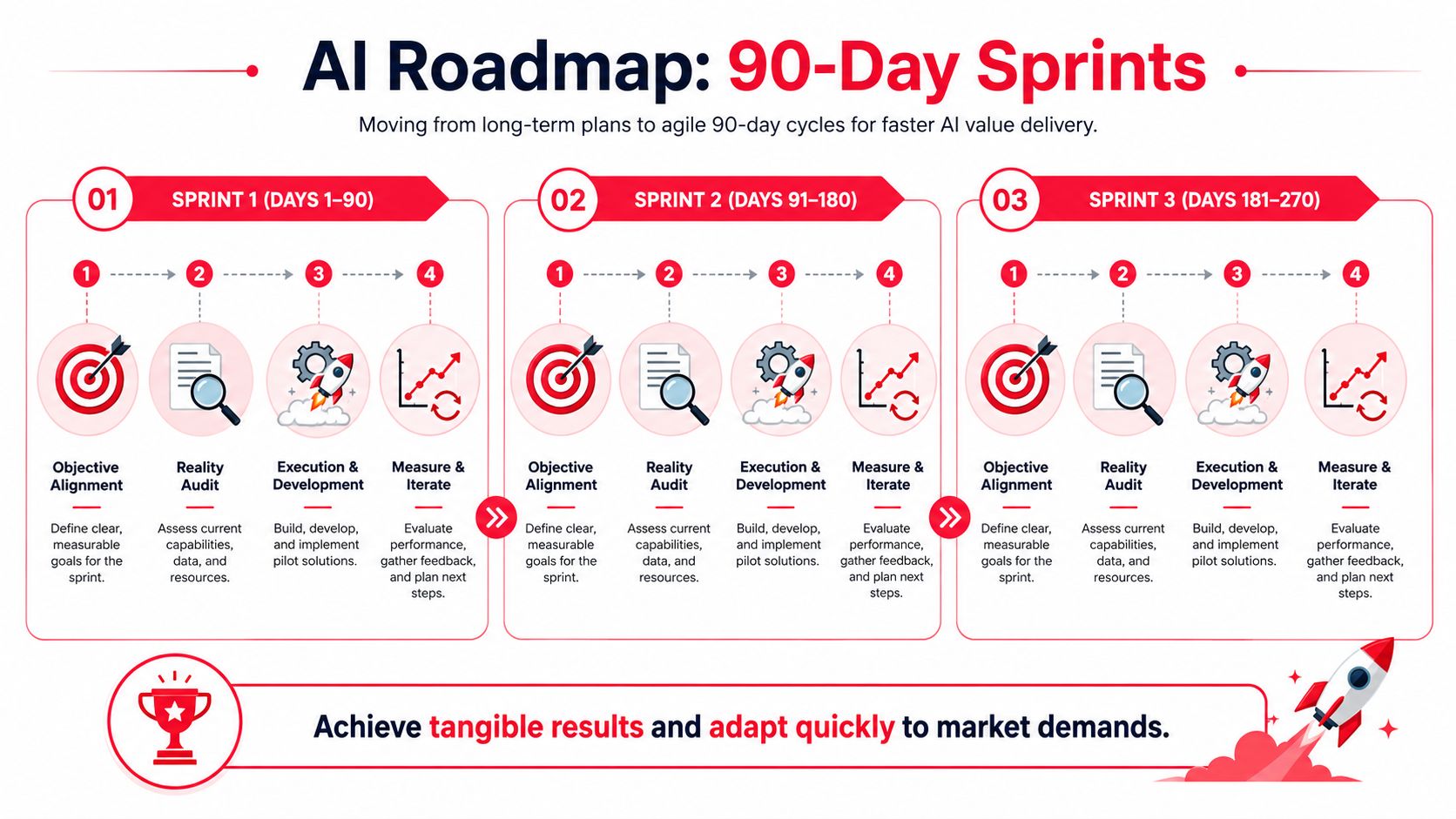
The better model is simple. Adopt a 90-day sprint model instead of an 18-month transformation timeline. Focus on one specific workflow, deploy in weeks, and measure ROI to scale success or kill failure immediately. Companies following this iterative approach avoid the 70–80% failure rate common in traditional projects because they generate rapid feedback loops, as described by Foxtrove's guidance on why AI implementations fail.
Moving from long-term plans to agile 90-day cycles for faster AI value delivery.
Why the sprint model works
In practice, most revenue teams don't fail because the model is weak. They fail because the scope is bloated. Someone tries to fix content ops, SDR research, reporting, support, and site personalization at the same time. Then nobody owns the outcome.
A sprint forces trade-offs:
- One workflow: landing page testing, outbound research, lead qualification, or product-feed structuring for AI discovery.
- One owner: usually a revenue leader with one technical partner.
- One scoreboard: pipeline, conversion, qualified meetings, or revenue-per-session.
- One decision point: scale, revise, or stop.
Practical rule: If your AI roadmap can't fit on one page for the next 90 days, it's too broad to execute.
What works and what usually fails
What works is boring. Tight scope. Baseline metrics. Weekly review. Clear owner. Small deployment group. Fast revision cycle.
What fails is also predictable:
- Committee ownership: everyone advises, nobody decides.
- Tool-first buying: the team buys software before choosing the workflow.
- No baseline: people say the pilot “feels useful” but can't tie it to revenue.
- No kill criteria: weak pilots linger because no one wants to admit they missed.
When I advise CEOs on an AI implementation roadmap, I push for the shortest path to proof. If the workflow can't produce a measurable operational or revenue signal inside one quarter, it's a second-sprint idea.
Phase 1 Align Objectives and Audit Reality
Organizations often start with tools. That's backward. Start with the revenue bottleneck, then check whether your current data, systems, and team can support a pilot without creating a side project that eats the quarter.

Start with the revenue bottleneck
For a CEO, the first question is simple: where does friction hit the P&L fastest?
For a CMO, that may be low conversion on high-intent pages. For a CRO, it may be slow follow-up, weak qualification, or inconsistent outbound personalization. For e-commerce teams, it may be product discovery, checkout abandonment, or poor merchandising signals for AI-mediated buying.
Here's the test I use in the first two weeks:
- Find the choke point: Where do deals stall, forms leak, or qualified buyers drop?
- Attach a business metric: Use revenue, pipeline, booked meetings, SQL quality, or conversion.
- Set a narrow hypothesis: Example: AI-assisted page testing can speed experiment cycles on a pricing page. Or AI-assisted account research can improve outbound relevance for named accounts.
- Name the owner: One accountable operator. Not a committee.
That sounds obvious, but it is frequently skipped. Then they join the group of companies using AI without seeing much business movement. As noted earlier, 88% of organizations use AI, but only about 39% report measurable enterprise-level EBIT impact, and nearly two-thirds haven't begun scaling AI across the business.
Run a fast reality audit
A real audit doesn't need months. It needs candor.
Use this checklist:
- Data access: Can your team reach the CRM, analytics, call data, product catalog, or page-level behavior data needed for the pilot?
- Workflow fit: Does the team already follow a repeatable process, or are you trying to automate chaos?
- Stack overlap: Do HubSpot, Salesforce, GA4, Shopify, Segment, or your testing platform already cover part of the need?
- Team capacity: Who will run this each week after launch?
- Risk limits: What customer-facing actions need review before full automation?
If you want a structured way to do that quickly, Stimulead's AI readiness assessment is one example of the kind of operator-level audit that keeps teams from buying ahead of execution.
Your first pilot should fit your current operating model. If it requires new headcount, a data rebuild, and a legal review cycle, it's too early.
A useful pattern here is to separate “possible” from “ready.” Plenty of use cases are possible. Few are ready this quarter.
A short walkthrough can help your team calibrate before you commit tools or budget:
The output you want from this phase
By the end of this phase, your AI implementation roadmap should produce four decisions on one page:
| Decision | What good looks like |
|---|---|
| Revenue target | A single business metric with a baseline |
| Pilot workflow | One narrow process with visible friction |
| Delivery team | One executive owner and a small execution group |
| Constraints | Budget, systems, review rules, and timeline |
If you can't state those four clearly, don't buy anything yet.
Phase 2 Prioritize Use Cases and Select Your Pilot
Once the bottleneck is clear, teams often make the next mistake. They generate too many AI ideas and treat them as equally urgent. They aren't. Your pilot has one job: earn the right to a second sprint.
Use an impact versus effort filter
I keep this simple. Put every candidate use case into four buckets based on business impact and implementation effort. Then ignore most of them.
High impact, low effort is where first pilots belong.
Here's how I score them in practice:
- Revenue proximity: Does this touch conversion, meetings, qualification, pricing visibility, or close velocity?
- Data readiness: Can we run it with current systems and acceptable cleanup?
- Operational fit: Will the team use it inside the current workflow?
- Review burden: How much human oversight is needed before output goes live?
Then allocate effort correctly. To avoid the 95% enterprise AI failure rate, use a 10-20-70 model: 10% on algorithms, 20% on tech and data infrastructure, and 70% on people, process, and change management, based on this analysis of enterprise AI failure patterns. That matches what I see in the field. Teams obsess over prompts and models. The core work involves workflow design, QA, adoption, and feedback loops.
Good first pilots for growth teams
The strongest early pilots usually live in one of these lanes.
CRO with AI
Use AI to speed hypothesis generation, QA test ideas, cluster session behavior, and draft page variants for high-intent pages. If your team already runs experiments, AI can increase testing velocity without forcing a redesign of the whole marketing stack.
GTM engineering
Use AI to structure account research, summarize call notes, draft personalized outbound angles, and route leads by fit. This works best when sales already has a decent process and just needs faster prep and cleaner execution.
AI search optimization and AEO
Structure content, product pages, and comparison pages so AI systems can interpret what you sell, who it's for, and why it's relevant. This matters more as buyers rely on AI-mediated research.
Agent commerce readiness
For commerce teams, product data quality becomes a revenue issue. If AI shopping assistants can't parse your catalog, pricing logic, or product attributes, you lose visibility before the click. For a concrete commerce angle, Optimizing Shopify for AI product discovery is worth reviewing because it focuses on how product structure affects AI-led discovery.
Pick the pilot where you already have demand, data, and team ownership. Leave the interesting but speculative ideas for later.
A good pilot brief fits in a few lines:
- Workflow: SDR research for named accounts
- Current pain: prep is inconsistent and slow
- AI action: summarize firmographic context, recent signals, and likely pain points
- Human review: AE approves final outreach
- Success signal: faster prep and better meeting quality
That's enough to start. Anything larger belongs in a later sprint.
Phase 3 Execute and Measure Your 90-Day Sprint
Execution is where teams either build momentum or get trapped in internal theater. Keep the pilot narrow, visible, and tied to weekly numbers. The team should know exactly what gets built, what gets tested, and what gets reviewed each week.
Workers using AI tools see a 66% increase in throughput for realistic daily tasks, equivalent to 47 years of natural productivity gains, according to the Stanford AI Index 2025 report. That doesn't mean every pilot will produce that outcome. It does mean speed is available if the workflow is real and the team uses the tool.
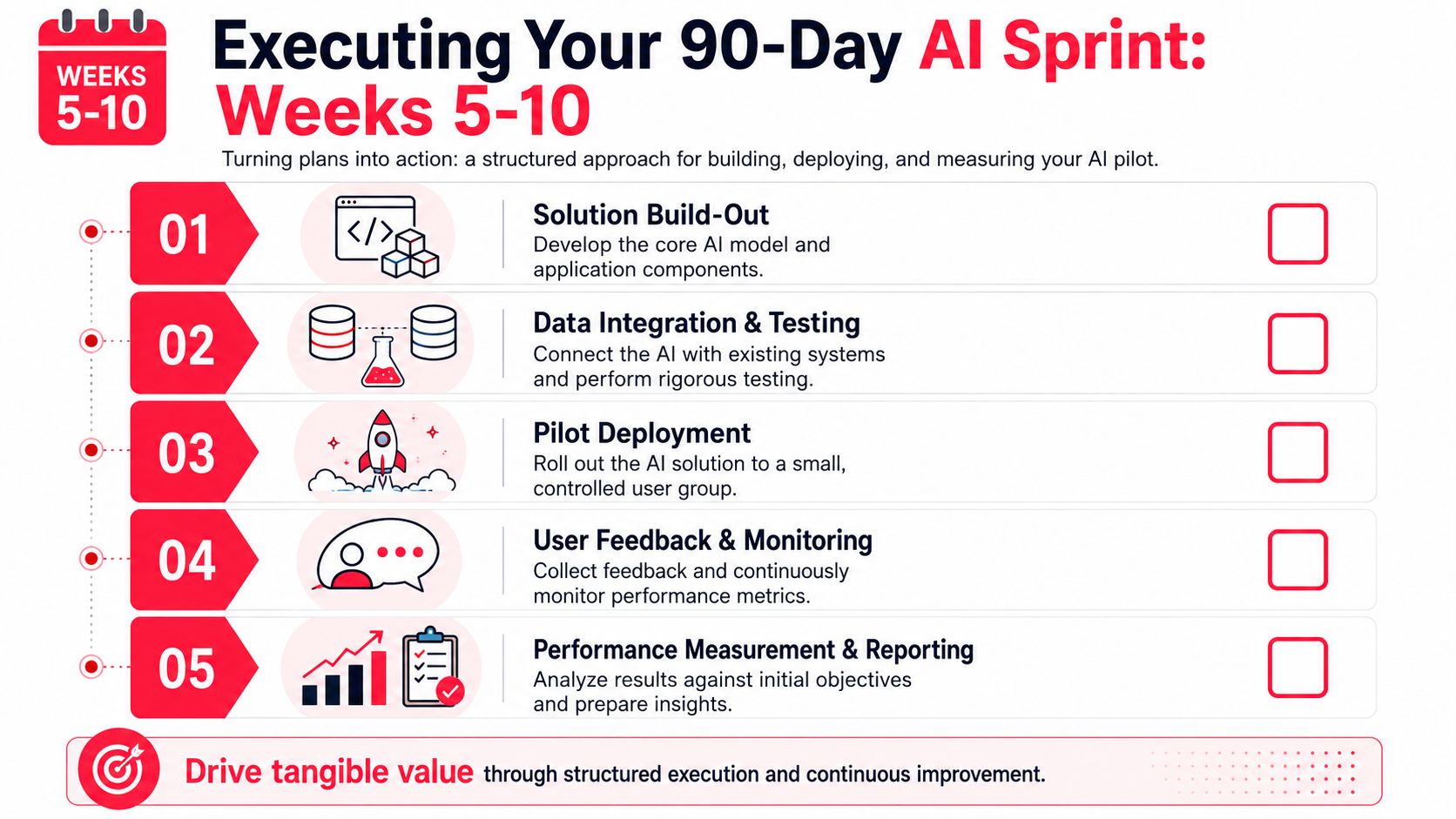
A workable week-by-week cadence
I prefer a cadence that looks like this for weeks five through ten:
| Week | Team focus | What should happen |
|---|---|---|
| 5 | Build | Configure the workflow, prompt logic, routing rules, and QA steps |
| 6 | Integrate | Connect CRM, analytics, CMS, product feed, or sales engagement tools |
| 7 | Test | Run internal trials with real inputs and log failure modes |
| 8 | Launch small | Put the pilot in front of a controlled user group |
| 9 | Review | Compare output quality, adoption, and business movement against baseline |
| 10 | Decide | Expand, revise, or stop |
Many operators often overcomplicate the tool choice. You rarely need a custom stack for sprint one. A mix of existing platforms, API workflows, spreadsheets, CRM automation, and a review queue is often enough.
Measure business output, not AI activity
A pilot fails when the team reports on AI behavior instead of business results. “People used it.” “The model responded fast.” “The output looked good.” None of that matters to a CEO.
Track outcomes the business already respects:
- Pipeline impact: influenced opportunities, qualified meetings, or sales-accepted leads
- Conversion movement: form completion, booked demos, or page-level conversion
- Time-to-output: account research time, response time, or campaign production time
- Labor value: hours saved translated into team capacity
For marketing teams, connect the pilot back to your existing reporting structure. If your measurement is weak, fix that before scaling. Stimulead's guide on how to measure marketing effectiveness is the kind of reference I give teams when attribution and KPI discipline are still loose.
Run weekly reviews with one page of numbers and one page of issues. If the pilot needs a slide deck to look healthy, it probably isn't.
What a healthy pilot feels like
A healthy sprint gets easier to explain as it runs. The team can show:
- what changed in the workflow,
- who used it,
- where output broke,
- what was fixed,
- and whether the business metric moved.
That clarity is the point. By day 90, the decision should be obvious.
Build Governance and Scale Your Wins
Most leaders hear “governance” and assume delay. Bad governance does slow teams down. Good governance removes tool sprawl, lowers rework, and speeds approval because everyone knows the rules.
Governance should speed decisions
Your AI implementation roadmap needs a lightweight operating layer before sprint two. Keep it lean:
- Approved use cases: which workflows can use AI today
- Approved tools: which vendors are allowed for those workflows
- Data rules: what can be entered, uploaded, or synced
- Human review rules: what must be checked before customer-facing use
- Owner map: who approves, who runs, who reports
For product-minded leaders building AI into customer workflows, I also recommend reviewing how teams think about AI product development. It's useful because it frames AI as an operating system decision, not just a feature choice.
If you need a working reference for policy and oversight, AI governance best practices gives teams a starting point for acceptable use, review gates, and vendor control.
Add a disinvestment protocol
This is the step most roadmaps skip. That's a mistake.
Industry data shows 40% of AI experiments fail to deliver measurable value, yet 90% of existing roadmaps lack a formal disinvestment protocol. If you don't define how to retire weak tools, your stack fills with subscriptions, partial pilots, and shadow workflows that nobody wants to own.
Use a simple removal rule. Every pilot and every vendor should face the same quarterly review:
| Review area | Keep it if | Remove it if |
|---|---|---|
| Business value | It improves a tracked KPI or saves meaningful team time | The impact is vague or unproven |
| Adoption | The intended team uses it inside the real workflow | Usage depends on reminders or workarounds |
| Risk | Review and data rules are clear | Data handling or approvals remain fuzzy |
| Cost | Spend matches output | You're paying for potential, not results |
Stop treating every AI experiment like a future platform. Most should stay small or get cut.
This is also where you deal with shadow AI. If sales, marketing, and success each buy their own tools, you'll get duplicate spend, conflicting data practices, and no shared learning. A governance group doesn't need to be large. It needs authority and a monthly decision rhythm.
Scale the winners. Cut the rest quickly.
A Sample GTM AI Roadmap Template
A real roadmap should be easy to copy into your operating plan. Keep each sprint tied to one focus area, one owner, and one success KPI that matters to revenue leadership.
How to use this template
Use this as a planning template, not a fixed prescription.
A few rules keep it useful:
- Start with one sprint only: don't approve all three at once.
- Set baselines first: every KPI needs a starting number from your own business.
- Name one owner per sprint: shared ownership kills speed.
- Limit active initiatives: one core initiative is enough for a first sprint.
- Review at day 30, 60, and 90: if the signal is weak, revise before you scale.
I also recommend matching the sprint to team maturity. If your marketing team already tests pages and analyzes behavior, start with AI-assisted CRO. If sales has a disciplined outbound motion, start with GTM engineering. If you're in e-commerce and product discovery is messy, start with structured data and agent-commerce readiness.
Sample 90-Day AI Roadmap for a GTM Team
| Sprint (90 Days) | Focus Area | Primary Objective | Key Initiative | Success KPI |
|---|---|---|---|---|
| Sprint 1 | Marketing and CRO | Improve performance on high-intent pages | Implement AI-assisted experimentation for landing pages, pricing pages, and form analysis. Use AI to generate hypotheses, prioritize tests, and support copy and layout variants | Movement in landing page conversion rate, form completion quality, and faster testing cycles |
| Sprint 2 | Sales and GTM Engineering | Increase rep efficiency and improve outbound quality | Build an AI-assisted research and outreach workflow that summarizes account context, drafts personalized talking points, and prepares first-touch messaging for rep approval | Faster research time, better meeting quality, and stronger pipeline creation from target accounts |
| Sprint 3 | E-commerce and AEO | Improve AI-led discovery and buying readiness | Structure product and category data for AI interpretation, refine PDP content for recommendation systems, and prepare catalog logic for agent-mediated shopping | Better product discoverability in AI-assisted journeys, stronger product page engagement, and cleaner handoff into checkout |
You can also adapt the same template by team size.
For a smaller company, the owner may be the CMO with one ops lead and one agency partner. For a larger growth-stage company, the owner may be a CRO or VP Marketing with RevOps, engineering, and analytics support. The structure stays the same. The staffing changes.
A few pilot examples that fit this template well:
- Marketing sprint example: use AI to review session recordings, cluster objections from on-page behavior, and generate test ideas for pricing-page copy.
- Sales sprint example: use AI to turn call transcripts and CRM notes into objection libraries and outbound personalization angles.
- Commerce sprint example: rewrite weak product attribute logic so AI shopping tools can interpret compatibility, use case, and pricing more clearly.
If you want to add one outside advisor or execution partner, keep the role narrow. One option in that category is Stimulead, which works as a fractional CAIO model for roadmap design, vendor evaluation, implementation oversight, and team training across CRO, GTM engineering, AI search optimization, and agent commerce readiness.
The bigger point is operational discipline. A usable AI implementation roadmap doesn't need dozens of workstreams. It needs a sequence. Sprint one proves a workflow. Sprint two expands what worked. Sprint three builds system-level advantage.
Pick one revenue workflow today. Set the baseline. Name the owner. Put the first 90 days on the calendar. If you can't decide where to start, begin with the bottleneck closest to cash: conversion, qualification, outbound efficiency, or product discovery. That's the roadmap.