
B2B sales automation fails when teams treat it like a volume switch. The key decision is whether to automate for capacity and control first, or to push more touches through a pipeline that already loses context, timing, and ownership.
Modern buying cycles force that choice. Forrester data shows the average number of interactions in a significant B2B purchase rose from 17 in 2019 to 27 in 2021, and buying groups of four or more people grew from 47% to 60% (Cirrus Insight). That means automation has to preserve context across more people and more steps, not just send faster follow-up.
Table of Contents
- The Shift to Committee-Based Purchasing
- Sequencing Automation Around Capacity
- Inbound Routing and Response SLAs
- Outbound Orchestration and Data Validation
- The Buyer Perception Gap
- Metrics That Prove Pipeline Impact
The Shift to Committee-Based Purchasing
B2B sales used to work as if one contact could carry the deal. That model is gone in most growth-stage companies, because the buying side now brings more people, more scrutiny, and more back-and-forth into the cycle. When interactions increase and buying groups expand, every missed handoff creates avoidable drag.
What changed in the cycle
The practical change is simple. Reps are no longer managing a neat sequence of intro call, demo, proposal, and close. They're managing multiple stakeholders who enter and exit at different moments, compare notes internally, and expect the seller to remember context without being asked twice.
Practical rule: If your automation can't preserve account context across stages, it's creating more motion, not more progress.
That's why the old idea of “automate more outreach” misses the point. The operational problem is keeping response times, qualification, and pipeline visibility intact while deal complexity rises. Automation earns its place when it helps the team coordinate follow-up, log activity, route the right owner, and keep the next conversation relevant.
Why this matters for growth-stage teams
For CEOs, CMOs, and CROs, the issue isn't theoretical. In a committee sale, one weak response can stall an entire account. A form fill that sits unattended, a routed lead sent to the wrong rep, or a CRM record missing buying-role context all slow the cycle and weaken confidence inside the account.
That is why b2b sales automation belongs in the operating model, not as a side tool for a few reps. It keeps the machine readable. It also gives leadership a clearer view of where the pipeline is breaking, which matters more than adding another sequence or another alert.
When buying gets more distributed, automation has to become the memory of the process.
Sequencing Automation Around Capacity
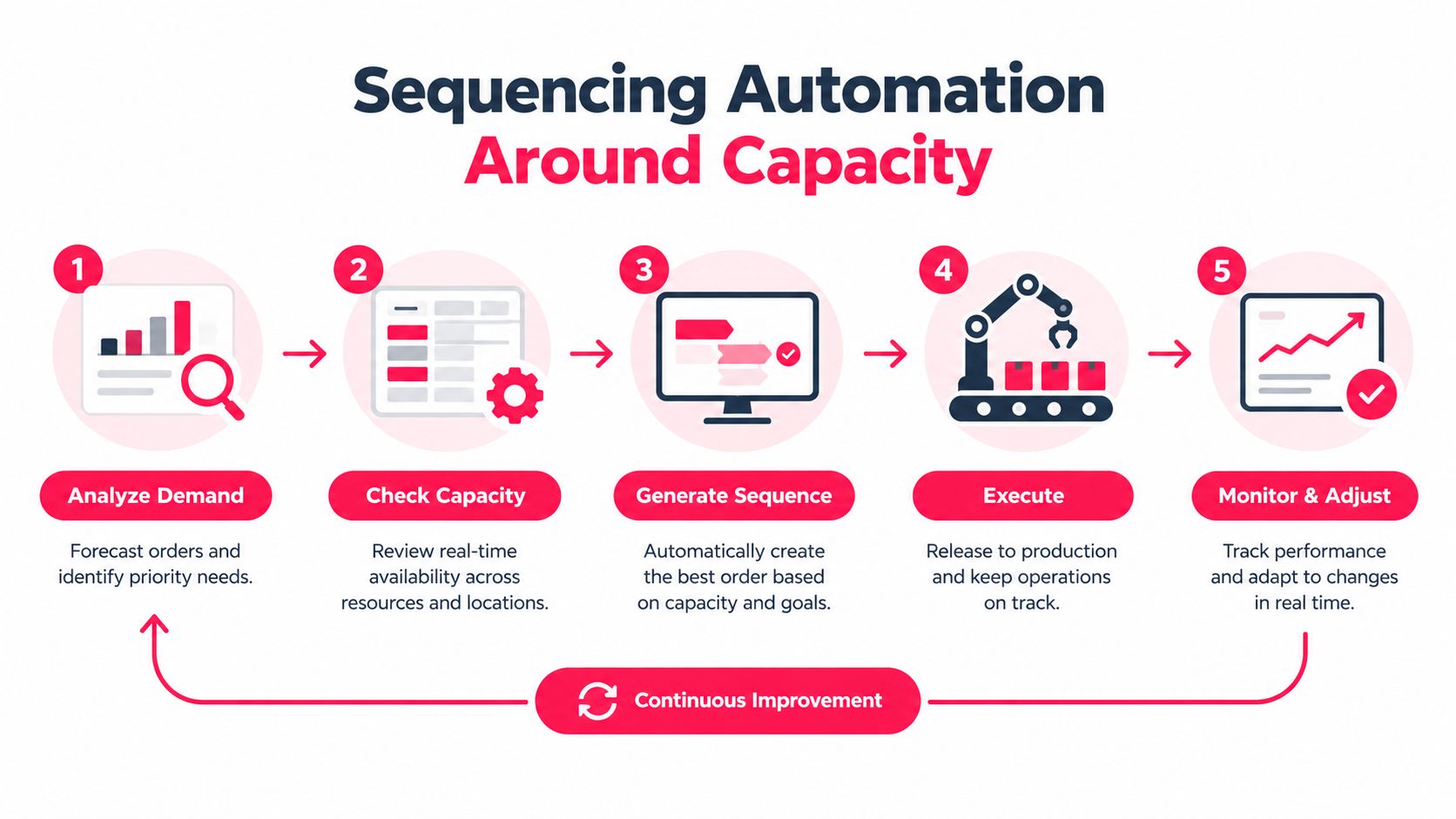
The wrong order is common. Teams start with outbound sequences, add more templates, then discover their CRM data is messy and their reps still spend hours on admin. That approach scales noise before it creates capacity.
Start with non-selling work
McKinsey's analysis of nearly 500 B2B companies found that automating non-selling work created about 20% additional sales-team capacity, with top-quartile companies improving productivity by up to 30% (McKinsey). The order matters. We've seen teams get better results by automating order entry, research, routing, and reporting before they touch autonomous prospecting.
That sequence returns time to the team in a way leaders can measure. The point is not to let reps do more of the same. The point is to redirect recovered hours toward qualified conversations, better discovery, and cleaner handoffs.
Use the recovered time on the right work
A useful way to manage this is to treat capacity like a budget.
- Automate the admin first. Pull repetitive work out of the rep's day, including logging, research, and reporting.
- Fix routing and ownership. Make sure each lead lands with the right person on the first pass.
- Stabilize the data layer. Clean the fields that drive segmentation, assignment, and follow-up.
- Only then expand outbound. Add sequences once the team can trust the inputs and the handoff rules.
- Measure what returns to selling. Track whether the saved time becomes more qualified conversation, not more low-value activity.
A practical resource for outbound workflow design is Pipecorn automation insights, especially if your team is deciding what should be fully automated and what still needs human review.
Where many teams get the sequence wrong
They automate prospecting before they automate cleanup. They add touches before they create ownership. They try to improve bookings while ignoring the tasks that consistently consume the team's selling time.
A better benchmark is hours returned to customer-facing work. If automation doesn't create more rep time for live selling, the stack is probably too early, too broad, or too disconnected from the way the team works.
Inbound Routing and Response SLAs
Inbound automation should start with a timer, not a nurture sequence. Once a lead submits a form, the system has to capture the event, enrich and deduplicate the record, route it by territory or segment, send an immediate acknowledgement, and create a human follow-up task with an auditable SLA.
Build the response path end to end
The operational target is contact within five minutes. That matters because contacting a lead within five minutes produces roughly 21 times higher qualification odds than waiting 30 minutes, while HBR audits found only 37% of companies respond within an hour (Expertise AI). The lesson for operators is plain, speed is a system property.
Practical rule: If your SLA can't be audited, it will drift.
The dashboard should show median response time, 90th-percentile response time, contact rate, meeting rate, qualification rate, and revenue by response-time cohort. Those measures tell you whether the workflow is genuinely improving outcomes or just sending more alerts.
Keep automation tied to human follow-up
Automation should support the rep, not replace the rep. That means pausing sequences when a meeting or opportunity is created, escalating unworked leads, and logging every state change so the team can see what happened and when.
A strong reference point for cross-functional handoff design is Stimulead's sales and marketing alignment guide, because inbound response usually fails where marketing, routing, and sales ownership overlap.
The most reliable setup is also the least glamorous. Use one source of truth for ownership, one response SLA, and one rule for what happens when a lead is hot. If the process relies on rep memory, the handoff is already too fragile.
Why the five-minute window matters
The five-minute window is useful because it forces discipline. It tells ops teams to design for immediacy, not convenience. It also makes performance review easier, because leadership can inspect cohorts by response speed instead of arguing over anecdotal follow-up quality.
For teams that want a sales-focused workflow view, boost revenue with sales automation is a useful lens on how response systems affect pipeline timing, especially when ownership moves between marketing ops and sales ops.
Outbound Orchestration and Data Validation
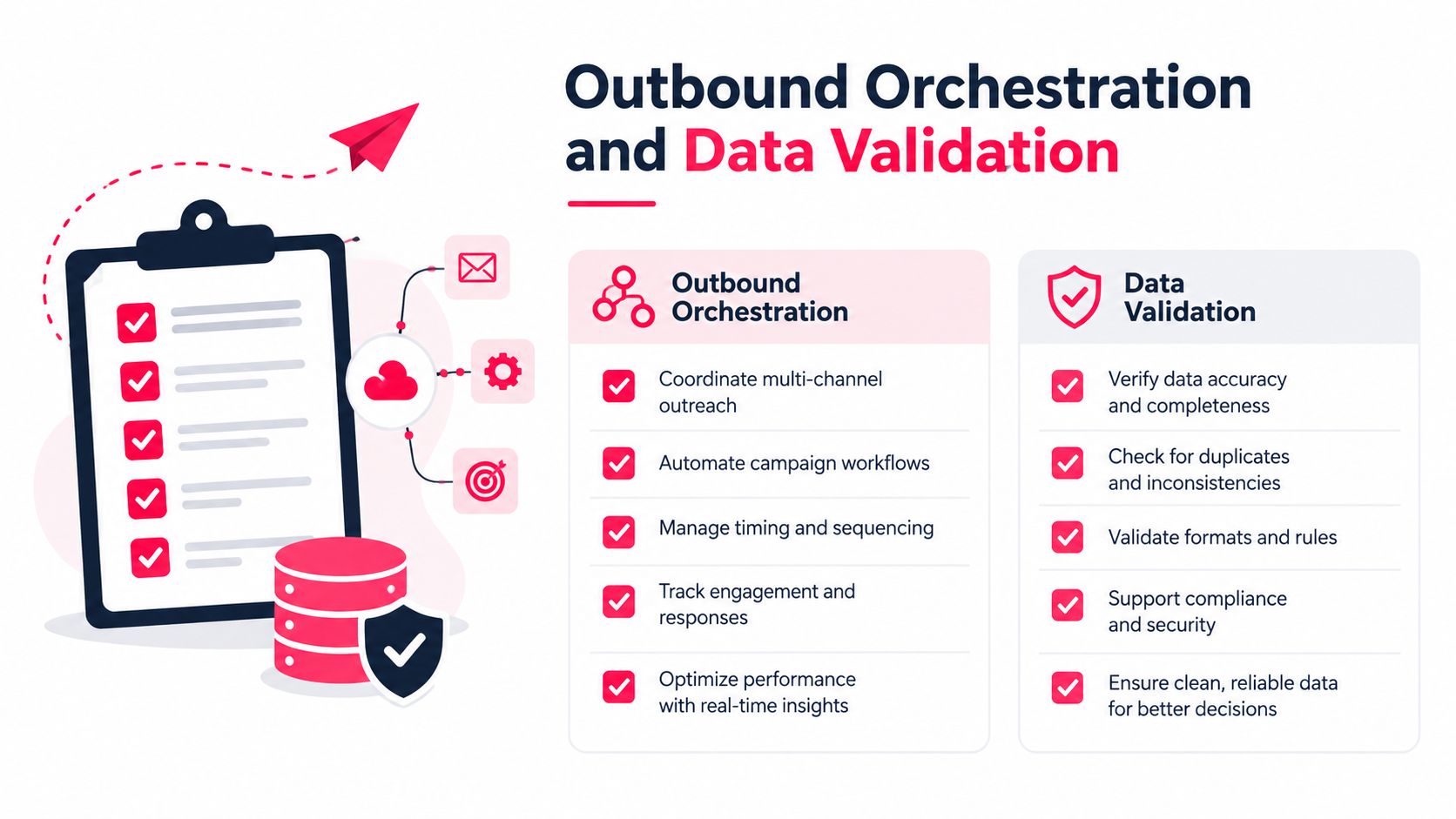
Outbound breaks when teams scale activity before validating data and buying signals. That failure mode is easy to miss because the dashboard still fills up, even while deliverability, reply quality, and brand trust erode underneath it.
Validate before you launch
A sound outbound workflow starts with an ICP and account-level qualification schema. Then it verifies firmographic, technographic, role, and intent fields, applies suppression rules for customers, competitors, unsubscribed contacts, and poor-fit accounts, and only then generates a bounded message from approved evidence.
That structure matters because only about 7% of B2B teams meet a five-minute response target for outbound replies, which shows how often orchestration breaks down when routing rules are weak (Plura). A sequence that sends quickly but routes badly still fails.
Put guardrails around the sequence
The operating rules are straightforward:
- Suppress bad-fit records. Remove existing customers, competitors, unsubscribed contacts, and weak matches before any send.
- Cap touches. More touches are not the same as more pipeline.
- Stop on reply. Positive replies, meetings, opt-outs, and opportunities should stop every active sequence.
- Review messages weekly. Inspect automated copy for weird claims, outdated proof, or tone drift.
- Route replies to humans. The moment intent appears, a seller should take over.
For the team thinking about process ownership, Stimulead's AI outbound page is a useful companion because outbound automation only works when data hygiene and message control are treated as part of the system.
Why volume is the wrong primary metric
If you optimize for send count, you can still end up with weak pipeline. We've seen teams celebrate higher activity while their valid-contact rate and meeting rate move the other way. The right question is whether automation improves decision quality and speed together.
More touches create more risk when the records are dirty and the buying signal is weak.
A practical control is to test holdout accounts and compare pipeline by cohort. If the automated path doesn't beat the manual baseline on qualified outcomes, the issue is usually data, routing, or message relevance, not effort.
The Buyer Perception Gap
The hardest part of b2b sales automation is that suppliers and buyers often disagree about how automated the process feels. Suppliers may see a polished sequence. Buyers may experience repetition, gaps, or a handoff that never quite lands.
Human escalation needs a threshold
A cross-study comparison found that 72% of suppliers described their sales processes as highly automated, while only 47% of buyers agreed, a 25-point perception gap (MarketBetter). That gap is the warning sign. It suggests many teams are automating internal activity without making the buying journey easier.
The fix is to define a human escalation threshold. Some work should stay automated, such as data enrichment, meeting coordination, reminders, and basic routing. Other moments need a skilled seller, especially pricing interpretation, security review, business-case building, executive alignment, and situations where the buying group is split.
Match the workflow to deal risk
Complex deals need more judgment, not more cadence. If a procurement thread turns ambiguous, or if the buying group disagrees on requirements, the automation should slow down and hand the account to a human who can read the room.
A useful test is to ask whether the next automated step adds information or just adds motion. If it only adds motion, it probably belongs in the rep's queue instead. That keeps the process from feeling mechanical in moments where trust matters most.
We use this same logic when advising teams on tool selection. Stimulead's work with growth-stage companies often focuses on where automation should stop and where a seller should intervene, because the wrong handoff can do more damage than a slow one.
Buyers don't reward automation for its own sake. They reward clarity, relevance, and timing.
The operating question is whether the workflow helps the buyer make progress. If it doesn't reduce confusion or improve access to a useful answer, it's probably adding friction, even if it looks efficient on a dashboard.
Related reading: what is sales automation covers the workflows that pay back and the CRM data they depend on, and what is revenue intelligence explains why data definitions come before any forecasting platform.
Metrics That Prove Pipeline Impact
Activity volume is a weak proxy for success. Reps can send more emails, close more tasks, and still leave pipeline quality unchanged. The better test is whether automation changes conversion, cycle time, and the quality of the accounts that move forward.
Measure the right cohort effects
McKinsey reports that companies enabling sales teams with automation often see efficiency gains of 10% to 15%, but that only turns into bookings when routing and qualification rules keep low-quality pipeline out of the funnel (McKinsey). That is the right frame for a CRO. Efficiency matters, bookings prove whether the workflow is helping.
A clean measurement model should include these checks:
| Metric | What it tells you | What to watch |
|---|---|---|
| Speed-to-lead | How fast the team responds | Median and 90th percentile by source |
| Lead-to-meeting rate | Whether routing and timing work | Compare automated vs manual cohorts |
| Qualification rate | Whether the right leads get through | Look for signal quality, not volume |
| Opportunity creation rate | Whether responses turn into pipeline | Separate inbound and outbound |
| Revenue by cohort | Whether automation improves deal value | Adjust for deal size and stage |
A useful operating reference for pipeline hygiene is Stimulead's sales pipeline optimization guide, because automation only helps when the stages are clean enough to trust. Recepta.ai's guide to streamline your sales process is also useful for teams that need a simple way to tighten routing and stage discipline before scaling more activity.
Test causality, not just correlation
The strongest proof comes from holdout tests. Randomly assign comparable leads or accounts to different response-time bands, keep the messaging and qualification criteria constant, and compare downstream opportunity creation and pipeline value. That shows whether the automation caused a better result or just happened to coincide with it.
Track unsubscribe and complaint rates too, because damaged trust is a pipeline cost. If automated activity rises while meeting quality falls, the stack is optimizing for motion instead of outcomes.
Make ownership visible
Governance is the final control. Assign ownership for prompts, permissions, model changes, audit logs, and human approval. Then review whether the recovered capacity became more qualified conversations, cleaner forecasting, or shorter quote and order cycles.
If you want that diagnosis mapped to your current funnel, use the sales pipeline optimization guide as the starting point, then compare automated cohorts against manual ones before adding another touchpoint.
