
Many teams ask AI to write better emails because that feels tangible. The better question is whether your outbound system can identify the right accounts, pick the right moment, and route the right message through the right channel without breaking trust. That's the core revenue problem, and it lives upstream of copy.
In practice, AI outbound works when it operates as a decision system, not a content toy. The strongest use cases sit in prospect scoring, trigger detection, and pre-call research, while the copy layer comes after the targeting logic is already sound Altus Alliance. If you want a related framework on why context quality matters before generation, RoverLead AI's guide to context engineering is worth reading through that lens.
Table of Contents
- Your AI Outbound Problem Is Not a Copywriting Problem
- The Blueprint Goals KPIs and Guardrails
- The Tech Stack and Data Foundation
- Designing the Prospecting and Personalization Engine
- Launching Your 30-Day Pilot Program
- From Pilot to Scaled Playbook
Your AI Outbound Problem Is Not a Copywriting Problem
The fastest way to waste AI is to ask it to write more messages for a weak list. If the ICP is loose, the signals are noisy, and the timing is wrong, the system just produces more bad outreach faster. That's why the highest-impact work sits upstream in prospect scoring, trigger detection, and pre-call research, where the targeting logic is decided before a single sentence is drafted Altus Alliance.
Think like a GTM engineer
A CRO does not need another content workflow. A CRO needs a machine that decides who should be contacted, why now, and through which motion. That's the shift from AI as a writing assistant to AI as an operating layer for revenue.
The practical implication is simple. Build the data and decision layer first, then let AI draft against that structure. Teams that skip this usually end up polishing prompts while the actual problem sits in segmentation, routing, and account prioritization.
Practical rule: if you can't explain why a prospect is in the sequence in one sentence, the sequence is too broad.
For growth-stage teams, that means tightening the target market, mapping stakeholder paths, and working from actual buying signals instead of static lists. If the account shows no evidence of fit or intent, the model can't manufacture relevance. It can only make the spam look more polished.
Why this matters for revenue
The industry has already moved toward signal-led prospecting. Intent-data and trigger-event-driven outreach can produce reply rates 2–3x higher than campaigns targeting static lists The Starr Conspiracy. That tells you timing and context matter as much as contact data, maybe more.
This is why I push clients to think about AI outbound as part of GTM engineering, not just sales enablement. The same logic that powers better routing in CRM should power prospect selection, message shaping, and handoff rules. Stimulead's work in CRO with AI, GTM engineering, AI search optimization, and agent commerce readiness fits that same mindset, because the system has to support revenue, not just content volume.
If your team is still debating prompt length while ignoring trigger quality, you're working on the wrong layer.
The Blueprint Goals KPIs and Guardrails
Set the goal before you automate anything
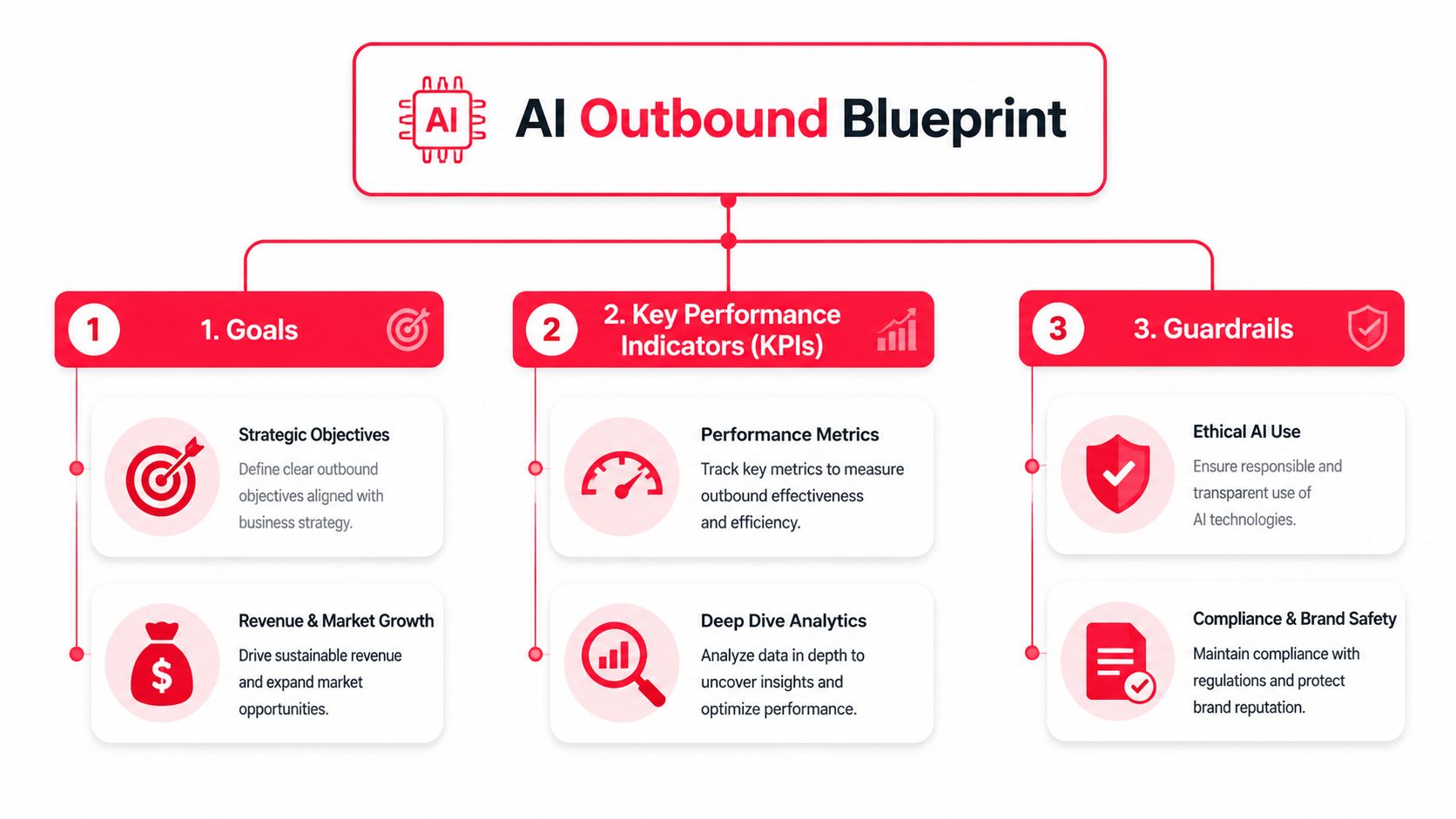
A useful AI outbound program has one job, create qualified revenue conversations at a lower cost per meeting. Everything else is a support metric. That means the scoreboard needs to start with reply rate, meeting-booking rate, show-up rate, and cost per meeting, not raw send volume AiSDR.
You also need to define what “good” means before the first campaign goes live. Benchmarks in published AI outbound guidance point to a 9.22% median response rate, a 5.63% median positive response rate, and about 31% of positive replies converting to a meeting AiSDR. Those numbers are useful because they keep leadership from declaring victory too early, or killing a valid test after a weak week.
The right goal is not “more outbound.” It's more of the right conversations with less waste. That framing changes how sales, marketing, and RevOps work together.
Build the scorecard and the safety net together
A leader should insist on a pilot scorecard with three layers:
- Pipeline outcome: meetings booked, show-up rate, and opportunities created.
- Engagement quality: reply rate and positive response rate.
- Operational cost: cost per meeting and time spent by humans on review.
Then add guardrails. As AI outbound expands from email into voice agents and broader automation, guidance still stresses small batches, human review, and iterative testing to protect sender reputation, reduce hallucinated personalization, and stay compliant Predictable Revenue. That is the right operating posture even when the tooling gets more autonomous.
A strong governance model usually includes:
- Review thresholds for accounts that need human approval.
- Quality checks for AI-generated personalization before send.
- Channel-specific safeguards so email, SMS, voice, and social don't all share the same risk profile.
- Suppression rules that stop outreach when a lead is already in an active deal cycle.
The moment AI starts sending at scale, bad data stops being a minor issue and becomes a market-facing problem.
If you want a practical reference for the autonomous side of this shift, Trackingplan's article on the future of autonomous marketing with AI is useful because it frames automation as a systems problem, not a copy problem.
Know what to ignore
Do not optimize around send volume. High send counts can hide bad targeting, weak routing, and deliverability drift. A CRO needs a dashboard that answers one question, did AI outbound create qualified revenue motion safely enough to scale?
That answer should be based on the scorecard above, plus a human review log. If the program can't show how personalization was approved, how opt-outs are honored, and how channels are segmented, the system is too fragile for real revenue use.
The Tech Stack and Data Foundation
An AI outbound engine has three layers. The data layer finds and enriches signals. The logic layer decides who gets contacted and when. The action layer drafts, sends, and responds. If those layers are blurred together, the system becomes hard to debug and even harder to scale.
Start with the data layer
The data layer needs enough context to distinguish a real buying event from background noise. That usually means account enrichment, contact enrichment, intent signals, CRM activity, job changes, technology changes, and website or social engagement where available. The exact vendor mix matters less than whether the inputs are current, structured, and tied back to account logic.
Many teams fall short in this regard. They buy tools for enrichment, but they don't define which signals trigger action. That leaves RevOps with a stack full of data and no decision path.
For teams looking to tighten the front end of the stack, LinqIn's Guide to B2B LinkedIn audience growth is a useful companion because it speaks to audience definition before outreach. And if you want a broader tooling angle, Stimulead's internal guide on the right tools for outbound B2B lead generation maps well to the same architecture.
Use the CRM as the logic layer
Your CRM or sales engagement platform should be the decision center, not a passive log. That means it needs to know the target account, the signal that triggered the workflow, the sequence rules, and the suppression logic. If the CRM can't tell the system who is in-market and who should be excluded, the outbound motion will keep stepping on itself.
Operational truth: most AI outbound failures are orchestration failures, not model failures.
This is also where teams should separate use cases. A cold outbound motion, an inbound follow-up motion, and a dormant-account reactivation motion should not all run through the same generic sequence. They need different triggers, different copy rules, and different human review thresholds.
Stimulead's own implementation approach fits well here because it treats AI as a production system tied to CRM-linked outputs, not as a sidecar for email drafting. That matters because reps should edit and send from structured context, not re-research from scratch.
Let the action layer stay narrow
The action layer should do one thing well, execute. It should draft messages, queue sequences, hand off replies, and route exceptions. The more responsibilities you stack into the action layer, the harder it becomes to audit quality and compliance.
Use generative AI and agents where they reduce manual work, but keep human control on high-value accounts and relationship-heavy motions. That balance matters. AI can research, draft, and even qualify, but strategic accounts still need a person owning the relationship.
Designing the Prospecting and Personalization Engine
Detect the signal, then score the account
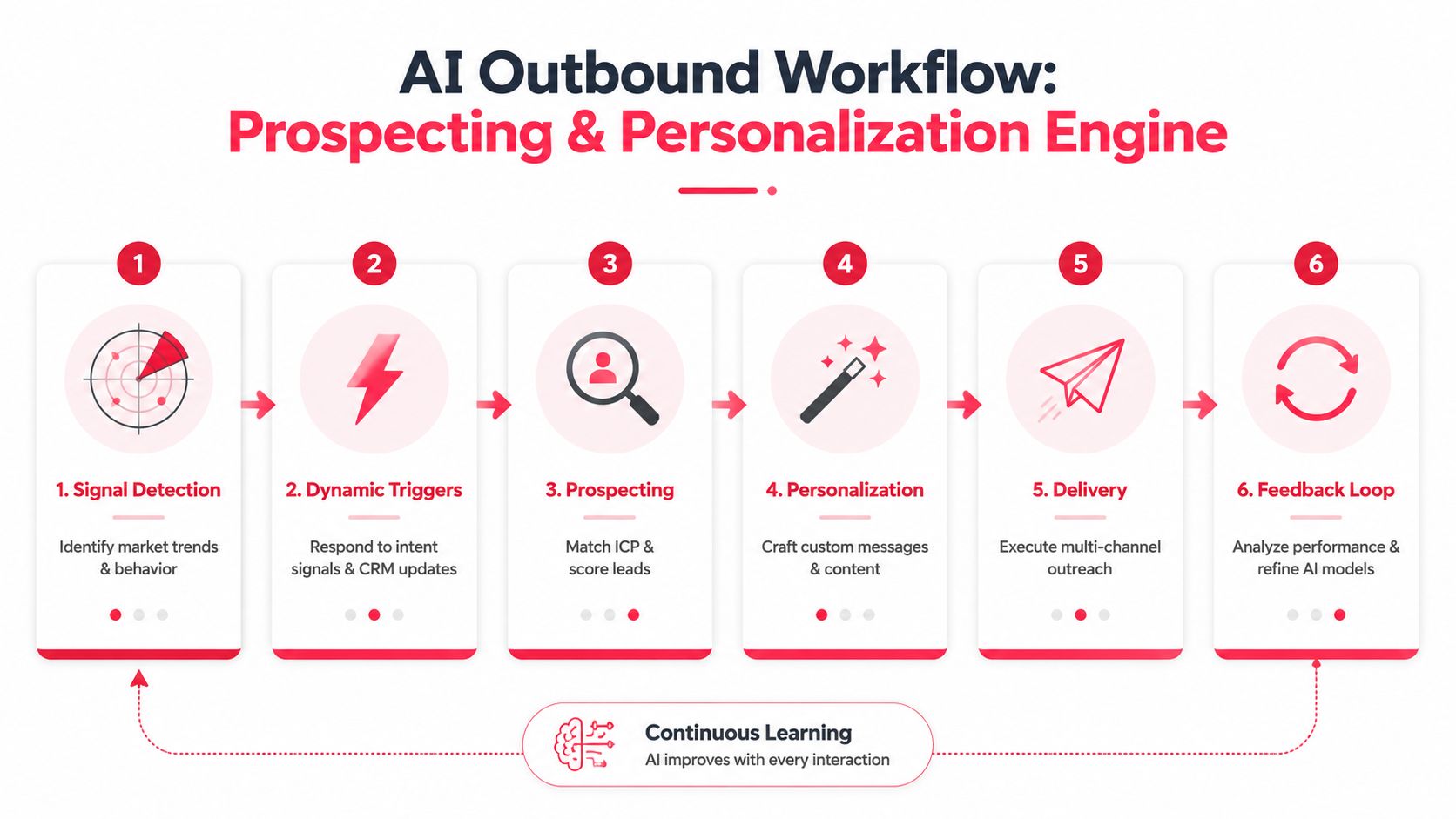
The workflow starts with a trigger, not a message. That trigger can be an intent spike, a job change, a funding event, a technology change, a page visit, or a recent engagement from the account. The point is to separate accounts that are merely on a list from accounts that have some reason to care now.
The Starr Conspiracy's research is useful here because it ties trigger-event-driven outreach to 2–3x higher reply rates than static-list campaigns The Starr Conspiracy. That is the difference between spraying everyone and contacting the few accounts where timing is already in your favor.
The first pass should be account scoring. The second pass should be contact selection inside that account. If you reverse that order, you end up personalizing the wrong person very well.
Research the prospect context before drafting
Once an account is in play, AI should pull the context that shapes the message. That means company focus, role, recent activity, likely pain points, and any relevant public signal. The model should then summarize the account in a short brief that a rep can trust.
This is the part many teams miss. They ask AI to write copy before it has enough context to know what matters. Better workflows generate a clean account brief first, then draft outreach from that brief.
Use this prompt structure:
- Target: who the account is and why it fits.
- Signal: what changed that makes outreach timely.
- Value proposition: what you solve and for whom.
- Proof: one concrete reason the prospect should believe you.
- CTA: one simple next step.
That order keeps personalization grounded in relevance, not decoration.
Draft the message with constraints
A useful AI prompt should limit length, limit claims, and force specificity. For example, tell the model to reference the signal, connect it to a business outcome, and avoid generic praise. Then require a single ask.
A practical template looks like this:
Write a short outbound email to a [role] at [company]. Use this signal: [signal]. Tie it to [business problem]. Mention [proof point or relevant asset]. Keep it concise, specific, and written for a CRO. Do not add filler or broad praise. End with one clear ask for a meeting.
That kind of prompt produces something a rep can edit quickly. It also makes review easier because the structure is predictable.
Orchestrate the sequence across channels
The strongest setups do not depend on one channel. They use AI to decide whether the sequence should move through email, SMS, voice, or social, based on the account's responsiveness and the risk profile of the motion. The sequence needs to feel coordinated, not repetitive.
The workflow becomes revenue engineering. The system should be able to say, “this account saw the first email, engaged on LinkedIn, and now needs a rep call,” or “this account ignored two emails, so stop the sequence and hold.” That is more valuable than producing ten more messages.
For teams standardizing this motion, Stimulead's AI sales prospecting tools fit naturally as a reference point because the primary win is the workflow around the tool, not the tool itself.
Launching Your 30-Day Pilot Program

Start small enough that the data is readable. A 30-day pilot gives you enough time to validate the motion without letting bad habits spread across the whole team. The goal is to prove the system on a narrow cohort, then decide whether to expand.
Week one should cover setup, integration, list definition, and review rules. Weeks two and three should run live tests on a limited set of accounts. Week four should be analysis, handoff, and go or no-go decisions. That cadence keeps the pilot honest.
Set the benchmark before launch
The numbers that matter in a pilot are reply rate, meeting-booking rate, and show-up rate. Published AI outbound benchmarks put healthy B2B response rates in the high single digits, with 9.22% median response rate and 5.63% median positive response rate reported by AiSDR AiSDR. About 31% of positive replies convert to a meeting, which is why meeting math matters more than reply vanity.
The pilot should also respect deliverability guardrails. During initial rollout, keep sending limits around 50 emails/day AiSDR. That protects the domain while the team learns what the market tolerates.
Run the pilot in controlled phases
A simple rollout pattern looks like this:
- Week 1, setup and approval. Connect data, define the segment, confirm suppression rules, and approve the first prompts.
- Weeks 2 and 3, live testing. Send to a limited cohort, track replies, review personalization, and fix targeting gaps quickly.
- Week 4, analysis and decision. Compare results to the scorecard, review human feedback, and decide what gets scaled.
The important part is discipline. If a test is losing signal quality, pause and fix the inputs. If it's producing qualified replies, preserve the winning pattern before broadening the segment.
The video below is useful for leadership teams that want a live working model of the pilot mindset.
Judge the pilot on revenue, not enthusiasm
A pilot can feel busy and still be useless. If the replies are mostly low-fit, if meetings don't convert, or if the team spends too much time cleaning up bad personalization, the workflow isn't ready. On the other hand, if the pilot creates qualified conversations at acceptable cost, you have something worth standardizing.
Pilot rule: if the reps wouldn't want more of these leads, the pilot failed even if the open rate looked fine.
Use the pilot to learn where humans still need to stay in the loop. That usually happens on strategic accounts, exception handling, and relationship recovery. The model can do a lot, but leaders should decide where automation stops.
From Pilot to Scaled Playbook

A successful pilot only matters if it becomes repeatable. The scale step is where many teams stall, because they never document the winning inputs, prompts, and routing rules. Without that playbook, every new rep or segment turns into another experiment.
Turn the winning workflow into a standard
The scaled playbook should record four things: the signals that qualify an account, the data sources used, the prompt structure that works, and the human review rules. If those elements aren't written down, the system depends on memory, and memory doesn't scale.
Tangible evidence supports the productivity argument. GTM professionals who frequently use AI report a 47% productivity increase and save an average of 12 hours per week SuperAGI. That's the kind of lift that justifies turning a pilot into a team-wide standard.
Use that productivity gain to standardize, not to slash oversight too early. The best teams turn AI into a shared operating pattern, then keep refining the exceptions.
Keep the feedback loop tight
The playbook should never be frozen. New signals show up, messaging drifts, and channel performance changes. A good operating rhythm reviews performance, updates prompts, and revises suppression rules on a regular cadence.
A practical iteration loop looks like this:
- Review what converted. Pull the messages, signals, and account types that booked meetings.
- Remove what failed. Delete stale proof points, weak triggers, and awkward CTA patterns.
- Train the next cohort. Give new reps the same logic and examples that worked in the pilot.
- Expand by segment. Add a new persona or territory only after the first playbook is stable.
That process keeps the program from becoming a pile of one-off exceptions.
Make scale a governance decision
The mistake is to treat scale as a volume decision. It's a governance decision. Once AI outbound is running, the question becomes whether your team can monitor quality, preserve sender reputation, and maintain trust as volume rises.
The companies that get this right document the system, keep humans in the loop where relationships matter, and treat AI like an operating layer for revenue. That's the difference between a clever pilot and a durable outbound engine.
If you want help designing the signal stack, the scoring logic, or the pilot scorecard for your team, contact Stimulead and ask for a practical AI outbound review. We'll map the path from data foundation to revenue workflow, then show you where the system will break before you scale it.