
Median B2B lead response time is still 42 to 47 hours. Leads contacted within 5 minutes convert at roughly 21% to 32%, while next-day replies convert at only 2.3% to 12%.
That gap points to the sales pipeline optimization problem. Many teams don't need more CRM rows first. They need faster response, clearer stage discipline, and a measurement system that separates qualified opportunity from optimistic data.
Table of Contents
- The Response-Time Gap That Controls Pipeline Performance
- How to Audit Your Pipeline Before Changing Anything
- Pipeline Metrics That Predict Revenue, Not Just Activity
- Automation, AI, and Testing Velocity Inside the Pipeline
- When Pipeline Growth Masks Weak Conversion
- The Next Decision a Sales Leader Should Make This Week
The Response-Time Gap That Controls Pipeline Performance
A lead can enter your CRM with a strong fit, urgent need, and active buying intent. If nobody responds while that intent is fresh, the opportunity can become harder to qualify before an SDR has a meaningful conversation. A landmark lead-response analysis found that companies contacting inbound leads within 5 minutes were about 21 times more likely to qualify them than companies waiting 30 minutes. The same source reports that successful contact odds were roughly 100 times higher in the first 5 minutes than after 30 minutes.
The operational lesson is uncomfortable because it sits earlier than most pipeline reviews. Pipeline velocity starts with the handoff from inquiry to first action, not with a late-stage negotiation workshop.
Speed is an operating design issue
The benchmark gap remains wide. A recent summary reports median B2B response times of 42 to 47 hours, while only 7% to 23% of companies respond within 5 minutes. Leads contacted within that window convert at roughly 21% to 32%, compared with 2.3% to 12% for next-day replies (Plura's lead response benchmarks).
That makes lead routing a revenue-process decision. Someone must own territory rules, enrichment, duplicate handling, alert priority, and the fallback when an assigned SDR is unavailable. Adding headcount before fixing those rules often gives you more people working inside the same delay.
What to inspect first
Review the elapsed time between four events:
- Form submission or high-intent signal.
- Record creation in the CRM.
- Assignment to a rep or queue.
- First human or automated response.
If the first two happen quickly but assignment takes hours, the routing layer is the bottleneck. If assignment is immediate but contact lags, inspect rep capacity, alert design, working-hour coverage, and the quality of the task queue. Teams assessing whether to hire SDRs should run this audit first, because hiring won't repair a workflow that loses intent before a person sees it.
How to Audit Your Pipeline Before Changing Anything
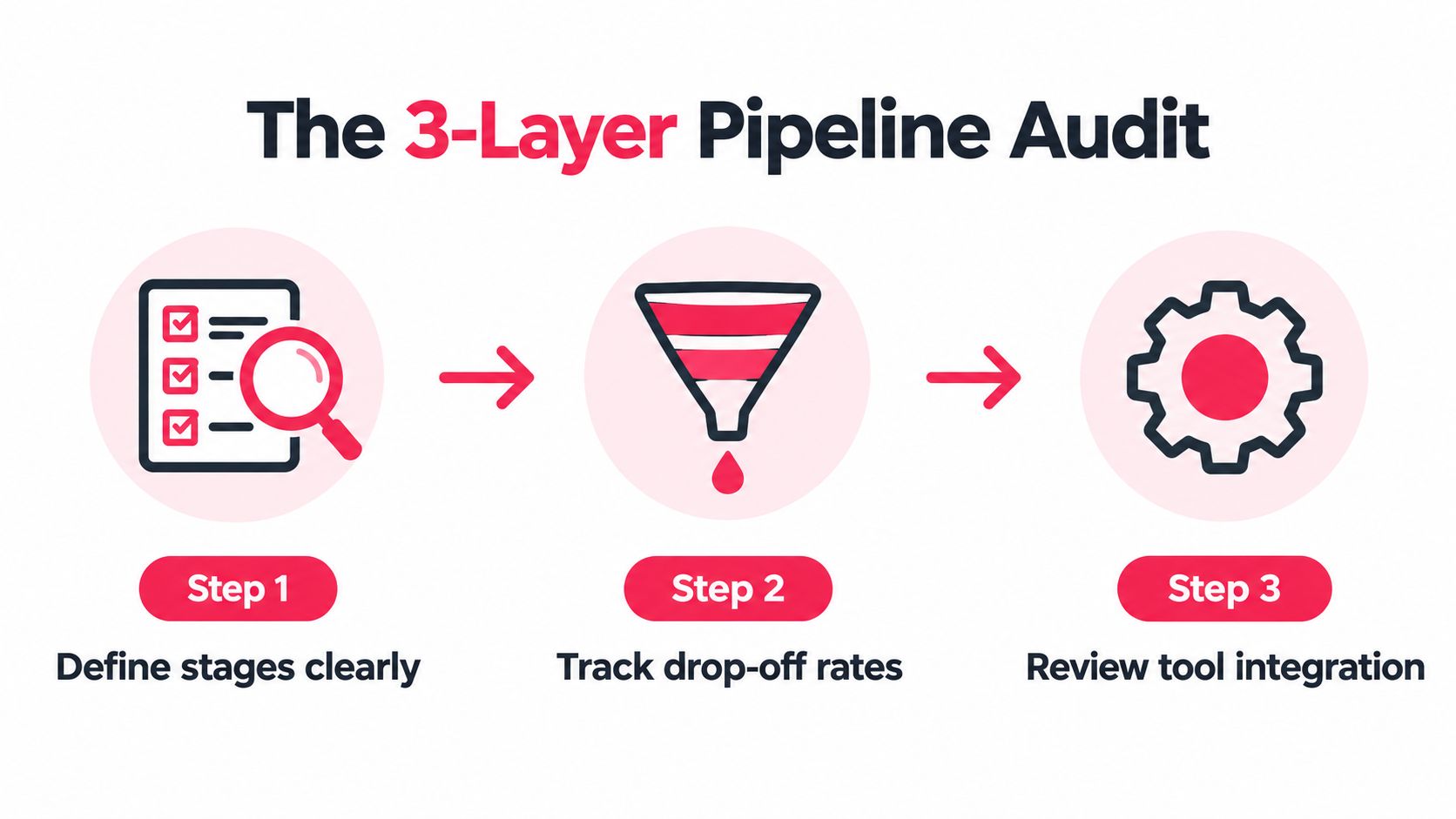
Don't rename stages or buy another forecasting tool until the current pipeline can answer three questions. What must be true for a deal to enter each stage? Where do opportunities drop? Which data feeds the report, and where does that data become unreliable?
Start with stage truth
Write an observable entry condition and exit condition for every stage. “Interested,” “in progress,” and “likely” describe opinion. A completed discovery with a documented business problem, agreed next step, and identified buying process describes evidence.
Then sample current deals against those conditions. You'll usually find opportunities sitting in late stages without a confirmed buyer, dated next meeting, or decision process. Those rows inflate coverage and make forecast conversations political.
Check coverage against actual conversion
A 3:1 pipeline-to-quota ratio is a widely used rule of thumb, but it isn't a universal target. The right ratio depends on win rate, as explained in this coverage analysis from Martal. A team with weak qualification may need more nominal pipeline, while a team with reliable stage conversion may need less.
Review coverage by segment, product, source, and rep. Aggregate coverage can look healthy while one segment contains most of the qualified opportunities and another contains unqualified volume.
Measure the leak between stages
Use this formula for each transition:
Conversion rate = deals advanced to the next stage ÷ deals that entered the current stage × 100
The formula comes from stage conversion analysis by Rework. Calculate it using cohorts that entered the stage during the same period, rather than mixing old opportunities with new ones.
A useful audit output is a table with stage entry count, stage exit count, median age, and documented exit criteria. Pair that table with dashboard design for pipeline health if your current CRM view can't show drop-offs and aging without manual spreadsheet work. For broader process ownership, compare the findings with Stimulead's sales and marketing alignment guidance.
Pipeline Metrics That Predict Revenue, Not Just Activity
Activity counts are easy to collect and easy to misuse. Calls, emails, meetings, and tasks matter only when they improve response, stage progression, buyer access, or forecast confidence.
We use four core views in pipeline rebuilds. Each answers a different management question, so combining them in one score creates confusion.
| Metric | Management question | Useful action |
|---|---|---|
| Stage conversion | Where do qualified deals disappear? | Fix exit criteria, messaging, or coaching at that stage |
| Deal velocity | How long does value take to move? | Remove approval, legal, or follow-up delays |
| Coverage quality | Is nominal pipeline supported by likely wins? | Requalify weak opportunities and segment the view |
| Forecast accuracy | Can leadership plan against the number? | Audit assumptions by horizon and method |
Forecast accuracy is calculated as forecasted revenue ÷ actual closed revenue × 100. RevOps teams commonly target staying within 5% to 10% of actuals, while some cross-industry benchmarks describe forecast error around 1.3% for top-performing organizations. These figures and the method are summarized by Avoma's sales pipeline metrics guide.
Accuracy also decays with time. The same source describes typical accuracy around 85% to 90% at 30 days, 75% to 80% at 60 days, and 65% to 75% at 90 days. That pattern supports shorter commit windows and stricter qualification for distant opportunities.
Choose the forecast method carefully
Rep roll-ups and gut-feel forecasts often produce ±25% to ±35% variance. Weighted pipeline methods are usually closer to ±15% to ±25%, while historical-trend methods are described at roughly ±15% to ±20% in the same benchmark.
Track the method, forecast horizon, segment, and owner. A single company-wide accuracy number hides whether the problem sits in enterprise deals, a new territory, a specific rep, or late-stage optimism.
For the data layer, keep the CRM definitions, enrichment sources, warehouse tables, and reporting logic documented. Our guide to data pipeline architecture covers the infrastructure decisions that prevent a sales dashboard from becoming another disconnected reporting surface.
Automation, AI, and Testing Velocity Inside the Pipeline
AI can rank signals, summarize calls, draft follow-up, and identify missing buying-process data. It can't make an ambiguous stage reliable. If the CRM contains stale close dates, duplicate accounts, incomplete contacts, and inconsistent stage movement, automation will produce faster noise.

Automate decisions with clear ownership
A practical signal workflow has four parts:
- Signal capture: Record intent such as a high-value page visit, product usage change, inbound request, or relevant account event.
- Prioritization: Score the signal using fit, recency, account ownership, and existing opportunity status.
- Routing: Send the task to the correct rep, queue, or manager with a response deadline.
- Measurement: Track signal-sourced pipeline and stage conversion against a defined baseline.
The decision rights matter. A CRO should approve what counts as a sales-qualified signal and what response standard the team accepts. RevOps can manage routing, field logic, and reporting. Sales managers should own coaching when reps receive qualified work but fail to act.
AI-assisted selling also needs a review path. Before an automated agent changes a stage, sends a pricing message, or suppresses a follow-up, define which actions require human approval. Stimulead's AI agents for sales is relevant for teams designing that operating layer.
Test workflows, not tool collections
Run one controlled change at a time. For example, compare an immediate routing workflow with the existing queue process, then inspect response time, qualification, and stage advancement. A sequence that creates more meetings but lowers opportunity quality may be a failure, even if activity dashboards look better.
Teams building these workflows can also review Flowkon's startup automation guide, especially when deciding which repetitive tasks belong in automation and which need judgment.
A short demonstration of pipeline orchestration can help executives see the operating model before approving a larger build:
When Pipeline Growth Masks Weak Conversion
Pipeline can expand while bookings remain flat. The usual cause is weak execution after leads enter the system, including loose qualification, incomplete stakeholder mapping, stalled next steps, and limited manager coaching.
Research in the B2B Sales Challenges Report from RAIN Group points to losses from no-decision outcomes, longer cycles, and weak value communication. That changes the question leaders should ask. Instead of asking how much pipeline marketing created, ask how consistently qualified opportunities progress once sales owns them.
Signs of inflated pipeline
| Signal | What it may indicate |
|---|---|
| High coverage with low close rate | Unqualified opportunities are being counted |
| Long deal aging without a dated next step | The buyer has disengaged or the rep lacks a plan |
| Repeated no-decision losses | Value, urgency, or stakeholder access remains weak |
| Frequent stage reversals | Stage criteria are unclear or managers are avoiding disqualification |
| Many single-threaded deals | The economic buyer and users aren't mapped |
A six-touch cadence has been cited as increasing contact rate by 138% in a benchmark summarized by Martal's pipeline and forecast analysis. Treat that as a testable benchmark, not a guarantee. The right cadence depends on channel, buyer role, relevance, and whether the prospect has shown intent.
Fix conversion before adding volume
Manager coaching should focus on the stage with the largest qualified drop-off. Review call notes, buyer roles, next-step quality, and reasons for no decision. If the same failure appears across several reps, change the process or enablement. If one rep shows the pattern, coach the behavior before redesigning the whole system.
More leads can hide these problems for a while. They don't solve them.
The Next Decision a Sales Leader Should Make This Week
A sales leader doesn't need a full transformation program to find the next constraint. Choose one decision that produces evidence quickly and gives RevOps a clear owner.
- Select one stage conversion metric and one forecast horizon. Pick the stage where qualified deals disappear, then compare the forecast at one horizon with actual closed revenue. Keep the cohort definition fixed so the result can support a real decision.
- Test the first-response workflow. Measure submission-to-assignment and assignment-to-first-contact separately. If routing is slow, repair ownership and alerts before evaluating SDR capacity. If contact is slow after assignment, inspect rep workload, queue design, and manager follow-through.
- Validate coverage with win rate. Apply the 3:1 rule only as a starting reference. Segment the calculation by product, market, source, and rep so unqualified volume doesn't make a weak segment look safe.
- Assign a decision owner. The CRO owns commercial standards, the CMO owns demand quality, the sales leader owns execution, and RevOps owns data definitions and reporting. Shared responsibility without a named owner usually leaves the workflow unchanged.
The practical trade-off is sequencing. A company with slow response should repair speed before buying predictive scoring. A company with clean routing but poor stage conversion should coach qualification and buyer access before increasing lead volume. A company with unreliable data should fix governance before automating forecasts.
Stimulead works with growth-stage B2B teams on AI roadmaps, GTM systems, CRO testing, signal-based selling, and implementation oversight. If your pipeline review shows a response-time gap or a stage where qualified deals repeatedly disappear, book a working session with Stimulead and bring the CRM export, stage definitions, response-time report, and latest forecast. The next decision should come from those four pieces of evidence, not from another dashboard.