
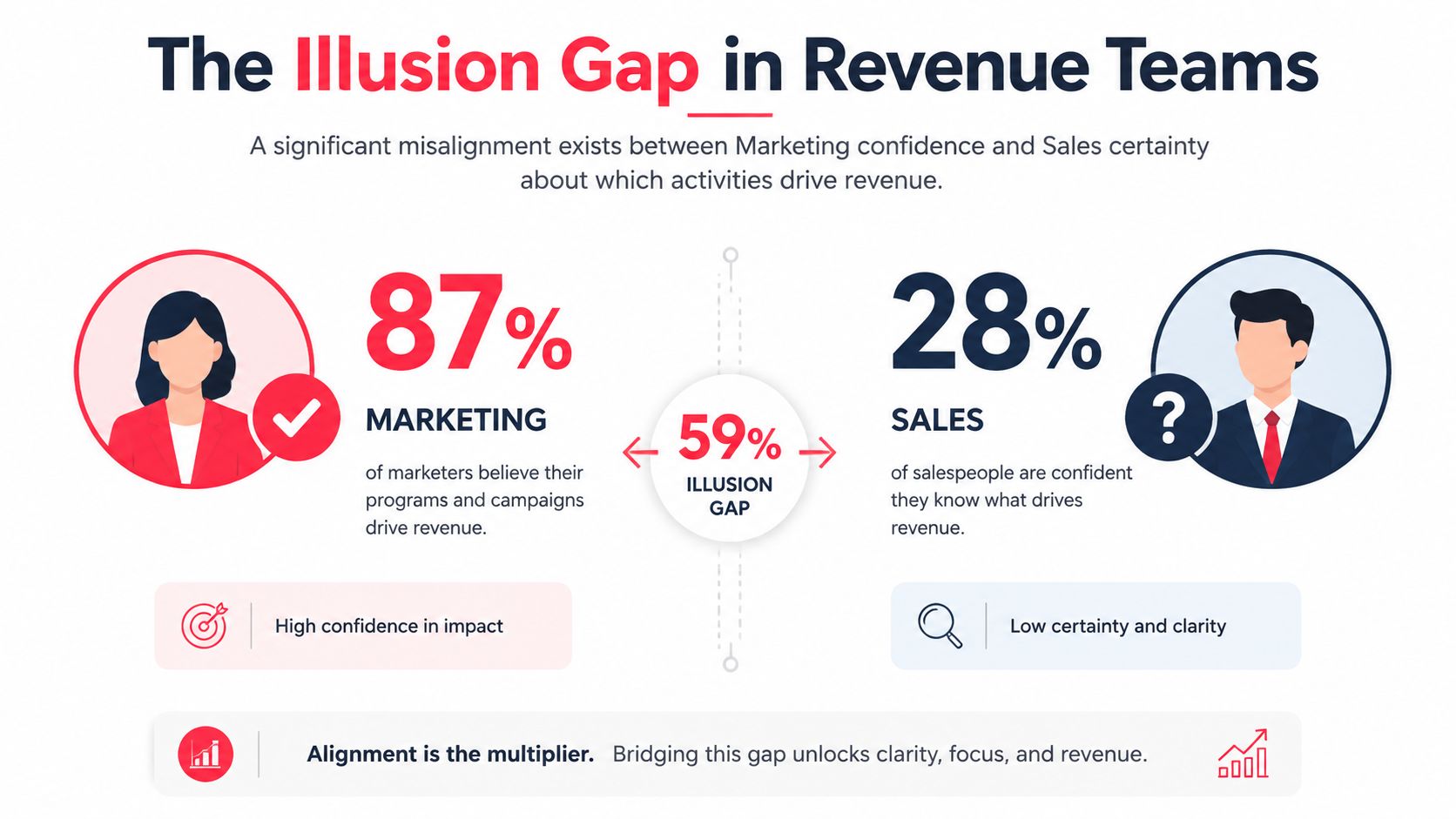
The decision facing a growth-stage B2B team is whether to call sales and marketing “aligned” because leaders communicate regularly, or to inspect the workflows that determine whether pipeline moves. 82% of C-suite leaders believe sales and marketing are in sync, while 65% of practitioners report a significant lack of alignment, according to Forrester's analysis of the perception gap. The practical answer is clear: alignment is an operating system built around routing, response times, signal interpretation, and shared measurement.
Table of Contents
- The Illusion Gap in Revenue Teams
- The Conversion Math of Alignment
- Where the Handoff Breaks
- Aligning Around Signals Instead of Messaging
- Shared KPIs That Predict Revenue
- Sequencing the Operational Fix
The Illusion Gap in Revenue Teams
82% of C-suite leaders believe sales and marketing are aligned, while 65% of practitioners report a significant lack of alignment, according to Forrester's analysis of the B2B alignment perception gap. The gap is operational, not merely communicative. Separate funnels, budget disputes, and different reporting lines create conditions where leadership sees coordination while frontline teams encounter broken handoffs.
Meetings, shared Slack channels, and off-site “smarketing” sessions may improve familiarity. They do not decide who owns an account, how quickly a high-intent lead receives a response, or what happens when a seller rejects an opportunity. Marketing works around campaign cycles and attribution windows. Sales works around deal stages, territory coverage, and quota periods. Those cadences collide at the handoff.
That collision creates an operating breakpoint. A routing rule can assign a complex account to an overloaded representative. An SLA can require follow-up “promptly” without defining a valid attempt. A salesperson can mark a lead unqualified without recording the reason. Each failure leaves evidence in CRM fields, timestamps, stage transitions, and disposition data.
Practical rule: If a meeting does not change ownership, criteria, timing, or a measurement rule, it probably is not fixing alignment.
A 2025 survey found that only 24% of respondents said they were completely aligned, while 51% were still trying to improve collaboration. For a CEO, CMO, or CRO, the response is to manage alignment as revenue operations engineering. Maintain an explicit backlog of breakpoints, assign owners, and use AI-era GTM engineering to monitor routing, enforce SLAs, and interpret buying signals consistently.
Lead quality is the first diagnostic. Review fixing lead quality misalignment, then map the fields and decisions that determine whether marketing-qualified demand becomes sales-accepted pipeline. Sales enablement best practices should reinforce those operating rules, rather than substitute for them with a workshop about team sentiment.
The Conversion Math of Alignment
Pipeline math exposes the cost of a weak handoff quickly. Consider a B2B SaaS company with 2,000 monthly MQLs, a 12% sales-accepted lead rate, and an 18% close rate. That produces 240 sales-accepted leads and roughly 43 closed deals before considering deal size.
A five-percentage-point increase in acceptance, from 12% to 17%, would produce 340 accepted leads at the same MQL volume. Holding the close rate constant, that becomes roughly 61 closed deals. The change comes from better routing, qualification, and SLA compliance, not additional top-of-funnel spend. The model below shows the operational effect, without assigning a dollar value that depends on the company's average contract value.
| Metric | Misaligned Baseline | Aligned State | Delta |
|---|---|---|---|
| Monthly MQLs | 2,000 | 2,000 | 0 |
| Sales-accepted lead rate | 12% | 17% | +5 percentage points |
| Sales-accepted leads | 240 | 340 | +100 |
| Close rate | 18% | 18% | 0 |
| Approximate closed deals | 43 | 61 | +18 |
This is why we use pipeline velocity as the unifying operating metric:
Pipeline Velocity = Number of Opportunities × Win Rate × Average Deal Size / Sales Cycle Length
The formula forces both teams to consider flow. Marketing can affect opportunity creation and fit. Sales can affect win rate and progression. Revenue operations can expose whether routing, data quality, and automation are extending the cycle. A team that generates more leads while allowing response time and qualification quality to deteriorate may produce less usable pipeline.
Response speed deserves its own control. Companies that contact inbound leads within 5 minutes convert at about 21%, compared with 2.3% for a next-day reply, and close at 32% versus 12% when first substantive contact takes more than 24 hours, according to Perspective's lead-response benchmarks. A separate study of more than 55 million sales activities across 5.7 million inbound leads at more than 400 companies found that 57.1% of first call attempts occurred after more than a week, with conversion falling more than 8x after the first 5 minutes.InsideSales' response-time study provides the evidence.
The trade-off is capacity. A five-minute SLA across every form fill can overwhelm a small SDR team and encourage low-quality activity. Apply speed selectively to high-fit, high-intent signals, then measure accepted-lead quality and opportunity conversion alongside response time.
Where the Handoff Breaks
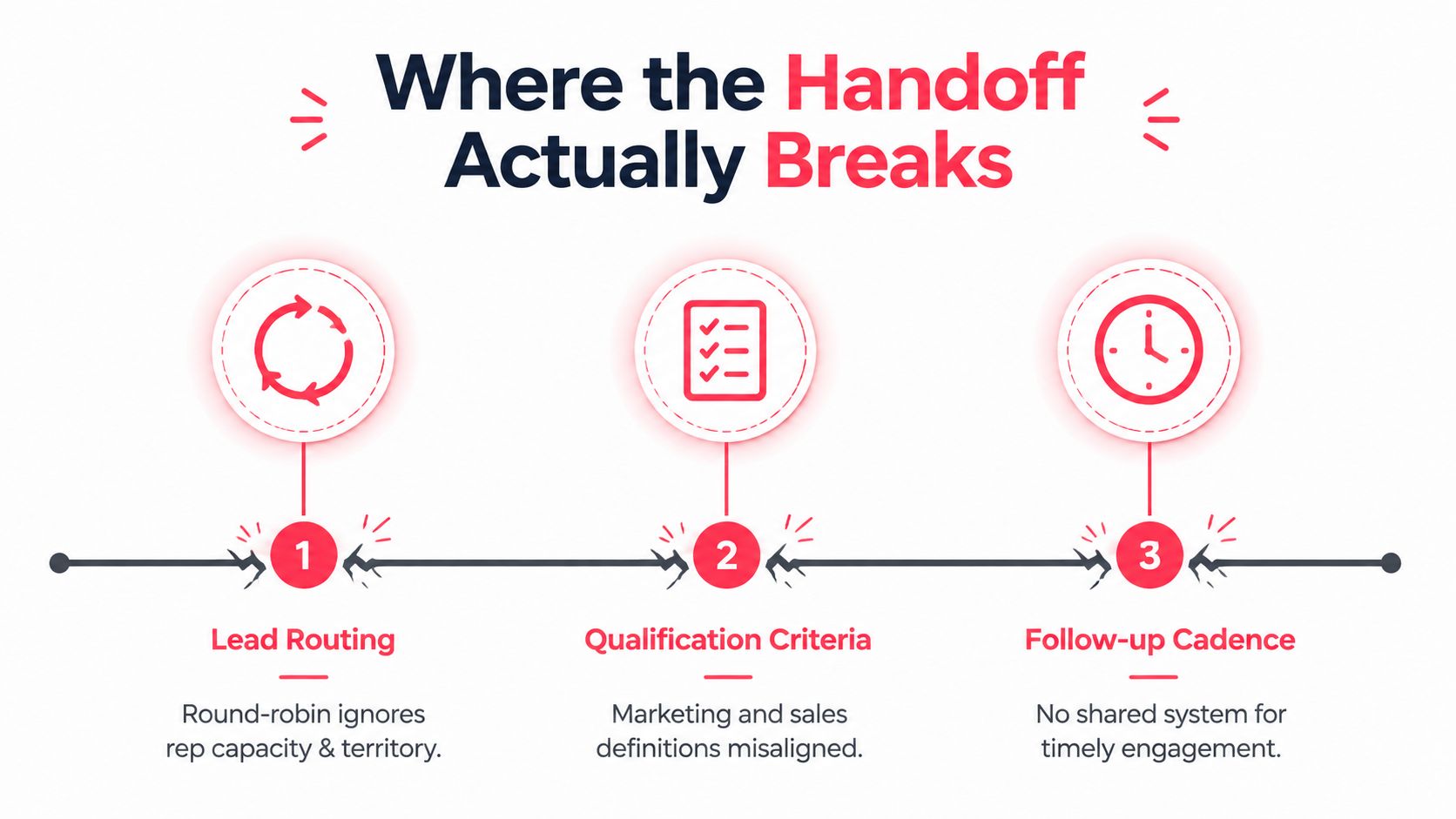
The handoff fails at three operating breakpoints: routing, response commitments, and feedback quality. Each needs a defined rule, an accountable owner, and a record of the outcome.
Routing rules ignore operating reality
Round-robin assignment looks fair in a spreadsheet, yet it ignores representative capacity, territory expertise, account complexity, and existing relationships. A high-intent buying group can wait behind an unavailable representative while another seller with relevant expertise has room to act.
Routing should consider account tier, geography, product fit, open opportunities, representative capacity, and signal type. Salesforce supports shared views for MQL-to-SQL conversion, marketing-influenced revenue, sales-cycle length, and full-funnel conversion velocity, as described in its Salesforce's guide to sales and marketing alignment. The rule matters more than the platform. If the CRM cannot explain why an account went to a specific owner, the routing design is too opaque.
SLAs describe intent, not action
“Follow up within 24 hours” leaves room for dispute. Does creating a task count? Does an automated email count? What happens when the first contact is a junior researcher and the account has several likely stakeholders?
Use a tiered contract that defines the trigger, owner, response window, action, and escalation:
- Tier A, high fit and active intent: Assign an owner immediately, require a substantive human action within 5 minutes, and escalate when the owner is unavailable.
- Tier B, strong fit with moderate engagement: Require a same-business-day review, an account-contextualized outreach attempt, and a documented next step.
- Tier C, lower intent or incomplete fit: Place the lead into a managed nurture path, with a qualification task and a clear recycling rule.
The SLA should specify the required number of attempts, qualifying channels, and conditions for marketing to resume ownership. Teams using demand generation software insights can connect campaign signals with accountable action. The outbound B2B lead management process guidance treats routing and follow-up as one system, because separating them creates another seam.
Feedback fields become useless
“Disqualified” is not a diagnosis. Require structured disposition reasons such as poor fit, duplicate account, no active project, wrong role, timing, competitor, or unreachable contact. Add a free-text field for context, while keeping structured reasons mandatory.
A weekly signal-review meeting should examine accepted leads, rejected leads, stalled opportunities, and closed-lost accounts. Marketing updates scoring and targeting. Sales checks whether the reason codes match real conversations, while RevOps verifies completion and tests whether routing rules produce the intended distribution.
Do not claim a performance lift for a specific client without permission and documented evidence. The frequently repeated example of a Series B SaaS company reducing lead-to-opportunity time by 40% is not verified evidence available for this article, so it should not be presented as a case study.
Aligning Around Signals Instead of Messaging
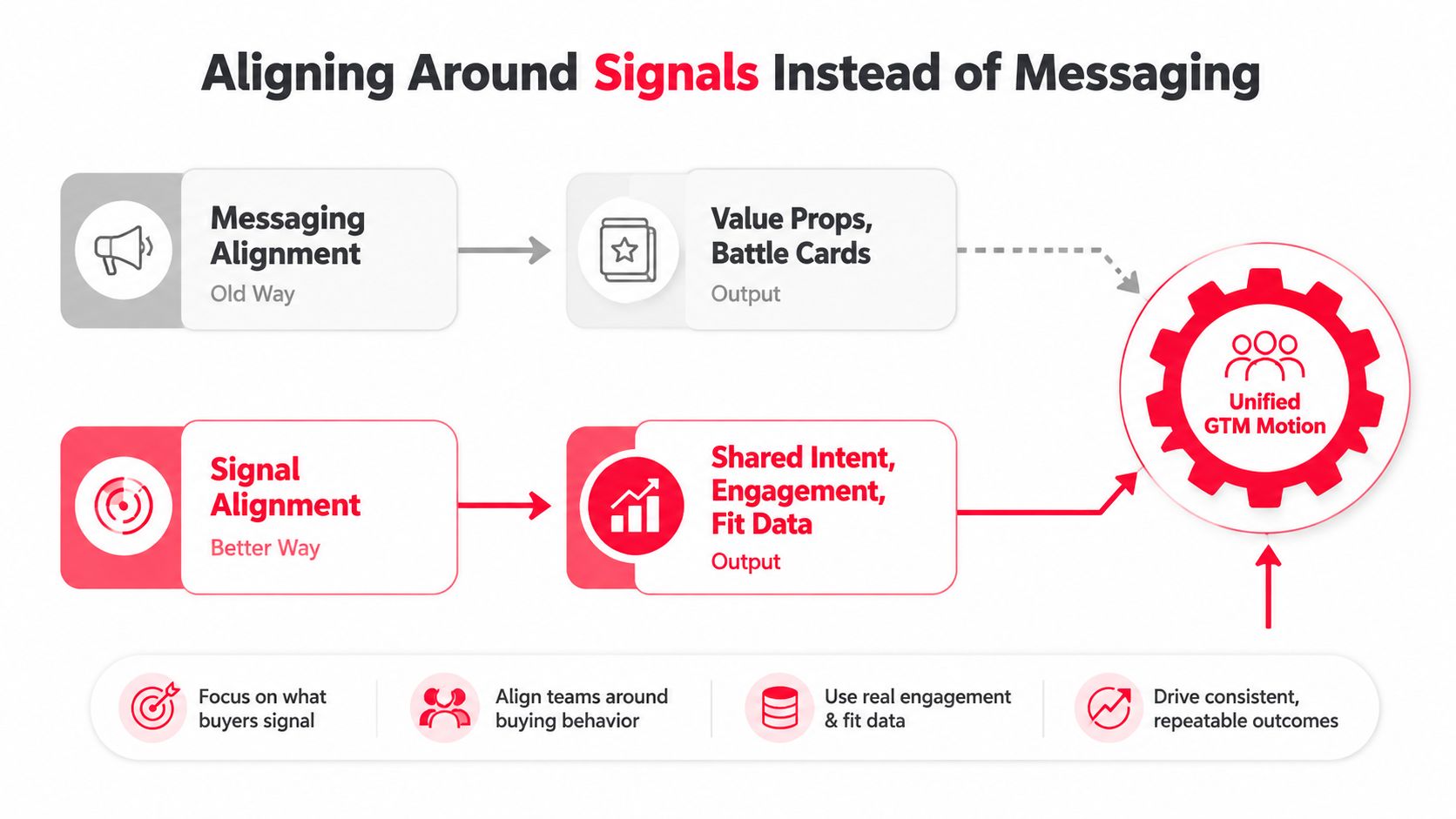
Most sales and marketing alignment programs begin with shared messaging. Teams review positioning, update battle cards, and approve a value-proposition deck. Those assets matter, but they don't tell a seller which account deserves attention today.
AI-assisted go-to-market work requires shared interpretation of signals. Marketing may detect a technographic change, a hiring pattern, a funding event, or a burst of engagement across an account. Sales needs a defined response, such as which role to contact, what context to include, and how quickly to act. A signal without an owner or play is only another data point.
Build a shared signal taxonomy
Start with a small set of signal classes:
- Fit: Industry, company size, technology environment, geography, and use case.
- Readiness: Intent activity, repeat visits, comparison research, and engagement from multiple roles.
- Change: Hiring, leadership movement, product launches, funding events, or technology replacement.
- Relationship: Existing contacts, previous opportunities, customer status, and executive connections.
- Negative evidence: Poor fit, inactive project, competitor lock-in, or a request that belongs outside the target market.
Each signal needs a threshold, a source, a confidence level, an owner, and an action. Predictive lead scoring can rank likely opportunities, while intent platforms can detect account activity. AI should help classify and prioritize evidence, but sales and marketing still need to agree on what counts as sufficient evidence.
Connect AEO to seller action
Answer engine optimization, or AEO, adds another input. Buyers may research through AI interfaces and receive recommendations without visiting many pages. Marketing should track the questions, entities, and use cases that shape those recommendations, then translate the resulting buyer concerns into seller-ready context.
That does not mean a seller should mention hidden browsing behavior or make unsupported assumptions. It means the team can prepare outreach around the problem the account is researching, with a clear distinction between observed activity and inferred intent. Our framework for signal-based selling uses that distinction to prevent AI-generated confidence from becoming sales misdirection.
The operating agreement is simple: teams don't need identical opinions about every message. They need the same definition of a meaningful signal and the same next action within a defined time window.
Shared KPIs That Predict Revenue
A shared dashboard creates friction when its definitions conflict. Total leads, marketing-sourced pipeline, and win rate describe performance, but they often arrive too late to guide a change during the current sprint.
Use metrics that expose flow and friction. Salesforce's framework for sales and marketing alignment emphasizes MQL-to-SQL conversion, marketing-influenced revenue, total sales-cycle length, and conversion velocity across the funnel. These measures connect activity to handoffs executives can redesign.
| Metric | Type | Leading Indicator | Mutual Accountability | Actionability |
|---|---|---|---|---|
| Total leads generated | Vanity | Low | Low | Medium |
| Marketing-sourced pipeline | Lagging | Low | Medium | Low |
| Pipeline velocity | Predictive | High | High | High |
| Signal-to-meeting conversion | Predictive | High | High | High |
| SLA compliance | Predictive | High | High | High |
| Net pipeline coverage ratio | Predictive | Medium | High | High |
| Win rate | Lagging | Medium | High | Medium |
| Sales-cycle length | Lagging | Medium | High | High |
Pipeline velocity belongs on the executive dashboard because it connects opportunity count, win rate, deal size, and time. Signal-to-meeting conversion tests whether the signal taxonomy produces useful action. SLA compliance shows whether the operating contract survives daily work. Net pipeline coverage ratio separates gross pipeline from pipeline that remains credible after exclusions, aging, and risk review.
Set one dashboard in Salesforce or HubSpot. Give both teams the same filters, stage definitions, and attribution rules. Looker Studio, Power BI, and automated KPI reporting from Oviond can reduce manual reporting. Automation cannot resolve disagreement about definitions, ownership, or stage entry criteria.
A practical OKR can give marketing and sales a shared target for qualified-account-to-opportunity conversion, while assigning RevOps responsibility for routing accuracy and SLA reporting. Marketing remains accountable for demand creation. Sales remains accountable for opportunity execution. The shared result is progression through the agreed stage, measured from one data model.
Dual dashboards let each team optimize its own narrative. A unified dashboard creates one inspection surface. Weekly reviews then turn the numbers into decisions about accounts, campaigns, routing, and capacity. In an AI-enabled GTM system, this shared KPI layer also provides the control point for automated prioritization and seller actions.
Sequencing the Operational Fix
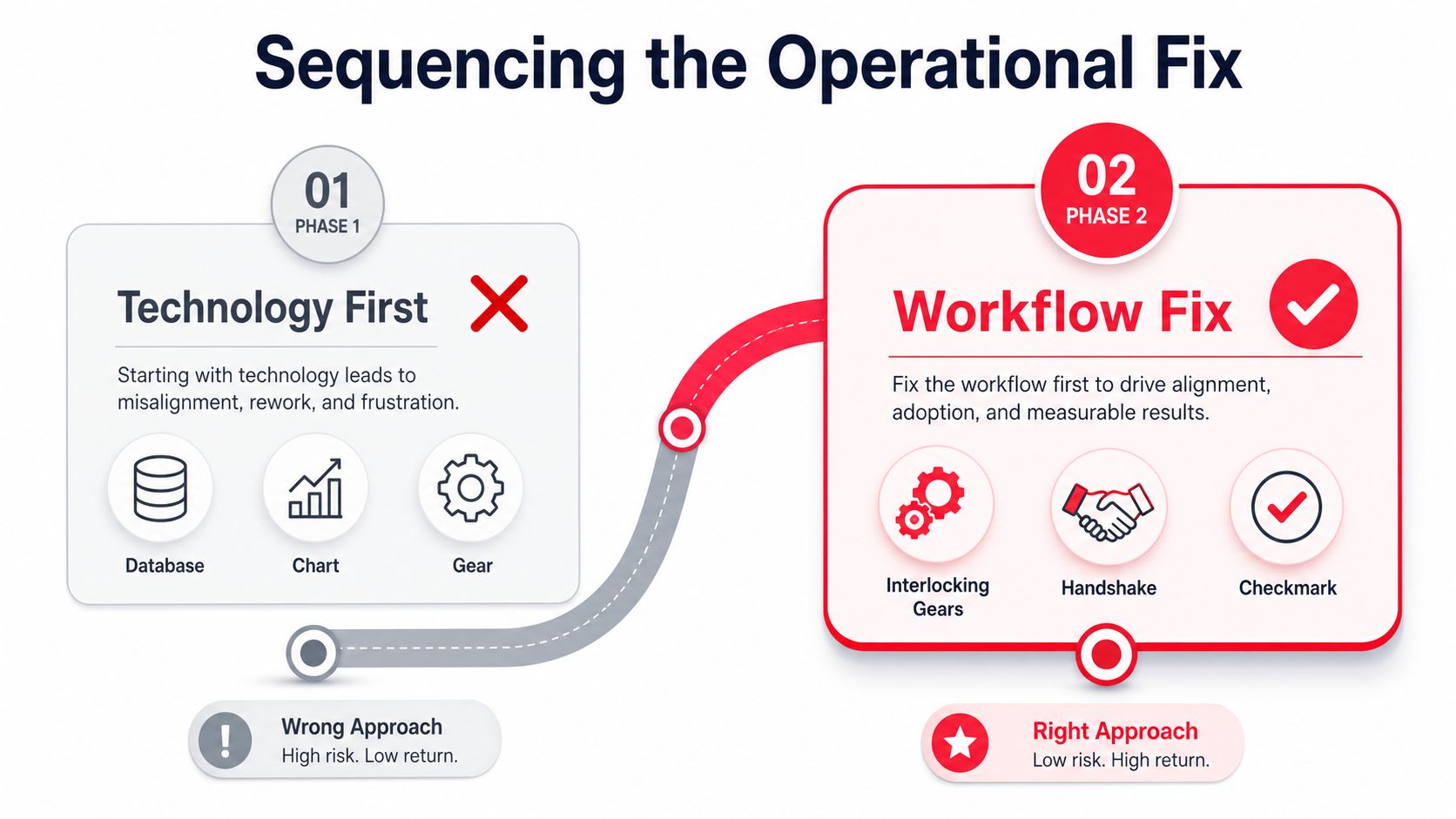
The most expensive alignment mistake is buying technology before deciding how the company should work. A new intent platform won't repair ambiguous ownership. Predictive scoring won't compensate for missing disposition reasons. An AI outreach agent can multiply bad targeting faster than a human team can detect it.
Days one through thirty
Begin with an audit of the last meaningful set of inbound and account-based handoffs. Review timestamps, routing outcomes, accepted and rejected leads, disposition completeness, owner availability, and stage progression. The CRO should approve commercial definitions. The CMO and VP Sales should approve qualification and response commitments. RevOps should own the data model and the exception log.
Document five decisions:
- Which accounts and buyers fit the target market?
- Which signals trigger coordinated action?
- Who owns each signal?
- What counts as a valid response?
- When does ownership return to marketing or move to another seller?
Don't buy a new platform during this phase. Fix fields, queues, permissions, routing logic, and escalation paths in the existing CRM where possible.
Days thirty-one through sixty
Create the shared signal taxonomy and dashboard. Run weekly reviews with sales, marketing, SDR leadership, RevOps, and one executive sponsor. Review a small number of records in detail rather than presenting a long activity report.
Use a decision log with four columns: observed failure, responsible owner, agreed change, and validation date. This prevents the same disagreement from returning in a different meeting. It also gives the executive team a record of which assumptions changed and why.
Days sixty-one through ninety
Only after the workflow produces reliable records should the team add AI-assisted automation. Suitable applications include predictive scoring, dynamic routing recommendations, account research summaries, next-best-action suggestions, and outreach sequence drafting. Keep human approval for high-value accounts, unusual signals, sensitive industries, and any message that could create compliance or reputational risk.
Tool choices depend on the current stack. Salesforce or HubSpot can provide the system of record. LeanData or native CRM workflows can support routing. 6sense, Demandbase, or ZoomInfo can provide account and intent context. Outreach and Salesloft can manage seller sequences. Gong or Clari can help inspect conversations and forecast signals. The right choice is the one your team can govern, maintain, and connect to the agreed workflow.
Stimulead provides fractional Chief AI Officer advisory, including an AI opportunity audit across conversion, search visibility, sales process, and data readiness, followed by a prioritized roadmap and implementation direction. That type of engagement can make sense when the executive team needs sequencing and oversight. It doesn't replace ownership by the CRO, CMO, or RevOps leader.
Implementation test: Don't automate a step until a human can perform it consistently, record the outcome, and explain the exception path.
Technology-first programs stall when the executive sponsor leaves, the CRM data remains incomplete, or sales sees automation as surveillance. Workflow-first programs still require change management, but they make disagreement visible in the records that govern pipeline.
The next decision is operational: choose one breakpoint, preferably routing or response time, and assign an executive owner for a 30-day audit. Review the resulting records with sales, marketing, and RevOps, then fund automation only where the evidence shows a repeatable task worth automating.
