
The popular advice is to hire the agency that can get your brand named inside ChatGPT answers. That's the wrong scoreboard, and it's why so many retainers run for quarters without producing a number a CMO can defend in a board meeting.
The reach behind the pitch is real. Google said AI Overviews reached more than 1.5 billion users each month by May 2025, across more than 200 countries and 40-plus languages, and reported a 10 percent-plus lift in Google usage for query types that triggered an overview in markets including the United States and India (Google's AI marketing report). Scale like that makes mention counts feel like progress.
We judge an answer engine optimization agency on three things: the measurement design it proposes, the order in which it sequences technical work, and whether its handover is specific enough for your team or your existing agency to build from. Everything else in the pitch is decoration.
Table of Contents
- How to Score an Answer Engine Optimization Agency
- What an AEO Engagement Includes and Who Builds It
- What AEO Engagements Cost and How to Compare Quotes
- Measuring AEO When Clicks Fall
- Sequencing Technical Eligibility Before Content Tests
- Where Buyers Verify AI Recommendations Off Site
- Building Content Sales Teams Can Confirm
- When an Advisory Partnership Fits Better Than an Agency
- Where AEO Programs Fail and When to Hold Off
- Confirm the Scope and Measurement Plan Before You Sign
How to Score an Answer Engine Optimization Agency
Ask for the prompt set in the first call, not the case study deck. A vendor that tracks visibility properly can name the buying prompts it would run for your category, say which assistants it runs them on, and hand the list over at kickoff so you own it after the contract ends. A vendor that can't do that on request is running a content retainer with new vocabulary.
Measurement design separates the two groups fastest. You want a fixed prompt set running across ChatGPT, Claude, Gemini and Perplexity on a weekly schedule, with a baseline captured before anyone rewrites a page. If you want to sanity-check a claim before signing, a geo API from BeatAPI lets you script the same buying questions across engines and keep the raw answers, which is the artifact you should be demanding from the agency anyway.
Attribution comes second. ChatGPT referrals can be isolated in analytics and tied to CRM opportunities; sessions reported without assisted-conversion analysis are a vanity line. Technical prerequisite comes third: crawl, index and snippet eligibility checked before a single content test runs.
| Agency evaluation criteria | Strong signal | Red flag |
|---|---|---|
| Measurement design | Fixed prompt set across ChatGPT, Claude, Gemini and Perplexity, rerun weekly | Mention count on a dashboard with no prompt list |
| Attribution | ChatGPT referrals isolated in analytics and tied to CRM opportunities | Sessions reported without assisted-conversion analysis |
| Technical prerequisite | Crawl, index and snippet eligibility checked before content tests | Rewrites launched on pages Google cannot index |
| Structured data governance | Visible copy matches markup, named source-of-truth owner, validation after each deploy | Schema added for FAQs or reviews that do not appear on the page |
| Third-party proof | Review sites, comparison pages and documentation audited for contradictions | Only owned pages optimized |
| Handover | Specifications an in-house team or dev agency can build from | Strategy deck with no implementation detail |
Structured data governance is where careless vendors create risk. Google's structured data policies prohibit marking up content that isn't visible to readers, including fake reviews, and require markup to stay accurate. Schema written for copy that doesn't exist on the page is policy exposure dressed up as optimization.
The test that settles it: ask for a prompt-set report from a past client, with the actual prompts named. Vendors who can't produce one are selling hours.
What an AEO Engagement Includes and Who Builds It
The component list is the least interesting part of an AEO proposal. Every credible vendor offers some version of a prompt gap analysis, entity and schema work, content restructuring, citation and mention building, a measurement stack, and a third-party proof audit. Who builds each piece, and who owns it after the engagement ends, decides whether the program survives contact with your team.
Prompt work spans four assistants because discovery is spread unevenly. Similarweb's analysis of AI tool traffic counted roughly 5.846 billion ChatGPT visits in August 2025 and about 388 million monthly active app users, around 69 percent of traffic among the AI tools it tracked. Google still took about 84.5 billion visits in July 2025 against ChatGPT's 5.72 billion. Both channels need measurement, and neither replaces the other.
Google's AI optimization guide is blunt about markup: no special schema is required for generative search, JSON-LD is the recommended format, and the Rich Results Test and URL Inspection tool are how a deploy gets validated. Schema work is an entity and content-discipline job, not an eligibility switch.
| AEO service components and owners | Output you should receive | Usually built by |
|---|---|---|
| AI prompt gap analysis | Prompt set run across ChatGPT, Claude, Gemini and Perplexity with a baseline score | Agency or internal analyst |
| Entity and schema work | Valid JSON-LD on representative templates, matched to visible copy | Agency developer, validated before release |
| Content restructuring | Pages rewritten for extraction, with verifiable claims | Agency content team with your product marketers |
| Citation and mention building | Placements on sources AI assistants already cite | Agency outreach or PR team |
| Measurement stack | Prompt tracking, referral tagging and CRM fields | Agency with your RevOps team |
| Third-party proof audit | Contradictions listed across reviews, listings and documentation | Agency, then owned by marketing |
Two prompt-tracking tools you may encounter in vendor proposals are Profound and Otterly.ai. Whoever directs the engagement should be the one deciding which tracker is production-ready before a subscription gets signed. Stimulead's AI Search and AEO scope covers the gap analysis across ChatGPT, Claude, Gemini and Perplexity, content restructuring for LLM discoverability, citation and mention-building strategy, and schema and machine-readability work, and Stimulead works with whichever team or agency does the building. The specifications it writes are detailed enough for engineers, marketers and agencies to build from without a translation layer.
Three components should never be outsourced without a named internal owner: the prompt set, the product facts inside the schema, and the CRM fields that record AI-referred opportunities. Assign the prompt set to the marketing lead closest to positioning, the product facts to product marketing, and the CRM fields to RevOps. Without those owners, the agency owns your source of truth and you inherit the ambiguity.
What AEO Engagements Cost and How to Compare Quotes
We won't publish a price band for this work. We haven't measured enough engagements to stand behind a range, and vendors that publish confident bands tend to leave tooling and publisher fees out of the number.
Ask each vendor to split the quote into three lines.
- Baseline prompt-set audit. A fixed fee covering the prompt set, the visibility baseline against named competitors, and the list of domains assistants cite for your prompts.
- The build. Schema on representative templates, page rewrites, comparison and alternatives pages, and citation outreach, priced by page count and placement count rather than by hours.
- Measurement stack. Prompt tracking, referral tagging and CRM configuration, with the tool subscription listed separately from the service.
Bundled quotes hide the recurring cost of a tracking tool, which is why the subscription line matters more than the total. Compare a fixed-fee audit against a monthly retainer by the number of test cycles each buys, since cycles produce evidence and hours don't.
An advisory engagement is priced on direction and decisions, so its quote should name the deliverables: the roadmap, the KPI set and the monthly readout. If a proposal can't list those three by name, the pricing is for availability, not output. Request written quotes from every shortlisted vendor and compare them line by line.
Measuring AEO When Clicks Fall
A falling click-through rate is a bad reason to cancel an AEO program and a worse reason to celebrate one. AI answers compress discovery inside the assistant, which pushes more of the buying decision into signals that arrive after the click or without one. The click count stops being the scoreboard before the pipeline stops moving.
A 2026 field study covering more than 100 brands and 100,000 AI responses found that wider access to AI search reduced traditional weekly search queries by 9.4 percent. The same research found a visibility gap by company size: global brands appeared in 73 percent of relevant answers, established mid-market brands in 44 percent, and niche brands in 11 percent.
That gap should reset your targets.
A niche brand fights a structural disadvantage in how assistants assemble answers, so a narrow, high-intent prompt set beats a broad one. Measure share on the prompts a real buyer would type, not on a list padded with queries no one asks. And ask each agency which metric it expects to move first and which one it refuses to be judged on. The answer tells you whether the measurement plan was designed or assembled after the contract.
What each metric can prove
| AEO metrics and what each can prove | How to measure it | What it can and cannot prove |
|---|---|---|
| Prompt-set share of voice | Share of tracked buying prompts that name the brand | Shows presence, not preference |
| Citation quality | Whether the cited source is your site, a review or a third party | Shows source dependence, not conversion |
| Recommendation accuracy | Share of answers that state your pricing, features and category correctly | Shows entity clarity, not demand |
| ChatGPT referral sessions | Sessions tagged with utm_source=chatgpt.com in analytics | Shows click-through, which fell for many brands |
| Assisted conversions | Opportunities with an AI-referred or AI-influenced touch before close | Shows influence, but depends on CRM field discipline |
| Branded and direct demand | Trend in branded queries and direct visits after prompt gains | Suggests preference, shows correlation only |
OpenAI's publisher documentation states that ChatGPT appends the UTM parameter utm_source=chatgpt.com to referral URLs, which gives you a real channel to isolate, and that publishers must not block OAI-SearchBot if they want their material discovered and cited. Treat crawler access as a prerequisite and the UTM tag as instrumentation. A tagged session proves the link fired, nothing more.
Assisted-conversion figures stay directional until the CRM fields have been complete for at least a full quarter.
The discipline sits in the fields, not the dashboard. Stimulead's AI opportunity audit covers search visibility alongside conversion, sales process and data readiness, so it shows which prompts and citations you already own before a vendor claims them as wins. Work through this AI visibility audit checklist before the kickoff call so the baseline conversation starts from your data rather than the agency's.
Sequencing Technical Eligibility Before Content Tests
Most AEO programs that fail do so at step one. Google's documentation on AI features in Search says there is no special file or schema required for a page to appear in AI Overviews or AI Mode, and that eligibility still depends on the page being indexed and eligible for a snippet in ordinary Search. Google also warns that meeting these requirements doesn't guarantee a page will be crawled, indexed or served.
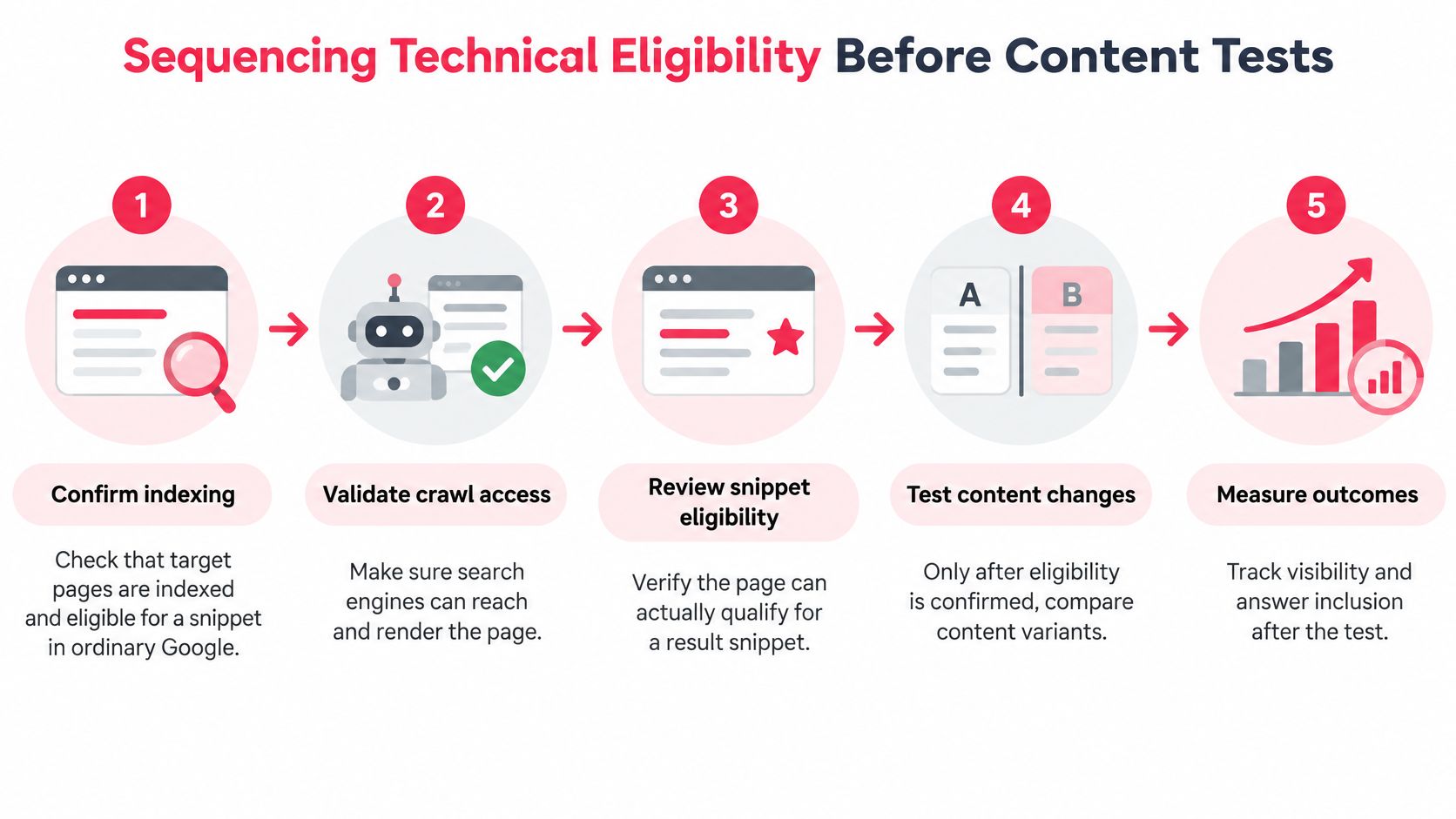
That makes AI visibility an extension of search eligibility, which sets the order of work.
- Confirm indexing. Check that the target pages are indexed and eligible for a snippet in ordinary Google Search before anything else gets budget.
- Clear access blocks. Remove robots.txt directives, noindex tags and login walls from the target templates, then verify with URL Inspection rather than assuming.
- Deploy valid JSON-LD on representative templates. Validate with the Rich Results Test and reconcile every marked-up claim against the visible copy.
- Baseline the prompt set. Run it before any rewrite, or you have no before-and-after comparison to show anyone.
- Rewrite a limited set of pages. Comparison, alternatives and product pages first. Whole-site rewrites burn budget before you know which format assistants cite.
- Track indexed pages and cited appearances for six to eight weeks. Only then attribute a pipeline change to the work.
That six-to-eight-week window is our working assumption from implementation experience, not a published benchmark. Public evidence on how quickly citation changes appear is thin, so hold the window loosely and check the prompt set weekly.
If your site still blocks crawlers or renders poorly, fix that first. Our guide to preparing a website for AI agents covers the technical checks that have to pass before content experiments mean anything.
Where Buyers Verify AI Recommendations Off Site
An AI mention is a starting point, and treating it as the conversion is where agency promises break. The buyer leaves the answer and keeps checking.
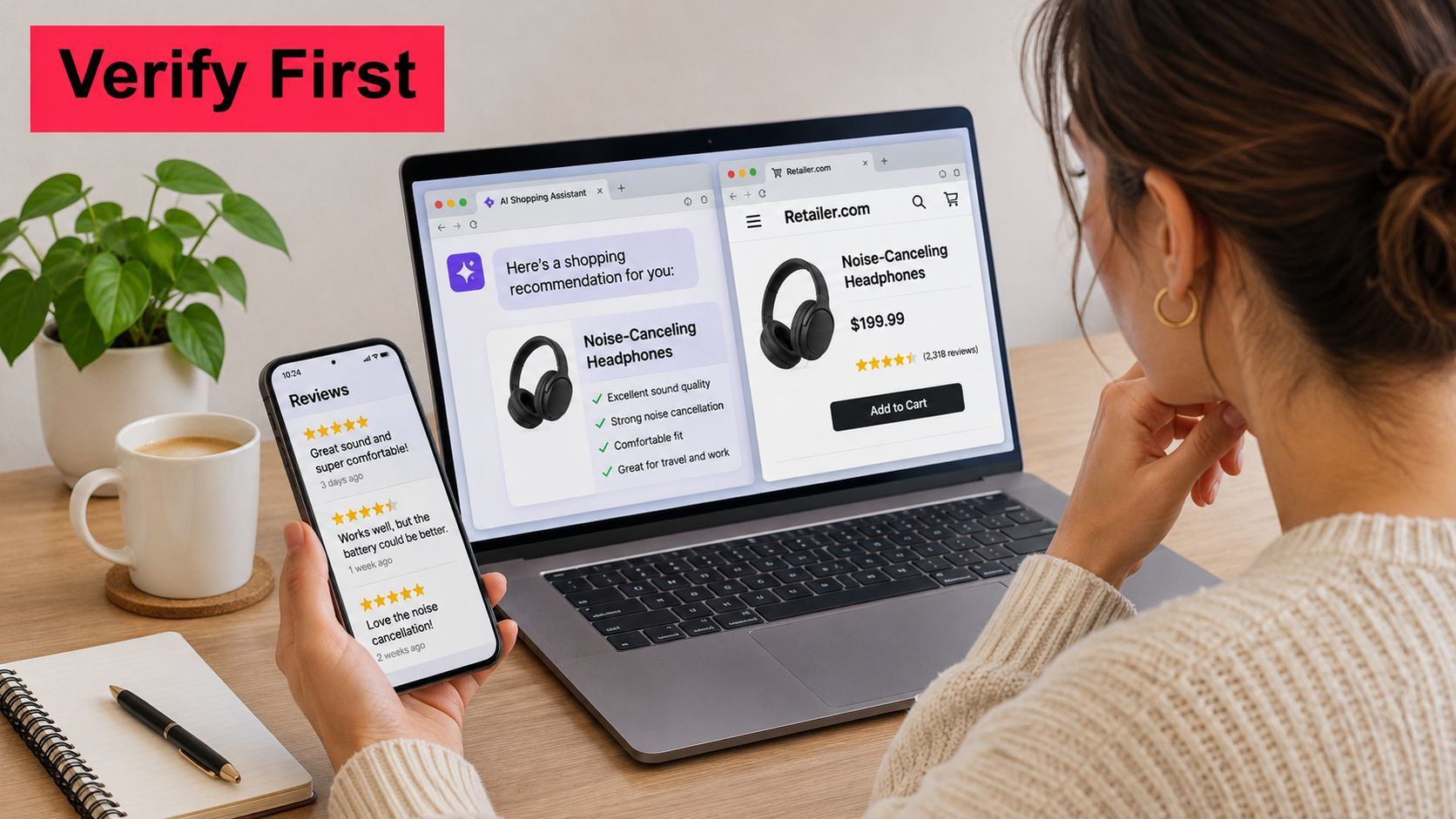
The behaviour is already mainstream. In 2025, 24 percent of consumers said they had used a generative-AI tool to search for a product instead of a traditional search engine, according to Bazaarvoice's Shopper Experience Index 2025. Only 46 percent of consumers fully trust AI shopping recommendations while 89 percent take additional steps to verify them, and AI-assisted shoppers take an average of 3.8 online steps before purchase against 1.6 for shoppers who didn't use AI (the 2026 commerce analysis).
That verification trail is where the audit belongs. Citation research in the same analysis found corporate websites account for about 78 percent of cited sources, YouTube is the most frequently cited non-corporate source, and ranked best-of listicles alone represented about 21 percent of citations.
The image shows a buyer doing exactly that work: phone in hand, assistant on the laptop, cross-checking before a decision. Your job is to make sure both screens agree about your pricing.
The audit an agency should run lists every price, feature and integration claim across your website, review sites, comparison pages, marketplaces, documentation and community threads, then flags contradictions and unsupported claims, then prioritizes independent validation over new owned content.
Two limits apply. These figures come from consumer and ecommerce research and from citation samples, so the B2B transfer is an inference, not a measured result. And directory and listing hygiene is unglamorous work that often moves accuracy faster than a blog rewrite, which is why directory submission discipline belongs in the plan rather than the afterthought.
Getting named is one problem. Getting described correctly everywhere a buyer checks is the harder one, and our breakdown of how to get recommended by ChatGPT, Claude or Gemini covers the third-party surfaces that decide it.
Building Content Sales Teams Can Confirm
Gartner's B2B buyer research puts the handoff problem in plain numbers. In a survey of 646 B2B buyers run from August through September 2025, 45 percent reported using AI during a recent purchase and 67 percent said they preferred a rep-free experience. A second Gartner survey of 645 buyers found an average of seven information sources per purchase, 45 percent using generative AI mainly to research vendors and products, and 69 percent preferring to validate AI-generated insights with a sales representative.
Read those together and the design requirement is obvious. Buyers want machine research and human confirmation, which means the facts an assistant retrieves and the facts a rep confirms have to come from one source.
Content built for extraction does both jobs when it states verifiable product facts, real comparison detail, implementation constraints and proof points. Vague positioning copy fails at both ends: an assistant can't quote it and a rep can't defend it.
The practical steps are unglamorous. Product marketing owns a shared fact sheet with current pricing bands, integrations, limits and proof points, versioned and dated. Marketing keeps a short list of the claims assistants misstate most often, refreshed monthly from the prompt set. Sales gets a briefing that names those claims and the corrected version, so the first call doesn't contradict the answer that generated it.
A test worth running: ask a rep to quote your own AI answer back to you. If they wince, the content is the problem.
We haven't measured this handoff in a controlled way across our own engagements, so treat the guidance as design reasoning with partial support. Run it with one segment and one prompt set before you rebuild onboarding around it.
When an Advisory Partnership Fits Better Than an Agency
The choice comes down to ownership. An agency builds; an advisory partner sets direction, decides which tools are production-ready, and writes the specifications your team and existing agencies act on. Stimulead sits above AI consultants and agencies on exactly that basis, with those partners keeping the build.
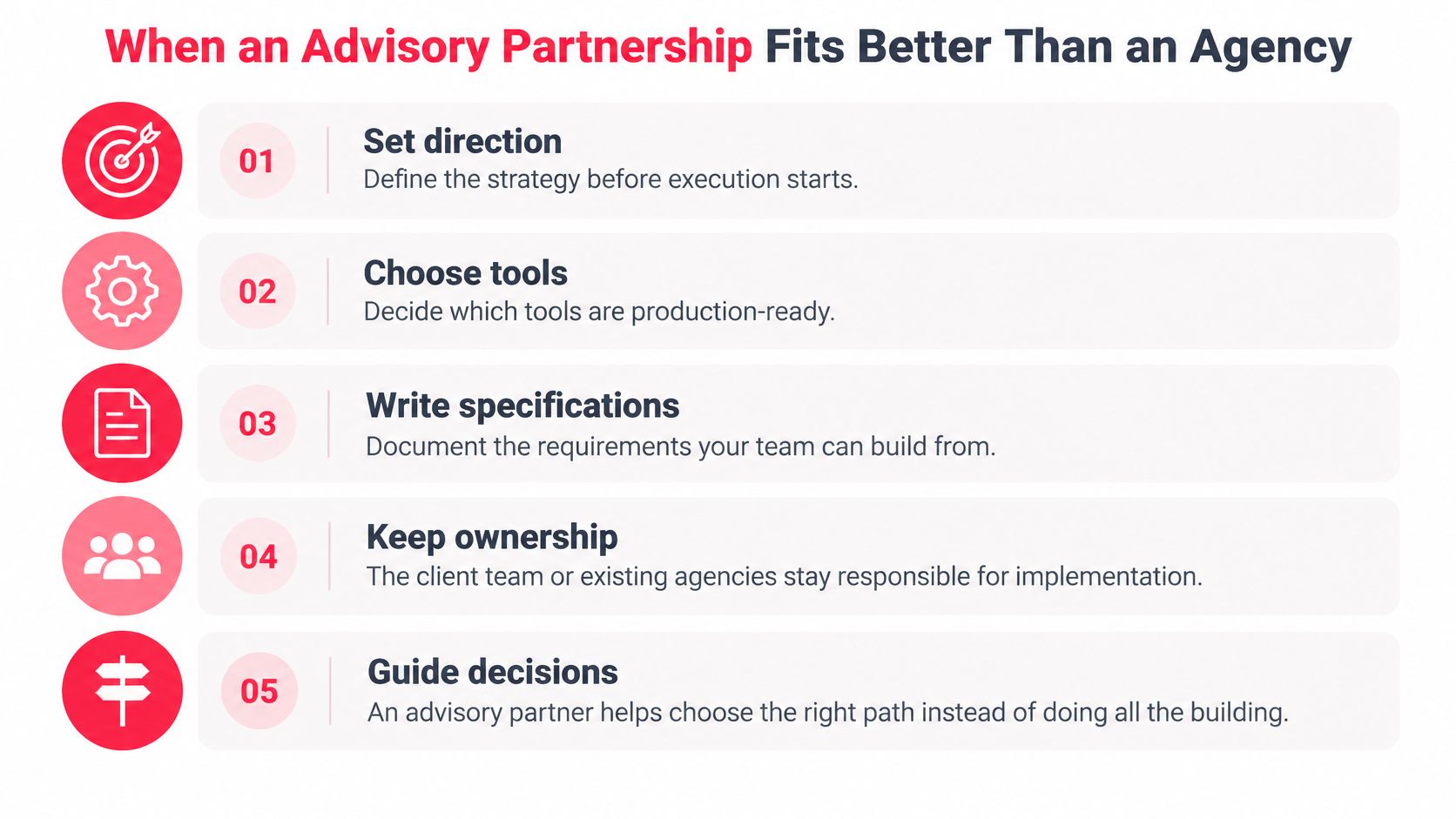
Take a 60-person SaaS company with a capable SEO agency and no executive owner for AI measurement. The advisory partner sets the prompt set, the attribution rules and the 90-day test window; the SEO agency builds the schema and rewrites. Nobody argues about who is accountable for the number.
| Signals that point to an agency or an advisory partner | Points toward |
|---|---|
| Missing content team with no build capacity | Agency that builds |
| No executive owner for AI measurement | Advisory partner |
| Several vendors giving conflicting reports | Advisory partner |
| Capable SEO agency already in place | Agency, directed by an advisory partner |
A company that already has a content team and an executive owner for measurement usually needs only the agency. Our AI Growth Partnership is built for established businesses with existing teams and agencies, and it starts with an audit across conversion, search, sales and data before any roadmap gets written.
Where AEO Programs Fail and When to Hold Off
The most expensive failure is chasing mention counts on a broad prompt set in a narrow category. If assistants rarely name companies your size for your kind of question, a category-wide visibility score will look catastrophic for reasons that have nothing to do with your content. Narrow the prompt set to buying questions and put the budget into third-party proof.
The second failure is schema for content that isn't on the page. FAQ blocks and review markup written to court assistants violate Google's structured data rules and create a compliance problem your legal team inherits.
The third is buying prompt-tracking software before a baseline exists. A tool with no before-and-after has produced a subscription, not evidence.
The fourth is reading a click decline as failure without checking assisted conversions and branded demand. Two of those three signals can improve while clicks fall.
Hold-off test: if you have no CRM field for AI-referred opportunities, no named owner for product facts, or no capacity to act on a monthly readout, wait. The program will generate reports nobody can use.
Public evidence on pipeline lift from AEO work is thin, and we would not promise a lift percentage to any client. The honest commitment is a measured baseline, a defined test window and a clear stop rule.
Confirm the Scope and Measurement Plan Before You Sign
Run these five steps before the contract goes to legal, and ask each question of the vendor in writing.
- Confirm the baseline exists and the prompts are named. If the report doesn't list prompts, it isn't a baseline.
- Name the owner of product facts and schema. A person, not a department, and written into the statement of work.
- Confirm the CRM fields for AI-referred and AI-influenced opportunities. Ask who maintains them and how often they're reviewed.
- Agree a 90-day test window with a stop rule. A failed test should end the engagement rather than extend it.
- Decide the split between the builder and the director. If work needs an agency that builds and an advisory partner that directs, write both scopes into one document.
Book a scoring call with your shortlist and run the six criteria from the first section against each vendor, with the prompt set in front of you. Any vendor that can't produce a named prompt set during that call should come off the list, whatever its deck says about visibility. If you want a second opinion on the measurement design before you commit, bring us the shortlist and the proposals, and we'll tell you which one you can hold to a number.
