
The popular advice on ChatGPT SEO starts with getting cited and assumes traffic will follow. We recommend a stricter decision: fund a narrow recommendation-and-measurement program, and refuse to call a citation a commercial win until you can connect it to qualified demand.
At Stimulead, we work as a fractional Chief AI Officer advisory. For CEOs, CMOs and CROs managing established B2B teams, the question is whether better answers about your company justify the implementation effort, compared with the acquisition work you'd otherwise fund.
Table of Contents
- The ChatGPT SEO Scorecard Executives Should Use
- Pages ChatGPT Can Retrieve and Quote
- Four Jobs to Hand ChatGPT, Each With a Stop Rule
- Where ChatGPT SEO Fails After Publish
- Two B2B Situations and the Right Scope
- Set the 90-Day ChatGPT Test Before More Pages
The ChatGPT SEO Scorecard Executives Should Use
Choose between treating ChatGPT as another session source and managing it as a smaller recommendation layer with a different conversion profile. We recommend the latter, particularly when buyers need to evaluate implementation risk or compare vendors against a specific stack.
The 100-site, 145-million-session analysis covered by Search Engine Land gives the commercial comparison below. These are sample-level benchmarks, not a forecast for your company.
ChatGPT SEO metrics against Google organic
| Metric | ChatGPT or AI answer layer | Google organic | Source |
|---|---|---|---|
| Share of sessions | 0.62% of Google organic sessions | Baseline | Search Engine Land industry analysis |
| Conversion rate where tracked | 13.8% | 3.02% | Same industry analysis |
| Conversion volume | All LLMs combined = 1x | 27x all LLMs combined | Same industry analysis |
| Click rate on results | No published ChatGPT figure in this comparison | 15% of visits with no AI summary; 8% with one | Pew Research Center, March 2025 Google activity |
| Outbound referral trend | Up 206%, January 2025 to January 2026 | No matched Google trend reported | Semrush clickstream analysis |
For the Google comparison, Pew Research Center's March 2025 analysis found that traditional result links received clicks on 8% of visits with an AI summary, compared with 15% without one. That measures Google behavior, so don't transplant its click rates into a ChatGPT forecast.
Meanwhile, Semrush's U.S. clickstream analysis reported 206% year-over-year growth in outbound ChatGPT referrals, from January 2025 to January 2026. A large growth rate can coexist with a small acquisition contribution.
Separate visibility from commercial evidence
Give the CMO an answer-quality scorecard and the CRO a demand-quality scorecard. Record recommendation frequency and factual accuracy separately from attributable sessions, qualified opportunities and accepted pipeline.
In GA4, preserve referral information; in HubSpot or Salesforce, retain original source and capture buyer-reported discovery separately. A prospect who says ChatGPT recommended your company provides useful assisted-discovery evidence, but that doesn't prove the assistant caused the deal.
Decision rule: A citation earns investigation. A qualified opportunity earns commercial attention.
Report value per AI-referred visitor alongside volume, using accepted pipeline divided by attributable visitors and clearly labeling it as pipeline rather than realized value. Keep assisted discovery outside that calculation to avoid double-counting.
Our AEO versus SEO comparison helps separate answer inclusion from conventional ranking objectives. Prioritize ChatGPT SEO when your offer requires serious consideration and you can prove why a particular buyer should choose it.
Pages ChatGPT Can Retrieve and Quote
Eligibility comes before copywriting. A content team can produce an excellent comparison page that never reaches the search retrieval system because a security rule blocks access.
The crawler documentation identifies OAI-SearchBot as the crawler for ChatGPT search and says sites that opt out won't appear in search answers, although navigational links may still appear. Allowing GPTBot doesn't settle search eligibility because its role is different.
Audit access by user agent
Ask engineering to inspect robots.txt and CDN or WAF decisions, then verify successful responses in server logs. Check bot authentication rather than trusting a user-agent string alone, and confirm that the returned HTML contains the actual page content.
The shares below come from Cloudflare's published crawler comparison, where GPTBot represented 11.7% of listed crawler activity in July 2025, compared with 4.7% in July 2024. They describe crawler activity, not buyer visits.
Crawlers to separate in ChatGPT SEO logs
| User agent | Role | July 2025 share | If blocked |
|---|---|---|---|
| GPTBot | Training crawl | 11.7%, up from 4.7% in July 2024 | Training access is restricted; this isn't the search switch |
| OAI-SearchBot | ChatGPT search retrieval | 0.9% | Pages don't enter ChatGPT search answers |
| ChatGPT-User | User-triggered fetch | 0.9% | Network blocks can prevent on-demand fetches |
| Googlebot | Google crawl and indexing | 39% | Ordinary Google visibility is at risk |
A robots.txt preference and a network-level block aren't interchangeable, especially for user-triggered requests. Have engineering record the control responsible for each failed fetch instead of putting every failure under “AI bots blocked.”
Make the evidence easy to extract
Once access works, organize the page around the buyer's decision. Put the direct answer early, attach dates and limitations to product claims, and place comparisons beside the supporting evidence.
Prismic's review of AI-search optimization analyses reports that 44.2% of ChatGPT citations came from the first 30% of a document. That supports testing early evidence placement; it doesn't establish a universal ranking formula.
Use our content optimization guidance for LLMs to review extraction readiness. When evaluating automation, WebinOne AI agents for SEO is a resource to examine against your actual publishing requirements, with human approval retained.
Google's AI-feature guidance requires no special AI-only markup and retains established crawl, indexing and snippet controls. Permission preserves eligibility; relevance and evidence still determine whether a page deserves inclusion.
Four Jobs to Hand ChatGPT, Each With a Stop Rule
Use ChatGPT to accelerate bounded tasks while people retain authority over claims. Pew Research Center reported that 34% of U.S. adults used ChatGPT in 2025, up from 23% in 2024, but broad adoption gives no reason to delegate your editorial judgment.
We write implementation specifications for the team or agency doing the building. The useful handoff names the input, the reviewer and the condition that stops publication.
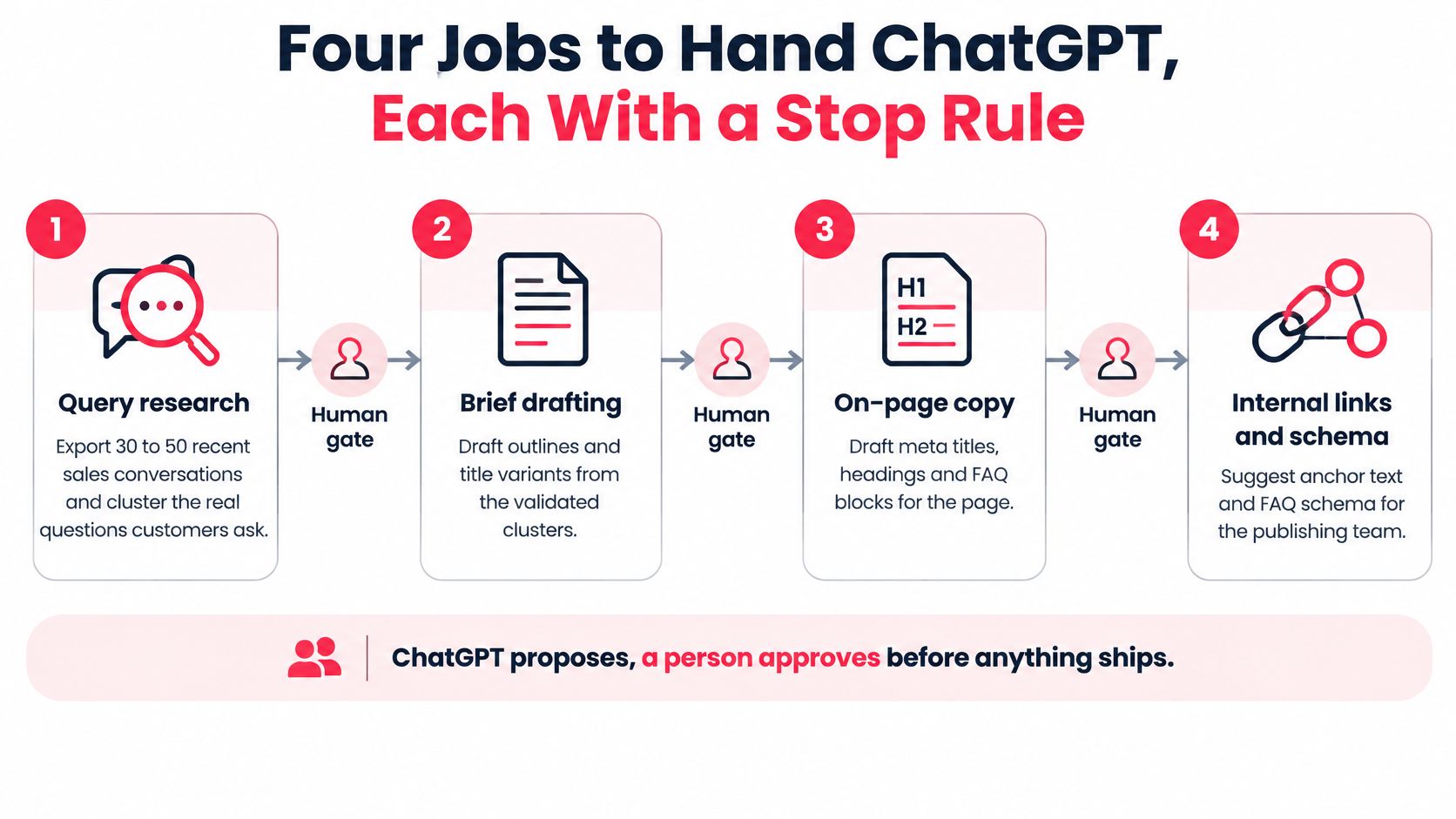
This workflow diagram illustrates the human approval gates that should remain between model output and production.
Give each job a constrained input
Start query research with sales evidence. As an initial working batch, export 30 to 50 recent sales notes, support objections and lost-deal reasons, then remove personal or confidential information. Add relevant ranking-page URLs and ask ChatGPT to group the questions without inventing search demand.
The SEO lead reviews those clusters with sales. Retain language connected to closed-won deals, and mark a thin sample rather than treating a plausible cluster as validated buyer demand.
Limit content planning to a reviewable batch. We recommend no more than five briefs per working session, each containing the buyer's question, intended decision and page owner. Every proposed factual claim needs a source field and someone responsible for verifying it.
Say lost-deal notes repeatedly describe deployment as taking six months. That's a hypothesis for an implementation comparison page, not permission to publish the duration as fact. Product and delivery owners must establish the defensible comparison.
Draft on-page copy against approved evidence. Ask for an opening answer block, a useful comparison and a proof line near the beginning. Give the model the source material it may use and require it to mark unsupported gaps.
Product marketing checks the draft against the live product, including exclusions and deployment requirements. Editors verify link targets and remove invented author credentials or customer proof.
Freeze the AI-search test inputs. Start with a proposed set of 10 to 15 buyer prompts and have the demand owner log returned entities, cited URLs and factual errors. Keep prompts unchanged within the test cycle so an apparent improvement isn't due to a different question.
Put rejection authority in the handoff
ChatGPT jobs in an SEO workflow
| SEO job | What ChatGPT drafts | Reviewer | Stop rule |
|---|---|---|---|
| Query research | Buyer-question clusters from calls and ranking pages | SEO lead with sales | Drop any cluster no closed-won deal used |
| Content planning | Brief with a source field on every claim | Content lead | No source owner, no brief |
| On-page drafting | Opening answer, comparison and proof line | Editor and product marketing | Unsourced or off-product claims are rejected |
| AI-search testing | Fixed prompt list and a log of answers | Demand owner | Don't change prompts during a test cycle |
Internal-link suggestions also need a destination check in the CMS. Schema must describe visible, accurate page content; a model's suggestion doesn't establish that markup is appropriate.
ChatGPT can propose the order of an argument. Your company must decide which claims it will defend.
Measure testing velocity by completed, reviewed iterations rather than generated drafts. If reviewers can't keep pace, reduce the batch instead of creating a backlog of unverified content.
Where ChatGPT SEO Fails After Publish
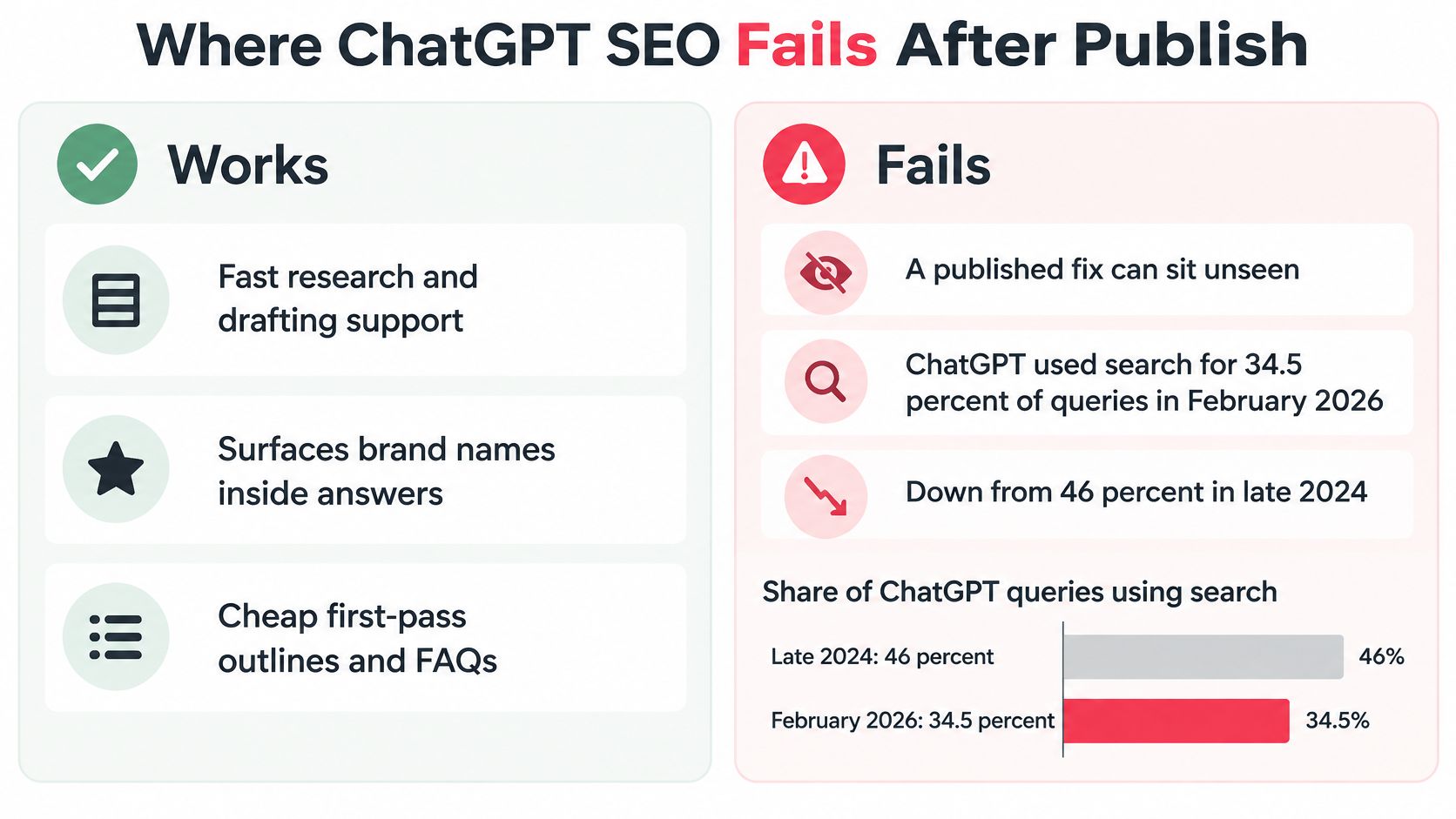
Semrush's clickstream analysis reported that ChatGPT enabled search for 34.5% of queries in February 2026, down from 46% in late 2024. Most observed queries therefore didn't trigger live search, so a page edit can improve what is retrievable while leaving the next answer unchanged.
Treat ChatGPT SEO as a citation and measurement problem, with referral traffic as a secondary signal. Non-search responses may retain outdated associations, and retrieved answers can still cite stale third-party material that sits outside your CMS.
The comparison separates drafting help from post-publication control.
Treat provenance as an investigation
For each priority prompt, save the answer and its cited passages with search enabled, then compare an equivalent run without search where the interface permits it. Record the model and test conditions so reviewers can distinguish a content change from a changed environment.
When answers disagree, inspect the cited review page, directory or partner profile. Correct a demonstrably stale claim at its source, and treat an uncited answer as unresolved: a citation identifies evidence; an uncited answer doesn't reveal its provenance.
The video gives the team one more review point before changes are assigned.
Stop tactics without a testable mechanism
- Padding pages to satisfy a supposed citation-length target adds review work without establishing better evidence. Rewrite for the buyer's decision instead.
- Counting a training-crawler spike as demand confuses machine access with commercial interest. Keep the demand report tied to human behavior.
- Rewriting inaccessible pages leaves the retrieval constraint unresolved. Assign the access failure to engineering before assigning another draft to content.
No dependable turnaround time is established for a corrected third-party page to change future model answers.
Maintain separate series for answer accuracy and source inclusion, with branded demand in the commercial report. Stop any tactic whose owner can't name the intended measure and the observation that would disprove it.
Two B2B Situations and the Right Scope
Consider a B2B software company whose buyers ask which vendor fits an existing stack. Scope ChatGPT SEO around category and comparison pages, supported by directory cleanup and a weekly accuracy review.
The commercial owner should examine demo quality and assisted pipeline alongside branded search. Give contradictory company descriptions a named owner rather than responding with a larger content calendar.
| Situation | Do this | Don't do this |
|---|---|---|
| High-consideration software purchase | Verify implementation evidence and vendor-fit comparisons | Expand across every informational keyword |
| Lower-consideration content property | Repair ordinary search and conversion problems first | Staff a separate program without buyer evidence |
A lower-consideration content property with dependable Google acquisition deserves a different decision. If important pages have crawl or indexing problems, fund those repairs before creating a dedicated ChatGPT workstream.
Run a monthly prompt check as a watch item, with escalation when answers contain a material error or qualified buyers report using the assistant. Low effort monitoring can be sensible without committing a publishing team.
Scope should follow the buyer's decision and the company's ability to maintain accurate evidence.
Our AI search optimization operating routine addresses monitoring beyond a single assistant. For a company between these situations, begin with the pages sales already use in late-stage deals and leave the rest of the library alone.
A useful page answers an objection sales hears in practice. If nobody can name that objection or defend the supporting proof, defer the page.
Set the 90-Day ChatGPT Test Before More Pages
Growth teams usually approve the production target first and look for evidence later. Reverse that order. Before another page enters the queue, set a 90-day test with 15 buyer-worded prompts and a fixed scope: five late-stage pages plus the third-party profiles that contradict them.
The test exists to force a decision.
ChatGPT answers still draw heavily on training data, and visitors who arrive through a citation convert differently from Google organic. Judge the run on citations earned, factual errors removed, and buyer-reported discovery rather than session counts. A shared Google Sheet is enough to run it: store answers and citations alongside test conditions, and name a demand owner who can reconcile observations with CRM records.
Define the operating commitment
- Establish the baseline with search-enabled and non-search runs where available. Keep an unchanged copy of every prompt and record factual errors.
- Publish a change log. Separate page edits from profile corrections so the team can investigate which intervention plausibly affected an answer.
- Review monthly against accepted pipeline stages and buyer-reported discovery. Use our A/B testing best practices for measurement discipline, without claiming this observational program proves causality.
Ninety days buys three of those reviews. That is long enough for a corrected profile or a restructured page to surface in answers, and short enough that a failed test costs a single quarter.
For the handoff after a visit, use Captiwate's inbound conversion insights as a review resource for lead capture and follow-up. Request current quotes before buying a visibility tool.
Our AI Search & AEO work covers gap analysis across ChatGPT, Claude, Gemini and Perplexity, content restructuring for LLM discoverability, citation and mention-building strategy, and schema, structured data and machine-readability work. Our AI opportunity audit examines conversion, search visibility, sales process and data readiness to identify where AI produces measurable gain and where it currently does not.
None of that makes a program mandatory. If your team cannot staff the log and review the evidence, leave ChatGPT SEO out of the quarter.
Name the owner and run the 15-prompt baseline before your next planning meeting. Bring the saved answers, the factual errors, and whatever buyer evidence you can attribute, so funding for more pages rests on observed conditions.
