
The CEO decision is not where to add an AI feature. It's which AI initiatives deserve capital, executive attention and operating capacity now, and which should wait or be killed. The popular advice starts with a use-case brainstorm. We think that's backwards.
AI strategy consulting should first establish what business outcome AI must change, who owns the decision, what data supports it, and what governance stands between a promising test and a production failure. The market's expansion makes that discipline more important. One estimate places the global AI consulting market at $8.4 billion in 2024, rising to $59.4 billion by 2034 at a 21.6% CAGR, while another estimates the broader AI consulting services market at $22.27 billion in 2025 and $349.80 billion by 2034 at a 35.8% CAGR. The spread between those estimates tells us to treat market sizing carefully, but both point to sustained enterprise demand for implementation, vendor decisions, governance and roadmaps, not classroom explanations. (Market.us AI consulting market report)
Table of Contents
- The Decision Most Growth Leaders Get Wrong About AI Strategy Consulting
- What an AI Assessment Should Actually Surface
- Roadmap Construction and Sequencing Trade-offs
- Vendor Selection as a Governance Exercise
- Measurement Frameworks That Tie AI to Revenue
- Fractional CAIO Versus Project Engagements
- Where AI Strategy Consulting Consistently Fails
- The Next Move for an Executive Considering AI Strategy Consulting
The Decision Most Growth Leaders Get Wrong About AI Strategy Consulting
The first question should be, “Which operating constraint are we willing to change?” It shouldn't be, “Where can we apply AI?”
A growth-stage B2B company may have a qualification bottleneck, weak conversion between opportunity stages, slow proposal production, expensive support interactions or unreliable customer data. AI might help with one of those problems. It might also distract the team from a tracking failure, unclear ownership or a process that needs redesign before automation.
An advisor earns trust here. We push the leadership team to state the target in commercial terms, such as faster time to qualified pipeline, better lead-to-opportunity conversion, lower service cost or greater capacity per employee. The target doesn't need a speculative forecast. It needs a baseline, an accountable owner and a decision rule for continuing or stopping the work.
Practical rule: If the executive team can't name the business decision an AI initiative will improve, the initiative isn't ready for funding.
The adoption context supports a move away from curiosity-led planning. A 2025 survey of professionals in the United States and United Kingdom found that 72% were using AI at work, up from 48% the previous year. The same survey found that 56% of firms had adopted AI and another 32% were getting started. (Intapp's 2025 technology perceptions research)
That doesn't mean every company needs a large AI program. It means usage is already affecting work patterns, risk and competitive expectations. Leaders now need a way to decide where the company will permit AI, where it will restrict it and how it will prove value.
A sound commercial plan still matters. Teams that need to revisit segmentation, channels and sales capacity should first build a go to market strategy, then decide where AI belongs inside it. AI strategy should serve the operating plan, not replace it with a catalogue of tools.
What an AI Assessment Should Actually Surface
An AI assessment should behave like a diagnostic. A survey that asks teams which tools they want, then turns the answers into a polished deck, creates activity without decision quality.
We start with the company's data and workflow reality. That means reviewing data architecture and lineage, checking existing software and license spend, interviewing the people who own conversion and retention metrics, and mapping decision points across the customer lifecycle. The assessment should also identify where a person currently reviews information, approves an action or handles an exception. Those points often determine whether an AI workflow can operate safely.
The buyer should expect four useful outputs:
A ranked opportunity set. Each candidate should connect to a revenue, margin, capacity or risk question. Rank candidates by expected business effect, data readiness, implementation effort and internal ownership.
A dependency map. Show the missing events, integrations, permissions, process changes and review steps. “Improve lead qualification with AI” means little if lead source data is inconsistent or sales representatives don't trust the routing logic.
An operating capability assessment. State what the current marketing, sales, data and engineering teams can run without outside help. Name gaps in product ownership, analytics, security review and change management.
A decision record. Separate initiatives to fund, defer, test or reject. A good assessment makes rejection useful because it records the reason and the condition that would change it.
A practical AI readiness assessment should leave the leadership team with a small, ranked set of candidates and explicit blockers. It shouldn't promise precision where the baseline is weak. Where evidence is thin, the recommendation should be to improve measurement or run a controlled diagnostic.
Questions that expose shallow assessment work
Ask the advisor to show which metric each opportunity could move, who owns that metric and what has to be true before deployment. Ask how existing platforms, including Salesforce, HubSpot, Snowflake, Microsoft Copilot or OpenAI-based applications, fit into the decision.
A generic opportunity matrix is a warning sign. So is a recommendation that names a tool before it documents data access, approval rights, human review and exit conditions.
Roadmap Construction and Sequencing Trade-offs
Roadmapping is where an engagement either earns its fee or reveals that the work was presentation design. The core choice is whether to pursue visible workflow wins first, build shared foundations first or develop internal capability before committing to broader deployment.
If you’re earlier in the process and still working out what kind of help you need, what AI consulting is compares strategy, implementation and embedded engagements.
| Sequencing Strategy | Time to First Revenue Impact | Organizational Cost | Primary Failure Mode |
|---|---|---|---|
| Quick-win sequencing | Usually the fastest path when a clean workflow and owner already exist | Lower initial cost, with a risk of repeated pilot work | Several disconnected pilots never reach normal operations |
| Platform sequencing | Slower while data, permissions and governance foundations are prepared | Higher early cost across data, security and engineering | Executives lose patience before a business result appears |
| Capability sequencing | Delayed until internal skills and ownership are in place | Cost sits in hiring, training and management capacity | The plan stalls because the company can't secure the required talent |
Quick wins make sense when the workflow is narrow, the data is available and the team can measure the result. They become wasteful when leadership counts launches instead of scaled use.
Platform work deserves funding when several approved use cases depend on the same identity, data, monitoring or approval layer. It needs a visible executive sponsor and a business milestone, or it becomes infrastructure spending without a commercial clock.
Capability sequencing suits a company that wants to own a differentiated workflow. It creates a different risk profile. Hiring a data engineer or AI product owner won't fix a missing business decision, and a new role without a funded backlog becomes another unresolved dependency.
Governance belongs inside whichever route leadership selects. Teams working with customer-facing workflows can use practical guidance on AI governance for support teams, particularly around permissions, review and escalation. Our AI strategy roadmap work treats those controls as delivery conditions rather than an appendix.
The right roadmap names what won't happen. If every initiative is marked urgent, the roadmap is a wish list.
Vendor Selection as a Governance Exercise
Vendor selection is often presented as a feature comparison. That approach lets the most persuasive sales team define the decision. A governance-led process asks who controls data, who carries risk and how the company can leave if the vendor changes its terms, quality or product direction.
The shortlist should test data residency, model portability, contract terms, audit trails and the vendor's ability to support review. It should also address contractual indemnification for hallucination-related harm where the product and use case make that relevant. No contract removes operational responsibility, but vague coverage creates avoidable exposure.
A scorecard should assign weights before vendor demonstrations. Useful dimensions include security posture, integration depth, total cost over the full contract period, roadmap transparency, export capability, identity controls, monitoring and support escalation. The exact weights should follow the use case. A support assistant and a sales forecasting system don't carry the same failure consequences.
| Dimension | Feature Checklist Approach | Governance Scorecard Approach |
|---|---|---|
| Security | Lists certifications and security features | Tests access controls, evidence, incident handling and ownership |
| Integration | Counts available connectors | Checks data flow, failure handling and maintenance responsibility |
| Cost | Compares subscription prices | Assesses total operating cost, services, migration and exit work |
| Model behavior | Reviews accuracy in a demo | Defines testing, monitoring, drift review and human escalation |
| Portability | Accepts the vendor's default format | Requires export rights, replacement options and documented dependencies |
| Accountability | Leaves responsibility unclear | Assigns decision rights and contractual obligations |
The consultant's role isn't to name a favorite platform. It's to keep the evaluation process intact when a preselected vendor enters the room. A defensible recommendation records why a vendor won, which risks remain, who accepted them and what event triggers a re-evaluation.
That record protects the company when leadership changes. It also prevents a technology purchase from becoming an operating policy.
Measurement Frameworks That Tie AI to Revenue
An AI dashboard can tell executives that employees logged in, generated outputs or used a feature. Those are activity signals. They don't prove that the company improved conversion, shortened time to revenue or reduced cost per interaction.
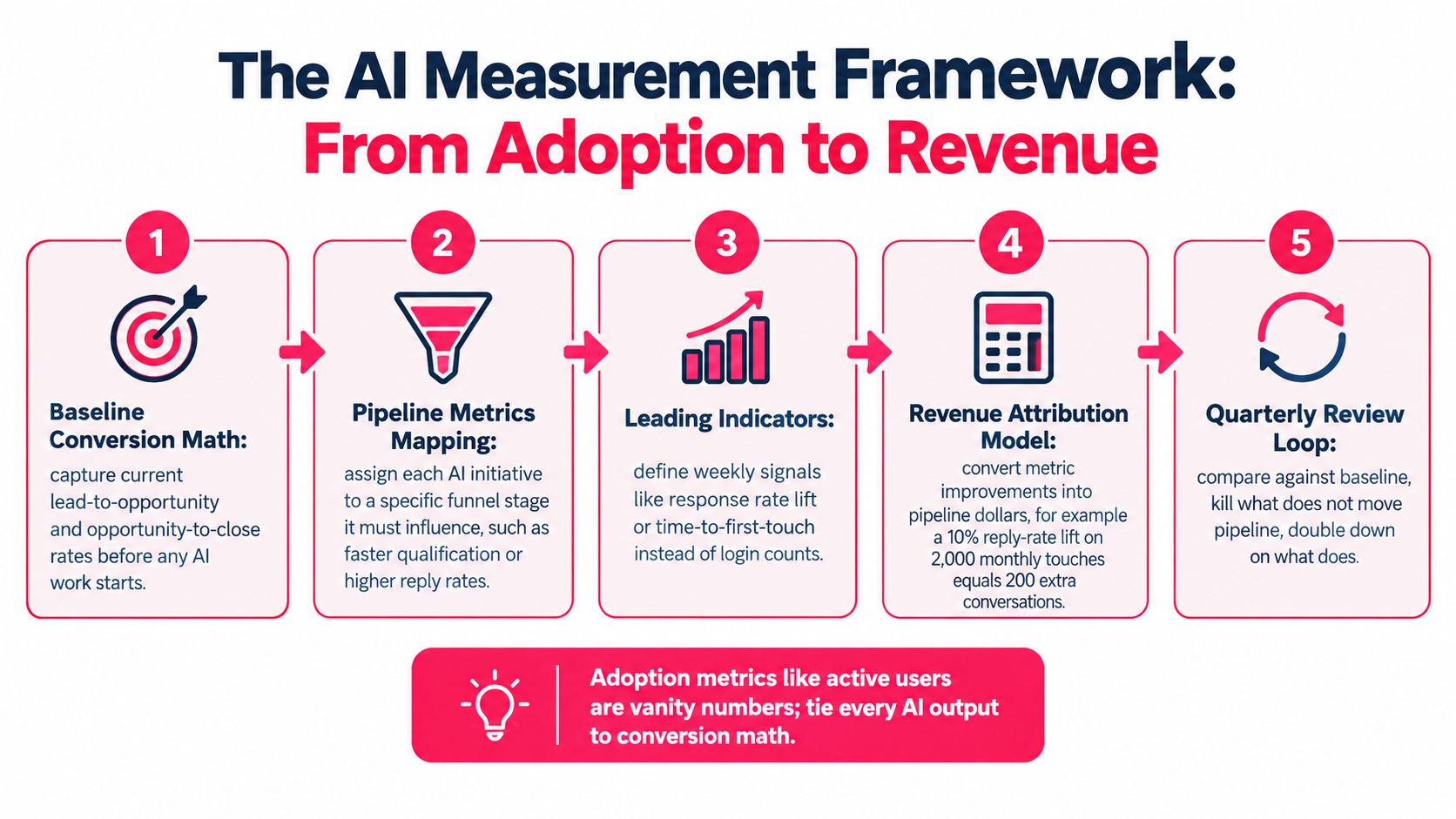
A strategy engagement should leave behind a measurement architecture with an owner, baseline, control method, review cadence and retirement threshold for every material initiative. The dashboard is the visible layer. The true asset is the chain from AI output to funnel movement.
Build the chain before deployment
Start with baseline conversion math. Capture the current lead-to-opportunity and opportunity-to-close rates before changing the workflow. Then map each AI initiative to one funnel stage, such as qualification speed, reply rate, meeting acceptance or proposal completion.
Leading indicators should update often enough for an operator to act. Examples include response rate, time to first touch, qualification agreement between human reviewers and the system, cost per interaction and escalation rate. Keep reliability measures beside commercial measures, since an apparent conversion improvement can hide more rework or customer complaints.
Attribution requires discipline when AI touches multiple stages. Use event tagging, control groups where practical and a documented rule for assigning influence. Don't claim that a content assistant caused pipeline movement because users adopted it during the same period.
For CRO, sequencing depends on measurement sufficiency. One CRO source says a structured program becomes statistically viable at roughly 30,000 monthly sessions and 500 or more monthly transactions, with each test running through at least two full business cycles, typically about two weeks, while meeting a pre-calculated sample size at 95% confidence and 80% power. (Metricuno's conversion rate optimization guidance)
At typical B2B SaaS traffic levels, individual A/B tests can need 4 to 8 weeks to reach statistical significance, and teams starting from scratch may need 4 to 6 weeks of setup before an AI layer adds meaningful value. (Omniscient Digital's AI CRO analysis)
That constraint changes the recommendation. If event data is poor, use AI to diagnose and prioritize before promising rapid personalization. A 2026 benchmark reported comparable insights from AI-assisted multivariate testing in 8 to 12 days, versus 6 to 8 weeks for traditional A/B testing after planning, execution and analysis time. (Build Grow Scale's 2026 CRO recap)
The measurement owner should review results against the baseline and decide whether to continue, change or retire the workflow. Adoption without that decision loop is reporting theatre.
Fractional CAIO Versus Project Engagements
The engagement model should match the executive problem. A fixed project is useful when the company needs a bounded artifact. A fractional CAIO makes more sense when AI decisions will keep appearing across planning, hiring, vendor management, risk and implementation.
A fractional CAIO is a part-time senior AI executive embedded with the leadership team. The role owns ongoing direction, governance, vendor oversight and decision support. A project engagement has a defined scope, such as an assessment, roadmap or vendor selection package, with a clear endpoint.
| Dimension | Fractional CAIO | Project Engagement |
|---|---|---|
| Primary use | Ongoing direction and decision ownership | A bounded question or defined deliverable |
| Leadership access | Regular participation with the executive team | Focused access during the project |
| Governance | Maintained as policies and systems change | Designed for handoff to internal owners |
| Vendor work | Ongoing evaluation and oversight | Shortlist, scorecard and recommendation |
| Internal fit | Company lacks a senior AI owner | Company can execute after the artifact is delivered |
| Commercial structure | Recurring advisory relationship | Fixed scope, duration and deliverables |
Price should be discussed as a proposal tied to seniority, complexity, access and execution responsibility. We won't present unsupported market ranges as facts. Ask every provider what portion of the fee covers diagnosis, executive participation, implementation oversight and post-delivery support.
A project can be the right first move for a company that needs a board-ready roadmap or a vendor decision. A fractional arrangement fits a company whose priorities will shift as the leadership team learns what works. The hybrid pattern is often practical: complete a focused diagnostic, then extend the relationship only if the company needs sustained governance and execution support.
The staffing market also matters. Teams building an internal function can review current hot AI Ops jobs in 2026 to understand the roles they may eventually need, but a job description doesn't replace interim ownership. For a fuller comparison of executive models, see fractional CAIO versus a full-time chief AI officer.
Where AI Strategy Consulting Consistently Fails
Strategy work fails when the contract is organized around documents instead of decisions. A consultant can deliver a policy, roadmap or vendor matrix and still leave the company unable to approve, fund or operate an AI workflow.
| Failure Mode | What It Looks Like | Early Warning Sign | Prevention |
|---|---|---|---|
| Governance theatre | Policies exist apart from daily work | A long policy has no owner, review cadence or approval path | Attach every control to a workflow, role and escalation route |
| Roadmap shelfware | The roadmap appears once and disappears | Dependencies on data, hiring or integration work are absent | Tie initiatives to quarterly planning, budget and named owners |
| Vendor capture | The evaluation supports a preferred platform | Criteria appear after vendor conversations have started | Approve weighted criteria before demonstrations and record exceptions |
Governance theatre is easy to spot. Ask who approves a new use case, who reviews model behavior, who can pause a workflow and what evidence that person receives. If the answer is “the policy covers it,” the control hasn't reached operations.
Roadmap shelfware usually comes from a planning process that ignores capacity. A roadmap that assumes unbudgeted integration work, unfilled roles or unavailable data is a presentation, not a delivery plan. Ask which current initiative will lose capacity when the AI work begins.
Vendor capture creates a quieter problem. The team may believe it ran a fair process while the requirements were written around one supplier's terminology. Require a written exception for every criterion that changes after demonstrations.
A useful scoping question is: What will this engagement look like at week six if it's going well, and what will it look like if it's failing? The answer should include decisions made, evidence gathered, owners assigned and work stopped. A consultant who welcomes that question understands accountability. A consultant who deflects it is selling activity.
The Next Move for an Executive Considering AI Strategy Consulting
Don't begin by asking which AI strategy consulting firm has the most impressive catalogue. Begin with the operating question your company needs answered.
Write a one-page brief with three elements:
The business question. State the revenue, margin, capacity or risk issue AI must address. Avoid writing a capability wish list such as “deploy agents across marketing.”
The decision horizon. Decide whether the issue needs continuing executive ownership or a bounded answer. A project suits a defined vendor audit or workflow assessment. A fractional CAIO suits a changing agenda that crosses governance, hiring, vendors and implementation.
The final artifact. Specify whether you need a quarterly roadmap tied to OKRs, a weighted vendor matrix, a governance charter with named owners or an operating review process.
Then interview references from every firm under consideration. Ask how the engagement handled a recommendation the client rejected, which work stopped, who owned implementation after delivery and what changed when the original assumptions failed. Those questions reveal more than a polished case study.
At Stimulead, we work as a fractional Chief AI Officer advisory firm for growth leaders that need roadmap development, vendor evaluation, implementation oversight and board-ready strategy connected to marketing and sales decisions. The same decision test applies whether you choose us, another advisor or an internal hire.
Your next action is simple. Send the one-page brief to two potential advisors and ask each to return the engagement model they recommend, the decisions they will own, the evidence they need and the artifact they will deliver. Reject any proposal that starts with tools before it names the business question.
For a diagnostic of your current AI priorities, governance gaps and measurement setup, contact Stimulead through stimulead.com and bring the one-page brief to the first conversation.