
73% of enterprise AI decision-makers say AI is already used regularly or across most business processes, yet only 10% say it is core to how the business operates. That gap is the core problem in an AI strategy roadmap, because tool adoption alone doesn't change how a company sells, serves, decides, or measures work.
For CEOs, CMOs, and CROs, the right roadmap starts with operating model change, then earns the right to scale.
Table of Contents
- The AI Execution Gap
- Building Your Value Thesis and Roadmap Phases
- Prioritizing Use Cases and Vendor Evaluation
- Infrastructure and Investment Readiness
- Implementing Governance and Risk Management
- Next Steps for Your AI Strategy
The AI Execution Gap
Broad AI use can coexist with weak business impact. Publicis Sapient's 2026 global enterprise AI report found that 73% of decision-makers say AI is used regularly or across most business processes, but only 10% say it is core to how the business operates, while 38% say AI is changing how the business operates today. That gap is an operating-model problem, because tool adoption does not change how a company sells, serves, decides, or measures work report data.

Many teams treat AI as a stack of pilots and then wonder why the numbers do not move. The usual failure point is ownership. No one is accountable for workflow redesign, KPI linkage, or adoption across functions. If the roadmap stops at licenses, prompts, or isolated automations, the revenue team gets activity, not transformation.
Practical rule: if the sales team, marketing team, or operations team cannot point to a changed workflow and a measured outcome, the roadmap has not left the pilot stage.
A useful external reference on the transformation side is technology brokerage AI transformation. The hard part is often brokerage between business goals, technical capability, and execution ownership. That is where most roadmaps stall, especially when leadership assumes access to a model means readiness.
What works is simple and hard. The AI effort has to sit inside a business process with a named owner, a baseline metric, and a decision rule for what happens if the result is weak. Without that, the company accumulates tools and demos, then calls the result strategy.
Building Your Value Thesis and Roadmap Phases
A serious roadmap starts before procurement. It starts with a value thesis, meaning a plain answer to where AI can change margin, pipeline, cycle time, or capacity in a way the business can measure. Skema's practical sequence is straightforward, frame and prioritize first, prepare data and governance next, ship one use case in a 90-day window, then scale only what proves its metric roadmap sequence.
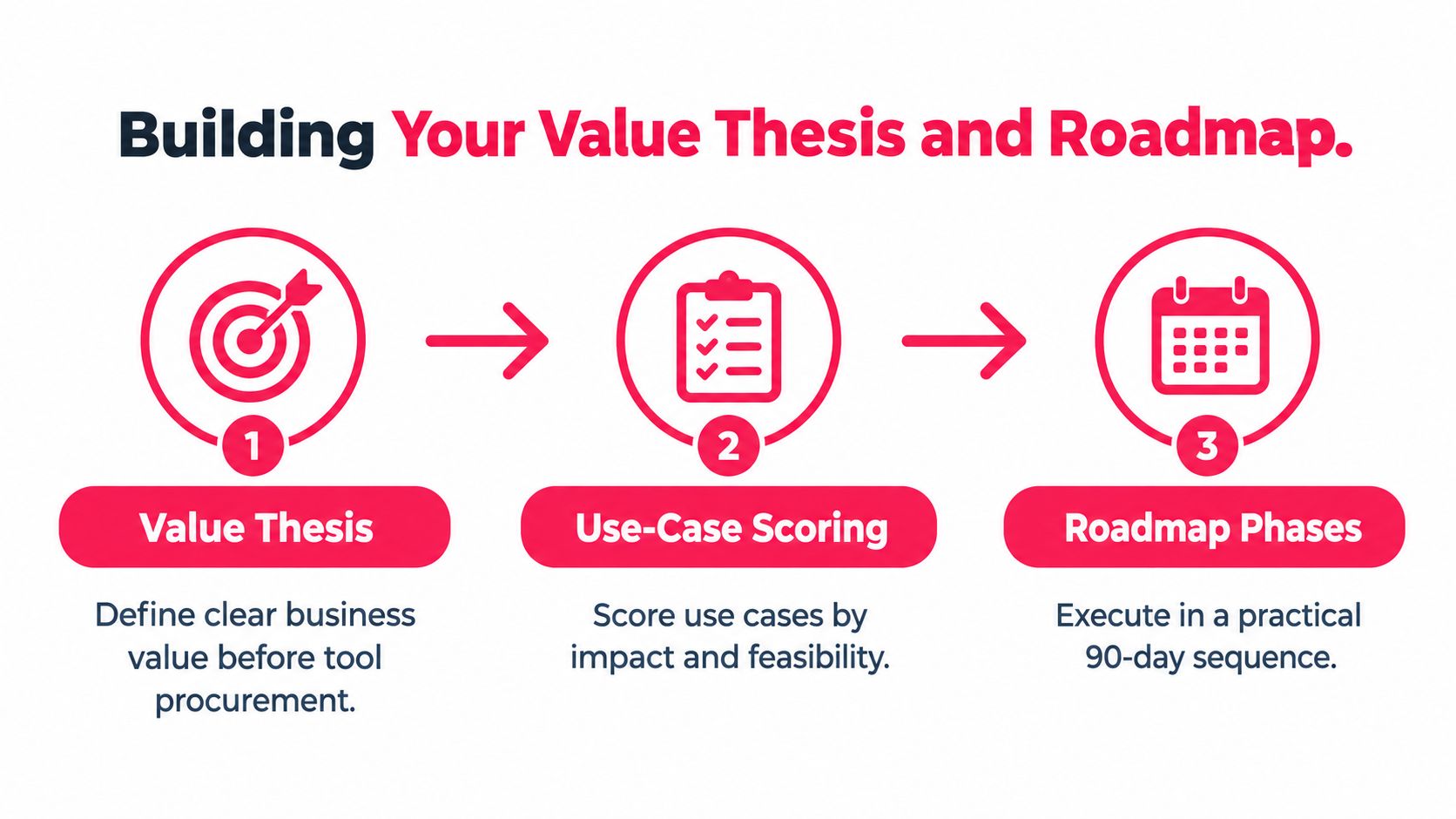
Days 1 to 30 define the bet
Start with three questions: where is the money, where is the friction, and where is the data already available. For a growth-stage B2B company, that often means one of three areas, lead routing, proposal generation, or qualification. The point isn't to inventory every idea. The point is to choose a problem that already has business pressure and a measurable baseline.
A practical scoring model uses three filters. Impact asks whether the use case can move a real business KPI. Feasibility checks whether the team has the data, access, and process control to deploy it. Adoption risk asks whether the people who must use it will change behavior.
Pick one workflow that already hurts, then make the improvement visible enough that finance can see it.
Days 31 to 60 prepare the operating conditions
Many teams stall here because they jump back to tools instead of fixing the path to production. Data access, permissions, review rules, and approval logic need to be set before anything goes live. If marketing wants AI to help with content production or sales wants AI to help with account research, the roadmap has to define who can approve outputs, who checks exceptions, and what systems the output touches.
Days 61 to 90 ship one production use case
Ship one use case with a live owner, a defined KPI, and a rollback plan. If it doesn't show the expected signal, stop and diagnose, don't keep adding prompts and vendors. A roadmap that protects learning is better than a roadmap that protects sunk cost.
For a practical example of how leaders sequence the work, the short video below is useful for seeing the cadence in a real planning context.
For teams looking for a similar structure in applied planning, AI transformation planning with Rite NRG is a relevant reference point because it treats sequencing and ownership as part of the roadmap, not an afterthought.
Prioritizing Use Cases and Vendor Evaluation
A disciplined roadmap doesn't rank opportunities by novelty. It ranks them by business value, implementation drag, and data readiness. That's where vendor selection usually goes wrong, because teams compare feature lists before they've agreed on the outcome they want.
| Evaluation lens | What strong teams ask | What weak teams ask |
|---|---|---|
| Business impact | Which KPI changes first | Which demo looks most impressive |
| Implementation complexity | What process, data, and approvals are required | How fast can we launch |
| Data availability | Is the data already usable | Can the vendor “work around” the data gap |
| Governance fit | Who signs off and monitors output | Does the tool have compliance language |
| Total cost | What does support, integration, and oversight add | What's the sticker price |
The best comparison framework is a simple matrix that forces trade-offs. A use case with high impact and low complexity should usually outrank a flashy use case that needs custom integrations, fragile data cleaning, and four different approvers. If the team can't explain why one use case beats another, the shortlist isn't real.
The same logic applies to vendors. Compare model quality, integration effort, change management burden, and ongoing review work. A cheap tool that creates more human checking can cost more than a pricier platform that fits the process cleanly.
A practical buying lens is available in our build vs buy AI tools guide, which is useful when your team is deciding whether the work belongs inside the company or with a platform partner. For use-case libraries, AI agent use cases can help pressure-test whether a proposed deployment is a workflow improvement or just a new interface.
Infrastructure and Investment Readiness
AI spend can rise faster than the business can absorb it. A useful signal is not how much budget moves, but whether each tranche buys a cleaner path to production, clearer ownership, and less manual rework. If the next allocation cannot be tied to a concrete gate, the roadmap is drifting into experimentation without delivery discipline.
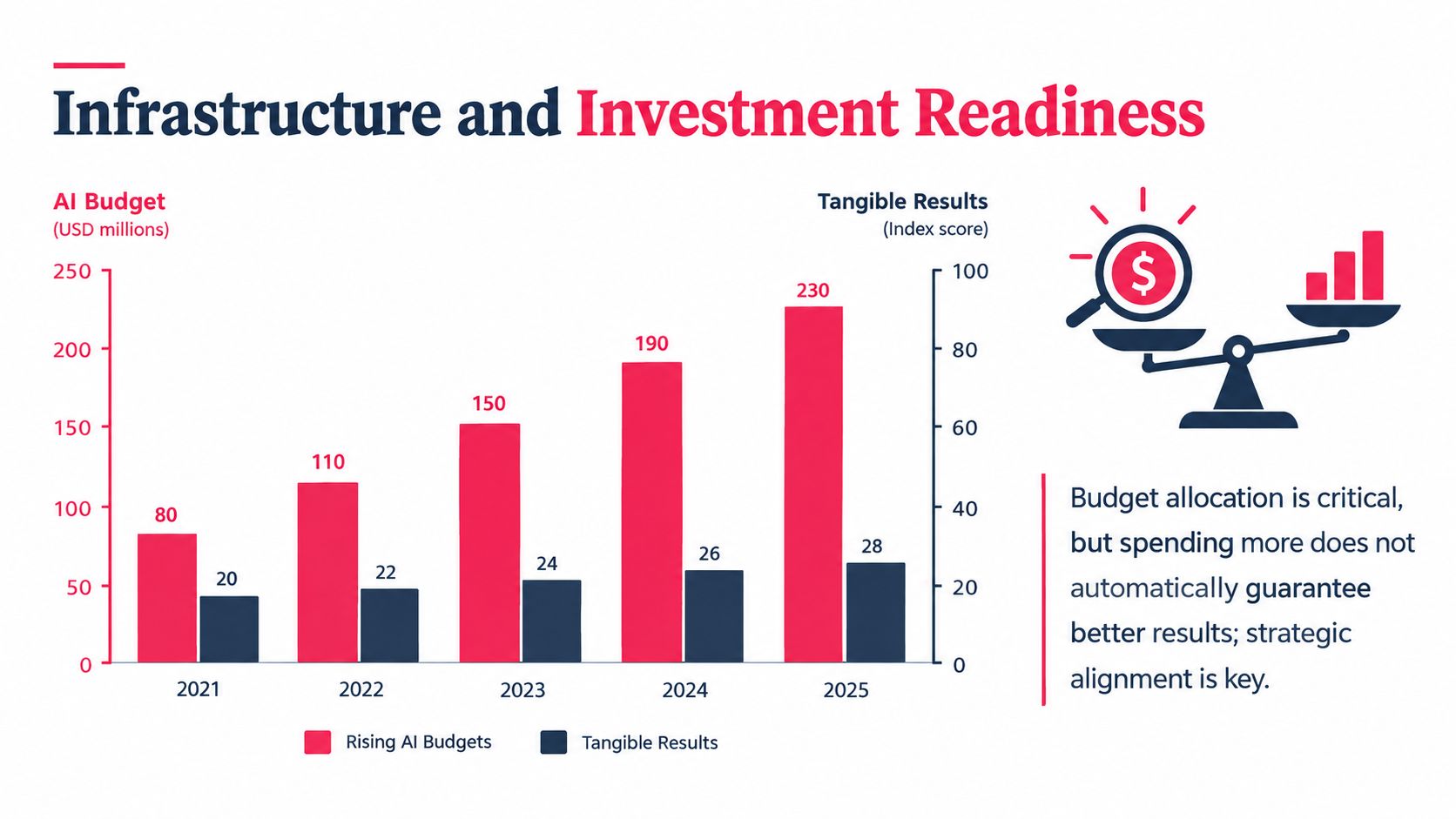
Budget guardrails beat open-ended funding
Treat funding as a series of production gates. For example, tie the next $50k tranche to a specific readiness threshold such as a data-access SLA under 24 hours or a human-review rate below 15% before approving the next use case. That keeps the conversation on operational readiness instead of vague ambition.
Deloitte's 2026 State of AI in the Enterprise report says worker access to AI rose by 50% in 2025, 66% of organizations said productivity and efficiency gains were the top benefits achieved so far, and 34% said they are using AI to transform their business Deloitte data. More access and more activity do not remove the need for process redesign. They only raise the cost of weak controls.
Readiness checks need to cover four areas
A roadmap needs explicit checkpoints for:
- Data quality and access, because no use case survives bad inputs for long.
- Talent and ownership, because someone has to maintain prompts, workflows, review rules, and exceptions.
- Risk and security, because controls have to exist before scale.
- Production discipline, because a pilot is not a business system until it is embedded in a live process.
Practical rule: if the roadmap has a budget line but no readiness gate, it is a spending plan, not an execution plan.
For a practical internal reference on readiness, our AI readiness assessment helps leadership locate the bottleneck before approving more spend.
Implementing Governance and Risk Management
Governance is where many companies either overcomplicate the work or leave it to chance. NIST's AI Risk Management Framework is a voluntary framework for organizations designing, developing, deploying, or using AI systems, and its Core is organized into four functions, govern, map, measure, and manage NIST AI RMF. NIST also released a Generative AI Profile on July 26, 2024, which means GenAI needs more specific controls than a generic policy memo NIST GenAI Profile.
The practical move is to embed governance into the workflow your teams already use. Marketing needs approval paths for customer-facing content. Sales needs rules for outreach claims and lead qualification. Operations needs escalation rules for exceptions and failures. The framework matters because it creates a common language between business owners, security, legal, and compliance.
NIST says the framework is meant to help organizations manage risks that could affect individuals, organizations, society, or the environment, and its trustworthiness goals include being valid and reliable, safe, secure and resilient, accountable and transparent, explainable and interpretable, privacy-enhanced, and fair with harmful bias managed NIST FAQ. That gives leadership a workable checklist for policy, but the actual work is operational. The controls must live where outputs are reviewed, not in a static document no one opens.
Our AI governance best practices guide is useful if you need a cleaner handoff between the executive team and the people approving outputs. The goal is simple, reduce risk without slowing the team down so much that they stop using the system.
Next Steps for Your AI Strategy
The right AI strategy roadmap is a sequencing tool, not a slogan. It starts with a value thesis, narrows to one production-worthy use case, and adds governance and readiness gates before scale. That's how you avoid the common mistake of funding more activity while the operating model stays unchanged.
If you run a growth-stage B2B company, the next decision is practical. Pick one workflow that touches pipeline, margin, or capacity, assign an owner, score it with rigor, and define the metric that will decide whether it stays. If the team can't name the owner and the metric, the roadmap still needs work.
We'd start by auditing readiness, then pressure-testing the use-case list against the budget, the data, and the review burden. After that, the roadmap gets sharper fast because the easy fantasies fall away and the actual constraints show up.