
Deloitte reported in 2026 that worker access to AI rose by 50% in 2025, and that companies with at least 40% of AI projects in production were expected to double within six months. For growth-stage revenue teams, that changes the question from “should we try AI?” to “who turns pilots into workflows that affect pipeline, content velocity, and conversion math?” Deloitte's enterprise AI research makes the answer plain, ai implementation consulting is the work of moving from experiments to operating discipline.
Many teams already have demos. What they lack is a stable path from tool selection to governed production. That gap is where implementation work earns its keep, because the bottleneck is rarely model capability. It's usually data readiness, ownership, integration, and adoption across marketing and sales.
Table of Contents
- Why Most AI Pilots Never Reach Production Revenue Work
- Discovery and Audit as the First Execution Decision
- Use Case Prioritization and Vendor Selection That Actually Fits
- Data Readiness, Integration Architecture, and Governance
- Pilots, Testing Velocity, and CRO plus AEO Controls
- Scaling to Production with KPIs and Ongoing Oversight
Why Most AI Pilots Never Reach Production Revenue Work
The gap between pilot activity and production revenue work is now the main story. Capgemini found that GenAI adoption rose from 6% in 2023 to 30% in 2025, while 93% of organizations were already exploring or enabling GenAI capabilities, and 14% were implementing AI agents at partial or full scale while 23% were running pilots (Capgemini and Deloitte press material). ISG also found that in 2025, 31% of prioritized use cases had reached full production, double the share from 2024. That kind of spread shows how much activity is underway, and how much of it still stops before it touches revenue work.
For a CEO, CMO, or CRO, a pilot matters only if it changes what the team can ship. A content workflow that still bottlenecks on approvals, a prospecting flow that still depends on manual research, or a CRM process that still needs human cleanup has not become production just because the model produced a good demo. The work counts when it changes throughput, consistency, or decision quality in a way the business can measure.
If you’re still deciding what kind of outside help you need, what AI consulting covers explains how strategy, implementation and embedded engagements differ.
Practical rule: if the pilot does not alter conversion math, testing velocity, or pipeline generation, it has already failed.
What implementation consulting actually fixes
The common mistake is treating AI like a software purchase. That leads to tool demos, then a stalled rollout, then blame on the model when the underlying issue is missing operating design. The better frame is process change, governance, and accountability, all tied to how revenue teams really work.

Implementation advisers earn their keep after the excitement phase. They turn strategy into production workflows, define ownership, and set the KPI structure that makes adoption visible. Without that work, teams get activity, not outcomes. A practical roadmap, such as the one outlined in the AI roadmap for execution planning, helps keep the effort tied to operating choices instead of slideware.
Discovery and Audit as the First Execution Decision
A pilot only matters when it can survive the jump into production revenue work. The audit is where that decision gets made. It shows whether AI can fit the way marketing and sales already move data, approvals, content, and leads, or whether the process needs redesign before anyone writes a prompt.
The weakest discovery process starts with tools. The useful one starts with friction. It traces the path from lead capture to opportunity creation, checks which fields are missing, where consent is stored, what the reporting layer can trust, and where human review still has to stay in place. If those answers are unclear, the scope is too broad and the rollout will stall.
A serious audit usually moves in a fixed order:
- Inventory the operating surface. List the systems, teams, approvals, and dashboards AI would touch.
- Trace one revenue workflow end to end. Follow a single path from first touch to closed-lost or closed-won, and note every manual handoff.
- Set risk boundaries early. Map privacy, consent, compliance, and brand-safety limits before implementation starts.
- Score workflow friction. Find where reps, marketers, or managers wait on data, copy, routing, or decisions.
- Rank by business value. Put the workflows with the clearest path to speed, consistency, or better measurement at the top.
That sequence keeps teams honest. It stops the common mistake of automating the flashy part of the funnel while the core bottleneck sits in the CRM, the approval chain, or the integration layer. Discovery-led work is slower at the start, but it avoids the false progress that comes from buying tools before the operating model is ready.
A structured starting point like the Stimulead AI roadmap helps because it forces audit before deployment. For teams that need a sharper read on what is visible, the AI visibility audit is the right next step, since it exposes where the current stack, content, and workflows can and cannot be measured.
The first implementation mistake is usually scope. If the workflow cannot be described cleanly, it cannot be automated safely.
Use Case Prioritization and Vendor Selection That Actually Fits
Use case selection should follow a simple test, revenue impact, data readiness, and execution risk. Too many teams rank ideas by excitement, vendor polish, or the loudest internal sponsor. That creates a backlog of attractive projects that aren't ready to ship.
A better way is to compare implementation paths side by side. In many cases, buying from specialized vendors or working through partner-led implementation succeeds more often than building internally. A 2025 MIT-linked analysis reported that only about 5% of enterprise generative AI pilots deliver rapid revenue acceleration, while about 95% fail to produce measurable P&L impact, and that buying from specialized vendors and forming partnerships succeed about 67% of the time, while internal builds succeed only one-third as often (MIT-linked analysis in Fortune). That doesn't mean internal builds never work. It means the burden of proof is much higher when your team also has to build the controls, integrations, and adoption layer.
| Path | When it fits | Main risk | What to verify |
|---|---|---|---|
| Packaged AI tools | A narrow workflow with clear inputs and outputs | Tool sprawl | Fit to current stack |
| Partner-led implementation | You need speed and process design | Vendor dependency | Ownership after launch |
| Internal build | You have strong data, engineering, and governance capacity | Slow delivery | Maintenance burden |
If you're comparing tools, a practical external resource is this choose AI marketing software guide from LLMrefs, which helps buyers think through fit before buying into feature lists. The value is in narrowing the field before procurement becomes a distraction.
The same logic applies to consultancy models. A fractional adviser, a systems integrator, and a software vendor each solve a different problem. If the team lacks governance and integration capacity, buying a bigger platform won't fix the gap. The right choice is the one your team can operationalize, monitor, and own after the launch meeting ends.
Data Readiness, Integration Architecture, and Governance
Revenue teams commonly hit friction here when CRM data is inconsistent or governance is not in place before launch. The model can produce a clean answer and still fail in production if the inputs are stale, the handoffs are unclear, or the review path is missing.
A 2025 Governance Institute of Australia survey found that 88% of respondents struggled to integrate generative AI into legacy systems, 72% cited data privacy as a major regulatory challenge, and 93% said they cannot effectively measure AI ROI (Governance Institute of Australia). That matches what happens inside real revenue operations. The dashboards look complete until someone asks which source of truth the team trusts.
What has to be true before production
- Data quality must be usable in operations. If CRM fields are inconsistent or stale, automation just accelerates the mess.
- Integration has to be mapped end to end. The AI workflow belongs inside the stack, not beside it.
- Ownership has to be named. Someone owns prompts, someone owns data, someone owns approval logic, and someone owns rollback.
- Governance has to be explicit. Risk review, compliance review, and content review cannot wait until after launch.
- Monitoring has to be repeatable. PwC's 2025 responsible AI survey of 310 U.S. business leaders says firms should “operationalize at scale” by automating testing, monitoring, and observability across the AI life cycle (PwC).
The trade-off is speed versus control. Fast launches without governance create rework later, while heavy process without a working pilot buries the team in approvals. The operating model needs enough control to make testing safe, and enough speed to keep revenue work moving.
For teams mapping the technical side, the Stimulead data pipeline architecture resource is useful because it keeps the focus on data flow, ownership, and system fit rather than abstract architecture talk. For the process side, Wispra's Wispra's AI SEO consulting guide points to the same reality, AI work only holds up when consulting, data, and execution are aligned.
Governance is not a policy document. It is the set of controls that lets a team ship, monitor, and correct AI work without losing trust.
A 2025 EY Europe West survey also found that one-third of organizations lack well-defined AI governance models, even while trying to integrate AI into strategic plans (EY). That is where implementation consulting earns its fee. It turns vague accountability into named roles, measurable checks, and clear release criteria.
Pilots, Testing Velocity, and CRO plus AEO Controls
Pilot work should be treated like a controlled business test. If a workflow cannot be measured cleanly, it should not be scaled. If it cannot be stopped without cleanup pain, it is not a pilot, it is an expensive bet. That matters for CRO and AEO because both depend on fast feedback, tight instrumentation, and a clear read on what changed.
Start with one hypothesis, one owner, and one measurement plan. For CRO, that may mean adjusting a landing page summary, a qualification flow, or a nurture path, then watching a specific conversion step. For AEO, the goal is different but just as concrete: make sure AI answer engines can find and cite accurate facts about products, categories, and company positioning, without unsupported claims leaking into the market.
A pilot only stays useful when the controls stay tight.
Controls that keep pilots honest
- Define the exact metric before launch. Do not backfill success criteria after the test starts.
- Instrument the funnel path. Track where the user entered, what changed, and where drop-off happened.
- Limit variables. Change one primary element per test, or the result becomes hard to read.
- Separate output quality from business lift. A strong draft or summary is not the same as pipeline impact.
- Set a stop condition. If the test underperforms or introduces risk, stop it quickly.
Informatica citing Gartner guidance is a useful reminder of the practical risk here. The guidance points to long prototype-to-production timelines and the abandonment of many GenAI projects after proof of concept because of poor data quality, weak risk controls, rising costs, or unclear business value. That does not mean every team needs a long cycle. It means sloppy pilots drag, and vague measurement makes them drag longer.
For teams that want a tighter reporting loop, a conversion-focused analytics dashboard guide can help structure outcome reporting without filling the team with metrics that do not change decisions.
Cadence is the test. If the team can launch, learn, and adjust quickly, the pilot becomes a production candidate. If it cannot, stop and rewrite the workflow before more spend goes in.
Scaling to Production with KPIs and Ongoing Oversight
Production is where AI either becomes part of the operating model or stays a side project. Analysts at Deloitte found that worker access to AI rose by 50% in 2025, and that the share of companies with at least 40% of AI projects in production was expected to double within six months. That shift matters because the true test is no longer whether a pilot works in a demo. It is whether the workflow keeps producing measurable value under normal business pressure.
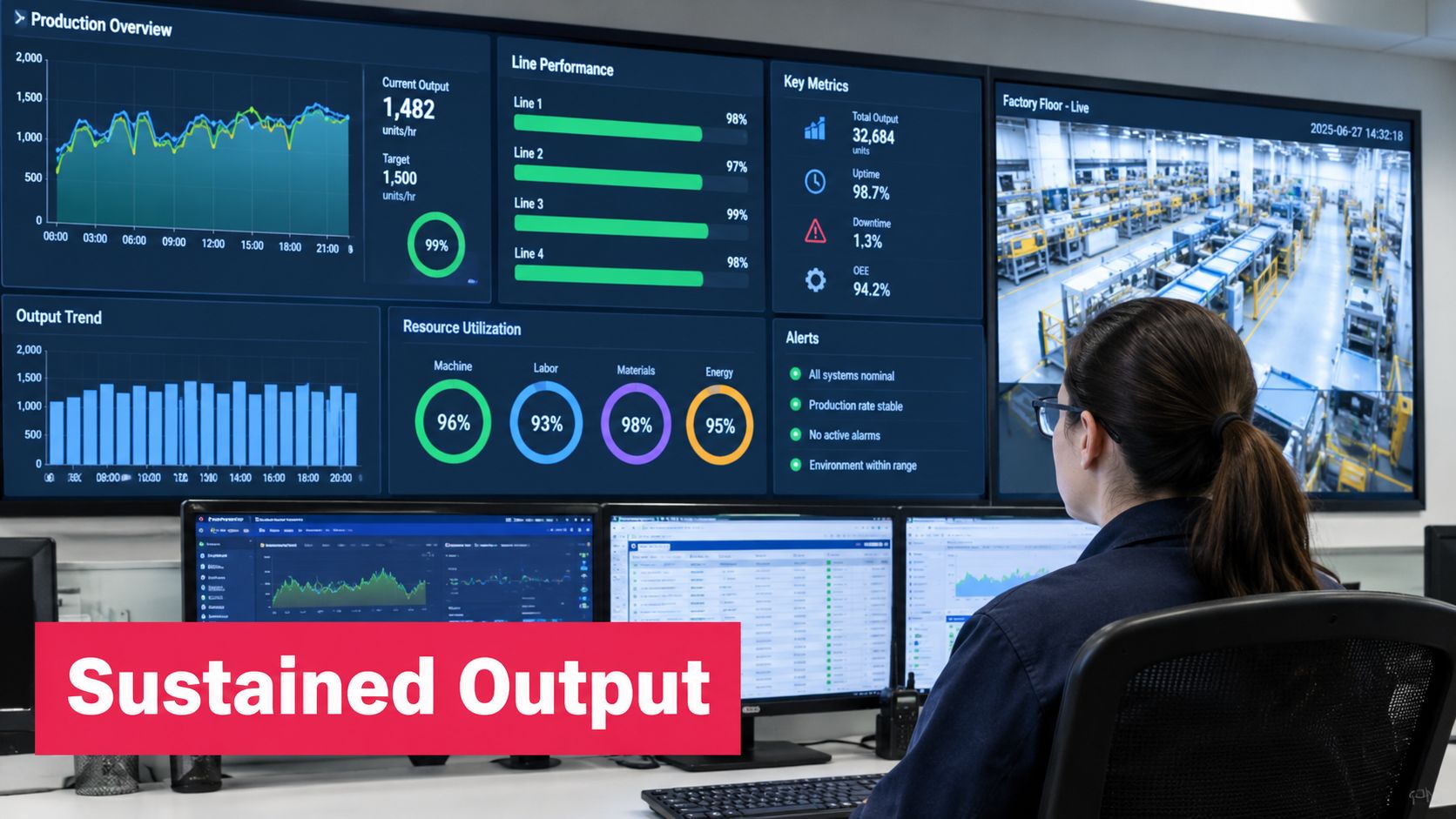
Oversight in production has to cover performance, risk, and ownership. Performance means the KPI set still reflects business reality after rollout. Risk means the team keeps watching for drift, privacy exposure, failed handoffs, and broken workflow logic. Ownership means someone is accountable for tuning the system after the launch team leaves.
A practical operating rhythm is simple:
- Weekly review: Check exceptions, defects, adoption issues, and any sign that the workflow is being used around the system.
- Monthly review: Compare business KPIs with the pilot baseline and confirm whether the production path is still creating lift.
- Quarterly review: Decide whether to expand the workflow, pause it, or redesign it.
That cadence keeps the work grounded. Fractional advisory support helps here because it prevents the program from turning into a one-time vendor handoff. Internal teams keep control of the workflow, while outside expertise keeps pressure on decisions, measurement, and follow-through.
For teams that want a practical way to structure outcome reporting, the conversion-focused analytics dashboard guide is a useful reference for keeping the reporting layer tied to decisions instead of noise. The Stimulead article on AI roadmap and implementation oversight also connects roadmap discipline, governance, and execution once the first workflow is live.
The next decision is direct. Pick one revenue workflow, assign an owner, define the KPI, and confirm the team can support it in production. If the answer is yes, scale with controls in place. If the answer is no, keep the pilot small until the operating model is ready.
