
The popular advice is to make every data pipeline streaming-first and AI-ready. We disagree. For growth-stage B2B companies, the sounder decision is to match data pipeline architecture to the freshness the business can act on, the cost it can absorb, and the operational maturity of the team running it.
That distinction matters because pipeline tooling has moved from custom scripts into strategic infrastructure. One market study estimates the global data pipeline market at USD 10.01 billion in 2024, projected to reach USD 43.61 billion by 2032, with a 19.9% CAGR (Fortune Business Insights' data pipeline market analysis). The market is expanding, but that doesn't mean every company needs the most complex pattern available.
Table of Contents
- Why Most Pipeline Architecture Advice Fails Growth-Stage Companies
- Core Components of a Production Data Pipeline
- Choosing Between Batch Streaming ELT and Federation
- Reference Architectures and Example Stacks
- Building Governance Into the Pipeline Control Plane
- Where Pipeline Architectures Break Down
- Your Next Architecture Decision
Why Most Pipeline Architecture Advice Fails Growth-Stage Companies
Most architecture guidance assumes the wrong operating environment. It targets very large engineering organisations with dedicated platform teams, or small startups moving data through spreadsheets and one-off scripts. Growth-stage B2B companies sit between those extremes. They have meaningful data volume, several revenue systems, real reporting obligations, and a small team that still has to support production applications.
That gap creates expensive overengineering. A company may buy Kafka, add stream processing, and build event-driven consumers even though sales leadership can make the right decision with data that is four hours old. Another may adopt a broad cloud stack while only a few analysts query the warehouse during scheduled reporting cycles.
Practical rule: Set the business freshness requirement before selecting the transport layer.
Batch remains the default when low latency isn't a hard business requirement. Batch pipelines are generally simpler to build, test, debug, and operate, and they can deliver data in minutes to hours (batch and streaming architecture guidance). Streaming earns its place when delayed data changes an immediate action, such as blocking a transaction, changing an operational decision, or updating an active customer experience.
The decision should begin with four questions:
- What decision depends on the data? A board report and a fraud intervention have different freshness needs.
- What delay is acceptable? Write the threshold in business terms, then translate it into a technical service level.
- Who operates the system? A small data team may sustain managed ELT more easily than a self-hosted streaming platform.
- What failure can the business tolerate? A delayed dashboard may be acceptable. Duplicate financial transactions aren't.
The market's direction does support investment in reliable ingestion, transformation, orchestration, and delivery. It doesn't justify copying an architecture designed for another company's constraints. The right question is whether the system will still be understandable and recoverable when the person on call is dealing with a failed dependency at 3 AM.
Core Components of a Production Data Pipeline
A production pipeline has distinct layers, and each one fails differently. Treating the stack as one tool makes troubleshooting harder because an ingestion failure, a transformation defect, and a serving problem require different owners and controls.
Ingestion and storage
Ingestion brings data out of systems such as Salesforce, PostgreSQL, product event services, and custom vendor APIs. A common growth-stage arrangement uses Fivetran for supported Salesforce objects and Airbyte for APIs that need custom connectors. That combination reduces connector development work, but it also creates two operational paths, so ownership, retry rules, and schema-change handling need to be explicit.
Storage determines how much flexibility the team has later. Snowflake separates storage from compute, which can help teams isolate workloads and control warehouse execution. Databricks with Unity Catalog suits teams that need lakehouse workloads, governance across data assets, and a closer path to machine-learning feature work. The minimum viable choice for a 10-person data team is usually one governed warehouse or lakehouse, a raw landing area, and documented retention rules.
Transformation and orchestration
Transformation is where raw records become revenue, customer, product, or finance models. dbt keeps business logic in version-controlled SQL instead of burying definitions inside individual BI dashboards. That makes reviews, tests, lineage, and rollback practical, especially when several teams depend on the same pipeline output.
Orchestration coordinates dependencies and recovery. Airflow represents work as task DAGs, while Dagster uses an asset-oriented model that can map more directly to the datasets a team owns. If a Monday run fails and dozens of downstream models depend on it, the important capability isn't the brand name. It's clear dependency visibility, targeted retries, alert routing, and a runbook that tells the operator what can safely be rerun.
Serving and governance
Serving delivers prepared data to the people and systems that use it. Census can push an enriched account score into HubSpot, where a salesperson can act on it, while BI tools query warehouse models for management reporting. A pipeline that ends at storage often creates analytical assets without changing any operating workflow.
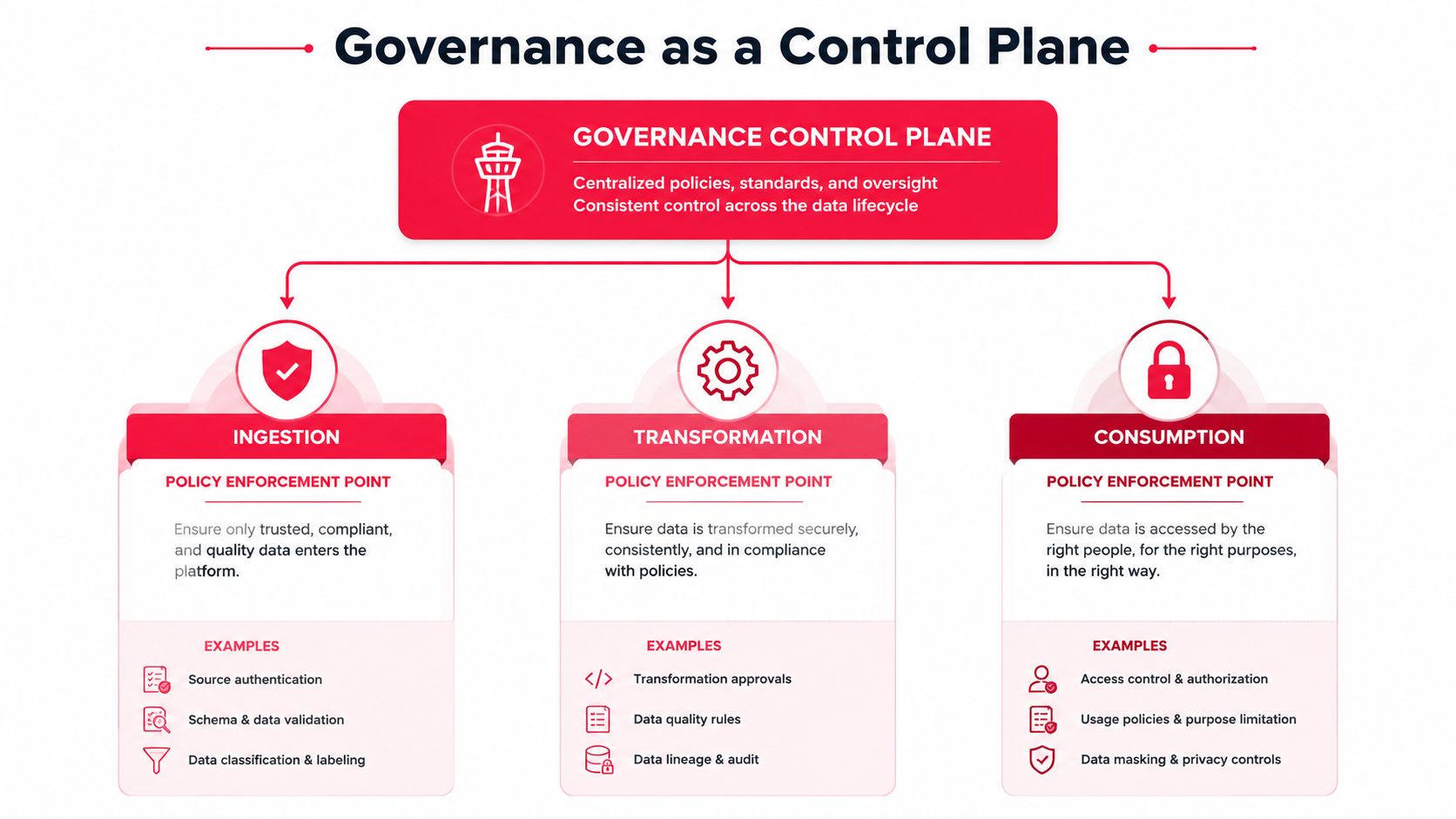
Governance should run across these layers as a control plane. Role-based access, immutable raw landing zones, lineage metadata, and data quality expectations make policies executable and auditable (Databricks' data pipeline best practices).
Teams comparing orchestration and platform options may also benefit from data engineering automation for 2026, provided they use it to evaluate operating requirements rather than collect tools.
Choosing Between Batch Streaming ELT and Federation
The four patterns solve different problems. Batch reduces operational complexity. Streaming reduces decision latency. ELT gives analytics teams flexible SQL-based transformation inside a cloud platform. Federation avoids moving data while a team is still assessing whether a source deserves a permanent pipeline.
The table below is a decision aid, not a price list. The verified material doesn't establish comparable monthly costs, event-based team minimums, or universal migration thresholds, so those fields should be defined during architecture discovery rather than fabricated.
Pipeline Pattern Decision Matrix
| Pattern | Latency | Monthly Cost (10M events) | Min Team Size | Best For | Failure Trigger |
|---|---|---|---|---|---|
| Batch | Minutes to hours | Depends on schedule and warehouse usage | Small team with clear ownership | Periodic reporting and decisions that tolerate delay | Business decisions require fresher data |
| Streaming | Near-real-time | Depends on brokers, processing, storage, and observability | Team able to operate distributed systems | Immediate scoring, alerts, and event-driven workflows | Operational burden exceeds business value |
| ELT | Schedule-based or frequent warehouse runs | Depends on connector, warehouse, and transformation usage | Analytics-focused team comfortable with SQL | SaaS data, reporting, and iterative modeling | Pre-load filtering or processing constraints require earlier transformation |
| Federation | Query-time access | Depends on virtualization platform and source systems | Team able to manage source contracts and query performance | Fast evaluation of distributed sources | Stale, slow, or unreliable source queries damage trust |
Streaming isn't automatically more reliable. Google Cloud Dataflow processes batch pipelines with exactly-once semantics, while streaming uses exactly-once by default and can also be configured for at-least-once processing (Google Cloud's exactly-once documentation). Even with pipeline-level protection, writes to an external destination need transactional behaviour or idempotency keyed to stable identifiers. Otherwise, recovery can apply the same event more than once.
CDC designs add another useful option. A source WAL or redo log can feed Kafka or Pub/Sub, then land in staging before MERGE or upsert logic applies changes to the target. The documented trade-off is direct: small batches reduce latency but add overhead, while larger batches improve efficiency until processing time rises. For many high-throughput MPP systems, the cited guidance places a practical balance at a 1 to 5 minute interval or roughly 50,000 to 100,000 rows (CDC pipeline design guidance).
For a deeper treatment of the operational boundary, batch vs streaming trade-offs is useful reading. The decision should still be made against your service levels, team capacity, and failure costs.
Reference Architectures and Example Stacks
A reference architecture is useful only when it describes who operates it and what happens during failure. We typically start with the least complex stack that meets the business service level, then add capability when a specific workload proves the need.
Batch-first ELT
For a B2B company focused on pipeline reporting, attribution, account analysis, and finance reconciliation, a practical stack is Fivetran or Airbyte for ingestion, Snowflake for storage and compute, dbt for transformation, and Airflow or Dagster for orchestration. HubSpot, Salesforce, product databases, and billing systems can land in raw schemas before tested models feed BI and activation tools.
The hidden cost is dependency management. Connector changes, warehouse query spikes, and untested model edits can still break executive reporting. The stack is easy to explain, but it needs ownership for source contracts, model tests, and freshness alerts.
Streaming-capable product analytics
A company that needs current product signals may use Kafka for durable event transport, Flink for stateful processing, a lakehouse or warehouse for history, and Materialize for maintained views that need low-latency access. This pattern can support product alerts or operational experiences, but the team must understand partitioning, replay, state recovery, schema evolution, and sink idempotency.
The cost is operational attention. Managed services reduce infrastructure work, but they don't remove the need to inspect consumer lag, bad events, replay behaviour, and downstream correctness.
Federated data access
A distributed company may begin with Denodo or Dremio to query data across systems without copying every source into a central store. That can shorten evaluation time when the team is deciding whether a source deserves a managed ingestion path. The trade-off is that query performance, source availability, permissions, and schema drift remain tied to systems the data team may not control.
| Architecture Pattern | Core Stack | Monthly Cost (10M–100M events) | Latency | Min Team Size |
|---|---|---|---|---|
| Batch-first ELT | Fivetran or Airbyte, Snowflake, dbt, Airflow or Dagster | Requires workload-specific pricing | Minutes to hours | Small data team with analytics and platform ownership |
| Streaming-capable | Kafka, Flink, Materialize, lakehouse or warehouse | Requires managed-service and workload-specific pricing | Near-real-time | Team with distributed-systems operating experience |
| Federated | Denodo or Dremio with governed source access | Requires source and query workload assessment | Query-time | Team able to manage source contracts and performance |
AI consumers add another design question. Teams evaluating retrieval systems can use AmasaTech's RAG architecture insights to examine retrieval, indexing, and serving boundaries. The same build-versus-buy judgment applies to data platforms, and Stimulead's analysis of AI tool decisions provides a related framework for deciding which capabilities belong in-house.
Building Governance Into the Pipeline Control Plane
Governance fails when it depends on a person remembering a policy during a rushed deployment. It works better when the pipeline blocks unsafe or invalid behaviour before data reaches a dashboard, model, or customer-facing system.
The control plane should enforce rules at three points:
- At ingestion, validate source schemas, record ownership, classify sensitive fields, and preserve the raw input in an immutable landing zone.
- During transformation, mask or remove personal data where downstream consumers don't need it, test accepted values, and capture lineage from source columns to published models.
- At consumption, enforce warehouse permissions with role-based access, row-level security, and dynamic data masking.
A growth-stage implementation can stay lightweight. Great Expectations can express data quality contracts, while Monte Carlo or Metaplane can monitor freshness and anomalies. Atlan or Alation can provide cataloguing and ownership workflows, and dbt or OpenLineage can capture transformation lineage. The exact product set matters less than making the compliant path the default path.
A useful governance design assigns a named owner to each critical dataset, defines what happens when a contract fails, and separates raw access from curated access. It also records exceptions. Without that record, teams eventually treat repeated exceptions as the official policy.
For leaders connecting data controls to broader AI deployment decisions, Stimulead's AI governance best practices covers related questions around accountability, approval paths, and operational guardrails.
Where Pipeline Architectures Break Down
The same structural failures appear across many client environments. They rarely come from one careless engineer. They come from designs that make the easy path unsafe or make the failure path impossible to inspect.
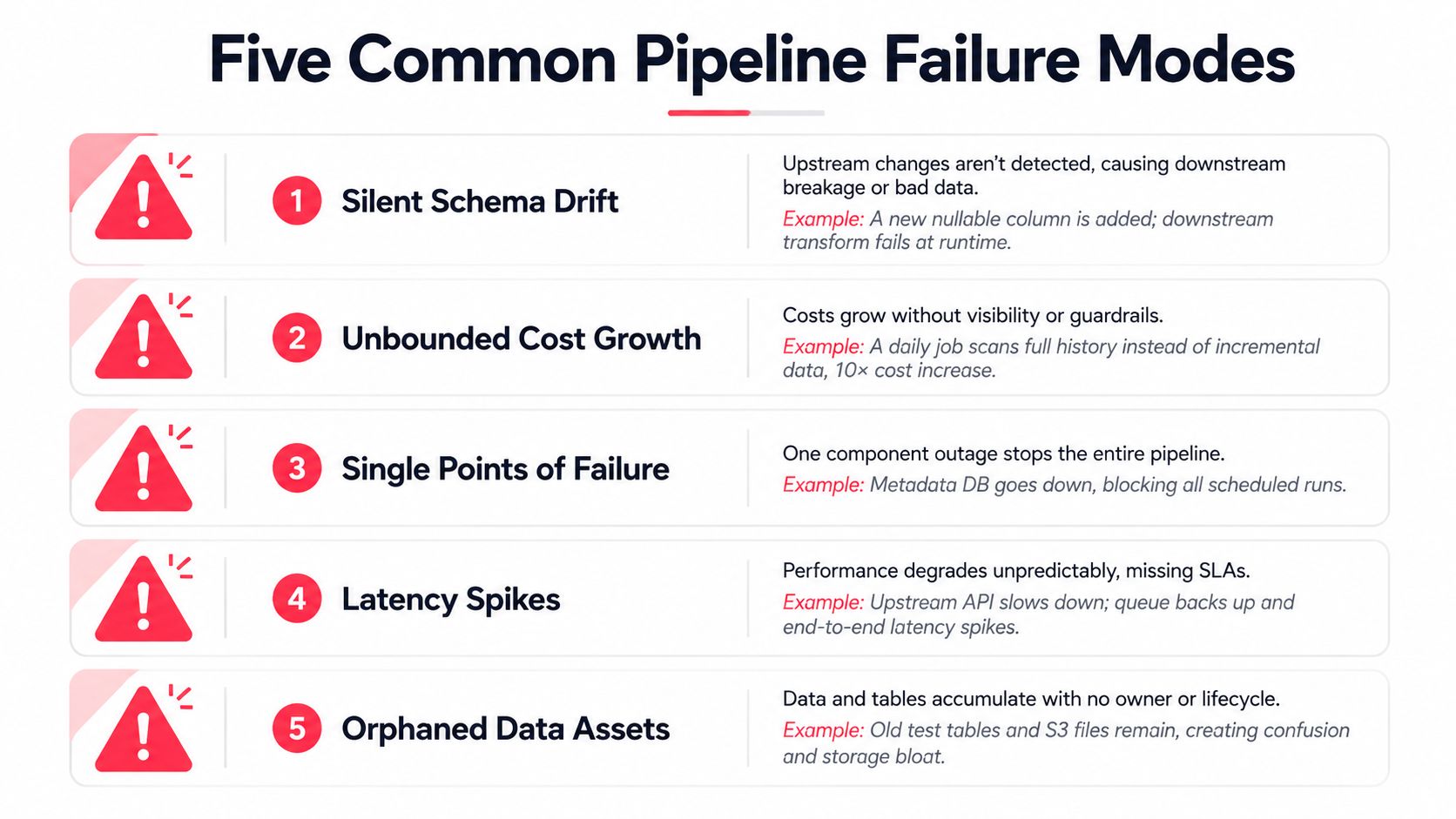
Silent schema drift
A Salesforce field changes type, an API adds a nested object, or a product event renames an attribute. The connector may continue running while downstream models interpret the value incorrectly. The result can reach a board report before anyone notices.
Schema registries, contract checks, and alerts on breaking changes prevent silent propagation. Store the original payload so the team can reconstruct what arrived.
Unbounded cost growth
Streaming consumers can multiply processing and storage charges when teams create overlapping subscriptions, retain unnecessary events, or fail to control warehouse queries. Cost monitoring belongs beside latency and error monitoring, with budgets assigned to workloads and owners.
Brittle orchestration
A task-level dependency can make an unrelated report wait for a failed enrichment job. Asset-aware execution, isolated retries, and clear dependency boundaries reduce the blast radius. Teams should also test recovery, because a pipeline that succeeds only after manual database edits isn't production-ready.
Stale federation
Federated queries preserve speed-to-source, but the result can be slow, unavailable, or inconsistent when upstream systems change. Cache policies, freshness labels, source ownership, and a migration trigger are required before leaders treat federated output as a system of record.
False pipeline success
A job can report success while row counts fall, values become null, or a key segment disappears. Freshness, volume, distribution, referential integrity, and business-level checks need to run alongside infrastructure health checks.
Your Next Architecture Decision
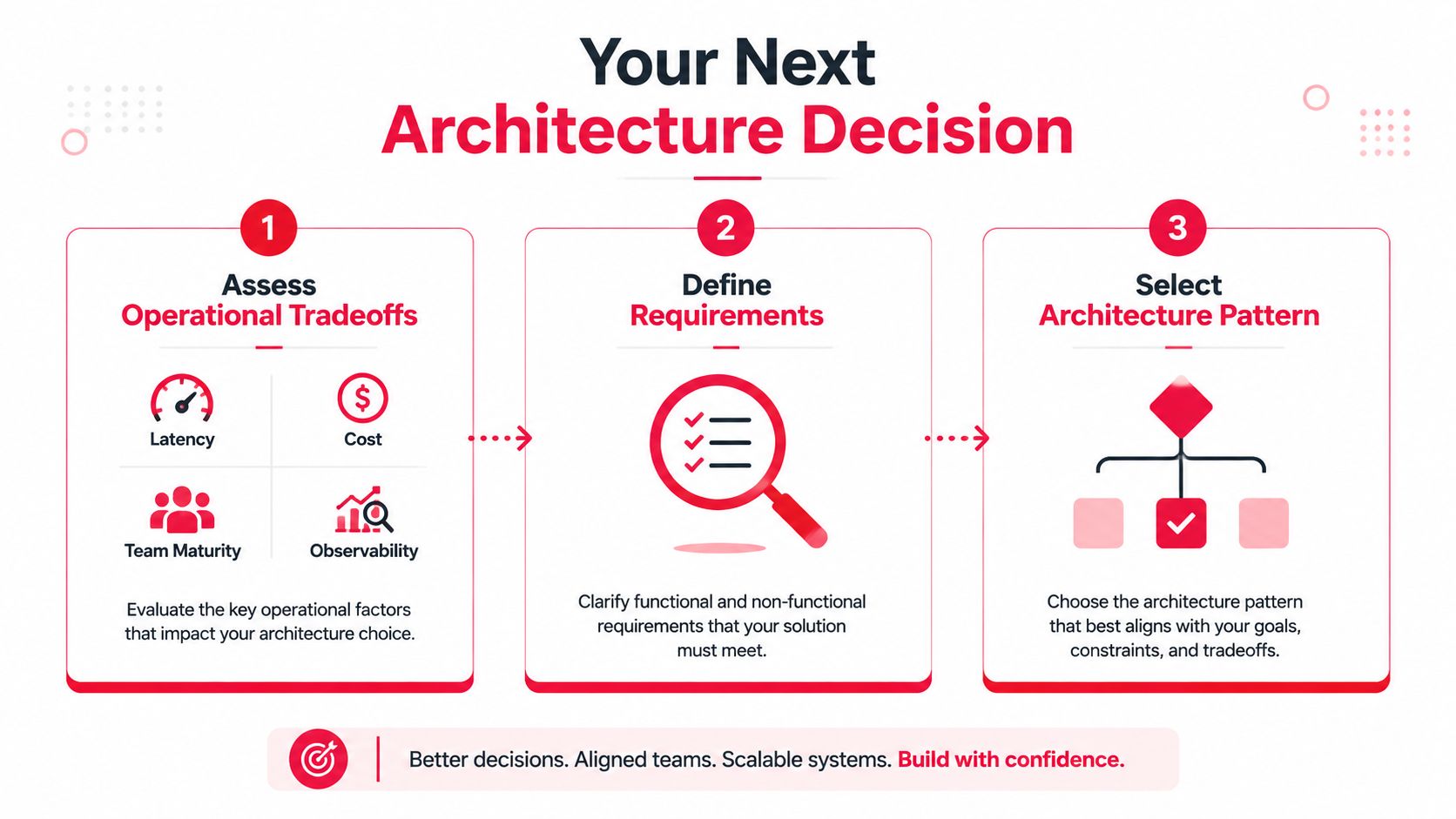
Start with the decision that consumes the data, not the tool catalogue. Audit current dashboards, alerts, sales workflows, product experiences, and AI retrieval paths, then record the maximum acceptable age of each dataset.
Use this sequence:
- Measure actual freshness needs. Separate decisions that need current data from reports that can wait.
- Map the operating team. Choose tools your present team can support, rather than a future team you may never hire.
- Set cost guardrails. Assign budgets and owners before adding consumers, retention, or processing paths.
- Score the work. Prioritise high business impact with manageable implementation complexity.
- Test recovery. Prove that the team can replay, backfill, and validate outputs without improvising.
There isn't enough neutral evidence to claim that one pattern wins across all growth-stage companies. Recent coverage does point toward adaptive, agent-managed, and AI-mediated pipelines, while also acknowledging thin public guidance on failure modes, governance, and human control (Data Workers' discussion of data pipeline architecture). Treat agentic automation as a controlled addition, with approval boundaries and observable decisions.
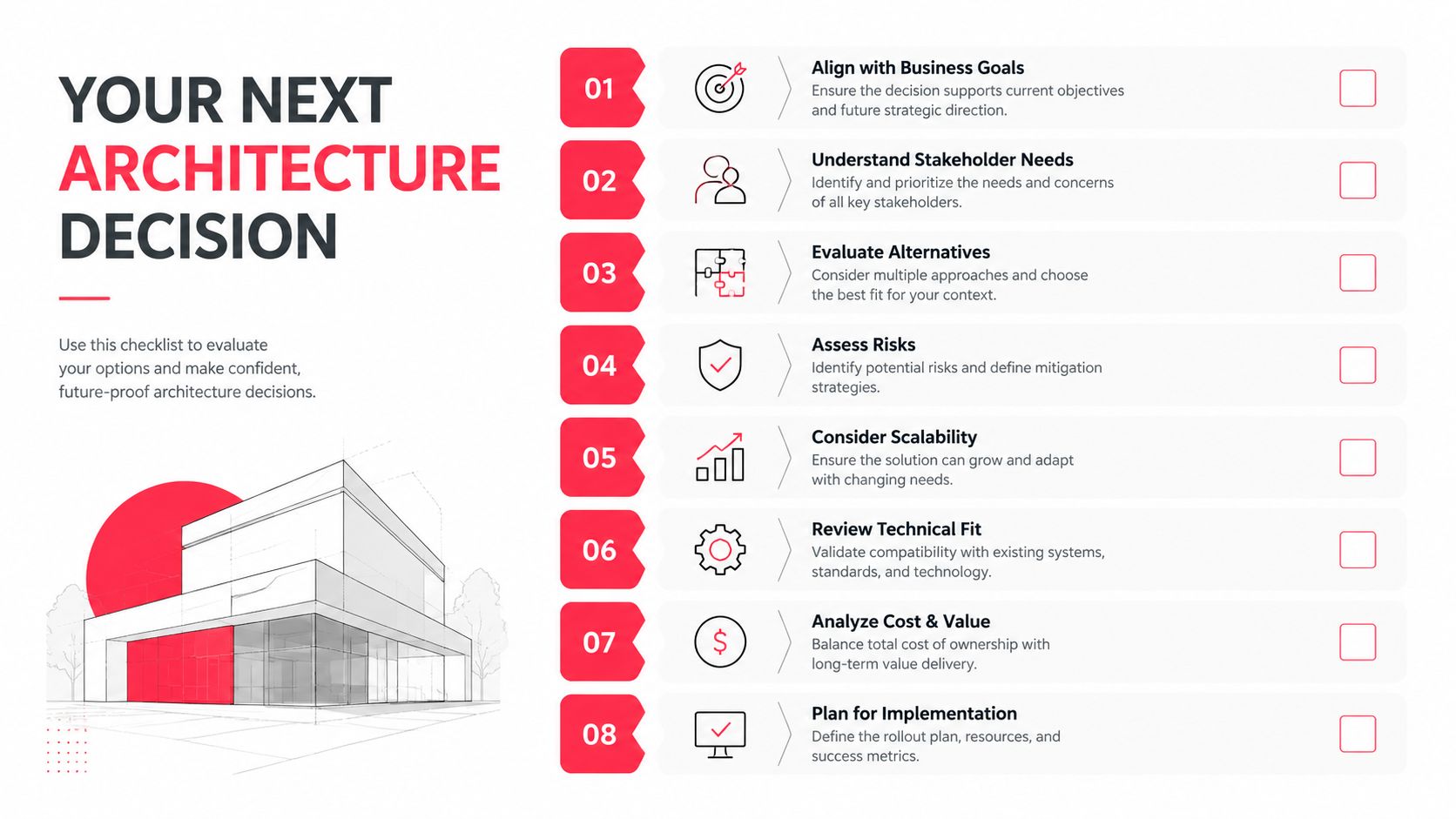
If your team is deciding whether its data foundation can support AI workflows, use Stimulead's AI readiness assessment to structure the review. Then choose the simplest architecture that satisfies the written service levels and that your team can recover at 2 AM.
