
Most companies still treat AI in B2B marketing as a content assistant. That's already outdated. The firms getting paid from AI are using it to compress launch cycles, improve conversion paths, tighten speed-to-lead, and earn visibility inside AI-driven buying flows. The operational shift is already measurable: campaign launch times fell by 75%, CTR rose by 47%, and ROI increased by up to 30% in the agentic marketing shift described by Demand Gen Report.
That changes the executive question. It's no longer “Where can AI save my team time?” It's “Where does AI change conversion math, pipeline velocity, and win probability?”
For smaller teams building process discipline before full-scale orchestration, a practical guide for UK small business automation is useful context. The same principle applies upmarket. Start with workflows tied to revenue, then systemize.
Table of Contents
- From Cost Center to Revenue Engine
- The Four Core AI Revenue Plays
- Play 1 Conversion Rate Optimization at Speed
- Play 2 GTM Engineering and Hyper-Personalization
- Play 3 Winning the New AI Search Era
- Measuring What Matters AI Driven KPIs and Governance
- Your Phased AI Implementation Roadmap
From Cost Center to Revenue Engine
If you lead a growth-stage company, you can't afford to file AI under marketing efficiency. Efficiency matters. Revenue matters more.
The change I see in the field is simple. AI has moved from a layer of automation to an operating system for go-to-market execution. Teams use it to build campaigns faster, route work, draft outreach, score intent, check quality, and adjust execution without waiting on a chain of manual approvals.
That shift changes how marketing should be measured. Old reporting rewarded activity. New reporting should reward movement toward booked revenue. If AI shortens cycle time from idea to launch, your team gets more shots on goal. If AI improves targeting and messaging, more of those shots turn into pipeline.
What leaders get wrong
The most common mistake is buying AI tools before deciding which revenue bottleneck needs to move.
A CEO wants more pipeline. A CRO wants better conversion from lead to opportunity. A CMO wants campaign throughput without adding headcount. Then the team buys a generic writing tool and calls it an AI strategy. That rarely changes outcomes.
Use a tighter lens:
- Launch speed: Can the team move from brief to live campaign without delays across copy, approvals, routing, and QA?
- Conversion performance: Can the team test offers, pages, emails, and segmentation faster than the market shifts?
- Sales response time: Can inbound and hand-raiser flows trigger action while intent is still warm?
- Discovery visibility: Can buyers and AI agents find and trust your company during vendor research?
Practical rule: If an AI project can't be tied to conversion rate, pipeline creation, sales cycle movement, or win rate, it belongs lower on the roadmap.
What good execution looks like
Good AI for B2B marketing isn't one tool. It's a connected set of workflows with clear constraints, clean data, and an owner who cares about revenue, not novelty.
In practice, that means marketing, sales, RevOps, and leadership agree on one commercial target first. Then they apply AI where manual work currently slows that target down. That's where the return shows up.
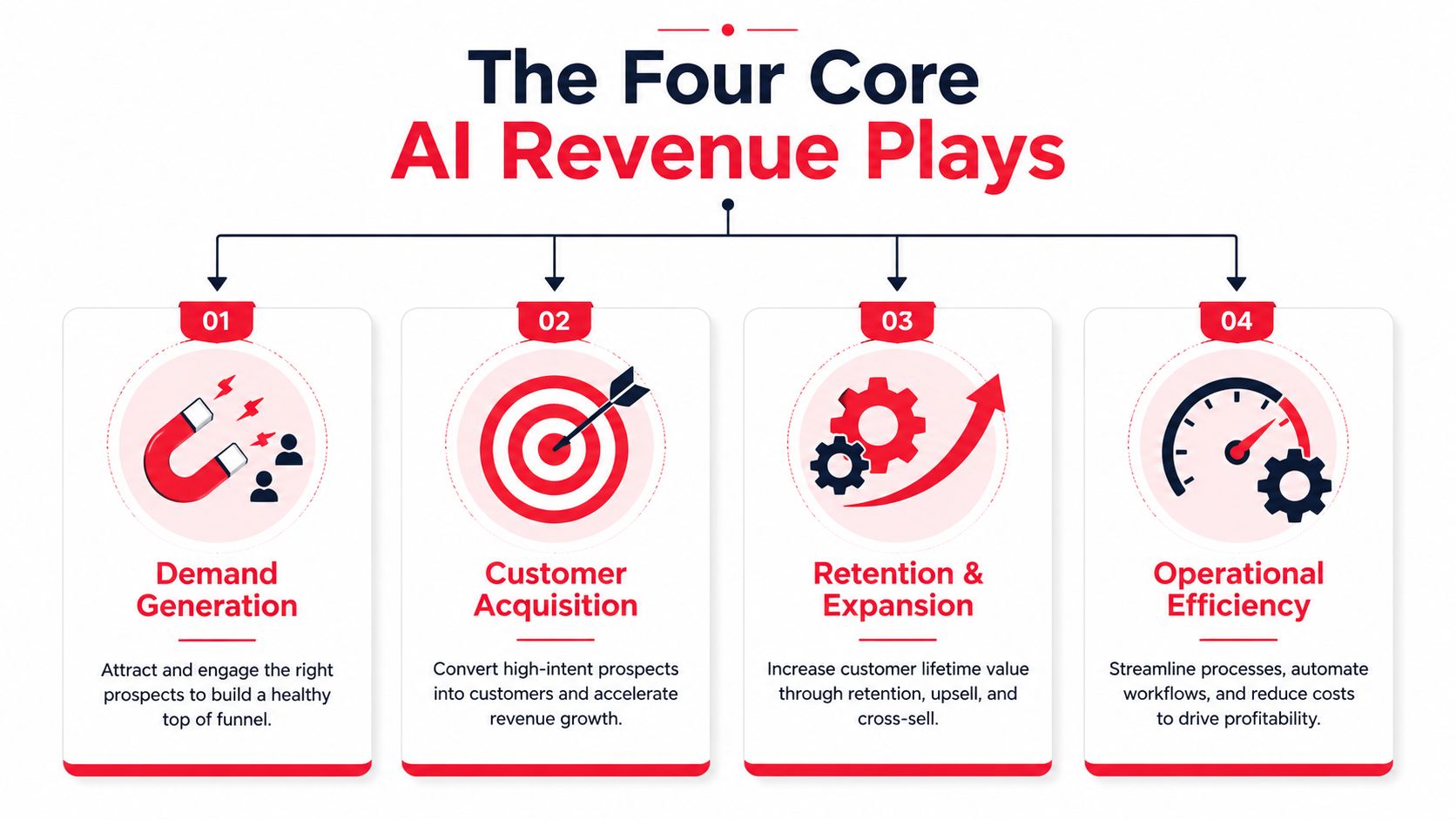
The Four Core AI Revenue Plays
The teams getting real return from AI tend to converge on four plays. Different companies enter from different points, but the pattern is stable. We break them down individually in our roundup of AI use cases in B2B marketing.
The four plays
| Play | What it changes | Revenue effect |
|---|---|---|
| CRO at speed | Faster test cycles across pages, ads, email, and offers | More conversion lift from the same traffic and demand |
| GTM engineering | Better research, routing, enrichment, and outbound execution | More qualified pipeline and faster rep action |
| AI search optimization | Better visibility in LLM and AI discovery flows | More inclusion in early vendor consideration |
| Agent commerce readiness | Better machine-readable trust, structure, and authority | Higher chance of surviving agent-mediated filtering |
One of the most useful signals here is predictive AI. Companies that integrate predictive AI models for scoring, segmentation, or journey orchestration report conversion rate increases of 20-30% according to Sopro. That matters because it shifts AI from production support into revenue control.
Where each play fits
CRO at speed works best when you already have traffic and demand, but your conversion path is weak or slow to improve.
GTM engineering works when sales and marketing are producing activity, yet handoffs are inconsistent, outreach is generic, or inbound follow-up drifts.
AI search optimization matters when your category is researched heavily before contact. If buyers use AI tools to shortlist vendors, weak AI visibility cuts you out before your SDR even has a chance.
Agent commerce readiness matters when procurement becomes more machine-mediated. Your content, proof points, and site structure need to be interpretable by software, not only persuasive to a human reader.
The best AI strategy for a growth-stage company usually starts with one play, proves revenue movement, then expands into the next system.
Play 1 Conversion Rate Optimization at Speed
Traditional CRO has a throughput problem. Teams form a hypothesis, queue design work, build one or two variants, wait for enough traffic, then argue over whether the result is real. By the time the team learns anything, the market has moved and the campaign has cooled.
AI changes the tempo.
AI conversion optimization delivers measurable results in 2–4 weeks by automatically testing hundreds of content variations simultaneously, eliminating the multi-month bottlenecks of traditional A/B testing and enabling CRO teams to iterate at 10x faster velocity according to Monday.com. That's why CRO with AI is one of the few AI initiatives I'd put in front of a CEO as an early revenue play.
Where to apply it first
Start where traffic is already concentrated and buying intent is visible.
A useful first wave includes:
- Landing pages: Test headline angle, proof sequence, CTA phrasing, field count, and section order.
- Paid media paths: Match ad promise to page language more tightly across audience segments.
- Email response layers: Test subject lines, opening hooks, and CTA framing across persona groups.
- Demo and trial pages: Reduce friction, clarify next step, and sharpen trust elements.
The operational point isn't “create more variants” for its own sake. The point is to create more learning cycles per month.
What works and what fails
A lot of teams point AI at copy generation and stop there. That creates volume without a testing system. It produces more assets, but not more insight.
What works is a closed loop:
- Pull conversion data from pages, ads, CRM stages, and call notes.
- Cluster failure points. Weak headline clarity, weak proof, offer mismatch, friction in form flow.
- Generate controlled variants against one issue at a time.
- Route winners into production fast.
- Feed results back into the next round.
That's why a dedicated AI conversion rate optimization workflow matters more than a standalone writing tool. The workflow creates speed and accountability.
A practical testing pattern
Here's a pattern I've used with teams that need cleaner execution:
- Round one: Test message fit. What promise gets the click and the scroll?
- Round two: Test proof. Customer outcomes, implementation friction, buyer risk.
- Round three: Test action. Demo wording, form design, calendar friction, post-submit path.
Most conversion lifts don't come from one brilliant page rewrite. They come from faster rounds of evidence-based adjustment.
If your team already has traffic, CRO at speed is often the fastest route from AI interest to revenue movement.
Play 2 GTM Engineering and Hyper-Personalization
GTM engineering is where AI stops being a marketing toy and starts acting like infrastructure.
The core job is to build systems that research accounts, enrich records, route signals, and trigger the next action without forcing reps and marketers to stitch it together by hand. Hyper-personalization sits inside that system. It works when the inputs are clean and the workflow is fast.
The biggest revenue break point in this area is response time. Contacting B2B leads within 5 minutes of form submission increases conversion probability, and every hour of delay reduces conversion likelihood by 10% according to Apollo. That isn't a copy problem. It's an operating model problem.
Build the system before you write the email
Many organizations start with “How do we personalize outbound?” Start earlier.
Ask these questions first:
| System question | Why it matters |
|---|---|
| Where does account research come from? | Weak inputs create generic messaging |
| Who owns routing logic? | Fast leads die in handoff gaps |
| What triggers first action? | Delay kills intent |
| How is output audited? | Bad personalization damages trust |
If your CRM is messy, your lead source mapping is unreliable, or your inbound form flow depends on manual triage, AI will only produce faster confusion.
A simple prompt chain that works
For growth-stage teams, I prefer short prompt chains over giant all-in-one prompts. They're easier to audit.
A workable chain looks like this:
Research prompt
Review Company X's website, product pages, newsroom, and public leadership commentary. Identify current growth priorities, likely operational pressure, and recent strategic language.Buyer mapping prompt
Based on those priorities, identify the likely executive owner. Then identify adjacent stakeholders in sales, marketing, RevOps, or operations.Message prompt
Draft a three-sentence email that ties one priority to one friction point and one concrete next step. Keep it specific and restrained.Follow-up prompt
Produce two follow-ups. One based on urgency, one based on operational clarity.
This works well with tools like Clay, HubSpot, Salesforce, Apollo, and OpenAI-based workflows layered into your CRM and outbound stack.
What to automate and what to keep human
Don't automate the whole front end blindly.
Use AI for:
- Research synthesis: Public signals, role inference, account summaries
- Data cleanup: Standardization, de-duplication, missing field logic
- Response routing: Assigning rep, sequence, and SLA path
- Message drafting: First-pass copy tied to account context
Keep humans on:
- Offer choice: What you're proposing
- Risk judgment: Compliance, sensitivity, and deal context
- Final review for strategic accounts: Especially for large opportunities
GTM engineering works when speed and relevance rise together. If one goes up and the other falls, the system isn't ready.
Play 3 Winning the New AI Search Era
The harsh truth in AI search is that your company can look strong in Google and still disappear in AI discovery.
That's already happening. 96% of B2B companies are invisible in AI discovery surveys, which means they don't appear in AI-generated vendor shortlists despite heavy spend on traditional content and SEO, according to Demand Gen Report's coverage of the 2X survey.
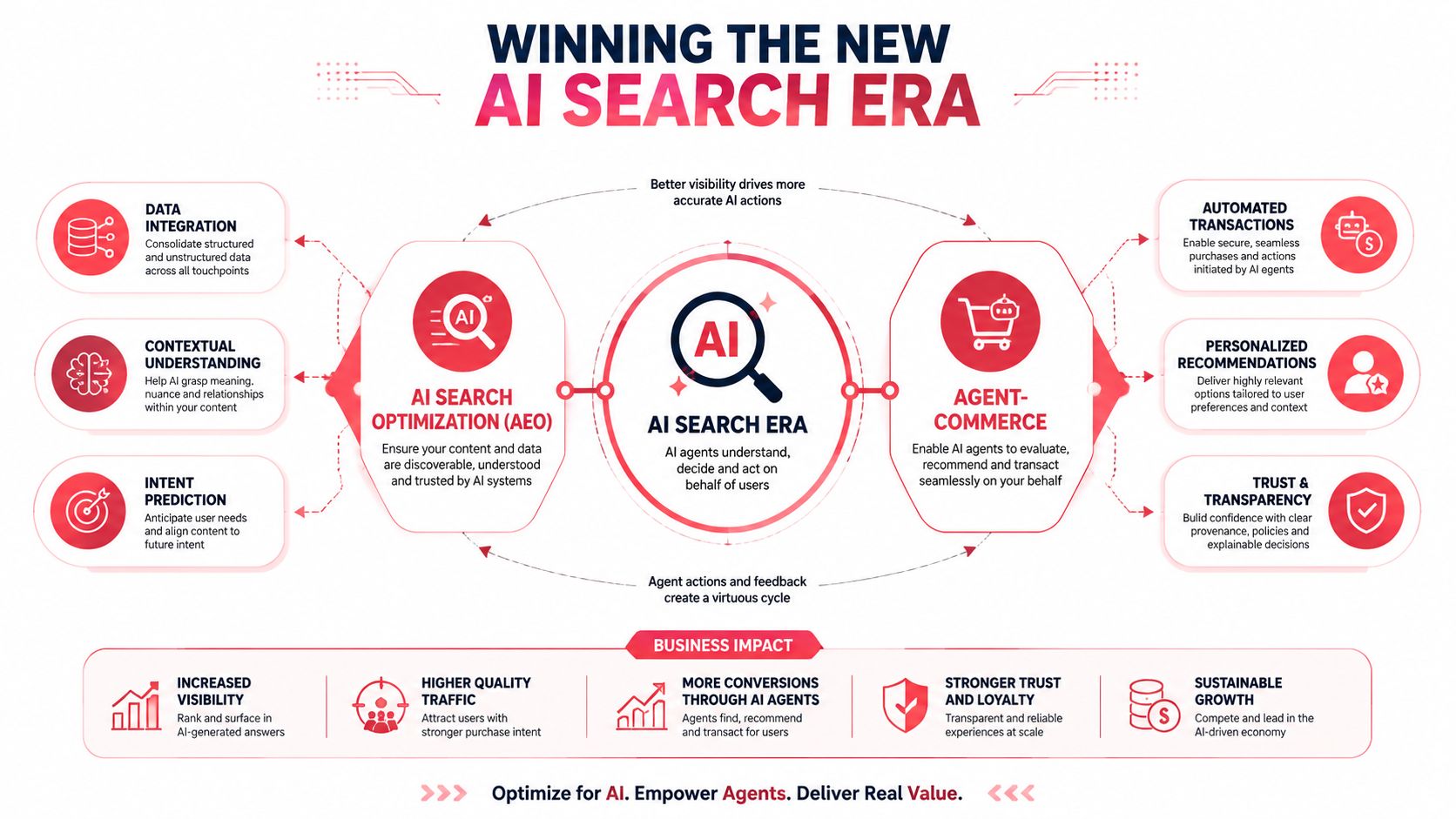
That number should reset how leadership thinks about visibility. If buyers ask an AI system for vendor recommendations and your firm doesn't show up, all the content volume in the world won't save you.
SEO still matters. It just isn't enough.
Classic SEO still helps with discoverability, authority, and topic coverage. But AI-mediated search adds a different requirement. Your content has to be interpretable, trustworthy, and easy for a machine to connect into a buying context.
That means your site needs:
- Clear entity signals: Who you are, what you do, and for whom
- Consistent category language: The same commercial language across product, use case, and proof pages
- Structured trust evidence: Awards, certifications, case proof, founder expertise, client fit
- Machine-readable organization: Clean page hierarchy, schema where appropriate, and explicit relationships between concepts
For a tactical walkthrough, this guide to B2B SaaS AI search optimization is worth reviewing alongside your content audit.
A practical overview of the operational side lives in this AI search optimization resource.
What to change on the site
The first move is usually not publishing more blog posts. It's fixing the parts of the site that confuse both buyers and AI systems.
I'd review these first:
- Homepage clarity: Does a buyer know the category, use case, and target customer inside seconds?
- Solution pages: Are they organized around actual buyer tasks and problems?
- Proof pages: Do they make authority easy to verify?
- Comparison and FAQ content: Do they answer evaluation questions directly?
If an AI system can't tell what your company sells, who it serves, and why buyers trust it, it won't recommend you with confidence.
Agent commerce is the next filter
The next step after AEO is agent commerce readiness. Procurement, comparison, and vendor filtering will increasingly pass through software agents before a human ever joins the conversation. Your digital footprint needs to survive that filter.
This is why AI for B2B marketing now includes machine trust. Content has to persuade humans, yes. It also has to give machines clean, validated inputs.
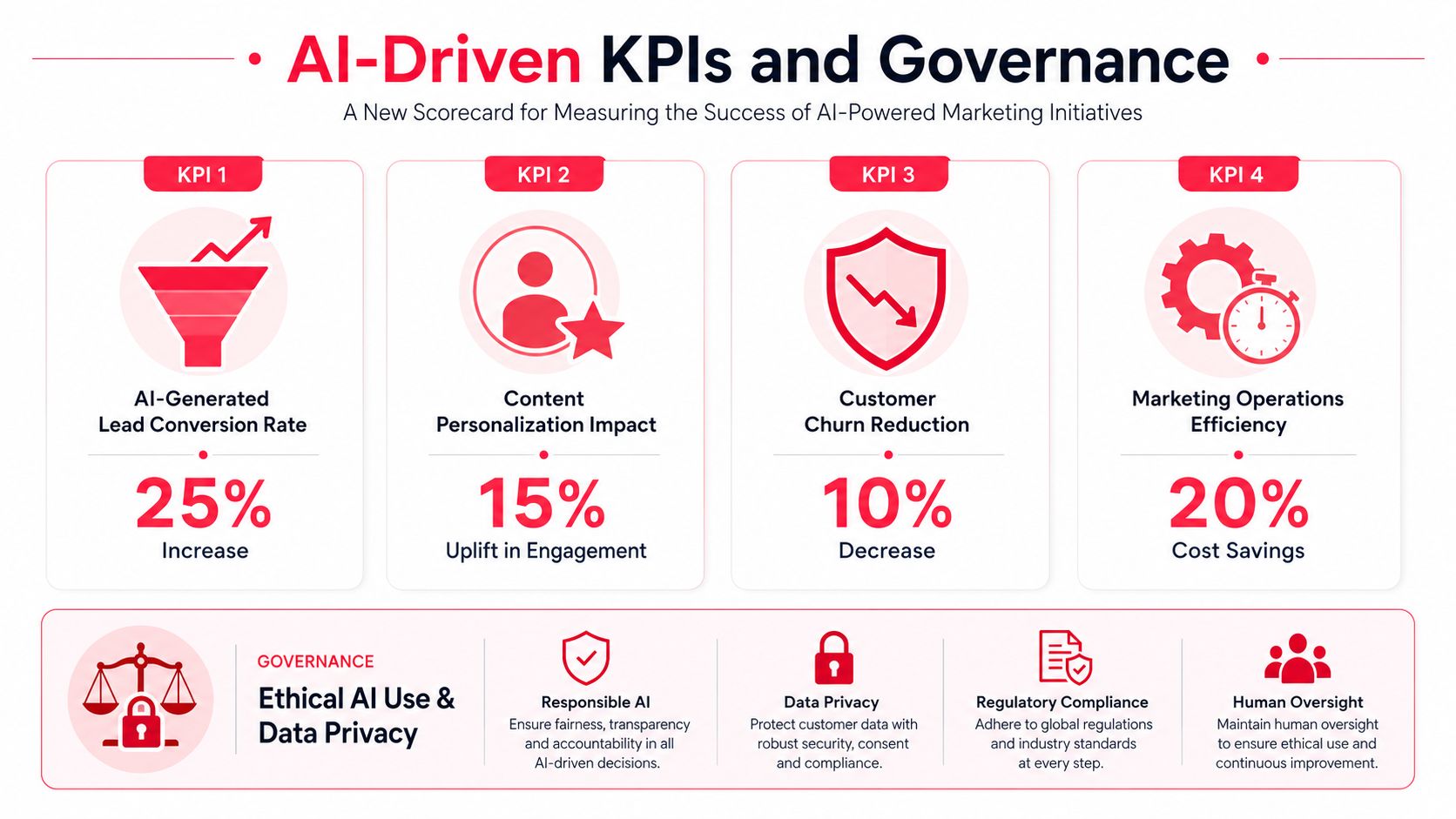
Measuring What Matters AI Driven KPIs and Governance
If you only measure AI by hours saved, you'll underinvest in the right systems and overpay for the wrong ones.
Leaders need a scorecard tied to money movement. The cleanest version tracks whether AI changed throughput, conversion, and time to revenue. Then governance keeps the system from drifting into noise.
The KPI set I use most often
| KPI | What it tells you |
|---|---|
| Testing velocity | How fast the team runs and closes learning cycles |
| Speed-to-lead | Whether intent is acted on while it still matters |
| AI-sourced pipeline | Which opportunities were influenced by AI-driven workflows |
| Time-to-revenue | How quickly execution turns into commercial movement |
You can add a personalization score if your team has a defensible rubric for message relevance, data completeness, and account-specific proof. If you can't define it clearly, leave it out.
Governance that keeps AI useful
Most companies don't need a heavy AI committee. They need a small operating group that can approve experiments, check inputs, and judge whether a use case should scale.
Keep it simple:
- One commercial owner: Usually the CRO, CMO, or CEO sponsor
- One systems owner: RevOps, Ops, or GTM engineering lead
- One workflow owner per pilot: The person accountable for output quality
- One review rhythm: A recurring decision point to keep, cut, or expand the pilot
For ROI discussions, teams often need a better baseline before they can judge improvement. This piece on how to determine your true marketing value is useful when you're cleaning up attribution logic and cost allocation.
Vendor questions that save money
Before buying any AI tool, ask:
- What exact workflow does this replace or improve?
- Which KPI should move if it works?
- What data does it require to perform well?
- Who reviews output before it reaches prospects or customers?
- How easily does it fit the current stack?
A deeper measurement framework belongs in your operating docs. This guide to measure marketing effectiveness is the kind of reference I'd want teams using during pilot review.
Good governance doesn't slow AI down. It keeps bad automation from reaching the market.
Your Phased AI Implementation Roadmap
Most growth-stage companies shouldn't try to deploy everything at once. They need a sequence that creates proof early, reduces operational friction, and builds toward harder use cases like AEO and agent commerce readiness.
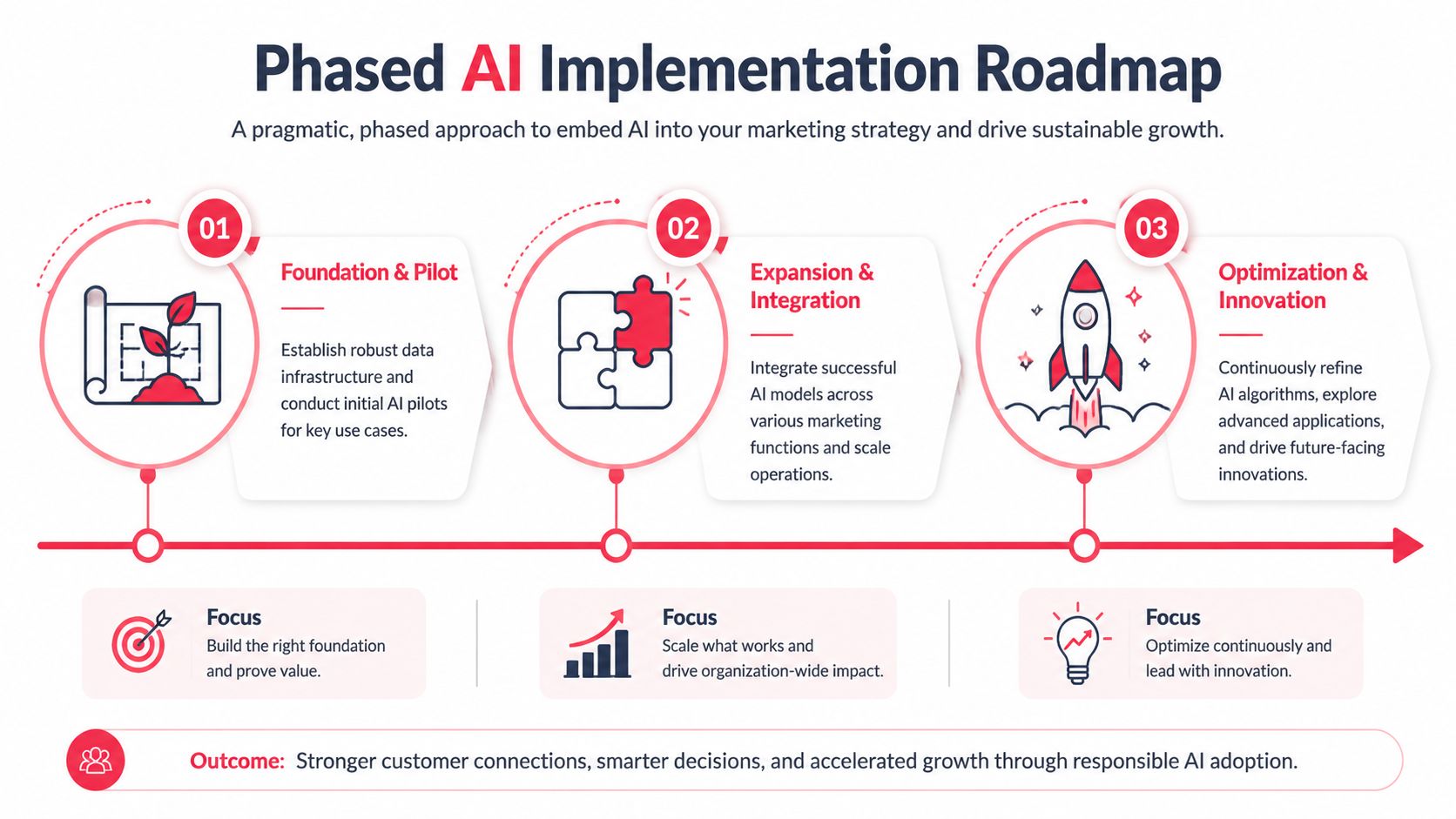
Phase 1 Foundation and pilot
Start with data hygiene and one fast revenue use case.
For most firms, that means cleaning CRM stages, standardizing lead source capture, tightening routing rules, and launching a focused CRO pilot on a high-intent page set. Use existing tools where possible. HubSpot, Salesforce, GA4, Hotjar, VWO, or an AI testing layer can be enough to start.
Your target in this phase is confidence. The team needs to see that AI can produce a measurable change in conversion workflow, not just more content output.
Primary KPI: conversion movement on a high-intent path, or faster test completion cycles.
Phase 2 Expansion and integration
Once the first pilot works, move into GTM engineering.
You connect enrichment, routing, personalization, and outbound support into a repeatable system. Sales should stop guessing which accounts deserve first response. Marketing should stop shipping generic nurture paths for every lead source. Ops should define SLA logic and ownership clearly.
A good build phase includes:
- Inbound response automation: Route and respond while intent is fresh
- Account research support: AI-assisted summaries for target accounts
- Outbound drafting workflows: Persona-aware first-pass messaging
- QA rules: Human approval for strategic accounts and sensitive claims
Primary KPI: sales response speed, acceptance rate of qualified leads, or cleaner movement into pipeline stages.
Phase 3 Optimization and innovation
The final phase is where the company starts preparing for AI-mediated buying.
That means auditing site structure, authority signals, comparison content, and machine-readable trust elements. It also means testing agent-assisted execution in bounded environments. Campaign setup, budget adjustment, or workflow orchestration can work here if constraints are explicit and someone owns audit review.
By this point, the company should also have a working AI policy that covers approved tools, data handling, review standards, and deployment criteria.
A simple executive view
| Phase | Focus | Team requirement | Primary outcome |
|---|---|---|---|
| Phase 1 | Data cleanup and CRO pilot | Marketing, RevOps | Fast proof of revenue impact |
| Phase 2 | GTM engineering rollout | Sales, marketing, Ops | Better pipeline creation and response |
| Phase 3 | AEO and agent readiness | Leadership, content, Ops | Stronger discovery and future buying fit |
If you want the practical next step, don't start with a broad AI initiative. Start with one revenue bottleneck. Audit the workflow, define the KPI, assign an owner, and run a bounded pilot for conversion, GTM engineering, or AI search. If you want outside help pressure-testing the roadmap, vendor choices, and implementation sequence, that's where Stimulead's fractional CAIO model is built to be useful.