
Deloitte says worker access to sanctioned AI tools rose by 50% in one year, from fewer than 40% to around 60% of workers, while its 2026 enterprise report expects the share of companies with 40% or more projects in production to double within six months (Deloitte state of AI report 2026). That should reset the way CEOs, CMOs, and CROs think about AI strategy for business leaders. The question isn't whether your teams can try AI. The question is whether you can turn AI into revenue motion, governance, and repeatable execution before your competitors do.
The firms that win here stop treating AI like a side project. They use it to improve conversion, sharpen GTM engineering, make content discoverable by answer engines, and prepare for agent commerce. They also put hard rules around what gets funded, what gets piloted, and what gets killed.
Table of Contents
- Why Most AI Programs Stall Between Pilot and Production
- Translating Business Objectives Into a Prioritized Use-Case Portfolio
- The 90-Day Pilot-to-Scale Operating Loop
- A Vendor and Build-vs-Buy Evaluation Checklist
- Governance, Risk, and Responsible AI as an Accelerator
- Winning the AI-Mediated Buyer with AEO and Agent Commerce
- KPI Tree, Team Enablement, and Your Next 30 Days
Why Most AI Programs Stall Between Pilot and Production
McKinsey's 2025 global survey says nearly two-thirds of organizations have not yet begun scaling AI across the enterprise (McKinsey, as cited in Deloitte's report). This is the key takeaway. Most companies don't have an adoption problem. They have an execution problem.
The common failure mode is simple. Leadership celebrates a pilot, the team demos a nice output, and then nobody owns the workflow change, the data path, or the decision rights. You get a new tool, a few enthusiastic users, and no production impact.
Practical rule: if your AI program can't name the owner, the workflow, and the KPI it moves, it isn't a strategy. It's a collection of experiments.
For growth-stage companies, this matters even more because AI value is showing up where revenue moves. Marketing, sales, and customer operations are the first places where AI can affect pipeline quality, response speed, and conversion discipline. That's why I push leaders toward the Lead, Lag, Exit model from PwC's CEO guide, where every initiative has a business outcome, a benchmark, and a decision date (PwC CEO guide).
A board-ready AI program has to answer three questions without hesitation. What are we trying to grow. Which use cases deserve capital. Which ones get cut if they don't move fast enough. If you can't answer those, you don't have a program yet.
Companies that get past scattered pilots usually formalize ownership first. Our AI center of excellence playbook covers the operating model, charter and staffing.
Translating Business Objectives Into a Prioritized Use-Case Portfolio
Start with the revenue objective, then force every AI idea through a portfolio filter. That means no broad “AI transformation” language. You want a short list tied to pipeline, conversion, sales velocity, customer response, or content discovery. The discipline is in the translation, from business goal to workflow to use case to owner.
A useful model is the impact-versus-feasibility quadrant recommended in the strategic frameworks cited by SKEMA and the World Economic Forum. Score each use case on business impact and feasibility, where feasibility includes data availability, technical readiness, and organizational appetite (SKEMA framework). Then fund the high-impact, high-feasibility work first. That's how you avoid random acts of AI.
For a CRO leader, that might mean AI-assisted landing page testing before a larger agentic sales motion. For a CRO or CMO, AEO work on product pages might beat a risky custom model build. For a sales leader, lead routing and account research could outrank a broad internal chatbot. The point is to pick the use case that improves a real revenue workflow with the data you already have.
| Criterion | What to measure | Low score signal |
|---|---|---|
| Business impact | Revenue, conversion, speed, differentiation | Weak link to a commercial KPI |
| Data readiness | Source quality, access, freshness | Data lives in silos |
| Technical readiness | Integrations, tooling, model fit | Too much custom engineering |
| Organizational appetite | Owner support, process change tolerance | No clear business owner |
Sequencing rule: put capital behind the use cases with the shortest path to ROI first. Long-horizon bets belong in the portfolio, but they shouldn't crowd out the work that can ship now.
If you want a starting point for this portfolio discussion, use the AI readiness assessment to sort ideas before they reach budget review. That saves time and keeps the conversation on business outcomes instead of tool preference.
The 90-Day Pilot-to-Scale Operating Loop
The best AI teams I've seen use a tight operating loop. First, they assess readiness. Then they run two or three focused pilots with explicit business cases. Then they install governance before broad rollout. That sequence matters because it turns AI from a brainstorm into an operating cadence.
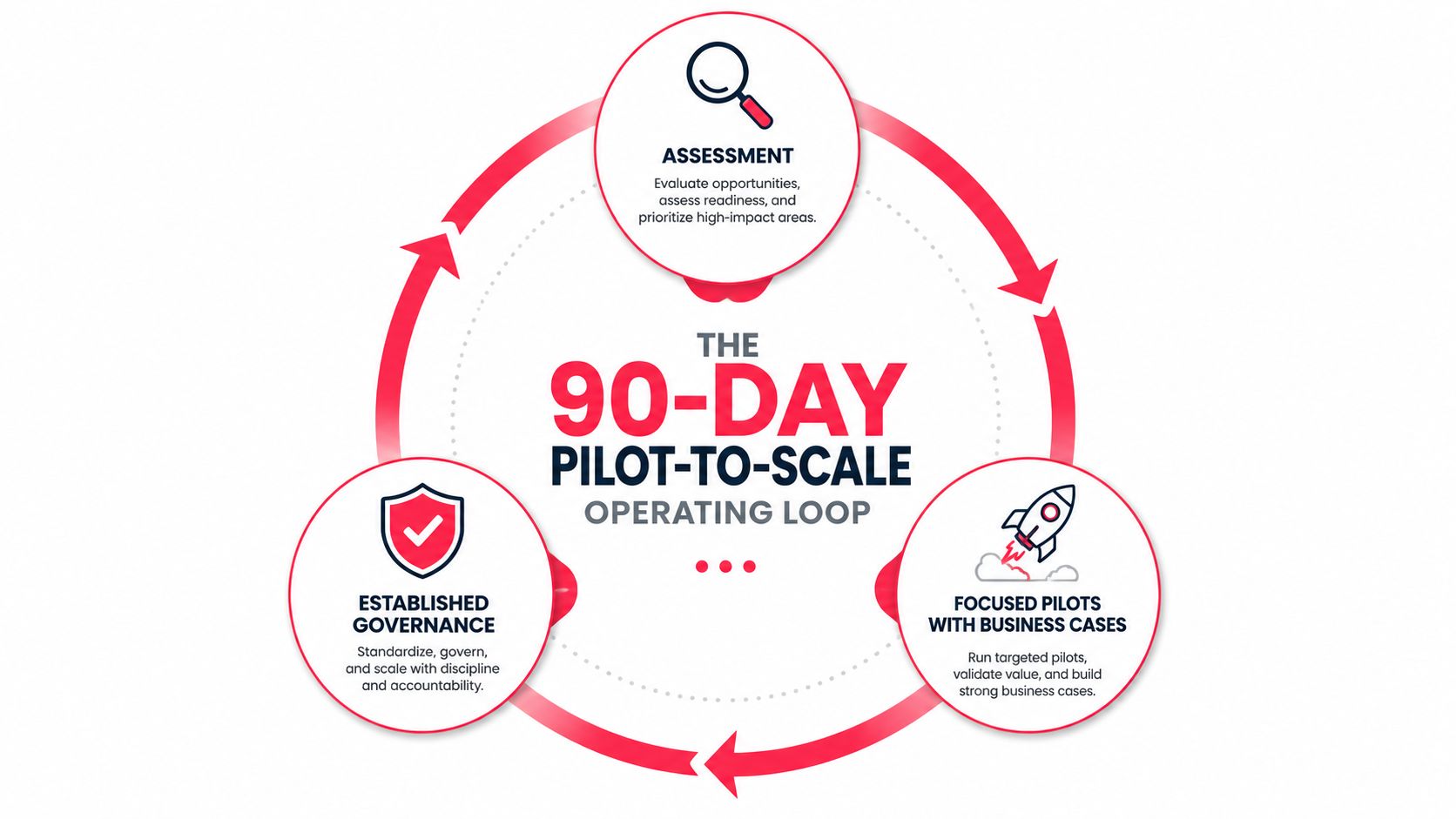
MIT Executive Education recommends defining measurable objectives, mapping data, infrastructure, and workflows, and building a roadmap that covers talent allocation, buy-vs-build decisions, and executive buy-in (MIT Executive Education). In practice, I like a simple split. Days 1 to 30 are for assessment and alignment. Days 31 to 60 are for the pilot. Days 61 to 90 are for review, governance, and go or no-go decisions.
A strong loop needs named owners. The executive sponsor clears blockers and protects the budget. The business owner owns the KPI. The AI or data lead owns the workflow and measurement. If those roles blur, the pilot drifts.
You also need hard exit criteria. If a proof of concept stalls after the expected window, cut it. If a pilot does work but lacks a clean path to production, hold scale until integration is clear. Enterprise roadmaps commonly reserve 2 to 4 months per proof of concept and 4 to 6 months per pilot before scaling (MIT Executive Education). Use those windows to keep teams honest.
A good artifact for this phase is a 30-60-90 plan. If you want a practical template for that kind of execution cadence, the onboarding plan generator is a useful reference for structuring owner, milestones, and checkpoints without making the process bloated.
Here's the CEO question I want in every review.
If this moves to production, what revenue behavior changes, who owns it, and what are we willing to stop doing to fund it?
For a road map view that keeps the sequence tight, I'd pair this with Stimulead's AI implementation roadmap and use it to force the transition from pilot to production discipline.
A Vendor and Build-vs-Buy Evaluation Checklist
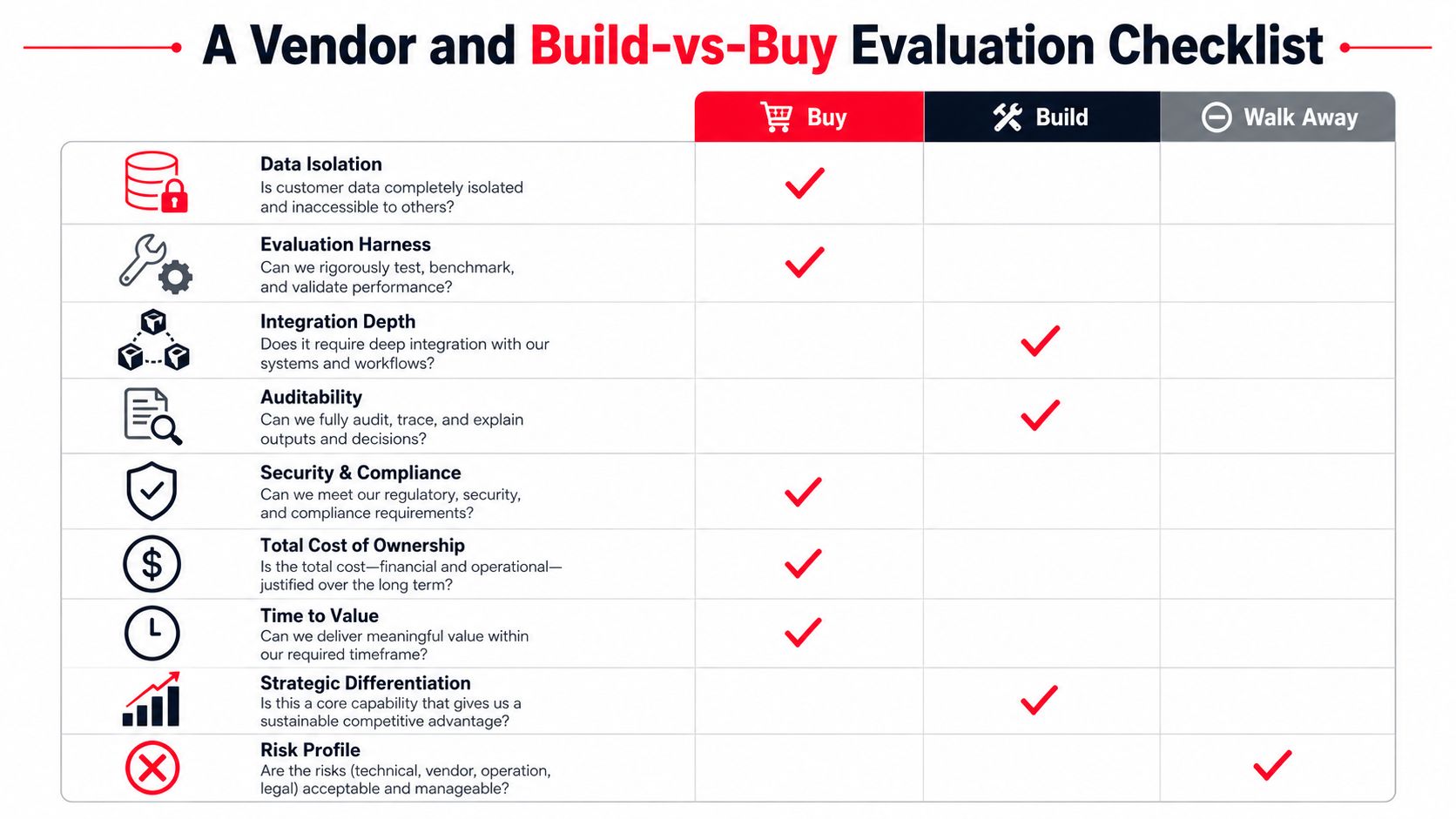
Vendor choice is a portfolio decision. If the use case is high-value but operationally standard, buy. If the use case is strategically differentiated and intrinsically tied to your data or workflow, build. If the vendor can't explain how it fits your security, integration, or evaluation needs, walk away.
The fastest way to get this wrong is to buy a flashy tool before you know how it will be measured. The slower, safer trap is to overbuild a custom system for a workflow that should have been purchased. I've watched both waste quarters.
A practical filter starts with four must-haves. Data isolation means your inputs are handled in a way your legal and security teams accept. Evaluation harness means you can test quality before scale. Integration depth means the tool can reach the systems where the work happens. Auditability means you can explain what happened and why.
| Criterion | Buy signal | Build signal | Walk away signal |
|---|---|---|---|
| Data isolation | Clear controls and acceptable terms | You need tighter governance than the vendor offers | The vendor can't answer where data goes |
| Evaluation harness | Built-in testing works for your use case | You need a custom scorecard | Quality can't be measured before rollout |
| Integration depth | Fits current stack quickly | Needs workflow-specific logic | Integration is vague |
| Auditability | Logs, traceability, reviewability | You need full internal control | Black-box outputs with no visibility |
If you want a structured reference for this conversation, the AI build vs buy decision framework is a useful lens for sorting vendor claims from real operating fit.
Slow vendor decisions are expensive because they freeze both time and talent. While the team debates, the revenue workflow stays manual and the better path gets buried under procurement noise.
Stimulead's advisory work often sits right in this decision layer, especially when the choice affects GTM workflows, but the broader rule is the same. Buy for speed where the use case is common. Build where the edge comes from how your team works, not from the model itself.
Governance, Risk, and Responsible AI as an Accelerator
KPMG's Q1 2026 Global AI Pulse says organizations are planning to invest an average of US$186 million over the next 12 months, and 99.1% say investment in data and AI is a top organizational priority (KPMG Global AI Pulse). That kind of spend changes the governance question. You're no longer asking whether to add controls. You're asking how fast you can move with controls already in place.
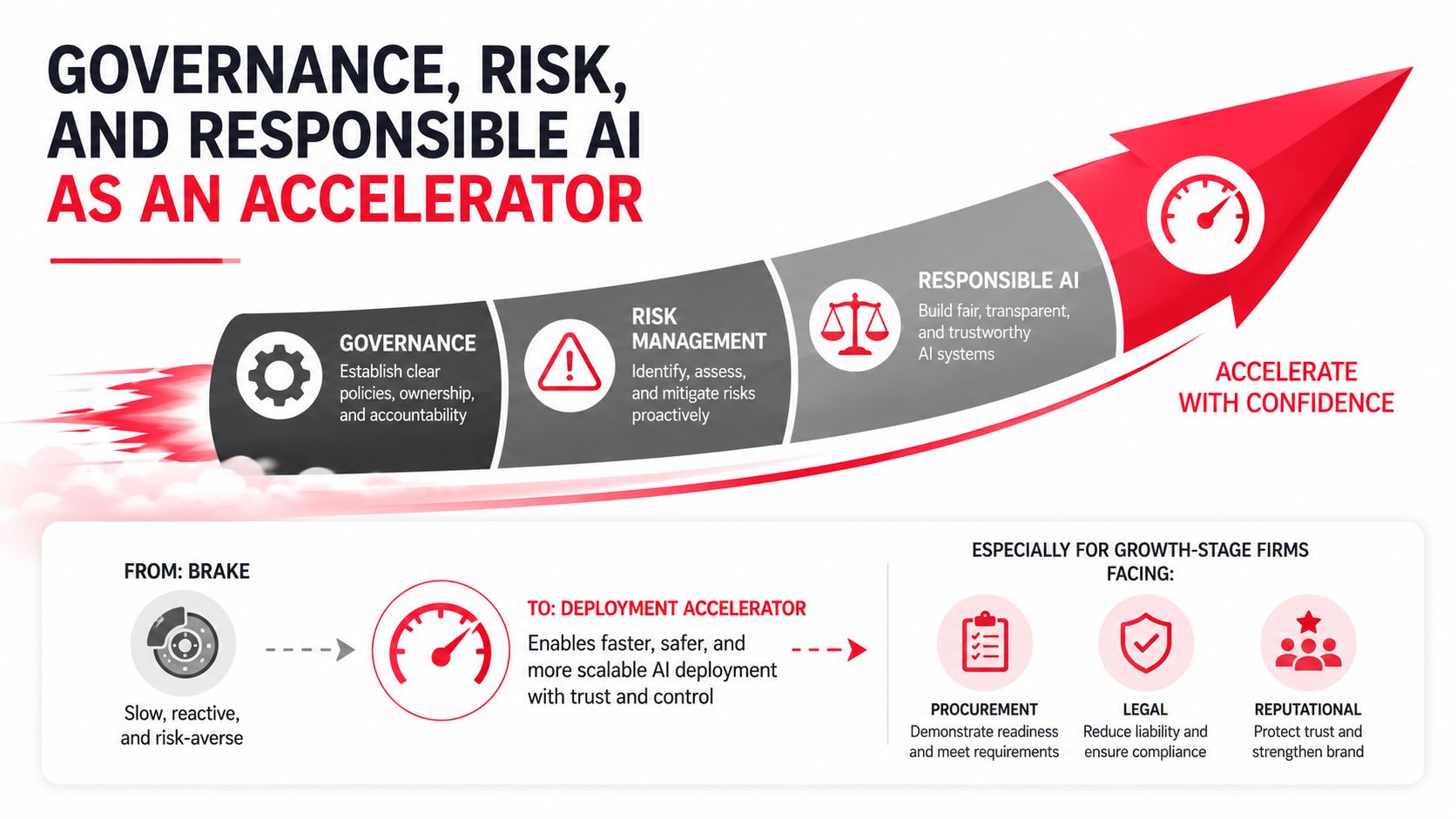
The minimum stack is straightforward. Model evaluation before release. Data lineage so you know where inputs came from. Access controls so the wrong people don't touch the wrong material. Incident response for bad outputs or misuse. Disclosure standards for how AI is used in customer-facing work. None of this slows deployment when it's set early. It speeds deployment because legal, security, and procurement stop reopening decisions every time a new use case appears.
Responsible AI becomes a commercial asset when buyers and partners see that your house is in order.
That matters in growth companies because the risk surface is real. Customer-facing AI, sales workflows, and content systems all create exposure if they're left unmanaged. The same KPMG survey reports 79.4% view Responsible AI as a top corporate priority and 88.7% already have guardrails in place (KPMG Global AI Pulse). That tells you where the market is going. Guardrails are becoming table stakes.
For a practical setup, I'd use one governance meeting per active AI initiative, a single owner for policy exceptions, and a simple release checklist before anything customer-facing goes live. If you want a working reference for the controls side, Stimulead's AI governance best practices is the right place to anchor that operating rhythm.
Winning the AI-Mediated Buyer with AEO and Agent Commerce
The usual AI strategy conversation stops at internal productivity. That's too narrow. Buyers are already being shaped by AI-mediated discovery, and some purchasing journeys are moving through agent-like workflows before a human ever lands on your site. If your content and product pages aren't machine-readable, you're invisible in the places that now shape demand.
The commercial move is simple. Make your differentiation easy for a model to recognize. That means clear entity names, clean proof points, and product language that maps to the problems buyers ask about. If your site says three different things about the same offer, an answer engine has to guess. Guessing is bad for revenue.
I've seen revenue teams make four practical changes that matter quickly.
- Entity clarity: Use one name for each product, feature, and category. Confusion kills recall.
- Citation-worthy claims: Put proof, customer outcomes, and specifics where a model can quote them cleanly.
- Machine-readable differentiation: Structure your pages so value props, integrations, and use cases are easy to parse.
- Agent-ready commerce flows: Reduce friction in quote, checkout, and follow-up paths so automated buying agents don't stall.
Stanford's AI Index reports 78% of organizations used AI in 2024, up from 55% a year earlier (Stanford AI Index). That tells you adoption is already broad. McKinsey's recent work on AI also notes that many companies are moving beyond simple chatbots toward agentic or workflow-embedded systems (McKinsey research cited in HBR). For revenue leaders, that means the buyer experience is changing faster than most websites are.
AEO belongs in the same portfolio discussion as CRO and sales enablement because the same revenue owner should care about both. If your pages can't be found, summarized, and trusted by an AI-mediated buyer, your funnel gets thinner before sales ever sees the lead.
Put AEO and agent commerce into the Lead/Lag/Exit review. If a page, asset, or buying flow can't compete in machine-mediated discovery, it belongs in the lag bucket until it's fixed.
KPI Tree, Team Enablement, and Your Next 30 Days
The board doesn't need an AI activity report. It needs a KPI tree that connects AI work to revenue. Start at the top with overall revenue growth, then trace down to pipeline conversion, sales cycle speed, and revenue per rep. If a use case can't move one of those branches, it's probably a nice-to-have.

The operating logic is direct. AI initiatives should feed measurable commercial outcomes, and team enablement should support the workflow that produces those outcomes. That means training marketers on AI-assisted research and content production, training sellers on AI for account prep and follow-up, and training managers on how to review outputs without turning every draft into a committee exercise.
A good KPI tree also makes ownership visible. Marketing owns pipeline conversion through content, AEO, and campaign execution. Sales owns cycle speed and conversion quality. Revenue leadership owns the combined view. If no one owns the branch, the metric becomes decorative.
A compact way to think about it is this.
| KPI branch | What AI should affect | What leaders should review |
|---|---|---|
| Pipeline conversion | Lead quality, content relevance, response speed | Source mix, handoff quality, conversion by segment |
| Sales cycle reduction | Research, follow-up, proposal prep | Time in stage, stalled deals, rep throughput |
| Revenue per rep | Prioritization, automation, account insights | Activity mix, win rate, rep capacity |
KPMG says 90.9% of companies are increasing investment in data and AI, and the share realizing high or significant business value from data and AI rose from 46% to 54% year over year (KPMG Global AI Pulse). That's the gap to close. Spending rises fast. Value realization still has to be managed.
The next 30 days should be boring in the best way. Assemble the portfolio. Set the first governance meeting. Pick one lead bet. Assign an owner for measurement. Then decide what gets cut so the team can focus.
If you want a practical next move, schedule a working session this week with your CRO, CMO, and whoever owns data or operations. Bring three use cases, rank them by impact and feasibility, and leave with one lead bet, one lag bet, and one exit. That's the point where ai strategy for business leaders stops being theory and starts changing revenue.