
You're probably in the same spot as a lot of growth-stage leaders right now. AI comes up in every executive meeting. Your marketing team is testing prompts and content tools. Sales wants automation for research and outbound. Vendors keep pitching “AI platforms” that all sound urgent. Meanwhile, your pipeline targets didn't get easier.
The problem isn't access to tools. It's ownership. Someone has to decide where AI affects revenue, where it creates noise, what gets funded, what gets killed, and how results get measured. If nobody owns that, AI turns into scattered experiments, duplicate spend, and a lot of internal optimism with very little P&L movement.
That's the context for when to hire a Chief AI Officer. The decision shouldn't start with org charts or job titles. It should start with conversion rate, sales productivity, testing throughput, pipeline quality, and whether your company can turn AI from curiosity into operating advantage.
For leaders who need executive context before making the org decision, AI training for executives is often the first useful step. It gives the C-suite a shared language, which matters more than often realized.
Table of Contents
- The AI Dilemma in Your Executive Meeting
- Five Clear Signals You Need AI Leadership
- A Readiness Checklist Before You Hire
- Prioritizing the CAIO Role for Revenue Impact
- The Hiring Model Full-Time vs Fractional CAIO
- Your First 90 Days with a New AI Leader
The AI Dilemma in Your Executive Meeting
The meeting usually sounds the same. One leader wants faster content production. Another wants better lead scoring. Sales asks for account research and personalized outbound. Ops wants internal automation. Finance wants spend controls. Everyone is talking about AI, but nobody is tying the discussion back to revenue mechanics.
That's why this is a leadership issue, not a tooling issue.
If your team can't answer which AI initiatives should move pipeline, improve close rates, lift demo conversion, reduce wasted spend, or speed up testing, you don't have a tech gap. You have an ownership gap. In growth-stage companies, that gap gets expensive fast because every department can now buy or trial its own AI stack without central direction.
Revenue first, title second
A Chief AI Officer only makes sense when the role has a business mandate. If the brief reads like “drive innovation” or “explore AI opportunities,” you're setting the role up to drift. If the brief reads like “increase landing page testing throughput, improve outbound relevance, strengthen AI search visibility, and guide vendor selection,” now you're talking about work that can be managed.
I've seen companies wait too long because they assume the CTO should absorb this. Sometimes that works. Often it doesn't. The CTO is already carrying platform, product, security, engineering hiring, and technical debt. AI across marketing and sales needs a different kind of attention. It needs someone who can move between funnel analytics, workflow design, vendor evaluation, prompt systems, content operations, CRM logic, and executive decision-making.
Practical rule: If AI is already affecting how prospects find you, how reps prospect, and how your site converts, it's executive scope.
The real decision in front of you
Most CEOs aren't deciding whether AI matters. They're deciding who owns results and risk.
That decision gets clearer when you stop framing AI as a future capability and start treating it like a revenue system. In that framing, the role is less about technical prestige and more about cross-functional execution. Someone has to decide what gets built, what data can be used, which vendors survive review, and which experiments deserve another cycle.
The right CAIO discussion starts there.
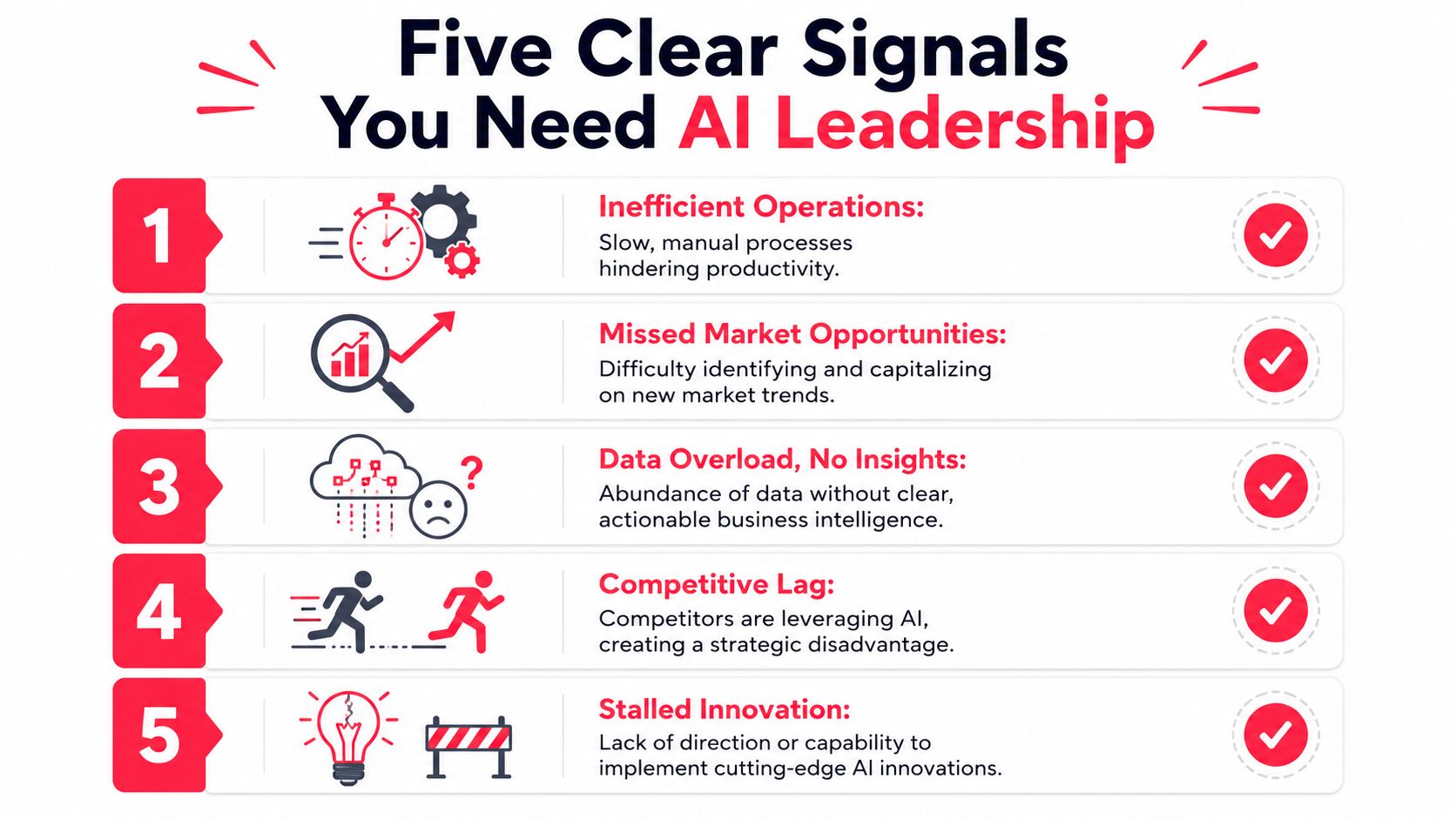
Five Clear Signals You Need AI Leadership
The need usually appears as a bottleneck before it appears as a job title. You'll feel it in campaign execution, outbound quality, slow decisions, and teams working around each other.
Early in the evaluation, this checklist helps align the room:
Signal one scattered experiments and no revenue owner
Marketing uses one set of tools. Sales uses another. RevOps is building automations in isolation. Nobody can tell you which of those efforts deserves more budget.
That's a sign you need AI leadership now. Not because experimentation is bad, but because scattered experimentation produces local wins and company-wide confusion. A CEO needs one person who can rank initiatives by revenue effect, execution burden, and operational risk.
Look for these symptoms:
- Multiple pilots with no kill criteria: Teams keep trying tools, but nothing gets formally adopted or shut down.
- No shared KPI model: Marketing tracks content output. Sales tracks activity. Leadership still can't see pipeline impact.
- Budget fragmentation: Departments buy overlapping capabilities and call them separate needs.
Later in the process, many leaders also benefit from reading Talent Pronto on unbiased hiring, especially if AI is going to affect recruiting workflows or candidate review. It's a useful reminder that governance questions start early, not after deployment.
Signal two testing velocity is stuck
If your CRO program still depends on a small queue of copy changes, design requests, dev tickets, and delayed analysis, AI leadership can pay for itself through speed alone.
The issue isn't that AI writes a headline. The issue is whether someone can redesign the testing system. That means faster hypothesis generation, structured variant creation, QA workflows, insight capture, and reuse across pages, offers, and audiences. Without ownership, teams add AI to the top of the funnel and leave the rest of the process untouched.
Watch for these patterns:
- Your backlog grows faster than tests ship
- Winning ideas don't get reused across funnels
- Insights live in decks, not operating systems
A company does not need more AI prompts when the real constraint is test design, approval flow, and learning capture.
The video below gives useful context on the broader leadership question.
Signal three sales personalization does not scale
Reps know generic outbound underperforms. They also know deep personalization takes too long. So the team lands in the middle. Messages are “customized” in theory, but most still read like templates with a few swapped nouns.
That middle ground kills response quality.
A CAIO can help build GTM engineering workflows that combine account research, buying signal interpretation, message generation, CRM context, approval logic, and performance feedback. The gain isn't about sending more email. It's about making relevant outreach operational instead of artisanal.
Signal four vendor noise is blocking decisions
When every week brings new demos, your executives need a filter. Without one, teams either freeze or buy too fast.
A good AI leader asks hard questions vendors often avoid:
- What business process changes if we adopt this
- Who owns the output quality
- What data does the system touch
- How do we monitor failure modes
- What gets retired if this goes live
Signal five your brand is absent in AI-assisted discovery
Search behavior is changing. Buyers now use AI systems to evaluate options, summarize categories, and compare vendors before they ever hit your site. If your team still treats visibility as a search-console-only issue, you're already behind.
AEO and agent commerce readiness matter. Someone needs to map the prompts, answer patterns, content formats, product data, proof assets, and site structure that make your brand legible to AI-assisted discovery and future buying agents. If nobody owns that, your pipeline gets shaped upstream by competitors who do.
A Readiness Checklist Before You Hire
A weak hire isn't the only failure mode. A strong hire dropped into a company with bad inputs also fails. Before you open a search, pressure-test the business.
If you want a structured way to do that, an AI readiness assessment is the right kind of pre-work. It forces clarity on systems, data, team capacity, and executive intent.
Data readiness
Start with the plain questions.
Can your team access clean CRM data without a weekly rescue mission from ops? Can marketing performance data be trusted enough to make budget decisions? Can someone trace a lead from acquisition source to pipeline outcome without stitching together six exports?
If the answer is inconsistent, a new CAIO will spend the first stretch cleaning up operational debt instead of moving revenue work forward.
Use this short board-level checklist:
- Source clarity: Can your team identify where prospect, customer, and campaign data lives today?
- Reliability: Do leaders trust the data enough to act on it without running side spreadsheets?
- Access rules: Is there a clear policy for what can and can't be used in AI workflows?
Team readiness
A CAIO should not be your first operator, first strategist, first technical translator, and first change manager all at once. That's too much load for one person.
The company needs at least a small execution spine. Usually that means some mix of RevOps, paid acquisition, lifecycle, web, analytics, sales ops, or technical support from product and engineering. The exact org doesn't matter as much as the ability to ship work once priorities are set.
A useful parallel is the playbook for founders from Underdog.io on hiring a chief of staff. Different role, same lesson. Executive hires fail when leaders expect one person to magnify results without any operating surface to work with.
CEO check: Ask your team, “If we had the right AI roadmap next month, who would actually execute the first three initiatives?”
Executive commitment
A common point where many searches go awry is when leaders say they want AI ownership, but they really want a translator who can attend meetings and keep options open.
That won't work.
A CAIO needs authority to stop weak projects, redirect spend, set priorities across functions, and push for changes that some teams won't love at first. If your executive team won't back those calls, hire later. Do the prerequisite work first.
A candid readiness review should answer these points:
| Readiness area | What to ask internally |
|---|---|
| Data | Can we trust the data behind funnel and pipeline decisions? |
| Team | Do we have builders and operators who can execute once direction is set? |
| Leadership | Will the C-suite support multi-quarter work instead of demanding novelty every week? |
If those answers are mixed, don't force a full-time executive hire. Bring in temporary leadership, fix the basics, and hire into a stable mandate.
Prioritizing the CAIO Role for Revenue Impact
The first mistake companies make is assigning a new AI leader a portfolio of “AI initiatives.” That language sounds modern and produces very little.
Assign revenue problems instead.
A growth-stage CAIO should spend the early phase on the parts of the business where AI changes throughput, quality, or conversion. In most companies that means the website, outbound motion, demand capture, and how the brand shows up inside AI-generated answers.

Priority one CRO with AI
Start where traffic already exists. If you can improve the conversion path on pages that already get visits, the path to impact is usually shorter than launching a brand new acquisition channel.
This means the CAIO should own a system, not a few experiments:
- Hypothesis pipeline: Pull ideas from call transcripts, session recordings, search intent, objections, and funnel drop-off.
- Variant production: Use AI to create structured test variants across copy, offers, layouts, CTAs, and message match.
- Learning loop: Store results in a way the team can reuse by persona, page type, and funnel stage.
If your current CRO motion depends on scattered docs and occasional tests, this is one of the cleanest areas for a CAIO to prove value.
Priority two GTM engineering
Most sales teams don't need more tools. They need a more disciplined system for research, prioritization, message creation, and follow-up.
GTM engineering sits right in that gap. A capable AI leader can help design workflows where account intelligence, CRM history, website behavior, content interaction, and rep judgment work together. That usually leads to better territory focus and better outbound quality.
The operating question isn't “Can AI write this email?” It's “Can we build a repeatable pipeline from signal to message to booked conversation?”
That's where many fractional engagements earn their keep. One option in this category is Stimulead's fractional CAIO work, which focuses on AI applied to CRO, GTM engineering, AEO, and agent commerce readiness for growth-stage teams.
Priority three AI search and agent commerce readiness
Buyers increasingly encounter your brand through machine-mediated summaries. If the CAIO ignores this, the company is managing yesterday's funnel.
This area should include:
- AEO content planning: Content designed to answer commercial questions clearly enough for AI systems to use.
- Entity and proof structure: Product pages, category pages, comparison pages, and supporting proof that machines can parse.
- Commerce readiness: A review of whether your product data, pricing logic, policies, and trust signals are clear enough for future agents acting on a buyer's behalf.
The role should own discovery shifts before they show up as a painful drop in branded demand.
A CAIO who spends the first phase buried in internal experimentation without touching demand capture is missing the job.
The Hiring Model Full-Time vs Fractional CAIO
Once you're clear on the need, the next decision is structure. For many growth-stage companies, the question isn't whether they need AI leadership. It's whether they need it full-time yet.
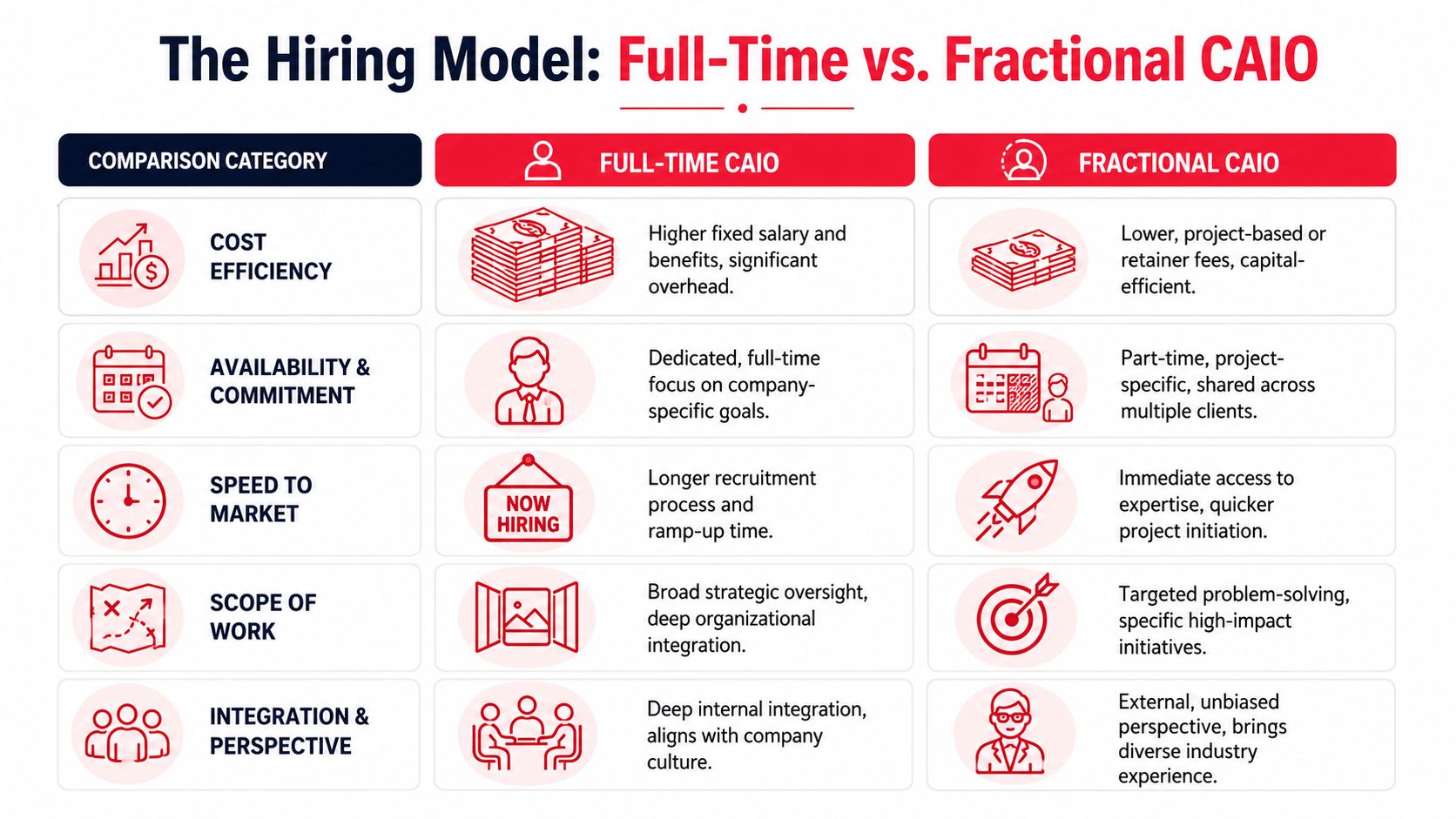
This visual makes the trade-offs easy to scan:
Where full-time fits
A full-time CAIO makes sense when AI touches multiple departments daily, the company needs deep internal integration, and the executive already has a large change agenda to run. This model also fits when the business is building AI into product, operations, and customer experience at the same time.
The upside is obvious. You get dedicated attention, tighter internal alignment, and one executive who can live inside the company's context. The downside is also obvious. The search is harder, the hire is expensive, and the wrong fit creates a large management problem.
Where fractional fits
A fractional CAIO fits when the business needs senior judgment fast, but the scope is still concentrated around a few high-impact areas. That often includes marketing and sales use cases, vendor evaluation, roadmap creation, and pilot execution.
For CEOs, the practical appeal is speed and flexibility. You can start with a narrower mandate, test operating fit, and avoid building a permanent role before the business has defined it well.
Leaders making this decision often benefit from outside perspectives on hiring process quality. Recruitment insights for managers from Hire Sense is useful for that. It's less about AI specifically and more about avoiding sloppy evaluation habits when the role is new and the market language is noisy.
Full-Time CAIO vs. Fractional CAIO
| Criterion | Full-Time CAIO | Fractional CAIO |
|---|---|---|
| Cost efficiency | Higher fixed executive cost and broader organizational overhead | More flexible spend tied to a defined scope or retainer |
| Speed to start | Slower, due to search, interviews, negotiation, and ramp | Faster, often suitable when a company needs direction quickly |
| Scope of work | Broad executive charter across multiple functions | Focused charter around selected revenue priorities |
| Integration | Deep internal presence and day-to-day access | Lighter footprint with more structured touchpoints |
| Risk profile | Bigger downside if role design or fit is off | Lower commitment while the company clarifies long-term need |
| Best use case | Mature AI agenda with wide internal dependencies | Early to mid-stage AI adoption with urgent commercial use cases |
Here's the simple decision rule I use.
Choose full-time if AI has already become a standing executive issue across the business and you know the mandate is permanent. Choose fractional if you still need to define the roadmap, prove impact, clean up vendor choices, and decide what the long-term org should look like after a few quarters of real work.
Your First 90 Days with a New AI Leader
The first phase should produce decisions, pilots, and operating cadence. If the new leader spends that entire period on broad vision work, you hired a strategist without an execution clock.
Use this period to separate signal from theater. If you need a concrete template for that rollout, an AI implementation roadmap gives you a useful reference point for the sequence.
Month one audit and decisions
The first month should end with a clear view of the business. That means funnel review, tech stack review, team interviews, vendor review, current experiment inventory, and a ranked opportunity list.
You should expect these outputs:
- Current-state audit: Where AI is already in use, formally or informally
- Risk map: Data exposure, workflow failure points, approval gaps
- Priority shortlist: A small set of initiatives tied to conversion, pipeline, or demand capture
Month two pilots with accountability
Month two is for live work. Pick a narrow set of pilots with visible owners and clear measurement. Good early candidates usually sit in web conversion, outbound workflow design, content production for commercial pages, or AI-assisted research for sales.
Keep the rules tight:
- One owner per pilot
- One core KPI per pilot
- One review cadence with leadership
If a pilot cannot be measured against a business outcome, it should not be in the first wave.
Month three scale what worked
By the third month, the AI leader should have enough evidence to expand one initiative and stop another. That's healthy. Early credibility comes from judgment, not from saying yes to everything.
Ask for these deliverables before the end of the period:
| Timeframe | CEO should expect |
|---|---|
| Month 1 | Audit, risk review, opportunity ranking, initial roadmap |
| Month 2 | Pilot launches, owners assigned, measurement defined |
| Month 3 | One scaled initiative, one stopped initiative, operating plan for the next phase |
The next step is practical. Take this article into your next executive meeting and answer three things in writing: where AI should affect revenue first, whether your team is ready to execute, and whether the role should start as full-time or fractional. Then turn those answers into the hiring brief.