
Most advice on AI training for executives is backwards. It starts with tools, prompt tips, and broad AI literacy. That feels productive. It rarely changes pipeline, close rate, or operating margin.
If you run a growth-stage company, your executive team doesn't need another overview. You need a short, hard-edged program that produces one live workflow inside the quarter. That's the standard. Anything else is education spend disguised as strategy.
Executive teams are already moving budget in this direction. A 2025 McKinsey workplace survey found that 92% of executives expect to increase AI spending over the next three years, and 48% said formal gen-AI training from their organization was one of the most useful supports for adoption, according to McKinsey's workplace survey on AI adoption and support. The issue isn't whether to train leaders. The issue is whether that training produces revenue impact or just better vocabulary.
Table of Contents
- Start with Revenue Not with Tech
- Design a Role-Specific Executive Curriculum
- Select the Right Delivery Model
- The 90-Day Revenue Impact Roadmap
- Measure What Matters KPIs for AI Enablement
- Your Next Step From Training to Operating System
Start with Revenue Not with Tech
The first decision in AI training for executives has nothing to do with AI. It's choosing the business number the program must move.
If you skip that step, the team drifts into demos, vendor chatter, and generic enthusiasm. Then the quarter ends and nobody can tell whether the effort changed anything that touches revenue or operating efficiency.
Pick one number that matters
Use one primary KPI. Keep it close to the P&L. Good options are pipeline velocity, sales cycle time, customer acquisition cost, meeting-to-opportunity conversion, win rate in a specific segment, or time spent on a repeated GTM task that limits output.
Don't pick five. Pick one and force the training to justify itself against that number.
Practical rule: If the KPI can't be baselined before the first workshop, it's the wrong KPI for a 90-day executive program.
A CEO should ask for a simple statement before approving the program:
- Business problem: What's stuck right now in marketing or sales
- Target metric: The one number the team must improve
- Workflow candidate: The repeatable process AI will change
- Owner: The executive accountable for the result
- Review date: The point in the quarter where you decide to scale, refine, or stop
If you need a planning template, I like using practical actionable AI implementation frameworks that force a team to define scope, ownership, and operating constraints before they touch tooling.
Write the business case before the curriculum
Here's the business case format I use with leadership teams:
| Decision | What to define |
|---|---|
| Revenue objective | The commercial outcome you need this quarter |
| Bottleneck | The process slowing revenue or adding labor |
| AI workflow | The single workflow to test first |
| Baseline | The current performance before training starts |
| Success rule | What evidence earns rollout |
That business case should fit on one page. If it takes ten slides, the problem isn't clear enough.
For most growth-stage companies, I'd start with a GTM workflow that already happens every week. Examples include account research for outbound, landing page testing for CRO, content production for AI search visibility, or follow-up summarization and routing after sales calls. These are easier to baseline and easier to operationalize than abstract strategy work.
Use an AI readiness assessment for revenue teams if you need to pressure-test where your current blockers sit across data, workflow, ownership, and governance. Do that before building the training deck, not after.
Design a Role-Specific Executive Curriculum
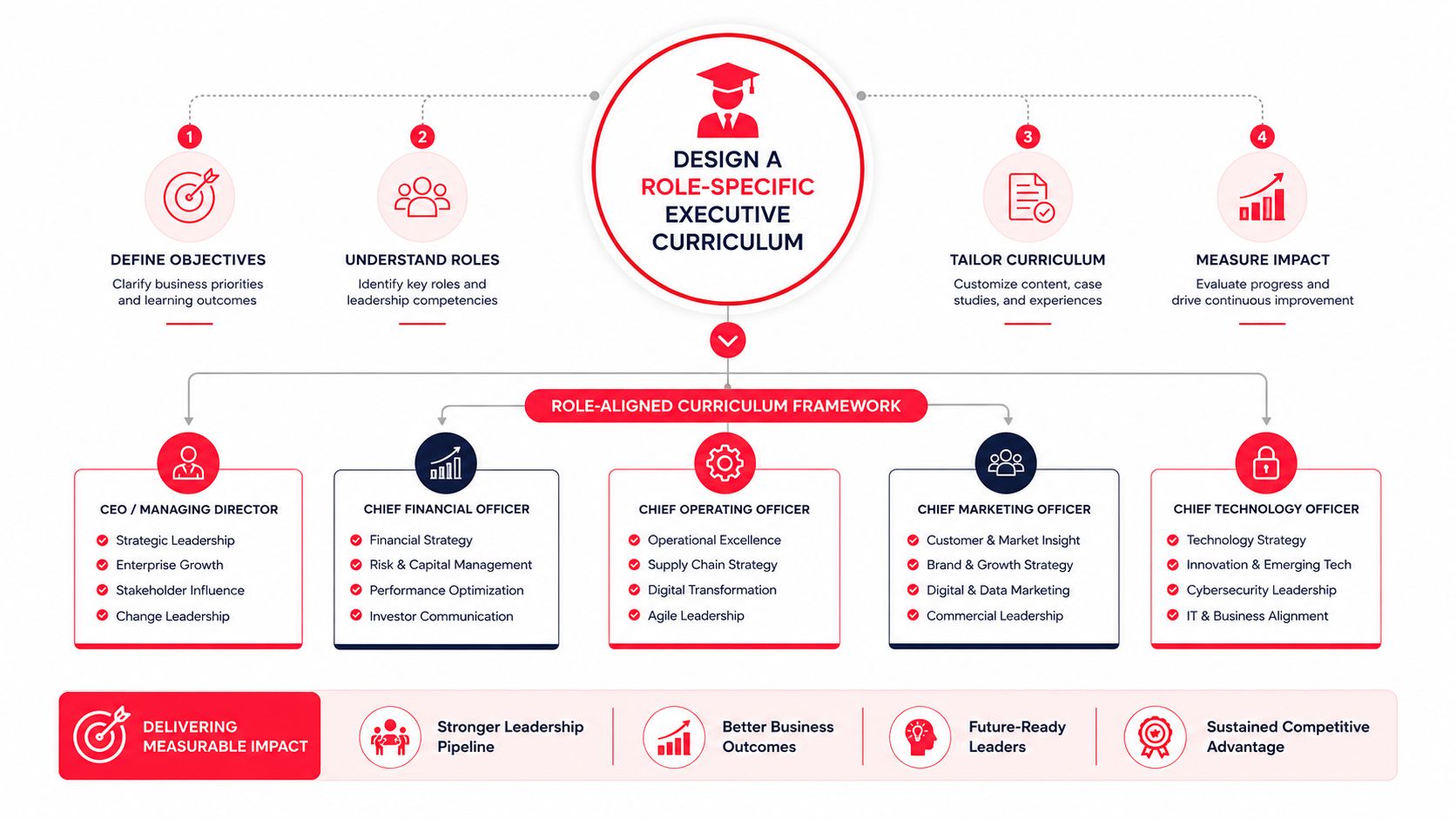
Generic executive AI sessions waste time because they flatten very different jobs into one audience. Your CEO decides where capital and focus go. Your CMO owns demand creation and conversion. Your CRO owns pipeline creation, deal movement, and forecast confidence. They shouldn't sit through the same curriculum and pretend it's useful.
Bessemer's executive guide makes the pattern clear: one-size-fits-all training fails. Effective programs are role-specific, workflow-specific, and paired with hands-on practice in a test environment, as described in Bessemer's guide to AI upskilling for executives.
What the CEO should learn
The CEO module should stay narrow. Three things matter.
First, where AI changes revenue economics. That means understanding which GTM workflows can produce more output from the current team, where cycle time can shrink, and where quality risk can hurt the brand or forecast.
Second, governance at the decision level. The CEO doesn't need to build prompts. The CEO needs to know where human approval stays mandatory, where customer-facing outputs need controls, and which workflows can safely move faster.
Third, operating cadence. The CEO should leave with a review mechanism for active AI workflows. If a workflow has no owner, no baseline, and no ROI checkpoint, it shouldn't be running.
What the CMO and CRO should learn
The CMO needs a curriculum tied to demand and conversion. In practice, I'd cover:
- CRO with AI: Faster test ideation, variation drafting, qualitative insight extraction, and page-level messaging refinement tied to conversion bottlenecks
- AI search and AEO: How AI-generated answers affect discovery, what content structure supports citation and recommendation, and how to build topic coverage that maps to buying intent
- Content operations: Brief creation, repurposing, internal linking logic, and editorial QA so the team spends less time on first drafts and more time on positioning and distribution
The CRO needs a different stack:
- GTM engineering: Account research workflows, segmentation logic, enrichment orchestration, and message assembly for outbound teams
- Sales execution: Call summaries, objection pattern analysis, follow-up drafting, and CRM hygiene support
- Forecast support: Cleaner activity capture, better deal notes, and tighter visibility into stall patterns by stage
Microsoft's AI Transformation Leader certification has the right idea here. It targets business decision-makers who can identify AI opportunities, plan adoption, and optimize processes without coding. That's the right frame for most executives.
How to keep the curriculum honest
Most curricula fail because they end with awareness. Executive AI training should end with committed use cases.
Use this rule. Every executive should leave with:
- One workflow to sponsor
- One operator team to involve
- One baseline metric to track
Anything beyond that is extra.
A simple AI skills gap review for leadership teams helps split real capability gaps from fake ones. Often the blocker isn't knowledge. It's weak process ownership, messy data, or no decision rights around rollout.
Train the executive and the operators together on the same workflow. If you separate them, you get strategy in one room and friction in the other.
Select the Right Delivery Model
Delivery drives adoption. Busy executives don't need a lecture series. They need a format that respects calendar pressure and still forces action.
I see three models repeatedly. Most firms choose one. That's the mistake.
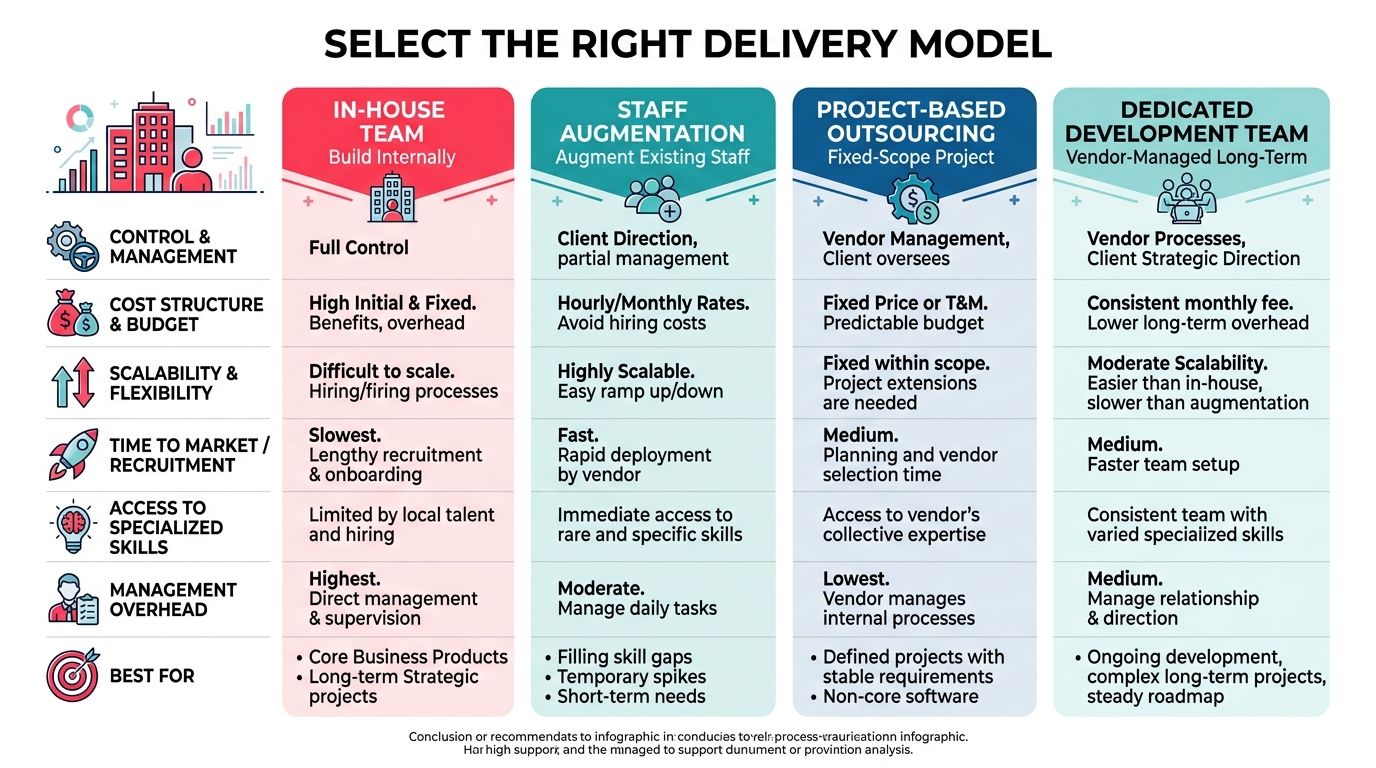
Three delivery models that show up in the market
| Model | Works well for | Fails when |
|---|---|---|
| Intensive workshop | Alignment, shared vocabulary, use-case selection | It ends as a one-off event |
| Executive coaching | Fast decisions, accountability, role-specific guidance | The operator team isn't involved |
| Action lab | Building a real workflow in live conditions | There's no executive sponsor |
The intensive workshop is useful at the start. You can align the leadership team, define the business case, and decide which workflow gets priority. But workshops create false confidence. Everyone leaves energized. Then nobody changes how work gets done on Monday.
Executive coaching solves for that. It gives the CEO, CMO, or CRO a place to make decisions quickly, remove blockers, and keep the workflow tied to business outcomes. Coaching also helps because executives often need judgment support more than information.
The action lab is where value appears. This is hands-on, inside the workflow, with the team, relevant data, and existing constraints. If your SDR team can't use the workflow during a normal week, you don't have an AI program. You have a demo.
The model I recommend
Use a blended model across the quarter.
- Kickoff workshop: Half-day. Align on KPI, workflow, owner, constraints, and success rule.
- Executive coaching: Short recurring sessions with the executive sponsor to keep decisions moving.
- Action labs: Working sessions with operators to build, test, refine, and document the workflow.
That sequence matches how executives adopt new systems. They need an initial decision moment, a tight accountability loop, and direct exposure to what breaks in execution.
A practical quarter can look like this:
| Week range | Format | Output |
|---|---|---|
| Early quarter | Workshop | Approved workflow and baseline |
| Mid quarter | Coaching plus action lab | Prototype in test use |
| Late quarter | Coaching plus action lab | Live workflow, measured result, rollout decision |
Keep the meetings short. Keep the owner visible. Keep the workflow narrow. If the program starts to sprawl into multiple departments, cut scope immediately.
The 90-Day Revenue Impact Roadmap
This is the part most companies skip. They send leaders to training, then hope good ideas turn into operating workflows on their own. They won't.
The better model is a six-step ROI roadmap: executive activation, use-case discovery and prioritization, business-owner enablement, governance and guardrails, workflow integration, and scaling and ROI management. The operating rule is simple. Baseline a metric before training, build a working prototype during the program, then validate impact against that baseline and decide whether to scale, refine, or retire the workflow within 90 days, based on Correlation One's ROI roadmap for corporate AI training.
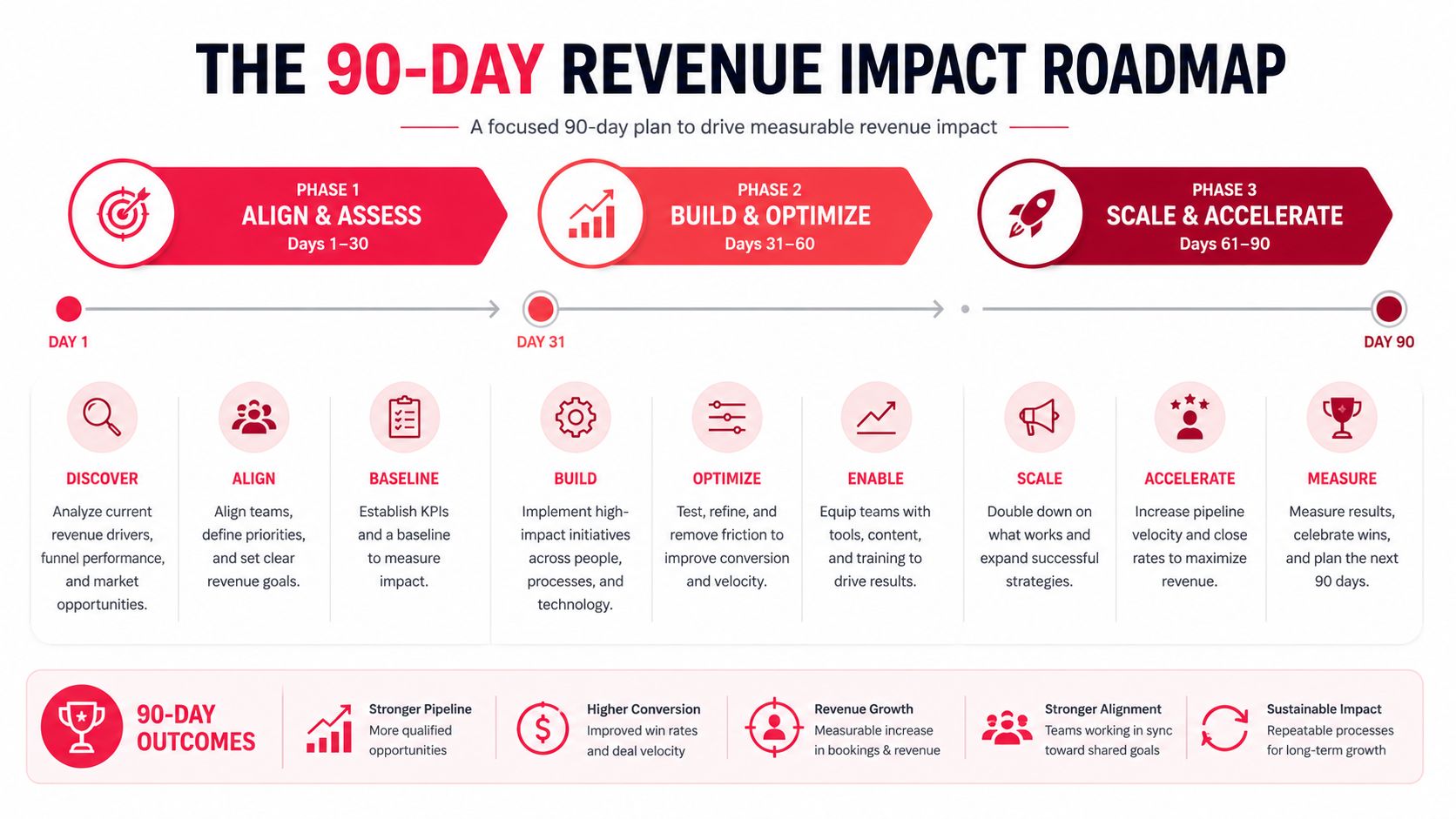
Days 1 to 15 activation and selection
Start with executive activation. The sponsor has to do more than approve budget. They need to state the business problem, name the owner, and commit to the review cadence. If that doesn't happen, the rest turns into delegated experimentation.
Then move into use-case discovery and prioritization. Keep this tight. You are not building an innovation portfolio. You are choosing one workflow with clear economic value and manageable execution risk.
Good first-wave candidates in marketing and sales usually share four traits:
- High frequency: The team does it often enough to create measurable change quickly
- Manual effort: People spend real time on it today
- Clear handoff: You can define where the workflow starts and ends
- Measurable output: You can compare before and after in a way the business accepts
The output of use-case selection isn't a brainstorm list. It's one workflow with one owner and one baseline.
Days 16 to 45 build with the business owner
Next comes business-owner enablement. Many executive programs falter at this stage because the room still contains only leaders. The actual workflow owner has to be present, and so do the operators who will use the process every week.
This phase should produce a working prototype. Not a strategy memo. A working prototype.
For a CMO, that might be an AI-assisted CRO workflow for generating test variants, reviewing qualitative feedback, and drafting follow-up changes for landing pages. For a CRO, it might be a GTM engineering workflow that assembles account research, buying signals, and message inputs for outbound teams. For a content leader, it could be an AEO workflow that turns topic clusters into answer-first assets shaped for AI search discovery.
Then lock down governance and guardrails. Keep them practical:
- Approved inputs: Which data sources the workflow can use
- Human review points: Where approval is mandatory
- Exception handling: What happens when the output is incomplete or wrong
- Usage boundaries: Which teams and scenarios are in scope now
Don't overbuild governance. Just make it specific enough that the team can operate without guessing.
Days 46 to 90 integrate measure decide
Now move into workflow integration. This is the dividing line between a training program and a real operating change. The workflow has to live where the team already works. CRM, call notes, content briefs, testing queues, outbound research docs, or internal knowledge bases. If it sits in a separate sandbox forever, adoption dies.
Integration also means manager involvement. Frontline leaders need to inspect use, not just cheer it on. That means checking whether the workflow is used in live work, whether outputs are good enough, and whether cycle time or throughput changes.
The final phase is scaling and ROI management. At the end of the quarter, make one of three calls:
- Scale it because the workflow improved the baseline and the team can run it consistently
- Refine it because the value is visible but output quality, data flow, or ownership still needs work
- Retire it because the economics don't justify continued effort
That discipline matters. A weak workflow shouldn't survive because people enjoyed the training.
A capstone for executive AI training should be a documented live workflow with owner, inputs, review steps, KPI logic, and a rollout decision. No certificates. No vague claims about transformation. A workflow the business can run.
Measure What Matters KPIs for AI Enablement
Attendance, completion rates, and survey scores are useless here. They tell you whether people showed up. They don't tell you whether the program changed revenue operations.
This matters even more because demand for AI capability is rising inside management ranks. edX reported that 71% of managers are driven to upskill by AI, 65% say AI-related skills are very or extremely important for staying competitive, and 75% are likely to pursue AI-related education or training within the next six months, according to edX research on leaders and AI upskilling.
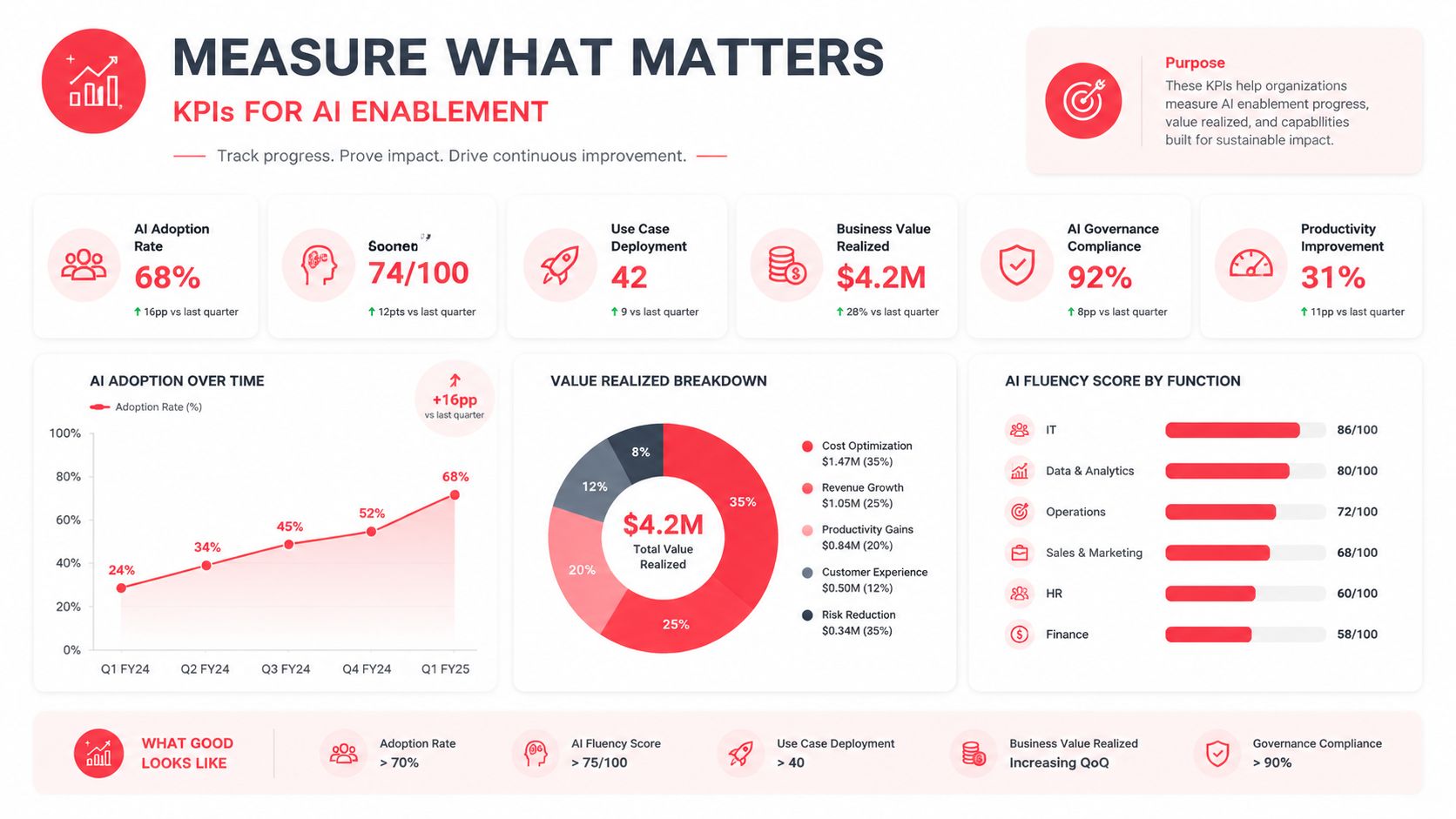
Use a two-layer KPI model
I use two layers.
Lagging indicators are the business outcomes leadership cares about. Pipeline movement. Sales cycle compression. Conversion improvement. CAC efficiency. These are slower to change, but they decide whether the workflow matters.
Leading indicators tell you if the workflow is being used and whether it's changing team output. These are the early signals that help you adjust before the quarter ends.
If you want a good general frame for connecting learning spend to business outcomes, this write-up on understanding employee development ROI is useful because it pushes beyond completion metrics and into operational value.
Example KPI stacks for revenue teams
For a CRO testing workflow, I'd watch:
- Testing velocity: Are more experiments moving through the queue
- Draft cycle time: Is the team producing test-ready variants faster
- Decision throughput: Are winners and losers reviewed quickly enough to ship the next round
For a sales prospecting workflow, I'd track:
- Research turnaround: How quickly reps get account context
- Message production: Whether the team can create more customized first-touch drafts
- Manager acceptance: Whether output quality is high enough for live use
For an AEO content workflow, I'd measure:
- Brief production speed: How fast the team moves from topic to approved brief
- Publishing throughput: Whether more answer-oriented assets ship
- Sales reuse: Whether commercial teams use those assets in live deals
If the leading indicators don't move, the lagging indicators won't bail you out later.
Don't overload the dashboard. A short stack of business and workflow metrics is enough. The point is to make executive AI training accountable to commercial output, not to build a reporting project.
Your Next Step From Training to Operating System
A good quarter doesn't end with “that worked.” It ends with “this is how we operate now.”
One successful workflow is enough to change the company's posture toward AI. It proves the team can move from theory to execution, and it gives leadership a model they can repeat across adjacent workflows in marketing and sales.
Turn the pilot into standard work
Take the winning workflow and document it like any other revenue process. That means owner, trigger, inputs, tool stack, approval rules, output format, and KPI review cadence.
Then create a lightweight operating rhythm:
- Monthly review: Executive sponsor checks KPI movement and blockers
- Use-case intake: Teams submit new workflow ideas in a standard format
- Priority filter: New ideas compete against revenue impact and ease of rollout
- Shared examples: Internal teams can see what worked, what failed, and what changed
Many firms benefit from outside operating support. A fractional Chief AI Officer model can give a CEO one accountable point of ownership for roadmap decisions, vendor evaluation, and implementation oversight without adding a full-time executive role too early.
If your team needs a practical example of where this can go next, work like AI for SaaS data analysis is a good reference point. It shows how fast teams can move once AI stops being a training topic and starts becoming part of day-to-day operating analysis.
What to do next week
Do these four things in order:
- Choose one revenue workflow that repeats often and has a clear bottleneck.
- Name the executive owner and the operator team that will build it.
- Baseline the current metric before any training starts.
- Book the quarter review now so the scale, refine, or retire decision is on the calendar.
That's the move. Don't buy another generic course. Don't ask your executive team to become AI experts. Ask them to build one workflow that earns its place in the business.
If you want a practical first pass, use one pilot in CRO, GTM engineering, AI search optimization, or agent commerce readiness and treat it as an operating build, not a learning initiative. That's how AI training for executives starts paying for itself inside the quarter.