
Your inbox looks the same as every other growth leader's right now. One vendor promises autonomous merchandising. Another claims predictive audience expansion. Your board asks for an AI plan. Your team asks which tool to buy. Finance asks what this does for revenue.
That tension is where most ecommerce AI efforts stall.
The problem usually isn't ambition. It's operational clarity. CEOs, CMOs, and CROs don't need another tour of model types or prompt tricks. They need a way to turn AI for ecommerce into a short list of initiatives tied to conversion rate, average order value, customer acquisition efficiency, and future buying behavior. They need to know what to ship first, what to ignore, and how to avoid six months of motion that never reaches the P&L.
I've seen the same pattern across growth-stage teams. The companies that get value from AI don't start with a grand transformation memo. They start with one revenue problem, one owner, one metric, and one implementation path their existing team can run. If you need a practical starting point, an AI readiness assessment is a useful way to pressure-test where your stack, data, and team are ready now versus where you're guessing.
Table of Contents
- Moving AI from Buzzword to Balance Sheet
- Five High-Impact AI Plays for Ecommerce Revenue
- Quick Wins Versus Strategic AI Projects
- Measuring the Real ROI of Ecommerce AI
- A Practical Framework for Evaluating AI Vendors
- Your First 90 Days An AI Implementation Roadmap
Moving AI from Buzzword to Balance Sheet
A CMO at a mid-market ecommerce brand recently described the situation well. Paid media was getting harder to scale. Email had room to improve, but the team was stretched. Site conversion had obvious friction points, yet every AI conversation drifted into abstract ideas about assistants, agents, and content automation.
That's the wrong starting point.
For operators, AI for ecommerce only matters when it changes buying behavior or improves the efficiency of getting buyers to revenue. Everything else is noise. If a tool can't connect to conversion, AOV, acquisition cost, merchandising performance, or retention behavior, it belongs in the parking lot.
The operating lens that works
I separate AI work into three questions:
- Where does it touch money: Does it improve checkout conversion, increase basket size, reduce wasted acquisition spend, or help your brand appear in AI-generated buying journeys?
- Who owns execution: A tool without an accountable owner becomes software rent.
- How fast can you see a signal: If the team can't tell whether it's working, the project drifts.
That sounds simple. It is. Most failed AI initiatives die from avoidable ambiguity, not from hard technical limits.
Practical rule: If you can't explain the path from model output to revenue metric in one minute, the initiative isn't ready.
The best teams treat AI like they treat CRO or paid acquisition. They define the bottleneck, build a testable workflow, instrument the result, and decide whether to scale. That discipline matters more than the vendor logo on the deck.
What leaders usually get wrong
The common mistakes are predictable:
- Tool-first buying: Teams buy a platform before they define the commercial use case.
- Overbuilt pilots: The team tries to integrate everything at once instead of proving one motion.
- Vanity reporting: Slack activity, generated assets, and prompt volume replace business outcomes.
A better path is narrower. Start where AI can speed testing, personalize intent, improve discoverability in AI answers, support GTM execution, or prepare your catalog and checkout systems for agent-mediated buying. Those are the areas where teams usually get a clean read on value.
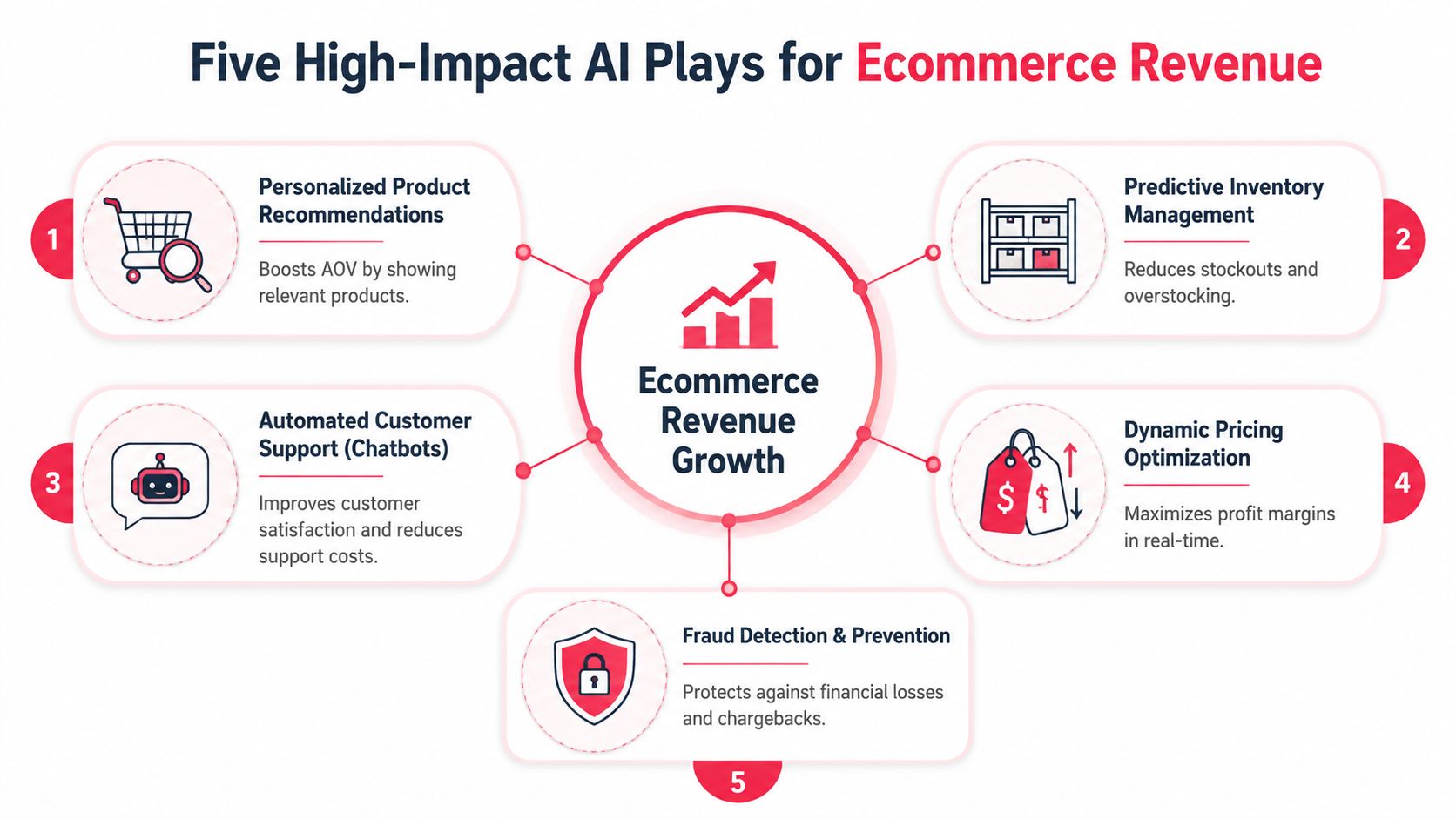
Five High-Impact AI Plays for Ecommerce Revenue
Start with the plays that have a straight line to commercial outcomes. These are the initiatives I see survive budget reviews because leaders can explain the workflow, the owner, and the expected business effect.
A simple visual helps frame the categories before you choose where to start.
AI-driven CRO
AI-driven CRO uses models and automation to generate hypotheses, build variants faster, and route more testing work through the team without waiting on the usual content, design, and analysis bottlenecks. It works because most ecommerce sites don't suffer from a lack of ideas. They suffer from slow execution.
The commercial case is clear. Companies that successfully scale AI-driven CRO can increase their experiment throughput by 10x, turning a typical 2-4 tests per month into 20-40, leading to a potential 5-10% annual revenue lift from optimization alone according to Stimulead's analysis of AI CRO execution.
Use AI here in the actual workflow, not as a shiny layer on top:
- Hypothesis generation: Pull themes from session recordings, on-site search logs, reviews, and support transcripts.
- Variant production: Draft landing page copy, product page modules, offer framing, and email creative for test cells.
- Analysis support: Cluster test outcomes by traffic source, device, or intent signal so the team can decide what to roll out.
After you've framed the process, a quick walkthrough can help teams picture the motion in practice.
True 1 to 1 personalization
Most brands still call segment rules personalization. That's better than nothing, but it leaves money on the table. Real personalization adapts product ranking, messaging, offers, and onsite experiences to the individual visitor in real time.
The material upside is clear: Brands that implement advanced AI personalization see an average revenue lift of 15-25% and a 20% increase in average order value by moving from segment-based rules to 1:1 real-time experiences according to McKinsey's personalization research.
The difference between what works and what doesn't usually comes down to scope:
- What works: Product ranking by visitor behavior, dynamic bundles, intent-based messaging, and adaptive homepage modules.
- What fails: Generic "recommended for you" widgets with thin logic and no testing discipline.
Personalization only pays when the model changes what the customer sees, in the moment, with enough control to measure the difference.
If you're still ranking the same category page for every visitor, you're running a fixed storefront in a variable market.
AI search optimization and AEO
Search behavior is shifting from blue links to synthesized answers. That changes how ecommerce brands earn visibility. AI search optimization, often called AEO, focuses on making your products, category pages, and supporting content easy for language models to interpret, cite, and recommend.
Execution is practical. Add product attributes that answer real buying questions. Tighten structured content across PDPs and comparison pages. Build content around commercial decision points, compatibility, use cases, and objections. This is one of the clearest areas where growth teams can coordinate SEO, merchandising, and content operations.
A strong AEO workflow usually includes:
- Query mapping: Commercial prompts buyers use in AI tools
- Content coverage: Comparison pages, FAQ blocks, buyer guides, return and shipping clarity
- Feed quality: Clean product data and attributes that help models understand fit and intent
Teams doing this well usually pair it with broader AI search work such as brand mention tracking, answer surface analysis, and content updates tied to high-intent query clusters.
GTM engineering for acquisition
GTM engineering applies AI to the machinery behind acquisition. That includes research workflows, creative briefing, audience analysis, message variation, CRM enrichment, and sales or lifecycle triggers. In ecommerce, it often sits between paid media, email, retention, and data operations.
The mistake is using AI to produce more content with no system around it. The better approach is to build repeatable flows. Feed top-performing ad angles into a prompt framework. Use customer reviews and support transcripts to generate objection-led copy. Route first-party behavior into triggered messaging that matches intent instead of broad campaign calendars.
Three examples that tend to work fast:
- Paid media briefing: Turn review themes and landing page behavior into fresh angle sets for Meta and Google.
- Lifecycle messaging: Generate email and SMS variations by purchase stage, product affinity, or risk signals.
- Merchandising inputs: Cluster search terms and support questions into content or assortment fixes.
Teams often find they need process design more than another app.
Agent commerce readiness
Agent commerce is the next operational issue most brands are underestimating. As AI assistants take a bigger role in product discovery and transaction handling, your catalog, policies, product data, and checkout flows need to be machine-friendly, not only human-friendly.
The near-term work is less dramatic than people assume. You prepare product data, shipping rules, return clarity, and compatibility attributes so agents can interpret your offer cleanly. You also review where your brand can support machine-mediated shopping flows and where friction breaks the handoff.
If you're studying how transaction-capable buying assistants are being built, Zinc's breakdown of the AI shopping agent is a useful technical reference.
The brands that win agent commerce won't be the ones with the loudest AI messaging. They'll be the ones whose data, policies, and product content are easiest for agents to act on.
For most growth-stage ecommerce teams, these five plays are enough. You don't need ten initiatives. You need one or two with clean ownership and a hard revenue case.
Quick Wins Versus Strategic AI Projects
A lot of AI waste comes from one bad decision at the start. The team treats a strategic build like a fast pilot, or treats a quick operational win like a transformation program. Then expectations drift, timelines slip, and leadership loses patience.
The true importance of that classification step is frequently overlooked. Internal analysis of corporate AI projects shows that initiatives lacking a clear classification as either a quick win or a strategic project have a 65% higher chance of being defunded or failing to meet their primary objective within 12 months according to Gartner's review of why AI projects fail.
What belongs in each bucket
A quick win should be narrow, operational, and easy to instrument. You can usually launch it with existing tools and a small working group. Think ad creative variation, support-assisted FAQ drafting, or AI-supported PDP copy testing tied to one category.
A strategic project changes a core growth system. It touches data pipelines, decision logic, ownership, and long-term process. Examples include a proprietary personalization layer connected to your ecommerce platform and CDP, or an AEO program that rewires product content, search intelligence, and merchandising governance.
The fastest way to break trust is to present a strategic project with quick-win expectations.
AI Initiative Prioritization Framework
| Attribute | Quick Wins | Strategic Projects |
|---|---|---|
| Scope | One workflow, one team, one KPI | Cross-functional process or core system |
| Typical example | AI-assisted ad copy testing, FAQ generation, support intent clustering | Real-time personalization engine, agent-commerce architecture, integrated AEO program |
| Team requirement | One owner plus a small execution pod | Executive sponsor, cross-functional leads, technical support |
| Time to impact | Near-term signal after launch | Longer path before reliable commercial signal |
| Investment pattern | Lower initial spend, tighter pilot budget | Higher commitment across tooling, data, and process |
| Best use | Build momentum and learn fast | Create durable advantage in a revenue-critical area |
| Failure mode | Activity with weak measurement | Overbuild before proving operational fit |
A simple filter keeps teams honest:
- Choose a quick win when the team needs proof, speed, and a low-risk pilot.
- Choose a strategic project when the problem sits in a core journey and temporary fixes won't move the metric.
- Kill or pause the initiative when nobody can name the owner, the KPI, and the business process that changes.
Some teams need both categories active at once. That's fine. Just don't let them blur together in status meetings or budget discussions.
Measuring the Real ROI of Ecommerce AI
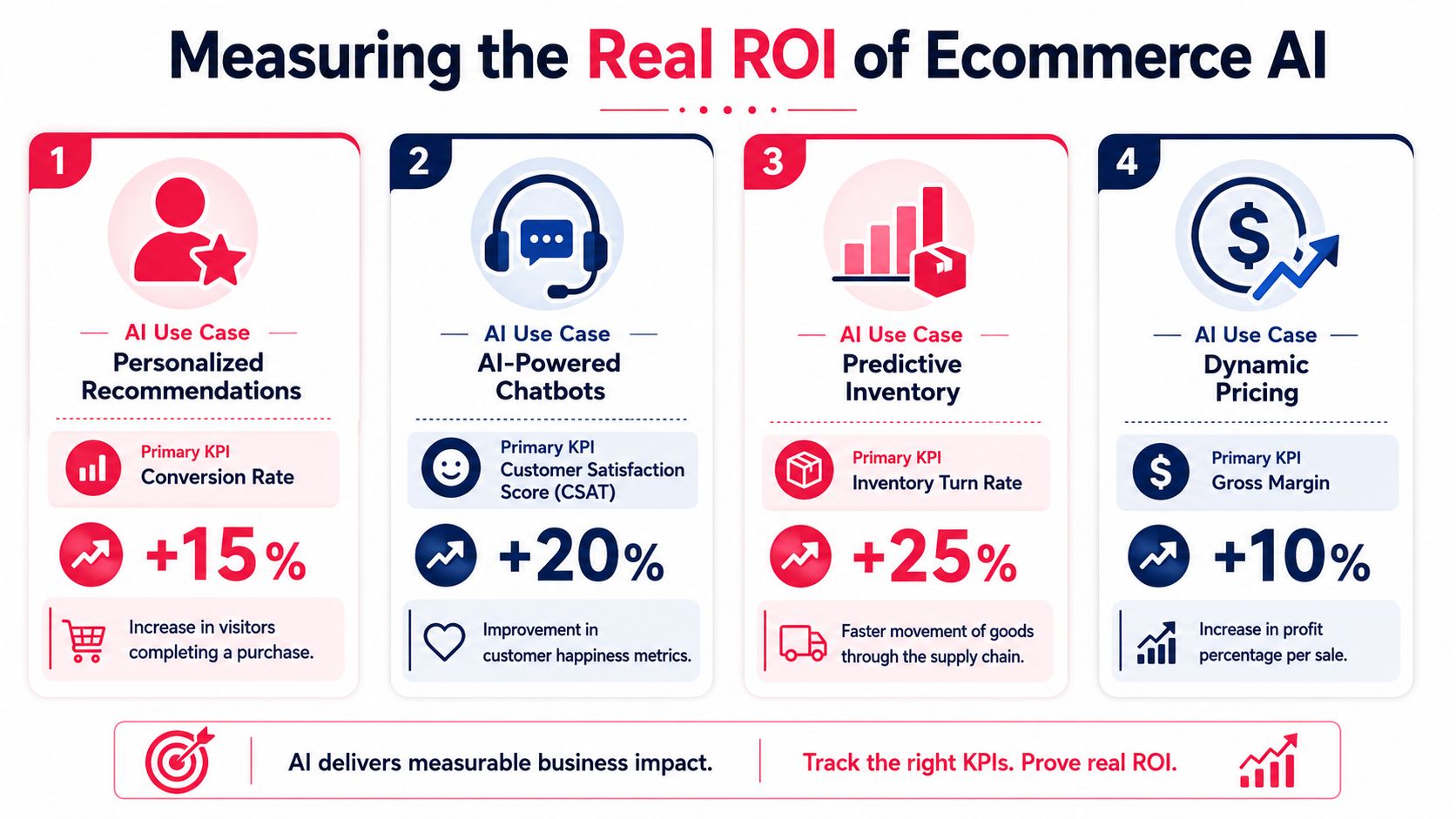
AI projects usually get approved on promise and judged on confusion. The fix is simple. Tie each initiative to one board-level business metric before implementation starts, then measure operational leading indicators that explain movement toward that metric.
Board-level metrics first
If the initiative is AI-driven CRO, don't report prompt count or variant volume by itself. Report experiment throughput, test win rate, and the conversion or revenue impact those tests influence over time. If the initiative is personalization, track AOV, conversion rate by audience condition, and repeat purchase behavior. If the initiative is AEO, measure visibility in generative answers for commercial queries and the downstream quality of that traffic.
I like to map each AI initiative to three layers:
- Primary KPI: The financial measure leadership already uses
- Operational leading metric: The activity signal that predicts outcome
- Decision threshold: What result earns rollout, revision, or shutdown
For teams building CRO systems, the throughput metric matters because speed compounds. The AI CRO measurement approach should connect test volume to actual commercial outcomes, not just team productivity.
If the dashboard tells you the model was busy, but can't tell you whether revenue moved, the dashboard is wrong.
Baseline before rollout
Set the baseline before the pilot touches production. Pull current conversion data, AOV, test velocity, traffic quality, or channel efficiency first. Then define the comparison window you'll use after launch.
The reporting format should stay simple:
- Baseline state: Where the metric sat before launch
- Intervention: What changed in workflow, content, logic, or delivery
- Observed impact: What moved and over what period
- Decision: Scale, iterate, or stop
That structure keeps AI in the same management system as every other growth investment. Which is exactly where it belongs.
A Practical Framework for Evaluating AI Vendors
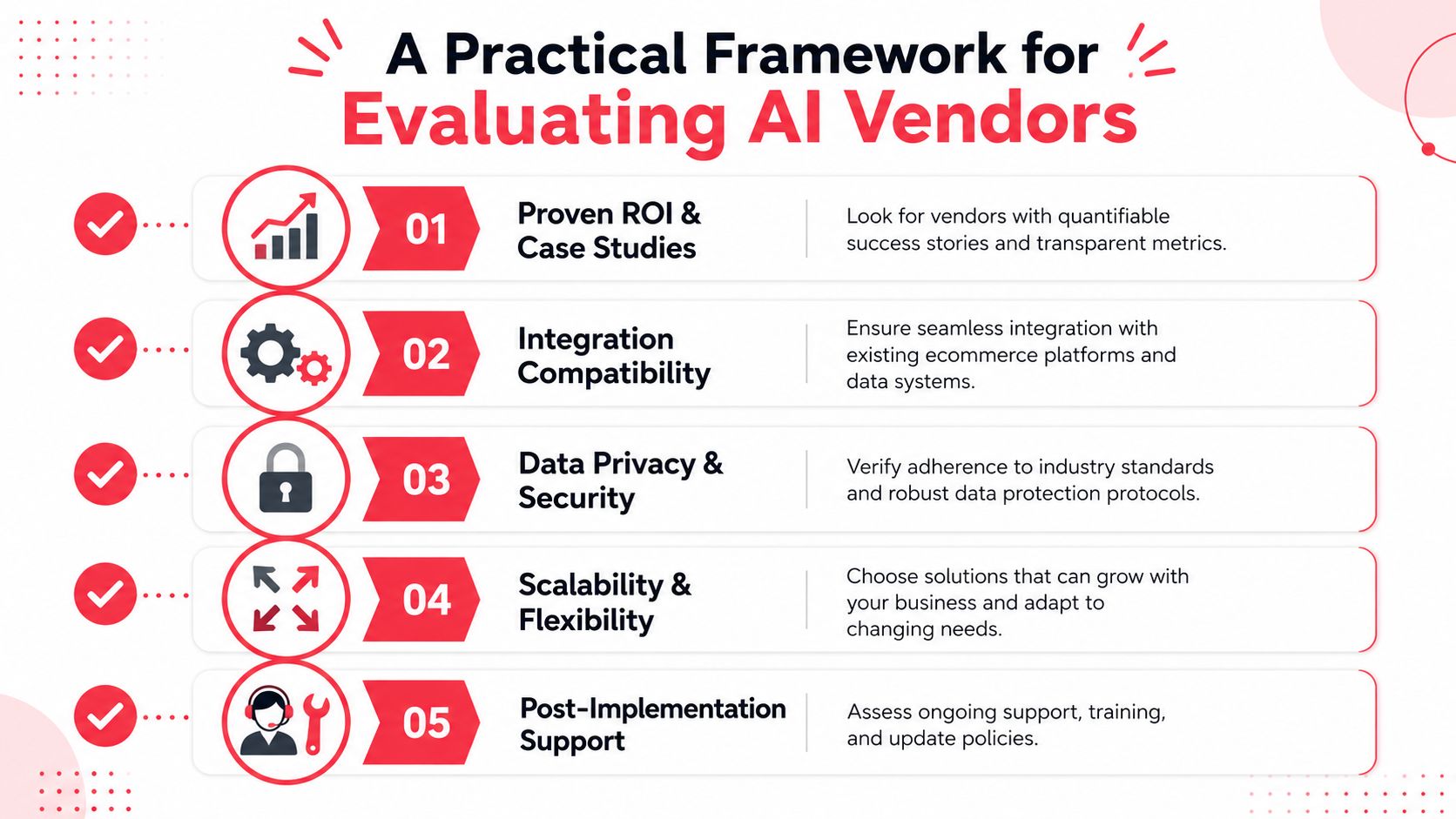
Most AI vendors can demo well. That's not the hard part. The hard part is finding out whether the product can fit your stack, support your team, and survive contact with real commercial workflows.
The questions I ask vendors
I start with integration depth. Can the platform connect to Shopify, BigCommerce, your analytics layer, your CDP, your email stack, and the data sources needed for action? If integration is weak, the product turns into another dashboard nobody uses.
Next is model transparency and control. I don't need a research paper. I do need to know how decisions are made, what inputs matter, where humans can review outputs, and how the team can override bad logic. Black box systems create political resistance fast, especially when they affect merchandising, pricing, or customer-facing copy.
Then I look at the delivery model:
- Implementation support: Who helps with setup, training, and early iteration?
- Operational ownership: What does your team need to own after go-live?
- Measurement design: Does the vendor help define KPIs and baselines, or just sell seats?
A vendor with a good product and a weak implementation model often fails in practice.
Red flags during diligence
There are a few warning signs I don't ignore:
- They sell capability, not workflow: If they can't explain who uses the tool, how often, and in which process, expect shelf-ware.
- They avoid measurement talk: If every answer returns to "efficiency" with no KPI structure, push harder.
- They require too much change at once: Large organizational shifts before proof usually stall.
- They demo edge cases instead of your use case: Nice demo. Wrong buying signal.
Ask for a live walkthrough using your category, your data shape, and your actual team constraints. The right vendor won't need a perfect environment to show fit.
Your First 90 Days An AI Implementation Roadmap
If you want traction, run a pilot with a business case attached. Don't start with a broad "AI transformation" program. Start with a contained initiative that teaches your team how to implement, measure, and govern AI in production.
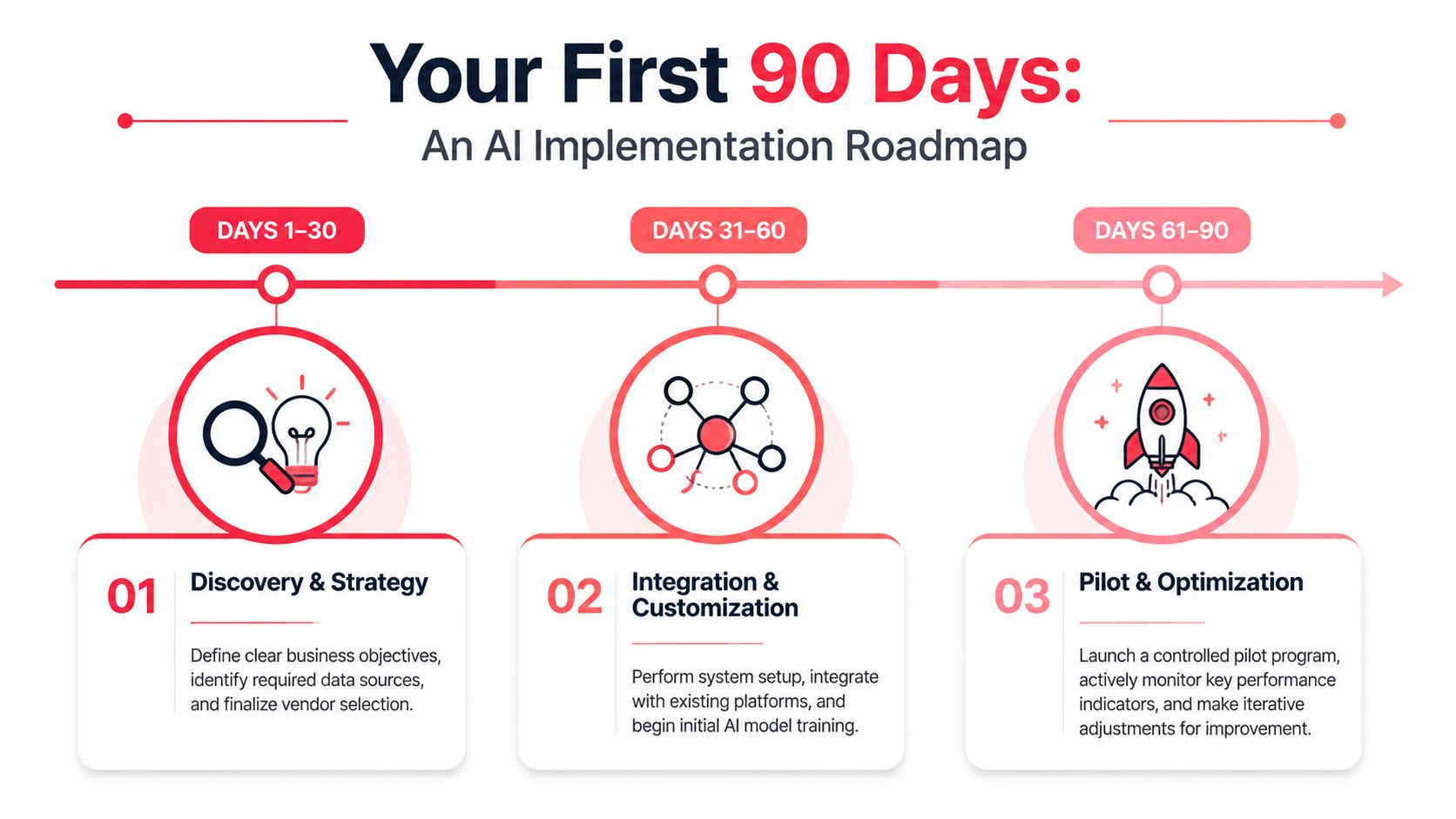
Days 1 to 30 select and align
Pick one initiative from the quick-win category that has clear revenue relevance. Good candidates include AI-assisted CRO on a high-traffic template, personalization on a product family with strong basket expansion potential, or AEO work on a narrow set of commercial pages.
Lock in four decisions early:
- Owner: One person owns delivery
- Metric: One success metric, with a baseline
- Scope: One journey, category, or workflow
- Decision date: When leadership reviews the result
If you need a planning structure, this AI implementation roadmap is the kind of document I want teams to build before tooling expands.
Days 31 to 60 implement and test
Now the team ships. Connect the data sources. Build the workflow. Train the people who'll use it every week. Keep the pilot narrow enough that the team can fix issues quickly without creating political drag across the company.
This phase is where discipline matters most. Don't add adjacent use cases because the vendor says you can. Don't chase polish. Get the workflow running, collect signal, and document what breaks.
Run the pilot in a real operating environment. Controlled doesn't mean artificial.
Days 61 to 90 measure and decide
By this point, you should have enough evidence to make one of three calls. Scale it, revise it, or stop it. All three are acceptable outcomes if the team learned something useful and made the decision with clean evidence.
The final review should answer:
- Did the metric move against baseline
- Did the workflow fit the team's operating reality
- What would wider rollout require
- Is this still a quick win, or has it become a strategic build
That last question matters. Some pilots prove value, then expose a much larger systems opportunity. That's a good outcome, but only if leadership recognizes the category change and funds it accordingly.
If you're deciding where to start, don't buy five tools and hope one sticks. Choose one revenue problem. Map it to one AI use case. Give it one owner and one scorecard. That's how AI for ecommerce becomes a management discipline instead of a boardroom talking point.
If you want outside help pressure-testing the opportunity, vendor fit, and rollout plan, Stimulead can support that through fractional CAIO advisory, team training, or a deeper AI growth partnership.