
62% of organizations are experimenting with AI agents, yet only 23% have scaled them in at least one function, according to independent 2026 adoption data. For CEOs, CMOs, and CROs, that gap is the decision: do you add another sales agent to the stack, or fix the operating conditions that determine whether any agent can affect pipeline?
At Stimulead, we've seen both outcomes. A research agent can remove manual work from an SDR's day, while a poorly governed agent creates duplicate records, inconsistent routing, and outreach that reps bypass. The software matters, but CRM grounding, ownership rules, review thresholds, and measurement decide whether the project leaves pilot.
Table of Contents
- The 62% Experimenting Problem No One Wants to Name
- What a Sales Agent Actually Is And What It Is Not
- Three Agent Workflows Wired Into the Marketing-to-Sales Pipeline
- How to Evaluate Sales Agent Vendors Without Getting Sold To
- The Audit Pilot Scale Roadmap With Exit Criteria
- Governance and Data Readiness Before You Add Another Agent
- Where Sales Agent Programs Quietly Fail
The 62% Experimenting Problem No One Wants to Name
The 62% experimenting versus 23% scaled gap is the central fact in AI agents for sales. The same source cites Deloitte data showing that only 14% of organizations are deployment-ready and 11% are in production. Adoption is moving faster than the operating model needed to control it.
That explains why so many sales-agent programs look successful in a demo and stall after approval. Teams connect a model to a workflow before they've agreed on which CRM record is authoritative, who owns the next action, or what counts as a qualified handoff. The agent produces activity, but nobody can prove whether that activity improved reply quality, meeting conversion, or pipeline creation.
Production requires more than a working demo
A production agent needs four conditions:
- Clean inputs: Account, contact, opportunity, stage, ownership, and consent fields must be reliable enough for automated decisions.
- Bounded authority: The agent needs explicit permission to read, write, recommend, or stop.
- Observable actions: Every meaningful decision needs a record, a reason, and an owner for review.
- A business baseline: The team must know what happened before deployment, or it can't establish incrementality afterward.
The practical mistake is treating an agent as a productivity purchase. A seller may save time while the company loses control of message quality or routing. That's why the first question shouldn't be, “Which agent can we buy?” It should be, “Which workflow is sufficiently defined to let an agent act without creating a second system of record?”
Operating rule: A sales agent is ready for production when the company can explain what it may do, what it must never do, and how a manager will detect failure.
The market is moving quickly. The broader AI agents market is estimated at about $10.91 billion in 2026, up from $7.63 billion in 2025, while sales adoption data cited by Laxis reports that 54% of sellers had already used AI agents and nearly 90% expected to use them by 2027. Those figures make experimentation easy to justify. They don't remove the work required to turn an experiment into a dependable pipeline process.
What a Sales Agent Actually Is And What It Is Not
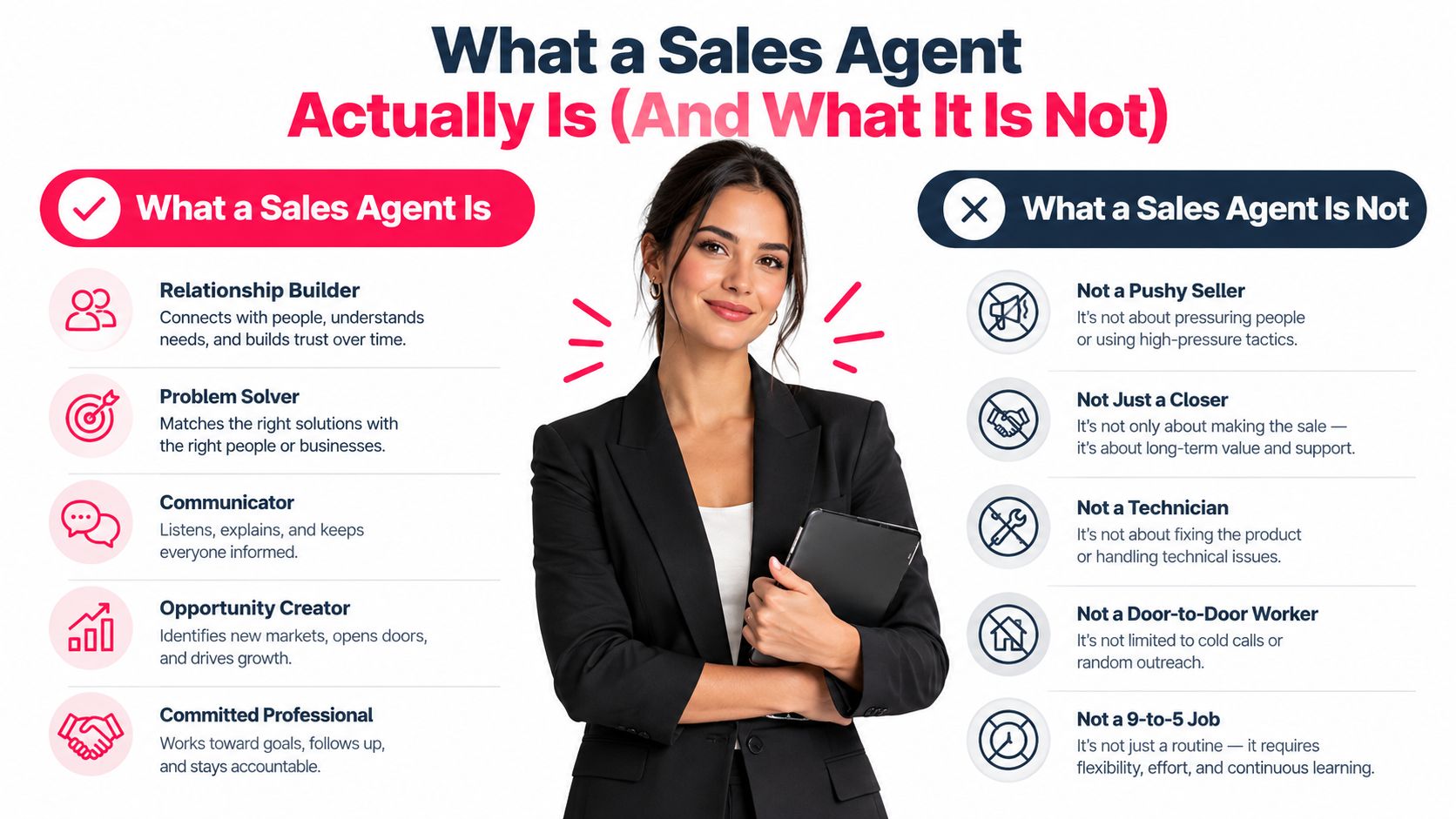
A sales agent is a system that uses business context, selects tools, takes bounded actions, and records the result against a sales workflow. A chatbot that drafts an email can be useful, but it isn't a full sales agent unless it can work from the relevant account and contact data, follow the organization's rules, and return an outcome to the CRM.
Microsoft's Sales Bench evaluates agents across research, outreach, and live qualification using real-world sales scenarios and human and AI-judged composite scoring. In its December 2025 evaluation, Microsoft reported that its Sales Qualification Agent outperformed ChatGPT-4, including a 16% higher engagement score for precise responses and targeted qualifying questions, as documented in Microsoft's benchmark report.
Four properties separate agents from copilots
Persistent context
The agent can use account history, previous touches, opportunity stage, product interest, and qualification rules without asking a rep to reconstruct the situation every time.Action execution
It can update a lead, create a task, route a meeting, or escalate a conversation. Suggestion-only tools can still help, but they leave the final operational step to a person.Role-based authority
An inbound qualification agent might schedule a meeting and update a lead status. It shouldn't approve pricing or send an unreviewed message to a strategic account.CRM grounding
The agent reads from approved records and writes structured outputs back to those records. If the work lives in a separate dashboard, the sales team must reconcile two systems later.
Microsoft's broader evaluation approach also considers accuracy, speed, trust, safety, and sustainability on real CRM data, rather than treating fluent text as a sufficient measure. Salesforce AI Research's CRM benchmark makes the same practical point through its emphasis on purpose-built evaluation for CRM workflows.
For vendor shortlisting, this changes the demo. Ask the vendor to operate against a cloned CRM environment, show failed qualification cases, and explain how the system handles incomplete or conflicting records. Vendors that avoid live CRM integration should receive a lower score, regardless of how polished the conversation sounds.
Teams comparing chat-based qualification with broader conversational agents for B2B sales should apply the same test. General fluency matters less than whether the agent asks the right qualification question, applies the agreed criteria, and creates a usable next step for the seller.
Three Agent Workflows Wired Into the Marketing-to-Sales Pipeline
The strongest starting points sit at handoff points where delay or missing context creates measurable leakage. We usually map the trigger, the record the agent changes, the human owner, and the metric that can falsify the business case.
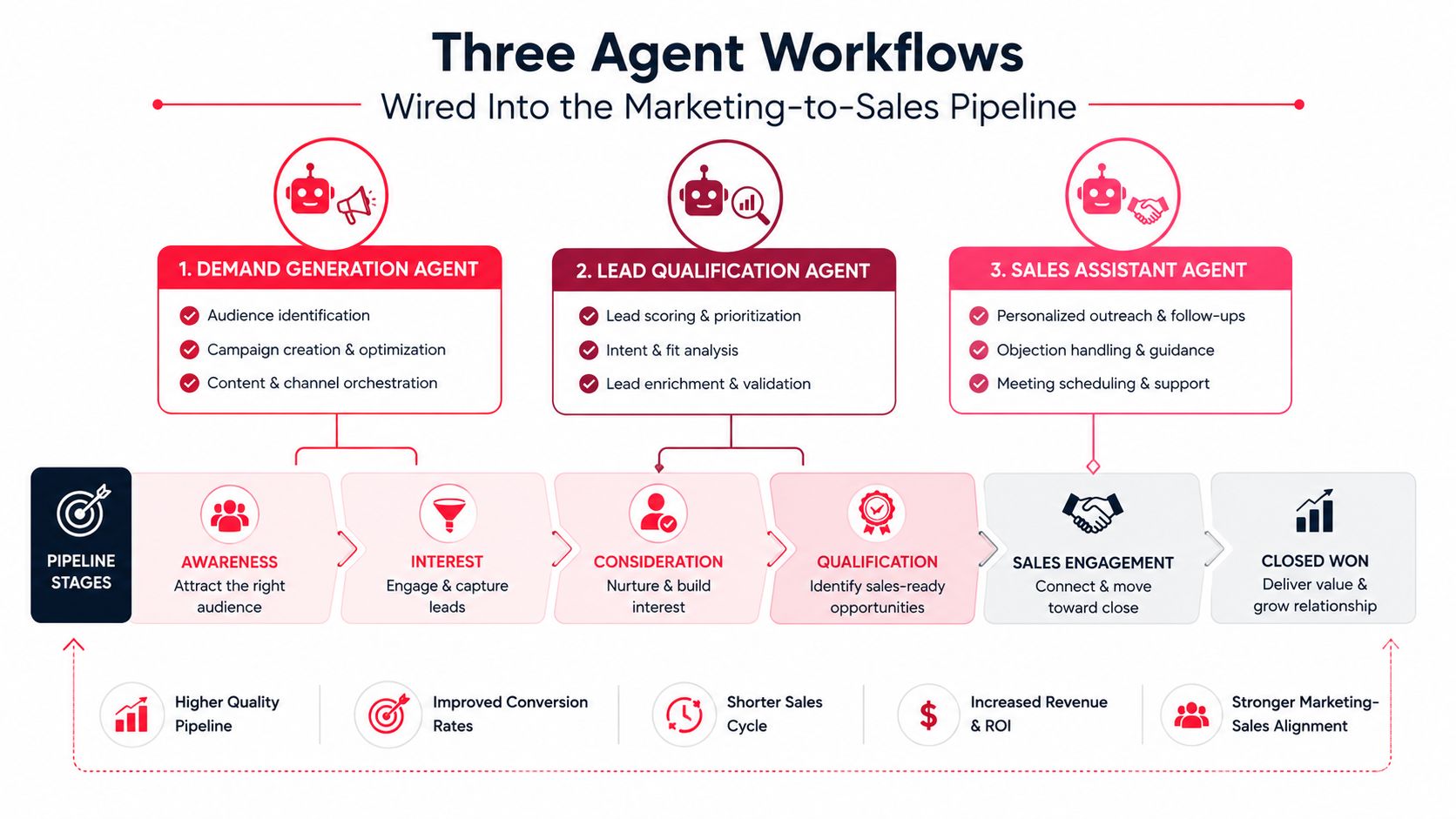
Lead research and enrichment
Trigger: A target account enters a campaign, a form is submitted, or a seller marks a record for review.
Tools: Clay, Apollo, 6sense, Clearbit, Salesforce, HubSpot, and a controlled model endpoint can form the stack. The agent gathers approved firmographic data, intent signals, prior engagement, and open opportunities, then writes normalized fields and a research summary to the account or lead record.
Human owner: The SDR or account executive reviews the evidence and decides whether the account belongs in an active motion.
Output: Measure research time per account, field completeness, routing accuracy, and the resulting meeting or opportunity rate. Don't count a completed enrichment job as success if sellers still need to rebuild the account picture manually.
External data collection can support this workflow, but the compliance and data-quality implications deserve attention. WebscrapingHQ's AI scraping guide provides useful context for evaluating where automated collection fits and where it should stop.
Outbound drafting and sequencing
Trigger: A qualified account enters an outbound sequence or an existing opportunity reaches a defined stage.
Tools: Outreach, Salesloft, Regie, HubSpot, and Salesforce can support drafting and task creation. The agent should use persona, account events, prior touches, opportunity context, approved proof points, and suppression rules. It can propose the sequence, but the first-touch message for a strategic account should remain under human review.
Human owner: The SDR manager owns the message policy. The rep owns the account relationship and approves the send.
Output: Track open rate, reply rate, positive reply rate, meetings booked, and pipeline created. Outreach's sales leader framework recommends connecting weekly measurement to core indicators such as open rate, reply rate, meetings booked, pipeline created, and closed-won revenue influenced.
Our signal-based selling approach fits this workflow when the agent uses a genuine account signal to prioritize a message instead of producing more generic touches.
Live qualification and routing
Trigger: A website visitor starts a conversation, submits an inbound request, or asks a product and buying-process question.
Tools: Qualified, Intercom, Drift, Salesforce Agentforce, HubSpot Breeze, and Microsoft's Sales Qualification Agent represent different approaches. The agent answers within approved knowledge, checks qualification criteria, offers a calendar slot, and writes the transcript, disposition, and next action to the lead record.
Human owner: Revenue operations defines routing and qualification logic. The AE or SDR receives the meeting with the context needed to continue discovery.
Output: Measure time to first response, qualified-to-meeting conversion, meeting attendance, opportunity creation, and disqualification accuracy. A fast response that routes poor-fit meetings to AEs is a cost transfer, not a pipeline improvement.
These workflows can share infrastructure, but they shouldn't share authority by default. Enrichment may auto-update approved fields, drafting may suggest content, and live qualification may schedule a meeting. Each requires a different review threshold.
How to Evaluate Sales Agent Vendors Without Getting Sold To
Vendor evaluation fails when buyers compare feature lists instead of operating behavior. Salesforce Agentforce, HubSpot Breeze, and Microsoft Sales Qualification Agent offer CRM-native paths. 11x, Artisan, and Regie represent standalone options that may support more focused workflows, though the buyer carries more integration work.
Start with a sandbox connected to a cloned CRM, not a vendor's clean demo records. Give every vendor the same scenarios: ownership is missing, a contact has opted out, the opportunity stage conflicts with recent activity, or the agent cannot establish qualification. Record whether it pauses, asks for help, writes an approved field, or takes an unsafe action.
| Criterion | Weight | CRM-Native, Agentforce, Breeze, MS Sales Qual | Standalone, 11x, Artisan, Regie |
|---|---|---|---|
| CRM grounding depth | Highest | Usually closer to native objects, permissions, and workflow rules | Must be tested at the connector and field-mapping level |
| Action execution | High | Can often write to CRM and trigger native actions | May depend on APIs, middleware, or separate task systems |
| Audit logs | High | Review platform and CRM logging together | Confirm retention, export, and reason-code support |
| Data residency | High | Evaluate the full cloud and model architecture | Require explicit hosting and processing details |
| Integration cost | High | Lower when your CRM configuration is standard | Can rise with custom objects and routing logic |
| Rep adoption friction | Medium | Familiar UI may help, though added controls can slow use | Focused UX may help, but context switching creates risk |
Microsoft's benchmark offers a useful reference because it evaluates sales behavior rather than generic text quality. Ask vendors to run comparable qualification scenarios and disclose failure patterns, grounding design, and recovery behavior. A general-purpose model may produce convincing language while still misreading your qualification rules or CRM records.
Use a practical framework to assess AI agent task success, separating task completion from outcomes such as accurate routing and usable records. Before reference calls, complete an AI adoption assessment for sales teams to baseline process ownership, data readiness, and manager capacity.
Pricing needs the same scrutiny. Model seat fees, usage charges, action volume, implementation, and monitoring. Hybrid per-seat and consumption pricing can make a successful pilot more expensive once the workflow runs across the full database.
Reference calls are operational diligence, not a customer-success formality. Ask what broke after the first few months, which fields needed redesign, how often managers overrode the agent, and whether reps kept using it without executive pressure. This is the diligence layer a fractional CAIO engagement typically owns, alongside implementation oversight and an AI roadmap.
The Audit Pilot Scale Roadmap With Exit Criteria
Run the deployment as a gated sequence, not a company-wide rollout. Each gate should answer whether the next investment is justified by evidence.
Audit
Spend two to three weeks mapping the current pipeline, documenting CRM data quality, and selecting one workflow with a measurable lift potential. Establish the baseline for cycle time, conversion, response speed, rep effort, and the relevant stage transitions.
The audit should name the system of record, process owner, compliance owner, and executive sponsor. Its exit criterion is a signed baseline report with named owners. If the team can't agree on the baseline, it isn't ready to judge an agent.
Pilot
Run the agent for six to eight weeks in one segment or team. Start with human approval for every external action during the first two weeks, then remove approval only where the error pattern and business risk justify it.
Instrument meetings booked, qualified-to-opportunity rate, time to first touch, rep hours saved, reply rate, and pipeline created. The pilot exits when it hits two of three agreed KPIs without reps bypassing the workflow. A team that ignores the agent or works around it hasn't validated the process, even if the model produces accurate text.
Scale
Expand to another segment only after audit logs are live, CRM fields update automatically, routing has an owner, and rollback has been tested. Use a holdout group of 10% to 20% of accounts receiving no agent touches to test incrementality, as recommended by Chronic Digital's field measurement framework.
Review attribution at 30, 90, and 180 days, and sample agent activity weekly with reason-coded overrides. That prevents the team from crediting the agent for pipeline that would have appeared through the existing process.
A scorecard can set explicit thresholds, but use them as operating targets rather than universal promises. One practical framework proposes lead response time under 5 minutes, CRM field completeness above 85%, meetings booked per rep per week up 20% against the pre-agent baseline, pipeline coverage at 3x quota, deal cycle length down 15%, and forecast accuracy within 10% of actuals, as described in this sales AI agent scorecard.
Governance and Data Readiness Before You Add Another Agent
The highest-impact sales-agent project may be CRM repair. Adding a second agent to unreliable routing, duplicate accounts, and stale stages gives the system more opportunities to make the wrong decision at higher speed.
Salesforce's governance research describes the need to evaluate agents on CRM-grounded behavior, trust, safety, and business-specific metrics. Independent reporting on UK and Ireland deployments found that 89% of organizations already deploy AI agents, while half of those agents remain in silos and only 54% have centralized governance with formal oversight, according to Computer Weekly's report. Adoption can therefore outrun control.
Three primitives belong in the operating model
Routing and ownership: Define the authoritative source for account, contact, opportunity, stage, territory, and consent. An agent must know whether it is allowed to act and which seller receives the result.
Action review tiers: Classify actions before deployment.
| Action tier | Examples | Default treatment |
|---|---|---|
| Auto-execute | Validated CRM field updates, task creation, deduplication suggestions | Permit within role and field rules |
| Suggest to rep | Email drafts, account summaries, lead scores, next-step recommendations | Require review and capture overrides |
| Block by default | External sends, pricing quotes, contract language, sensitive-data exports | Require named approval or keep disabled |
Observability: Log the input context, agent decision, action, timestamp, policy result, and human override. Add an immediate kill switch that a revenue operations owner can use without waiting for the vendor.
Data readiness means de-duplicating accounts, normalizing lifecycle stages, removing conflicting values, and closing stale opportunities older than 90 days where the sales process permits it. It also means confirming that call, email, and CRM data may be processed by the selected model provider under customer and contractual requirements.
A fractional CAIO can own this cross-functional layer when no internal leader has both executive authority and technical implementation depth. Our AI readiness assessment is one way to structure that review before the company commits to another agent.
Governance test: If nobody can explain why the agent changed a record, who approved its authority, and how to reverse the action, the workflow isn't ready to scale.
Where Sales Agent Programs Quietly Fail
The visible failure is usually a bad email or an incorrect lead score. The deeper failure is a missing operating control that lets the problem repeat.
Over-automated outbound
An agent can generate a large volume of plausible sequences while reply quality falls. Reps then stop trusting the drafts, prospects receive duplicate messages, and the sending domain carries the operational cost.
Set a reply-rate service level agreement by segment and review first-touch templates before they reach strategic accounts or higher-volume campaigns. Pause the workflow when the signal shows declining positive replies, rising opt-outs, duplicate touches, or rep edits that remove most of the agent's content.
Data leakage
An agent that reads CRM records, email, and call transcripts can expose personally identifiable information or confidential deal terms if the model endpoint and permissions aren't controlled. The risk is highest when teams connect a useful tool before security has reviewed its data path.
Require field-level redaction, approved deployment boundaries such as a vendor's virtual private cloud where appropriate, and security evidence including SOC 2 documentation when it applies to your procurement standard. The prevention step belongs to security and revenue operations together, not to an individual seller configuring a browser extension.
Rep deskilling
A sales team can lose discovery practice when the agent drafts every email, qualifies every lead, and summarizes every call. Junior reps may become efficient at approving output without learning how to identify a weak business case, challenge an assumption, or ask a follow-up question that changes the deal.
Preserve rep-authored touchpoints on key accounts, cap autonomy for discovery and pricing conversations, and use agent output in coaching reviews. The intervention signal is a widening gap between activity completion and seller judgment during call reviews.
| Failure Mode | Operational Signal | Prevention Step |
|---|---|---|
| Over-automated outbound | Falling reply quality, rising opt-outs, duplicate touches, heavy rep editing | Set reply-rate SLAs and require human approval for initial templates |
| Data leakage | Unapproved fields sent to a model, unclear retention, security exceptions | Use field redaction, approved hosting boundaries, and security review |
| Rep deskilling | Sellers approve drafts but struggle in discovery or qualification | Preserve human-led moments and review agent output in coaching |
The right response isn't to remove autonomy from every workflow. It's to match autonomy to risk, measure the result, and keep a human accountable for decisions that affect trust, pricing, and strategic relationships.
A sales-agent program should move forward only when the next action is clear: choose one bounded workflow, document its baseline, and assign an owner who can stop it. If your CRM data, routing, or approval rules are weak, fund that work first. Book a working session with Stimulead to audit the workflow, define exit criteria, and decide whether an agent belongs in production at all.
