
Top-quartile SaaS companies average around 71% growth when strong net revenue retention and CAC payback support a Rule of 40 score near 47%. Weaker-economics companies average only 10% growth, so the right SaaS growth agency must improve the mechanics behind growth, not decorate the reporting dashboard.
For CEOs, CMOs and CROs at growth-stage B2B companies, agency selection is an operating decision. The wrong partner creates activity, reporting noise and channel conflict. The right partner helps your team identify the constraint in the funnel, run disciplined experiments, validate attribution and improve the economics of acquiring and retaining customers.
We evaluate agencies by one standard: can they connect what ships each week to qualified pipeline, CAC payback, retention and pipeline velocity? If they can't, their service list is irrelevant.
Table of Contents
- Why Most SaaS Growth Agencies Fail to Move Revenue
- Service Models and Engagement Structures
- The Hidden Costs of Channel-Centric Approaches
- Evaluating Agency Competence Through Operating Loops
- Pricing Structures and Commercial Terms
- Setting KPIs That Predict Sustainable Growth
Why Most SaaS Growth Agencies Fail to Move Revenue
The main failure is economic misalignment. A SaaS growth agency that reports leads, clicks and impressions while ignoring CAC payback is optimizing a local metric instead of the company's operating model.
The benchmark cited above comes from DiMarTech's SaaS growth agency analysis, which compares companies with strong and weak revenue economics. The gap between roughly 71% and 10% growth tells us where agency selection should begin. Growth-stage SaaS companies need partners that can identify which part of the revenue system is limiting progress, then connect each experiment to a financial outcome.
The agency must own a loop
Most agencies still divide work into SEO, paid media, content, email and conversion rate optimization. Each specialist may perform competently, yet nobody owns the movement from visitor to qualified opportunity to closed-won business.
That creates a familiar pattern. Paid media reports cheaper clicks, content reports organic sessions, and the CRM shows little change in qualified pipeline. The agency can defend every task because no one agreed who owned the full commercial loop.
We look for an operating cycle with five parts:
- Audit the constraint. Review CRM stages, conversion paths, campaign data, product signals and sales feedback.
- Prioritize one or two KPIs. Choose the metric most connected to the current bottleneck.
- Run a focused experiment. Change the offer, audience, page, routing, follow-up or channel decision.
- Validate attribution. Check whether the result appears in the CRM and sales process, not only in an ad platform.
- Review and reallocate. Keep, revise or stop the test based on commercial evidence.
A useful external reference is Otter A/B's SaaS growth playbook 2026, especially for teams comparing channel activity with broader funnel execution. Your agency should explain how its own operating loop differs from a monthly status report.
For companies adopting AI across marketing and sales, the same principle applies. Stimulead's AI roadmap advisory is one example of a governance-first approach that evaluates use cases, vendors and implementation priorities before teams add more tools.
Practical rule: Ask the agency which commercial metric it will own, what data it needs to access and what decision it will make when the metric stalls.
Service Models and Engagement Structures
The service model determines how much control the agency has over decisions, how quickly the team can ship and whether learning stays inside your company. Three structures appear most often.
| Model | Best fit | Main benefit | Main risk |
|---|---|---|---|
| Project-based | A launch, audit or defined channel test | Clear scope and a fixed decision point | Knowledge leaves with the deliverable |
| Retainer | Ongoing acquisition and funnel work | Capacity for repeated testing | Scope expands unless governance is strict |
| Embedded advisory | A company that needs senior operating direction | Shared priorities across marketing, sales and product | Internal leaders must make decisions quickly |
Project-based work
A project works when the question is narrow. Examples include validating a new category message, rebuilding a demo page or auditing HubSpot attribution. Set an acceptance criterion before work begins. A deliverable should change a decision or create a system your team can run.
Project work fails when leadership expects a one-off campaign to create a compounding acquisition system. The agency can complete the agreed tasks while your internal team lacks the ownership, data access or cadence needed to continue the work.
Retainers
A retainer makes sense when the company has a functioning marketing foundation and needs ongoing execution. The agreement should define the backlog process, senior involvement, meeting rhythm, access requirements and the work that remains outside scope.
Retainers create value through repeated learning. They also create waste when the agency fills capacity with low-impact content, campaign maintenance or reporting that no longer serves the commercial priority.
Embedded advisory
An embedded advisory model places a senior operator close to leadership and the internal team. The advisor may set the measurement framework, select vendors, prioritize experiments and coordinate specialists while internal owners retain control of the company's systems.
This model suits companies where the problem is fragmented ownership. It's especially useful when the CMO needs stronger connection with sales operations, product analytics or AI implementation. Stimulead describes its fractional CMO agency service as an advisory structure that can include strategy, vendor evaluation and execution oversight.
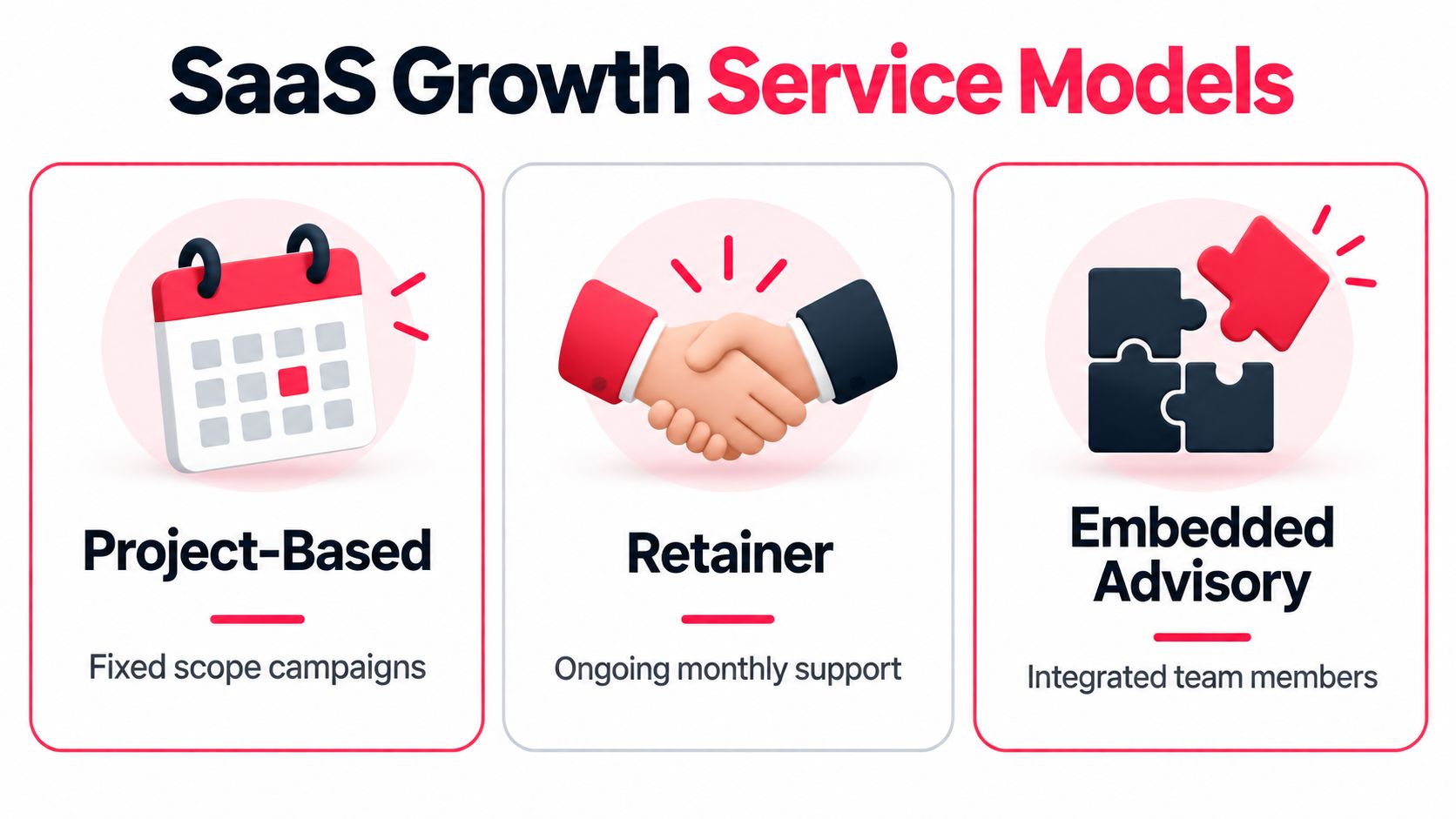
Choose the model based on the decision you need to make. Don't buy a retainer when you need a diagnostic. Don't buy an embedded advisor when nobody inside the company can approve changes or provide clean data.
The Hidden Costs of Channel-Centric Approaches
SEO and paid advertising matter, yet neither deserves automatic priority. The correct starting point is the stage where buyer movement breaks.
The B2B SaaS marketing benchmarks from Understory Agency show why a staged view matters. Typical visitor-to-lead conversion sits around 1.5% to 2.5%, lead-to-MQL around 20% to 35%, MQL-to-SQL around 13% to 35%, SQL-to-opportunity around 30% to 55%, and overall lead-to-customer around 2% to 5%. Each range describes a different operating problem, so more traffic won't solve a qualification failure.
Diagnose before reallocating budget
Suppose your visitor-to-lead rate is acceptable while MQL-to-SQL performance is weak. More paid search will increase the number of leads entering a broken qualification process. The agency should instead inspect audience definition, form criteria, routing, lead response and the agreement between marketing and sales.
The same logic applies lower in the funnel. If opportunities fail to close, the agency may need to improve offer fit, sales enablement, proof, pricing communication or deal progression. SEO specialists and media buyers can't solve every constraint.
| Agency recommendation | Question to ask |
|---|---|
| Increase paid search | Which downstream stage will improve, and how will we verify it? |
| Publish more content | Which buying stage and sales objection does each asset address? |
| Rebuild landing pages | Which conversion event matters after the form submission? |
| Add another channel | What attribution or operational gap does this solve? |
AI search adds another reason to stop thinking in isolated channels. Coverage from Arobis on SEO, GEO and AEO agencies for SaaS cites an estimate that 48% of queries trigger AI Overviews. Treat that figure as an external estimate, not a universal reporting standard. The practical question is whether your agency can track prompt coverage, citation share and repeat visibility against buyer-intent queries, then connect those observations to pipeline.
Traffic is an input. Pipeline velocity and payback are operating outcomes.
A channel-centric agency will defend its channel. A revenue-minded partner will recommend less activity when the evidence says the bottleneck sits elsewhere.
Evaluating Agency Competence Through Operating Loops
A polished proposal proves presentation skill. It doesn't prove that the agency can diagnose your funnel or make sound decisions with incomplete data.
We recommend a live evaluation built around the agency's operating loop. Give every shortlisted team the same high-level context, then ask them to show how they would work during the first several weeks.

Ask for the work behind the promise
Request a sample audit structure. You're looking for questions about ICP quality, sales-cycle friction, conversion paths, CRM hygiene, product activation and the handoff between marketing and sales. A competent agency won't prescribe a channel before it understands the commercial path.
Then ask these questions:
- What will you inspect first? The answer should name systems and evidence, such as GA4, HubSpot or Salesforce, ad accounts, call recordings, product analytics and landing pages.
- How do you choose the first KPI? The agency should explain how it separates a symptom from a constraint.
- What will ship first? Look for a specific experiment, instrumentation fix or message test rather than a vague strategy document.
- How do you handle missing data? Strong operators define a temporary measurement method and state what cannot yet be known.
- How do you validate attribution? Ask how campaign data connects to contacts, opportunities, pipeline stages and closed-won records.
- How do you report CAC payback? The answer should include the finance and revenue data required, plus the assumptions that could distort the calculation.
The B2B pipeline metrics overview from Rework gives useful stage context. It lists Discovery to Qualification at 60% to 70%, Qualification to Proposal at 50% to 60%, Proposal to Negotiation at 60% to 70%, and Negotiation to Closed-Won at 70% to 80%. It also distinguishes enterprise sales cycles of 6 to 18 months from high-velocity SaaS cycles of 15 to 45 days. Your agency should use your actual motion rather than importing a generic benchmark.
A second reference, SPOTIO's B2B sales funnel benchmarks, states the pipeline velocity formula as (# opportunities × average deal value × win rate) ÷ sales cycle length. Ask the agency to show how its work could affect each input and which input it can realistically influence.
For teams comparing implementation stacks, PostSyncer's guide to best tools for agencies can help structure a tooling review. Tools matter only when the agency can assign ownership, maintain data quality and use the output in weekly decisions.
Watch the agency explain a failed test. If it blames the audience, algorithm or client without showing what changed in the next cycle, you've learned enough.
Pricing Structures and Commercial Terms
Pricing should follow the operating problem, the required seniority and the amount of execution capacity. A low fee can become expensive when the agency lacks access to data, needs constant direction or produces work your team can't deploy.
Fixed project fees suit defined diagnostics and launches. Retainers suit ongoing testing, content production, media management or conversion work. Performance pricing can sound attractive, yet it often creates disputes over attribution, sales-cycle timing and factors outside the agency's control.
Structure the agreement around decisions
A hybrid model can work when the base fee covers the people and systems required to operate, while milestones relate to agreed changes in pipeline quality, conversion or CAC efficiency. Define the baseline, measurement window, exclusions and decision authority before signing.
Don't tie payment to raw lead volume. That encourages the agency to maximize form fills even when sales rejects the leads. Use commercial measures the agency can influence and your team can verify.
Your contract should specify:
- Access: GA4, HubSpot or Salesforce, ad accounts, product analytics and relevant finance data.
- Ownership: Campaign assets, landing pages, creative files, dashboards, audiences, tracking configuration and documentation remain accessible to your company.
- Exit terms: Define notice, handover support and the format of exported data.
- Review dates: Set formal decisions for continuing, changing or ending the engagement.
- Internal obligations: Name the people responsible for approvals, development, sales feedback and data quality.
The agency should also state what it won't do. If it doesn't own sales follow-up, product onboarding or pricing, those boundaries belong in the operating plan. Clear limits prevent the commercial review from turning into an argument about scope.
Setting KPIs That Predict Sustainable Growth
Your first monthly review should test whether the company is creating and retaining revenue more efficiently. Put website sessions and platform clicks in the appendix. They should not determine whether the agency continues.
Use metrics that expose economic quality:
- Net revenue retention: Tracks expansion, contraction and churn among existing customers.
- CAC payback: Measures how long acquisition investment takes to return.
- Pipeline velocity: Measures how quickly qualified opportunities progress through the sales process.
- Stage conversion: Identifies where opportunities lose momentum.
- Qualified pipeline created: Separates sales-relevant demand from raw contact volume.
- Activation or trial-to-paid movement: Applies to PLG and hybrid motions.
- Attribution coverage: Shows how much of the funnel has a traceable source and outcome.
The ClickMinded B2B marketing benchmarks report a typical website visitor-to-lead range of 0.8% to 2.5%, with stronger performers at 3% to 5%. The same source cites a 6.6% median landing-page conversion rate overall and 3.8% for SaaS pages, based on an Unbounce dataset of 41,000 pages, 464 million visits and 57 million conversions. Treat these figures as context, not targets. Your stage data should determine which constraint receives attention.
Use a decision cadence
Review leading indicators weekly while experiments are active, using a consistent framework for measuring marketing effectiveness across pipeline and retention metrics. Review CAC payback, retention and pipeline quality monthly or quarterly because sales cycles and revenue recognition can delay the signal.
The first operating period should establish a baseline, close measurement gaps and ship a small set of tests. Tactical changes may appear quickly. Structural improvement requires sustained execution across marketing, sales, product and finance.
Stimulead is one possible fractional Chief AI Officer partner for roadmap development, vendor evaluation, team training and implementation oversight. The fit depends on whether your company needs operating direction around AI and growth systems rather than another channel executor.
Before signing, require each agency to produce a one-page operating proposal covering the first audit steps, required access, KPI ownership, initial experiments, reporting cadence and exit conditions. Compare the proposals with current pipeline data. Choose the team that can make the next commercial decision clearer within your existing systems.
Book a working session with shortlisted agencies and require each one to map its first experiments to your CRM stages, CAC payback and pipeline velocity. If a proposal cannot show who owns those decisions, do not sign it.