
Stop buying a better list until you can name the owner of every handoff in your prospecting workflow. That's the decision in front of most growth-stage teams, and it's the opposite of the popular advice to fix outbound with more data, more personalization, or a new sequencer. In our work with B2B marketing and sales teams, we look first for the stage where work waits, arrives incomplete, or has no named owner, because that stage sets the ceiling for everything after it.
Table of Contents
- Prospecting Workflow Stages and What Each Must Produce
- Speed and Coverage Numbers to Test
- How to Build the Workflow in Five Ordered Steps
- Where AI Belongs and Where a Person Must Approve
- Failure Modes That Stall a Prospecting Workflow
- Confirm the Stage That Breaks Before You Rebuild
Prospecting Workflow Stages and What Each Must Produce
A prospecting workflow runs on six stages, and each one is a small contract: one decision, one defined output handed to the next stage, one metric proving the handoff landed. Map the contracts before you shop for software, because a platform only matters once you know which contract it serves.
The workload explains why informal handling fails. The Aslan Training guide reports that top sellers spend about six hours per week researching prospects, and that the average prospect takes roughly eight cold calls or outreach attempts before contact. That is production volume, and it needs scheduling and staffing to hold up. The tool category follows the work: enrichment or intent providers feed account selection and triggers, the CRM handles routing and suppression, and the sequencing engine runs the touches.
| Stage | Decision it makes | Output passed on | Metric to track | Owner |
|---|---|---|---|---|
| Account selection | Which accounts fit the ideal customer profile | Scored account list | Qualified accounts added per week | Marketing operations |
| Trigger detection | Which signals justify outreach now | Prioritized signal queue | Signal-to-meeting rate | GTM engineer |
| Contact capture and routing | Who owns the lead and how fast | Assigned owner with timestamp | Minutes to first human contact | Sales operations |
| Sequencing | Channels, touches and exit rules | Three to five step sequence | Positive reply rate by step | SDR manager |
| Suppression | Who must not be contacted | Unified suppression list | Suppression violations per month | Legal and RevOps |
| Qualification handoff | Which replies become pipeline | Qualified meeting | Opportunities created per 100 contacts | Account executive |
How to Read This Table
Find the stage where outputs stop arriving on time or arrive without an owner. A scored account list that nobody works produces the same pipeline as no list, plus tooling costs. A signal queue that nobody triages does the same.
Each row also gives you a test. For routing, measure minutes to first human contact against your current baseline. For sequencing, positive reply rate by step shows which touch earns the meeting and which ones only spend sender reputation. For suppression, violations per month works as a pass or fail audit rather than a trend to watch.
Trigger detection deserves particular care because weak signals consume SDR capacity before copy quality ever gets a vote. Our signal-based selling guidance covers priority tiers for that stage. For the suppression and sequencing rows, Molted Email's take on responsible AI outbound outreach is a useful check on where automation should stop.
No tool repairs a stage that nobody owns.
Speed and Coverage Numbers to Test
Speed is the clearest control point in the system, and the published numbers are large enough to test before you rebuild anything else. The Callingly speed-to-lead analysis covered more than 15,000 leads and over 100,000 outbound call attempts, and found that contacting a lead within five minutes carried approximately 100 times greater odds of reaching that person than waiting 30 minutes, and approximately 21 times greater odds of qualifying the lead.
Treat those odds as a reason to measure, not as a promise. They're an odds comparison from one analysis, and your offer, lead quality, and channel mix will shift the result. Still, a gap of that size means minutes to first human contact belongs on the same dashboard as meetings and opportunities.
Current practice is nowhere near that standard. The RevenueHero lead response times report tested 1,000 B2B websites and found only 365 companies responded to demo requests, with an average response of 1 day, 5 hours, and 17 minutes. Of companies that responded, 172 replied instantly and 12 took more than a week. If your company sits in the slow group, routing is a cheaper fix than rewriting copy.
Coverage Per Account
Coverage is the second number worth testing. The IntentSignal speed-to-lead analysis reviewed 25,138 sequence campaigns and found a 3.35% reply rate when two or more people at a company were contacted, compared with 1.61% for one person, while the per-person reply rate fell to 1.36% when a trio was contacted.
| Contact design | Reply rate | What it means |
|---|---|---|
| One contact per account | 1.61% | Control group for account-level tests |
| Two or more contacts per account | 3.35% | Account-level reply rate roughly twice the single-contact figure |
| Three contacts per account | 1.36% per person | Per-person rate falls as coverage widens |
Run two contacts per account against a single-thread control, with a primary operational buyer plus one adjacent stakeholder. Bucket response times as under five minutes, 5 to 30 minutes, and over 30 minutes. Judge both tests on qualified meetings, because a higher reply rate with flat meetings means you bought activity, not access to a buying group.
How to Build the Workflow in Five Ordered Steps
Build in this order so each step gives the next one clean input. Swapping the order is how teams end up with a sequencer sending to accounts nobody qualified.
The diagram below sets out the build order before the detail.
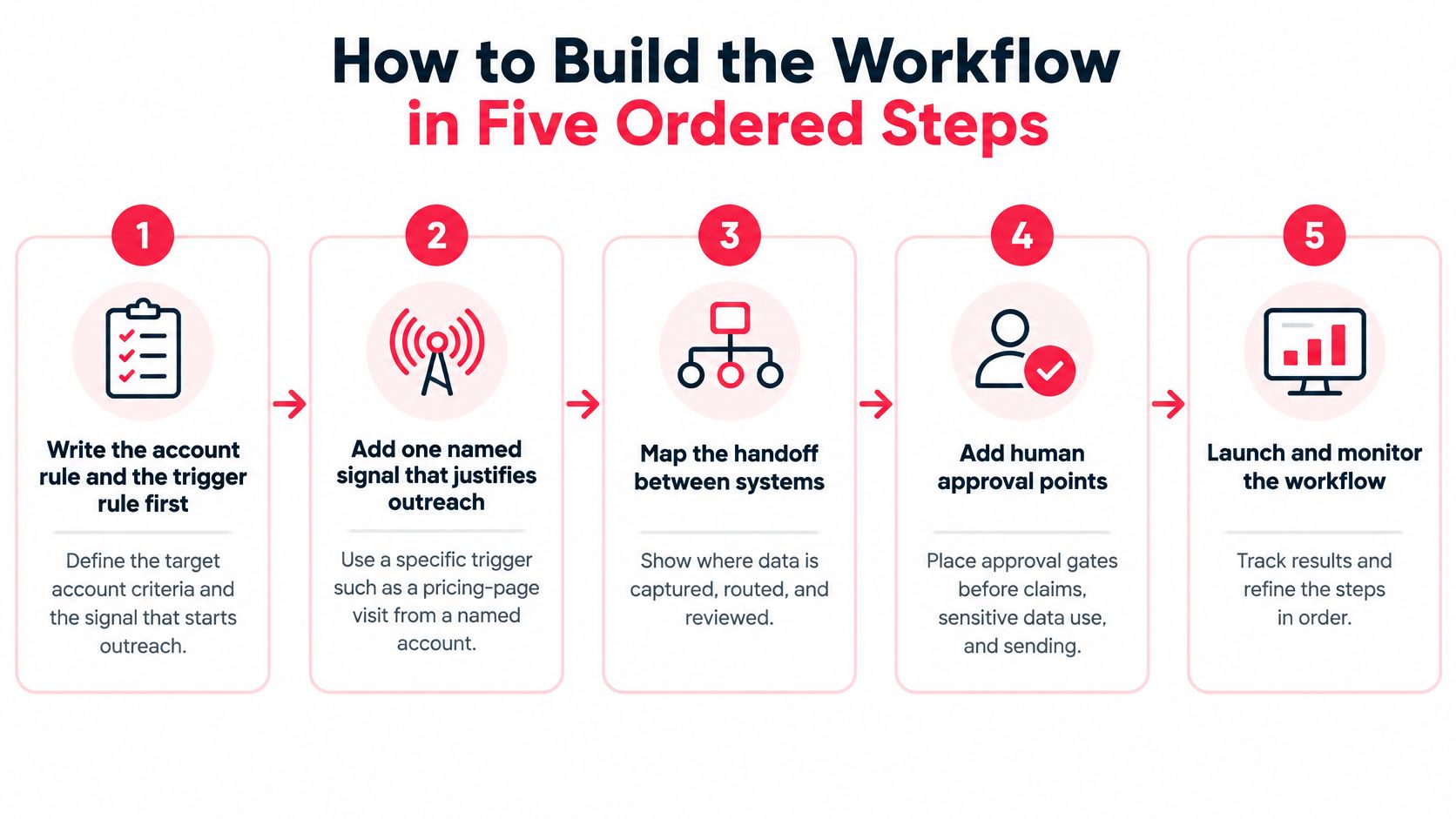
- Write the account rule and the trigger rule. State which companies qualify and name one signal that justifies outreach now, such as a pricing-page visit from a target account. Without both rules written down, reps decide case by case and the queue fills with accounts that fit loosely.
- Connect capture to routing in one system. Every form or inbound inquiry gets an owner and a timestamp at submission, and an automated acknowledgement fires within seconds. The five minute target becomes an operating rule rather than a hope, because the clock and the assignment live in the same record.
- Build a finite sequence with one purpose per step. Use three to five email steps that clarify the business problem, supply relevant proof, and offer a low-friction next step. Spread the remaining touches across calls and other channels, since email alone rarely carries the whole motion.
- Set exit conditions before launch. A reply, an opt-out, a disqualification, or an active opportunity removes the contact from every active sequence. Contacts who keep receiving automated follow-up after replying stop trusting the sender, and deliverability suffers with them.
- Add a suppression check before every send. Run the check on manual calls and created tasks as well as automated sends, then test it with synthetic opt-outs before launch. A suppression rule that only covers the sequencer leaves the highest-risk channel, the manual one, unguarded.
The sequence length in step three has a published baseline behind it. RAIN Group sales prospecting research covering 488 B2B buyers and 489 sellers reports that reaching an initial meeting or another conversion takes an average of eight touchpoints. The same research found top-performing prospectors generated 2.7 times more conversions and 1.8 times more quality outcomes than other sellers, and they were stronger at targeting the right buyers and articulating meeting value.
Plan for eight touches across channels rather than eight emails. A call that lands before the second email gives the follow-up context a cold email can't create on its own. For high-value accounts, we generally put the call earlier in the sequence than is common.
The video below walks through sequence construction in a format your SDR manager can use for training.
Reporting Rhythm
Review step-level reply rates weekly and meetings plus opportunities monthly. Change one variable per test, because adjusting cadence and message at the same time tells you nothing about which one worked. Report sequence results through to qualified meetings, opportunities created, and win rate, and retire any step that produces replies but no opportunities.
Where AI Belongs and Where a Person Must Approve
AI can run research, signal aggregation, and draft creation. A person approves any claim about a prospect, any use of sensitive data, and every message before it sends. That's the rule, and the table below assigns it task by task.
The reason for the gate is measurable. Salesforce generative AI statistics report that 54% of workers worry generative-AI outputs are inaccurate, 59% worry about bias, and 73% believe generative AI introduces new security risks. Among sales professionals, 47% don't know how to use generative AI safely and effectively. Gartner names reliability, data protection, and anomalous AI-generated content as continuing risks in sales workflows.
The image below shows the working arrangement we recommend, with a person reviewing output at the point of sending.

| Task | AI may automate | Human approves before use |
|---|---|---|
| Account research | Firmographics, technology stack and job-change pulls | Account fit confirmed by the owner |
| Signal aggregation | Grouping and scoring of intent signals | Owner reviews any signal before it routes |
| Draft creation | First-touch and follow-up drafts | Every message approved before sending |
| Claims about a prospect | Suggested personalization line | Each claim checked against a cited source |
| Sensitive data | Flagging fields that carry consent or jurisdiction | Legal basis logged before any use |
| Contradictory evidence | Flagging the conflict | Sequence stopped until a person resolves it |
The Evidence Trail Behind Each Claim
Require four fields for every AI-assisted claim about an account. Store the source URL, the retrieval date, a confidence rating, and a stop rule that fires when sources contradict each other. If a rep can't open the source behind a personalization line, the line doesn't ship.
This is also where automation scope should be decided rather than assumed. Our explanation of sales automation scope and limits sets out which parts of the sales process machines handle safely. For a related view on the qualification side, H2 explains how to use AI to qualify sales prospects without handing the judgement to the model.
An AI opportunity audit is a deep dive across conversion, search visibility, sales process, and data readiness that identifies where AI produces measurable gain and where it currently does not. Run that check and let the result set your approval gates, task by task. A workflow that sends fewer, better-supported messages usually beats one built to maximize output, and that trade-off matters most for regulated, enterprise, and multi-market teams.
Failure Modes That Stall a Prospecting Workflow
Optimizing reply rate alone is the most expensive failure mode. A high reply rate from poorly qualified prospects fills calendars with meetings that never become opportunities, and the SDR team looks productive while pipeline stays flat. Judge every sequence on qualified meetings and win rate, then kill sequences that win the reply metric and lose the pipeline one.
The second failure sits at the signal handoff. A pricing-page visit, a funding announcement, and a content download need different queues, different response times, and different owners. When all three land in one queue, reps work them in arrival order, and the signal with the shortest shelf life waits behind one that could have sat for a week. Assign each signal type an owner and a response-time target before you add another intent source to the stack.
Irrelevant outreach carries a cost beyond one ignored email. The RAIN Group prospecting statistics summary of Gartner research found that 73% of B2B buyers actively avoid suppliers that send irrelevant outreach. Poor targeting also damages sending reputation, so we recommend teams test email deliverability before scaling any new sequence to a wider list.
The Buyer Who Never Replies
A workflow built only for seller-led outreach misses the buyer who researches alone. According to Gartner's 2025 sales survey release, in 2024 61% of B2B buyers in a survey of 632 B2B buyers preferred an overall representative-free buying experience. Your sequence should link to proof a buyer can use without a call, such as a benchmark or an implementation explanation, while keeping a clear path to a person. The handoff between marketing's self-serve content and the rep's live outreach is where these buyers drop out, and our sales and marketing alignment guidance covers how to close it.
Be honest about the evidence base before you act on it. The speed odds come from one analysis, and most reply benchmarks come from vendor datasets with their own customer mix. If your team has no written ideal customer profile, no named stage owners, or no suppression list, automation should wait. Writing those three things down costs a week, and it determines whether the tooling you buy next has anything sound to run on.
Confirm the Stage That Breaks Before You Rebuild
Pull 30 days of data for the six stages and find the one whose metric lags furthest from target. Fix that stage first, because work upstream of a broken handoff produces inventory nobody processes.
- Routing above 30 minutes. Fix assignment and alerts before writing new copy.
- Replies rising, qualified meetings flat. Run the two-contact test and check account fit before adding touches.
- A stage with no named owner. Assign one person and one metric before buying tooling.
- AI drafts sending without approval. Add the approval gate this week and require the evidence trail behind each claim.
Every engagement we run starts with the question of where AI moves revenue in the client's business, and this audit answers the same question for outbound. Where signal rules are the gap, setting priority tiers comes before any new intent purchase.
This week, have the owner of your lagging stage book a 45-minute review of its metric, bring the last 30 days of stage data, and write down the one change they'll test first. If you'd rather have that diagnosis done across conversion, search visibility, sales process, and data readiness before you commit budget, talk to us at Stimulead about an AI opportunity audit and we'll tell you plainly where the gain is and where it isn't.
