
By 2026, Gartner projects that traditional search volume will decline by 25% as AI answer engines gain adoption, and 13.1% of U.S. desktop queries were already triggering Google AI Overviews as of March 2025 (Try Profound). If you still evaluate search as a traffic channel first, you're looking at an old scoreboard.
For growth-stage companies, answer engine optimization is a revenue issue. Buyers are asking ChatGPT, Perplexity, Gemini, Copilot, and Google AI Overviews for vendor comparisons, implementation guidance, product recommendations, and category education. The win condition has changed. Your page doesn't just need to rank. It needs to be the source an AI system selects, summarizes, and cites.
That shifts ownership. This can't sit only with an SEO manager. AEO touches content, web, analytics, sales enablement, product marketing, and conversion tracking. It belongs inside GTM strategy, alongside CRO with AI, GTM engineering, and agent commerce readiness.
Table of Contents
- Why Search Is No Longer About Clicks
- The New Goal Is Citation Not Ranking
- How Answer Engines Consume and Credit Your Content
- Your AEO Implementation Roadmap
- Measuring What Matters in AEO
- AEO Implementation Notes for Your Business Model
- Your First Move in Answer Engine Optimization
Why Search Is No Longer About Clicks
Gartner expects traditional search volume to drop 25% by 2026. For leadership teams, that changes the math behind organic growth. A program built to maximize sessions can look healthy in reporting while losing influence at the point where buyers form a shortlist.
The old model was straightforward. Rank for valuable queries, earn the click, then convert the visit into pipeline. AI interfaces interrupt that sequence by answering the question before the visit happens. They summarize options, frame the buying criteria, and often name vendors before your site gets a chance to do the job.
That matters at the revenue layer, not just the traffic layer.
The budget assumption that breaks
Many teams still budget search as a volume channel. More rankings should produce more sessions. More sessions should produce more pipeline. That logic weakens once answers are delivered inside Google, ChatGPT, Perplexity, and other AI interfaces.
A buyer can now ask for the best tools in your category, get a comparison, and leave with a preferred set of vendors without opening ten tabs. If your brand is missing from that answer flow, you lose consideration before attribution starts. Analytics will underreport the miss because the lost visit never existed.
Practical rule: Treat answer engine optimization as a distribution channel for commercial intent, not as an SEO side project.
What this means for the C-suite
The operating change is simple: search now shapes who gets considered, not only who gets clicked.
- For CEOs: Search spend now affects category presence and recommendation share. If AI systems do not mention your company for money queries, pipeline can soften before demand-gen dashboards show a problem.
- For CMOs: Content has to work in two modes. It must persuade human buyers and also give machines clear, quotable answers they can reuse.
- For CROs: AI-assisted discovery changes pipeline composition. Sales teams may see fewer early education calls and more buyers arriving with fixed assumptions about which vendors made the cut.
If your team is still optimizing primarily for blue-link traffic, start with a better model for influencing AI search answers. The immediate payoff is understanding how source selection affects revenue before competitors lock in the default recommendation position.
The New Goal Is Citation Not Ranking
AEO changes the scorecard. For leadership teams, the question is no longer whether a page holds position three or position seven. The question is whether your brand shows up inside the answer that shapes the shortlist.
A citation does more than create visibility. It places your company in the buyer's decision frame before the click, before the comparison page, and often before sales ever hears about the account. That changes how revenue should be modeled. In this channel, share of answer affects share of consideration.

What executives need to change
The operating question is simple. For your commercial queries, does the model mention you, cite you, or leave you out?
Ranking reports cannot answer that. They show page position, not recommendation presence. A CEO looking at pipeline risk needs a different view: whether ChatGPT references the implementation page, whether Perplexity includes the brand in category comparisons, and whether Google AI Overviews pulls language from your site or a competitor's.
That shift has budget implications. Teams often keep funding traffic production while underinvesting in answer-ready assets such as product comparisons, FAQ blocks, pricing explanations, category definitions, and implementation pages. Those assets are less glamorous than volume content, but they are more likely to influence high-intent discovery. The practical playbook overlaps with AI content marketing for answer-first discovery more than with a standard blog calendar.
A useful carryover from traditional search is snippet formatting. This guide to boosting visibility with snippets is worth reviewing because concise answers, tight headings, and extractable page structure still improve your odds of being reused.
SEO vs AEO Core Differences
| Factor | Traditional SEO | Answer Engine Optimization (AEO) |
|---|---|---|
| Goal | Rank pages on search results pages | Be cited inside AI-generated answers |
| Success metric | Organic traffic, impressions, clicks | Citation rate, share of answer, attributed mentions |
| Content focus | Keyword targeting and topic coverage | Direct answers, factual clarity, extractable structure |
| User interaction | Click through to evaluate options | Consume answer first, then decide whether to visit |
| Technical focus | On-page SEO, internal links, backlinks, crawl health | Schema markup, entity consistency, semantic structure, machine readability |
The trade-off leaders should accept
This work is usually operational, not flashy. Teams rewrite intros so the answer appears early. They add Q&A sections, tighten headings, fix schema, standardize product naming, and remove vague brand language that a model cannot interpret cleanly.
That is often the right trade because answer engines reward clarity before they reward style.
A long thought-leadership page can still rank and still help human buyers. But if the first usable answer sits halfway down the page, the engine may pull a competitor's cleaner explanation instead. Citation wins the consideration moment. Rankings only tell you where the page lives.
How Answer Engines Consume and Credit Your Content
Most executive teams don't need deep model architecture. They need to know why some pages get reused and others get ignored.
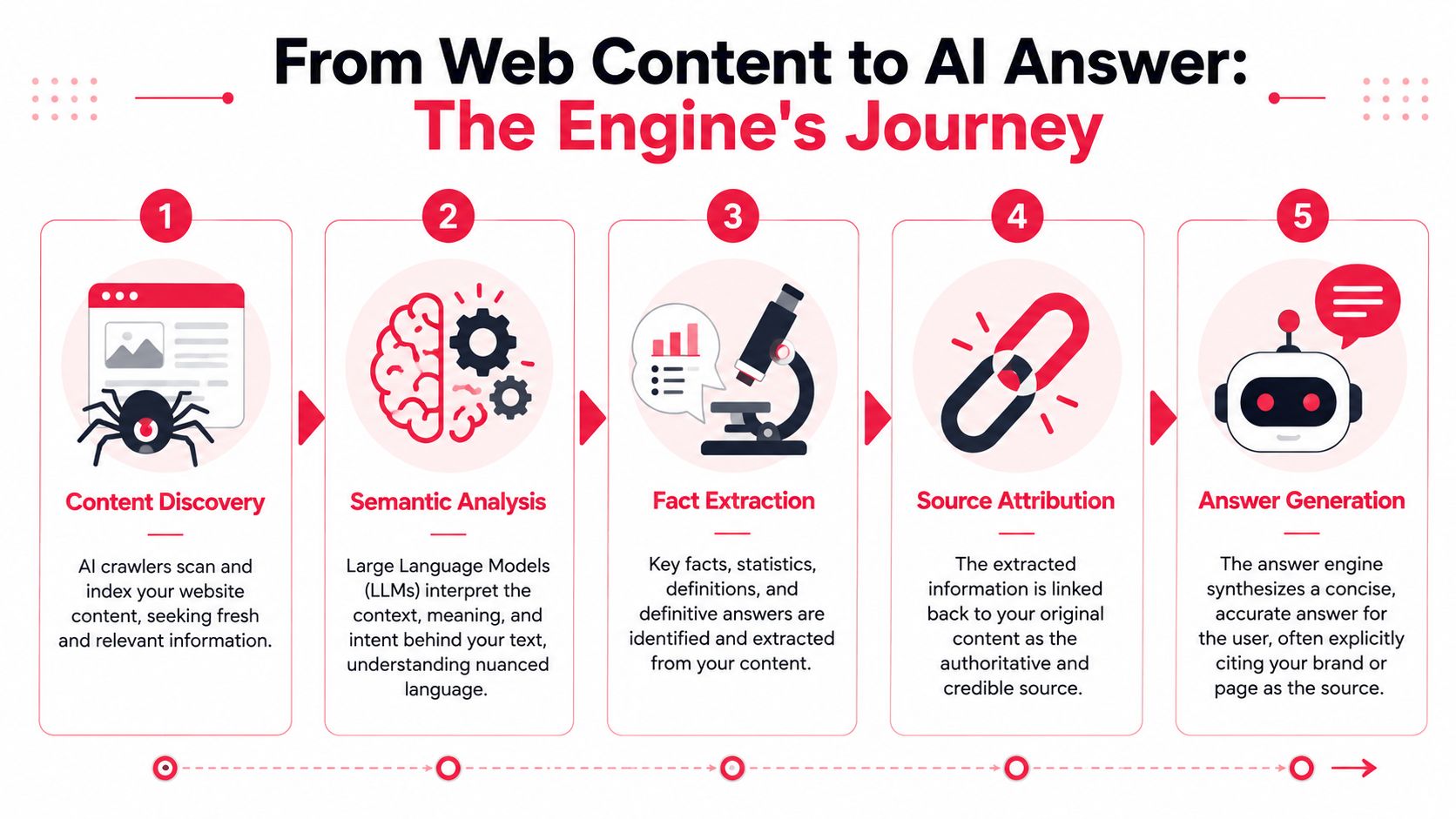
The easiest way to think about answer engines is this. A human can read a messy cookbook and still cook dinner. A machine wants a recipe card. It wants clear labels, direct steps, and facts it can extract without guessing.
Think like a machine not a reader
Answer engines scan for structure before they reward style. They need raw HTML they can crawl, semantic structure they can interpret, and answers they can quote or paraphrase safely. That's why pages built around abstract messaging often underperform, even when the copy is strong.
They also respond better to direct language patterns. Pages using close or exact language matches like “what is,” “how to,” or “does X work” are significantly more likely to be cited than pages built around abstract marketing phrasing (AirOps on LinkedIn).
The signals that get reused
Your team should assume the engine is looking for a short list of trust and extraction signals:
- Direct answer formatting: Headings that match query language, followed by an immediate answer.
- Structured facts: Bullets, comparison tables, short definitions, and explicit labels.
- Entity clarity: Consistent use of your brand name, product names, and category terms.
- Attribution support: Author details, source transparency, and credible on-page context.
- Technical accessibility: Clean HTML, limited reliance on JavaScript, semantic markup.
If you're scaling content production, review how your team creates answer-ready assets. A practical reference is Nuwtonic's framework for Create Content That AI Cites, especially if your current workflow still starts with brand storytelling instead of direct response structure.
This is also where content and technical SEO meet. Crawlable raw HTML, semantic HTML5, front-loaded key messages, and concise headings matter because they make extraction easier for answer engines (Amsive).
For leadership teams building AI search as a repeatable motion, the operating model should connect editorial, SEO, and product marketing. That's the same discipline behind effective AI content marketing systems. You need one team writing for humans and machines at the same time.
Good AEO content feels obvious when you read it. That's usually a sign the page is easy for machines to parse too.
Your AEO Implementation Roadmap
Companies that treat AEO as a content side project usually get activity, not pipeline. The teams that win set it up like a revenue channel. They start with pages that influence deals, make those pages easy for answer engines to extract, then connect the work to sales, support, and product signals.

Phase 1 fix extraction before you publish more
Start with assets already close to revenue. Pricing-adjacent pages. Product comparison pages. Solution pages. High-intent FAQs. Docs that sales reps send during active evaluations.
Then audit for answerability.
- Check structure: Can an answer engine find the question and the answer within a few lines?
- Check schema: JSON-LD Schema.org markup, specifically FAQPage, HowTo, and Organization, is required to explicitly communicate content types to AI systems (Parachute Design).
- Check crawlability: If the answer sits behind scripts or awkward rendering, extraction becomes less reliable.
- Check naming: Keep your brand name, product names, and category terms consistent across the site.
Skipping this step gets expensive fast. If high-intent pages are hard to parse, publishing more content just creates more pages that fail to earn citations.
A more complete cross-functional rollout model is outlined in this AI implementation roadmap for leadership teams. The same rule applies here. Build a process your current team can run every month, not a one-time sprint that dies after launch.
Here's a practical walkthrough to brief your team on the technical and editorial side:
Phase 2 build answer first assets
Once the site can be extracted cleanly, publish pages designed to earn citations and move buyers closer to a decision.
I would prioritize four formats:
Comparison pages
“Product A vs Product B” and “best X for Y” queries often sit close to purchase. Keep them factual, current, and easy to scan. If legal or product teams insist on vague language, citation rates usually suffer.Use-case FAQs
Turn repeated sales and support questions into standalone assets. “Does this integrate with X?” “How long does implementation take?” “What changes between plan A and plan B?” These pages reduce friction in live deals and give answer engines clean material to quote.Glossary and definition pages
These work when they support commercial topics instead of floating as an isolated SEO library. A definition page should route readers to a product, service, or next step.Process content
Short how-to pages perform well when they map to onboarding, rollout, compliance, or evaluation steps. They also tend to surface objections earlier, which helps sales teams address them before procurement stalls the deal.
Phase 3 connect AEO to GTM systems
This is the point where AEO starts behaving like a go-to-market program instead of an editorial experiment.
Use inputs your revenue teams already have. Sales call notes. CRM objection fields. Lost-deal summaries. Support tickets. Onboarding questions. Those are not just content ideas. They are records of friction that slows conversion or lowers win rate.
The financial case is straightforward. If one objection appears in enough deals, answering it clearly can improve conversion efficiency across multiple channels at once. Paid search traffic converts better when the landing page resolves the question. Sales cycles shorten when reps stop rewriting the same explanation. Answer engines get a page they can cite. One asset can reduce CAC and improve close rates at the same time.
For companies preparing for agent commerce, this work also builds machine-readable product context. That supports recommendation engines, shopping assistants, and AI-assisted buying flows beyond traditional search.
Operator note: If a question changes deal velocity, publish an answer-first page for it.
Phase 4 measure and iterate fast
AEO usually gives faster feedback than traditional SEO, which changes how teams should allocate effort. Run short testing cycles. Review citation movement on revenue-adjacent queries. Expand what earns visibility. Cut what does not.
Do not spread effort evenly across the entire site. A page that influences evaluation, pricing confidence, or implementation risk deserves attention before a top-of-funnel article does.
That trade-off matters for budget. If the content team has capacity for five updates this month, put four against high-intent query sets and one against broader education. Leadership should treat AEO the same way it treats paid acquisition. Fund the work that shows a path to pipeline first.
Measuring What Matters in AEO
73% of leadership teams I advise still review organic performance through a click-based lens. That misses how AEO creates demand. Prospects can see your brand in an AI answer, return later through branded search, direct traffic, or sales outreach, and never show up as a clean last-click SEO conversion.

Traffic is now a partial metric
Traffic still matters, especially if AI platforms send qualified visitors. But leadership should judge AEO by influence on pipeline, not by sessions alone.
The reporting model needs to separate standard organic search from AI-assisted discovery. Otherwise, AEO gets buried inside blended organic numbers and the budget conversation goes sideways. Teams keep funding what is easy to count instead of what improves revenue efficiency.
A practical starting point is simple. Track high-intent queries where citation could affect evaluation, pricing confidence, implementation risk, or vendor selection. Then compare visibility shifts against branded search lift, demo requests, qualified pipeline, and close rate movement in the same period. If visibility rises and revenue signals do not, the problem is usually message quality, page fit, or sales follow-up, not distribution.
Build an AEO dashboard leaders can use
Keep the executive view tight. Four metrics are enough if each one ties back to commercial outcomes.
- Citation share for priority queries: On your highest-value prompts, how often does your brand appear compared with direct competitors?
- Share of answer: Are you the primary source in the response, or just one citation in a long list?
- AI-influenced assisted conversions: Which opportunities included AI-referred visits, branded search growth, or known exposure to cited content before conversion?
- Platform-level presence: Measure Google AI Overviews, ChatGPT, Perplexity, Gemini, and Copilot separately. Performance rarely moves evenly across platforms.
Then give operators a second layer that explains what changed and who owns the fix.
| Metric | Why it matters | Team owner |
|---|---|---|
| Citation frequency | Shows whether pages are being selected as sources | SEO or content lead |
| Question coverage | Exposes unanswered commercial prompts | Product marketing |
| Assisted conversions | Connects answer visibility to pipeline | RevOps |
| Branded search lift after citation visibility | Captures delayed demand effects | Growth team |
One warning. Do not build a giant reporting stack before you define the query set that matters to revenue. Tracking every mention creates noise. Tracking 20 to 50 commercially meaningful prompts gives leadership a decision tool.
For teams that need a better cross-channel measurement model, this guide on how to measure marketing effectiveness is a useful companion. AEO should sit inside the same attribution and budget framework as paid search, outbound, and content.
The leadership question is simple. Did visibility increase on high-intent AI queries, and did qualified pipeline move with it?
AEO Implementation Notes for Your Business Model
AEO should map to revenue model first, content format second. The question for leadership is simple: which answers influence buying decisions early enough to create pipeline, and close enough to purchase to improve conversion rate.
SaaS
For SaaS, the highest-value pages usually sit in evaluation, implementation, and internal justification. These are the moments where a buyer asks an AI system for a recommendation, a comparison, or a plain-language explanation they can pass to a technical lead or CFO.
The pages I'd prioritize first:
- Competitor comparison pages: Buyers use AI tools to shortlist vendors before they speak to sales.
- Integration pages: Compatibility questions often signal active buying intent.
- Technical FAQs: Clear answers reduce friction for champions, security reviewers, and procurement.
- Use-case pages: Role-specific and workflow-specific pages help connect the product to real demand.
Specificity wins. “How does [product] compare to [competitor] for [use case]?” gives an answer engine something concrete to cite. A generic product page rarely does.
The trade-off is brand control. Legal and brand teams often want softer language, broader claims, and polished positioning. That usually lowers citation probability. If the answer appears three paragraphs down, another site gets the mention and your pipeline pays for it.
E-commerce and DTC
For e-commerce, AEO sits closer to merchandising and conversion than traditional SEO. If AI assistants become a shopping layer, your catalog has to answer product selection questions clearly enough for both humans and machines.
The commercial queries usually sound like this:
- Best product for a use case
- Does this product work for a specific need
- What is the difference between two product types
- How to choose the right product
That changes what a strong product page looks like. Merchandising copy alone is not enough. Product detail pages need structured attributes, concise summaries, compatibility details, care instructions, use-case language, and comparison content that can be cited without interpretation.
The implementation trade-off is operational. Expanding attribute depth across a large catalog takes coordination across ecommerce, product, and content teams. But the payoff is straightforward: better answer coverage improves discovery, and better-qualified discovery lifts conversion rate. For DTC brands, that is not just a visibility play. It is margin protection in channels where recommendation engines may influence what gets considered before a customer ever reaches your site.
Agencies and professional services
Agencies and service firms have two opportunities. They can use AEO to create their own demand. They can also package the capability into client delivery if they have the team to execute it well.
For firm growth, service pages should answer the buying questions prospects ask before they book a call:
- Who is this service for
- What does implementation look like
- How do you differ from a freelancer, in-house hire, or another agency
- What happens in the first month
For client work, the commercial advantage is category authority. A specialist firm can earn citations around regulations, workflows, definitions, pricing logic, and buyer education long before a prospect is ready to fill out a form.
Generic “full-service” positioning usually underperforms here. Answer engines need a clear category match. If your agency claims to serve everyone, across every service line, on every budget, you make it harder for the model to associate your firm with any specific commercial query. Clear specialization tends to produce better citations, stronger trust, and a shorter path to qualified conversations.
Your First Move in Answer Engine Optimization
Start with 10 money questions.
Not vanity keywords. Not broad awareness topics. Questions that buyers ask right before they book a demo, request a proposal, compare vendors, or make a purchase. Pull them from sales calls, chatbot transcripts, support tickets, onboarding friction, and lost-deal notes.
Then pick one.
Create the best answer on your site for that question. Keep it in raw HTML. Use a heading that matches how buyers ask it. Put the direct answer first. Add supporting detail, a short table if comparison helps, and the right schema if the format fits. Make sure the page names your brand, offer, and use case clearly.
That's the pilot.
If the page starts earning citations, brand mentions, or assisted conversions, you've got proof. Then you expand the system across product marketing, SEO, RevOps, and sales enablement. That's how answer engine optimization becomes a GTM motion instead of another isolated tactic.
If you want help building that motion end to end, Stimulead works with growth-stage teams on executive AI advisory, hands-on implementation, and ongoing fractional CAIO support across CRO with AI, GTM engineering, AI search optimization, and agent commerce readiness. The best next step is a working session around your revenue-critical questions, current AI visibility, and the fastest pilot to launch.