
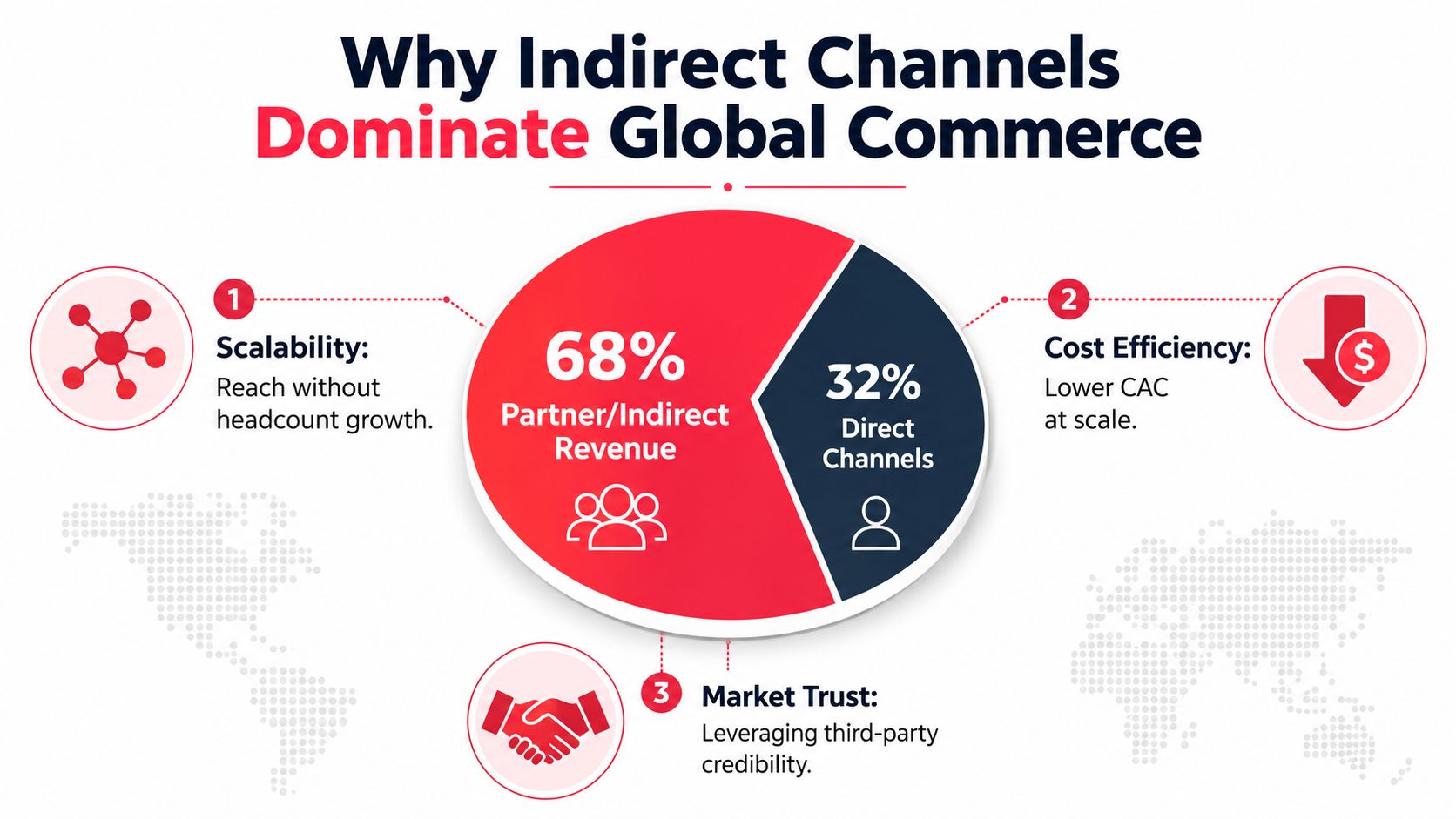
About 75% of global trade flowed through indirect channels in 2019, according to the WTO-linked trade data cited by Forrester analyst Jay McBain, with roughly $60 trillion of $80 trillion in goods traded purchased through an intermediary each year (TigerPistol's analysis of indirect channels). That changes the CFO conversation. Affiliates, referrals, resellers, marketplaces, and AI recommendations aren't side projects for when paid acquisition gets expensive. They often determine how buyers discover, evaluate, and purchase a product in the first place.
For growth-stage SaaS and ecommerce companies, the operating question is more specific: when does an indirect channel create incremental revenue at a better contribution margin than paid media, and how can you prove it? The answer depends on partner economics, customer quality, channel rules, and measurement. AI-mediated discovery adds another variable, because a buyer may now receive a brand recommendation from an LLM before visiting Google, an affiliate site, or your website.
Table of Contents
- Why Indirect Channels Dominate Global Commerce
- Comparing Channel Types by Unit Economics and Scalability
- Managing Channel Conflict Before It Destroys Margins
- Attribution Without User-Level Identity
- AI-Mediated Discovery as a New Indirect Channel
- When Indirect Channels Outperform Paid Media
- Your 90-Day Indirect Channel Implementation Plan
Why Indirect Channels Dominate Global Commerce
The 75% global trade figure is a useful correction to the way many companies allocate attention. Direct sales may offer control over messaging, pricing, and customer data, but intermediaries often provide the reach and trust required to enter markets efficiently. Distributors already understand local purchasing habits. Resellers may have established relationships with accounts your sales team can't reach quickly. Marketplaces package demand, payment, logistics, and buyer confidence into one environment.
The channel reduces friction because the intermediary already occupies a position in the buying process. A regional IT reseller can recommend a SaaS platform alongside implementation services. An ecommerce marketplace can put a product beside familiar alternatives, reviews, fulfillment options, and payment methods. An affiliate publisher can answer the buyer's comparison questions before the buyer engages with the brand.
The channel types that matter
Affiliate marketing pays publishers, creators, comparison sites, or networks for tracked actions. In SaaS, that might mean a software review site referring trial users. In ecommerce, it could be a creator demonstrating a product with a tracked purchase link. The model is measurable, though last-click rules can reward low-intent coupon or comparison traffic.
Referral marketing uses existing customers, users, or professional networks to introduce new buyers. The trust transfer is direct. A customer who recommends a workflow tool to a peer has already supplied context that a cold advertisement can't provide.
Resellers and distributors add sales coverage, local expertise, onboarding, fulfillment, or support. They work well when the product requires configuration or when a company needs regional access without building a full local operation.
Marketplaces supply built-in demand and transaction infrastructure. They can accelerate product discovery, but the seller gives up some control over customer access, merchandising, and margin.
Co-marketing partnerships combine audiences without requiring a full resale motion. A CRM company and an accounting platform might publish joint content, run a webinar, or build an integration that introduces each product to the other's users.
Operating principle: Treat the intermediary as part of the revenue system, not as an external traffic source.
The same principle applies to agent commerce. AI assistants can compare products, interpret requirements, and recommend vendors before a buyer reaches a brand-owned property. Companies preparing for that shift should understand what agentic commerce means for buying journeys and decide which product facts, proof points, integrations, and transaction paths an AI system needs to make a recommendation useful.
Indirect channels scale because they distribute work. Partners contribute discovery, credibility, selling, fulfillment, or service. Your company still needs to manage economics and governance, but it doesn't need to perform every activity itself in every market.
Comparing Channel Types by Unit Economics and Scalability
A channel decision should begin with contribution economics, not reach. Measure the cost of acquiring a customer, the revenue quality that follows, the margin retained after partner compensation, and the effort required to operate the program. A channel with cheap clicks can be worse than a channel with expensive referrals if the first group churns quickly or would have converted without the partner.
The matrix below uses qualitative operating ranges because CAC and LTV vary by product, contract value, audience, and partner agreement.
Indirect Channel Comparison Matrix
| Channel Type | Typical CAC | LTV Multiplier | Scalability | Attribution Complexity |
|---|---|---|---|---|
| Affiliate | Variable, often tied to commission or qualified action | Depends on traffic intent and customer fit | High through publisher and creator recruitment | Medium to high |
| Referral | Low cash acquisition cost, with incentive and program costs | Often stronger retention and lifetime value | Moderate, constrained by customer participation | Medium |
| Reseller | Includes enablement, margin share, and sales support | Can be strong where partners add implementation value | High across regions, slower to activate | High |
| Marketplace | Includes platform fees, promotions, and margin pressure | Depends on repeat purchase and customer access | High for distribution, limited for ownership | Medium |
| Co-marketing partnership | Shared campaign and production cost | Depends on audience fit and post-conversion quality | Moderate, constrained by partner capacity | High |
Affiliate programs are attractive when finance needs a clear payout formula. You can pay for a sale, qualified lead, or approved action, then compare partner-sourced contribution margin against paid acquisition. Rising competition can increase commission expectations, and networks can add operational complexity. Teams building this function may also benefit from an affiliate marketing careers overview because program performance depends on people who understand publishers, tracking, content, compliance, and partner development.
Referrals usually produce better customer quality when the advocate knows the buyer's needs. Verified benchmarks report that referred customers convert 3 to 5 times more often, show 18% lower churn, and deliver at least 16% higher lifetime value than leads from other channels (referral marketing benchmarks). Those economics don't mean referrals should receive unlimited budget. The channel grows at the pace of satisfied customers and credible advocates.
Resellers can create geographic reach that direct marketing can't replicate quickly. They also retain part of the gross margin and may control the relationship. Marketplaces offer faster access to demand, but fees, price competition, and restricted customer data can weaken long-term economics.
Use marketing effectiveness measurement guidance to connect channel reporting to revenue outcomes. For each channel, track sourced revenue, assisted revenue, gross margin after commissions, sales-cycle length, retention, and the internal cost of partner management.
Managing Channel Conflict Before It Destroys Margins
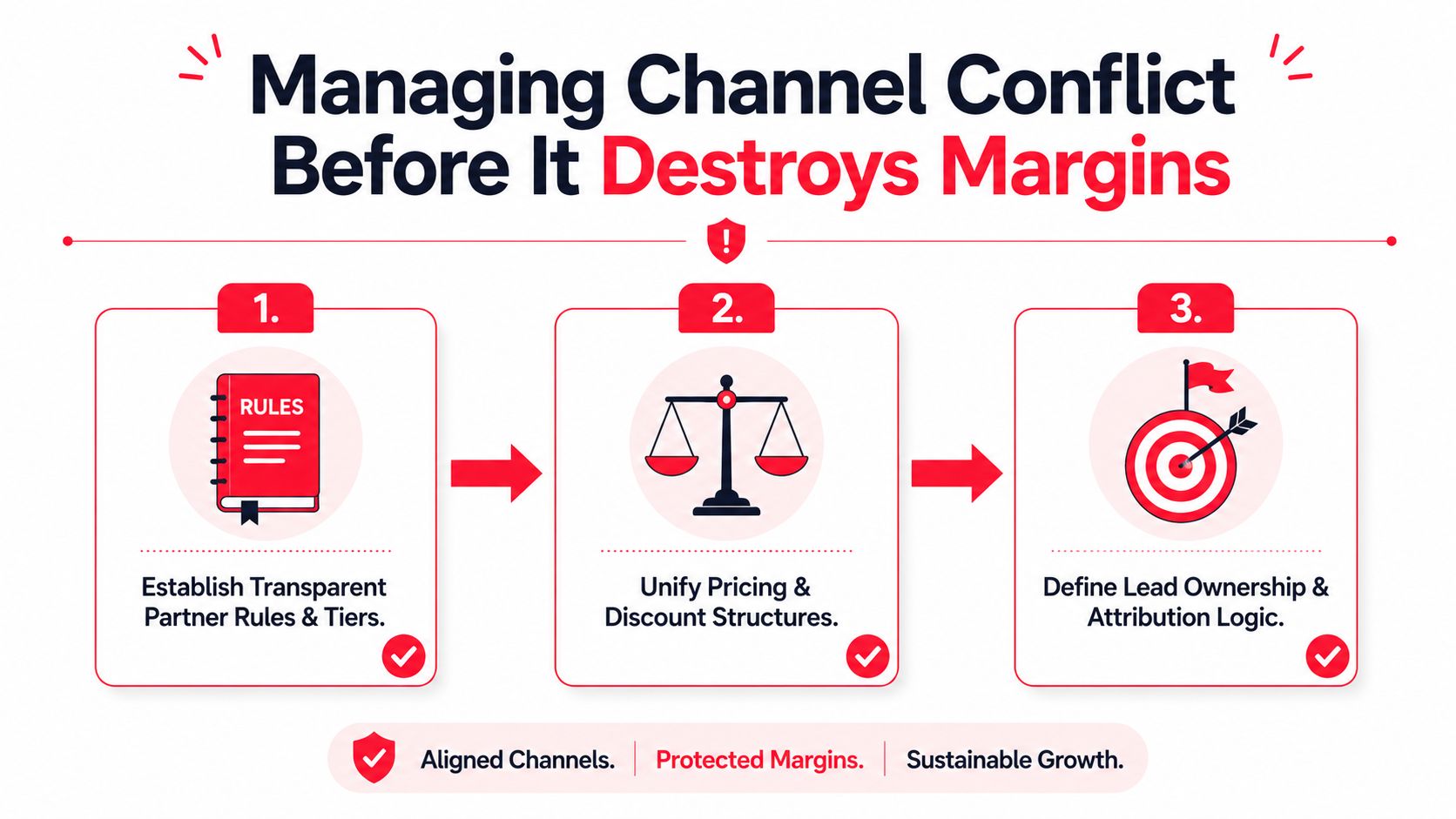
Channel conflict begins when two routes can claim the same buyer without agreed rules. The common flashpoints are inventory allocation, discount authority, territory boundaries, deal registration, representational policies, pricing, and direct sales bypass. An ICT supplier-reseller study found that moderate functional conflict could improve channel performance, while excessive conflict produced dysfunctional conflict that damaged performance (research on channel conflict and performance).
That distinction matters. Productive disagreement can expose weak pricing or poor enablement. Unmanaged disagreement creates discounting wars, partner poaching, disputed attribution, and slower closes.
Set rules before recruiting partners
Start with a written operating agreement. In a B2B SaaS program, it should define:
- Deal registration: State what evidence qualifies, how long protection lasts, and what happens when the partner stops progressing the opportunity.
- Territory assignment: Use customer segment, geography, vertical, or account ownership. Avoid vague language that lets several partners claim the same account.
- Discount authority: Set the maximum partner discount, approval requirements, and whether direct sales can match it.
- Lead ownership: Record the source, acceptance status, assigned seller, and required follow-up activity in the CRM.
- Escalation: Give channel operations authority to resolve disputes against a documented policy rather than informal influence.
Ecommerce agreements need similar precision. Define who controls marketplace pricing, which seller receives scarce inventory, how promotions are approved, and whether the brand can sell directly into an account served by a distributor. A partner program may also need a public participation path, such as the option to join the affiliate program, but open access doesn't remove the need for approval, content standards, or prohibited-traffic rules.
Use customer segments to set channel boundaries
BCG recommends analyzing existing customer segments with qualitative and quantitative research before mitigating e-commerce channel conflict (channel conflict guidance). Apply that approach before setting a universal route-to-market policy. Some buyers want direct checkout. Others need a reseller, service provider, distributor, or marketplace because of procurement requirements or local support.
A practical policy assigns each segment a primary route, an approved secondary route, and a clear exception process. Review conflict through margin, win rate, sales-cycle length, and partner activity. Don't manage it through partner sentiment alone.
Attribution Without User-Level Identity
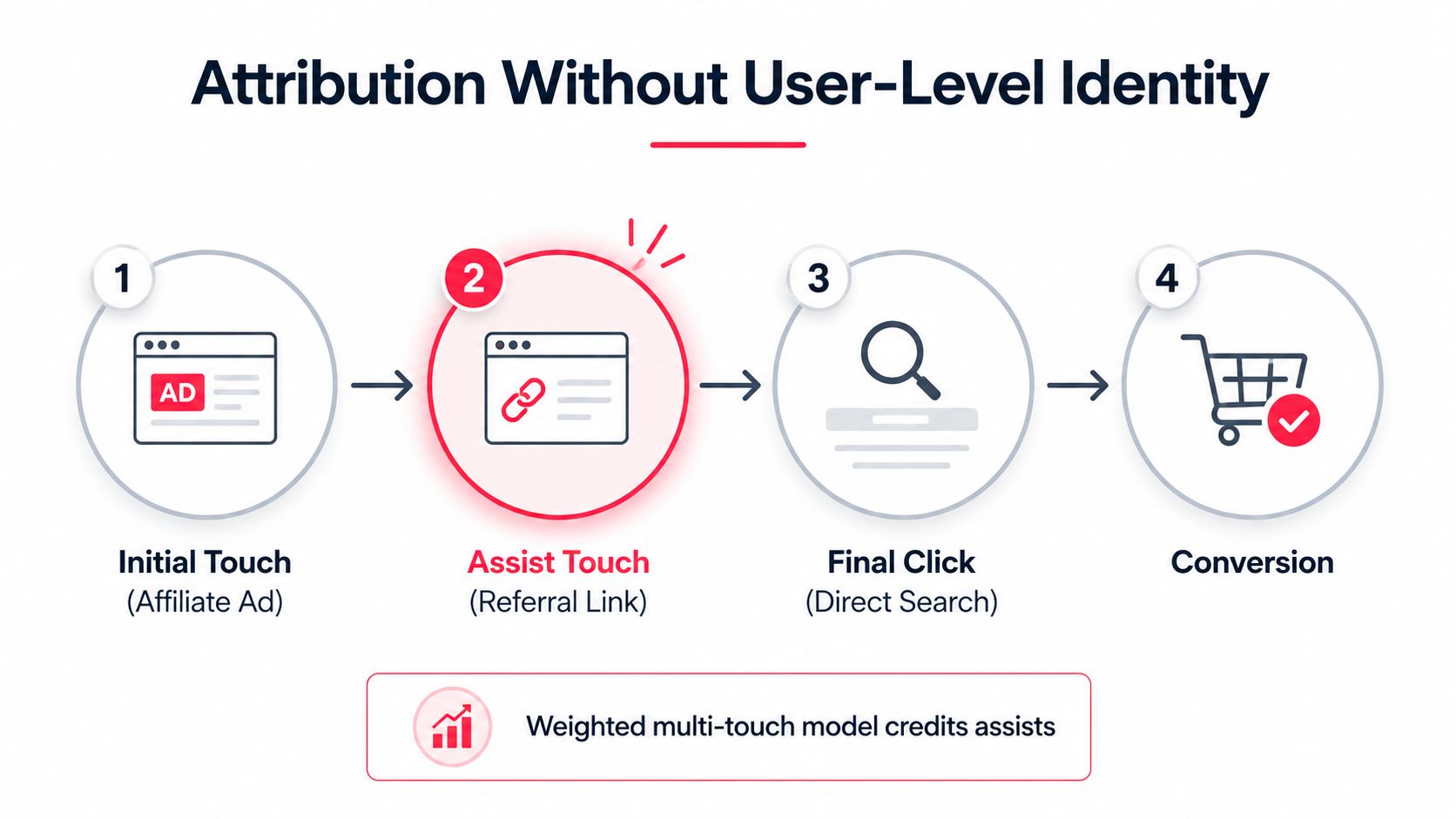
Last-click reporting favors the final interaction. Indirect channels often create earlier exposure, supply education, or transfer trust before the buyer searches directly. If the customer clicks a partner link, reads a comparison page, returns through branded search, and converts through the website, the final click can receive too much credit.
The answer isn't to assign every conversion to every touch. That produces a different form of fiction. The better approach is to estimate incremental contribution using aggregated exposure data and controlled comparisons.
Build an aggregate measurement layer
Advanced attribution research describes causal-driven frameworks that use aggregated impression-level data rather than user-level identity or deterministic click paths (causal attribution research). The model can compare exposed and unexposed groups at an aggregate level, account for timing and channel conditions, and estimate whether exposure changed conversion activity.
Your data team needs a consistent event schema:
- Exposure: Record partner, placement, campaign, audience context, date, and geography where permitted.
- Outcome: Record qualified pipeline, purchase, revenue, margin, retention, or another agreed business outcome.
- Control: Define a comparison group or market condition that provides a reasonable counterfactual.
- Decision: Convert the estimated lift into budget, commission, placement, or partner-management decisions.
The model should also separate assisted influence from incremental influence. An affiliate may introduce a buyer who was unlikely to convert without the exposure. Another may capture a coupon click from someone who already intended to purchase. Both interactions can appear in a tracking platform, but they don't have the same economic value.
Measurement rule: Credit should follow changed behavior, not merely the presence of a tracking parameter.
For teams working on conversational journeys, chat-driven revenue attribution offers useful context for connecting chat interactions with downstream conversion analysis. The broader operating principle is the same: preserve privacy, measure contribution at the channel level, and avoid making budget decisions from a single touchpoint.
A fractional CAIO or internal analytics lead can turn the model into a recurring review. Compare partner cohorts, placement types, customer quality, and post-conversion behavior. Then adjust commission rules and investment based on contribution margin rather than reported clicks.
AI-Mediated Discovery as a New Indirect Channel
AI recommendations create a channel that most partner programs still ignore. A buyer can describe a problem to an LLM, receive a shortlist of brands, and move into evaluation without starting with a traditional search query. The recommendation comes from an intermediary system, even though no affiliate link or reseller may be involved.
Accenture reports that 18% of active generative AI users prefer generative AI as a purchase-recommendation source, ahead of online marketplaces and search engines within that segment (Accenture's report on consumers, brands, and AI). A separate 2026 study, summarized in industry reporting, found that LLMs recommended brands in 19% of problem-unaware prompts, 28% of problem-aware prompts, and 79% of solution-aware prompts. Those figures describe a new discovery surface. Brand visibility can begin before the buyer knows the category or product name.
Make the company easy for an AI system to recommend
AI Search Optimization, or AEO, requires more than publishing pages around broad keywords. The brand needs clear, consistent evidence that answers the questions an LLM uses when comparing options.
For a SaaS company, that means maintaining:
- Product capabilities and limits in plain language
- Integrations, supported workflows, and implementation requirements
- Pricing structure or a clear explanation of how pricing works
- Security, compliance, and procurement information
- Customer evidence that describes the problem and outcome without inflated claims
- Comparison pages that state where the product fits and where it doesn't
For ecommerce, add structured product data, accurate availability, specifications, shipping information, returns, compatibility, and review content. The information must remain consistent across the website, marketplaces, partner pages, documentation, and third-party references.
Bazaarvoice found that 55% of consumers trust generative AI tools and shopping agents for at least some things, rising to 75% among people aged 18 to 34, as reported in the same Accenture source. Trust raises the cost of being vague. If an AI system can't establish fit, it may recommend a competitor with clearer documentation.
Stimulead works across CRO with AI, GTM engineering, AEO, and agent commerce readiness, which are practical workstreams for this channel. A company can test how often its brand appears in relevant prompts, audit the evidence supporting those recommendations, and improve the destination experience once AI sends a buyer to the site. Read more about AI shopping agents before treating agent commerce as a future-only project.
When Indirect Channels Outperform Paid Media
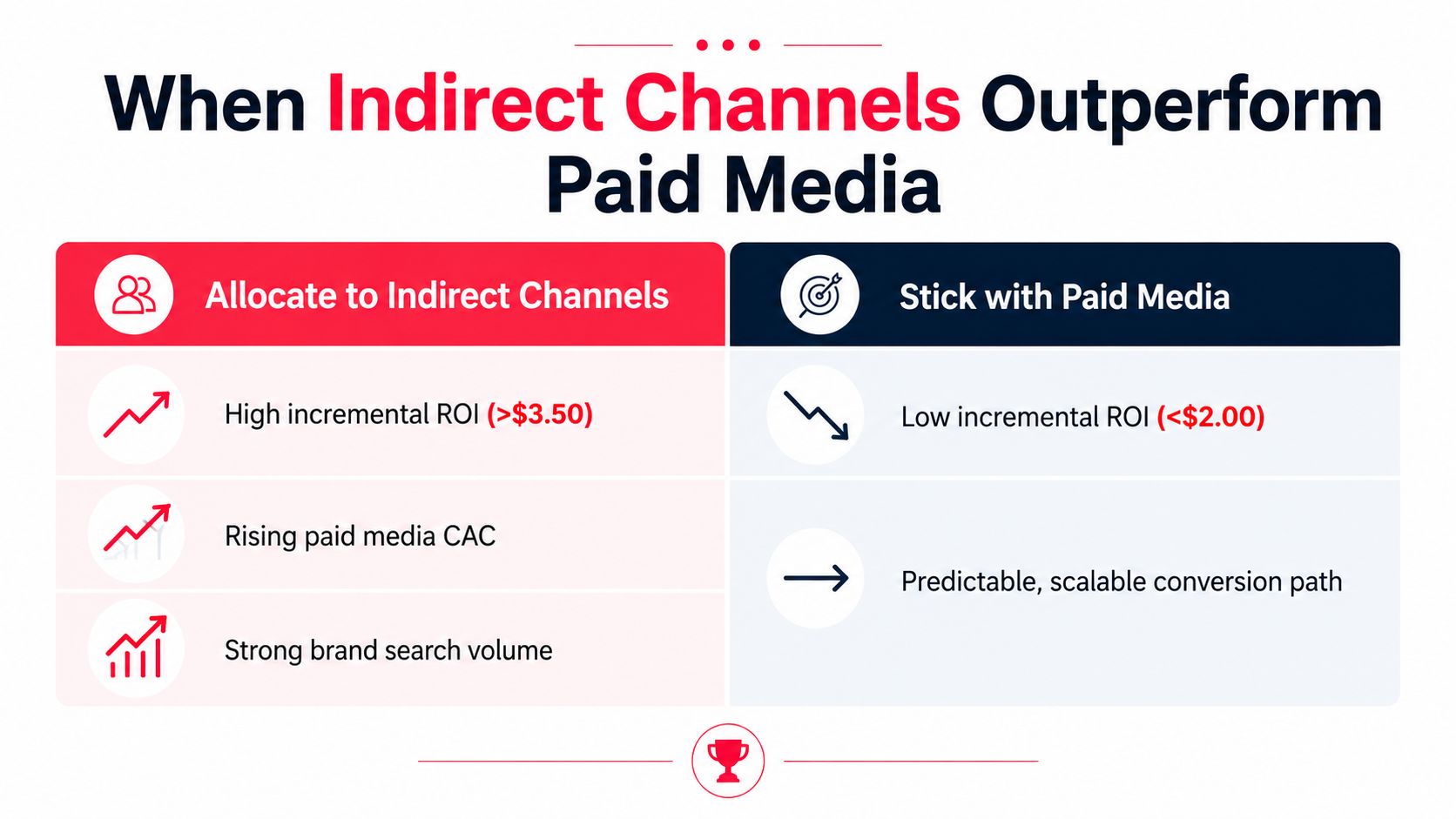
The CFO-level test is incremental contribution margin per dollar, not attributed revenue. An indirect channel outperforms paid media when the partner exposure changes buyer behavior and produces more contribution after commission, incentives, platform fees, sales support, and retention differences.
Track four operating measures:
- Partner-sourced pipeline: Separate accepted, qualified, and closed pipeline. Don't count every submitted lead.
- Referral revenue share: Measure the portion of revenue from referred customers and compare their retention with other cohorts.
- Affiliate incremental ROAS: Test whether the affiliate caused the conversion, especially for branded search, coupon, and retargeting placements.
- Net contribution margin: Deduct partner payout, discounts, marketplace fees, enablement, operations, and customer support.
Affiliate marketing has meaningful budget scale. Industry roundups estimate the global market at $32.3 billion in 2024 and project $37.3 billion in 2025, while the same source estimates U.S. affiliate spend at $9.1 billion in 2023 and projects $11.2 billion in 2025 (affiliate marketing benchmarks). Another benchmark reports that 74% of brands generate 11% to 30% of total revenue from affiliate marketing. These figures establish the channel's maturity, but they don't prove that any individual partner is incremental.
Reallocate budget with evidence
Move budget when paid CAC rises beyond the level your customer economics can support, when partner cohorts retain better after commissions, or when an indirect channel continues producing incremental conversions without a matching increase in payout pressure. Keep paid media where it supplies predictable demand capture and the incremental return remains acceptable.
Don't use the infographic's dollar thresholds as universal finance rules. The correct threshold comes from your gross margin, payback period, retention, and sales capacity. Run holdouts, geo tests, partner-level exclusions, or time-based tests where possible. Remove coupon partners from selected campaigns to see whether conversion volume changes. Compare branded demand before and after partner exposure. Separate new-customer revenue from customers who were already active in your funnel.
The channel is a margin-preservation strategy when the company can prove that partner influence creates new demand or improves customer quality. It becomes margin leakage when partners receive credit for conversions that paid media, organic demand, or direct sales would have captured anyway.
Your 90-Day Indirect Channel Implementation Plan
Start with the revenue target and the constraint. If paid CAC is rising, referrals and affiliates may deserve the first test. If regional coverage is weak, evaluate resellers. If AI recommendations are already sending qualified visitors, prioritize AEO and agent-commerce readiness.
Days 1 through 14
Audit existing partner, referral, marketplace, and AI discovery activity. Build one baseline view of sourced revenue, assisted revenue, commissions, gross margin, retention, sales cycle, and internal operating cost. Identify unattributed conversions and partners that claim credit without evidence of incremental influence.
Days 15 through 28
Segment customers by buying behavior. Document which groups prefer direct purchase, reseller assistance, marketplace convenience, implementation support, or third-party validation. Use the segment map to assign primary and secondary channels.
Days 29 through 56
Pilot two or three channel types with written agreements and distinct success criteria. Create partner tiers, deal registration rules, discount limits, lead ownership fields, prohibited-traffic policies, and escalation paths. Document the attribution model before launch, including how assisted exposure and incremental contribution will be evaluated.
Days 57 through 84
Review cohort quality and contribution margin. Scale the channel that produces incremental revenue with acceptable operational cost. Pause partners that generate low-intent clicks, duplicate existing demand, or create pricing conflict. Update product pages, structured data, comparison content, and proof assets so AI systems can assess fit.
Keep the deliverables practical: a partner agreement template, a deal registration policy, a channel P&L, and attribution documentation that finance and sales can audit. Schedule a channel strategy audit with your revenue team to decide which pilot should receive the next budget allocation.
Schedule a channel strategy audit with Samuel J. Woods and your revenue team, then bring your current CAC, partner payouts, pipeline report, retention data, and AI discovery questions. The first working session should identify where indirect marketing channels can produce measurable incremental revenue and which channel rules or attribution gaps are currently eroding margin.