
AI shopping agents are already moving money before most retailers have a clean plan for them. The uncomfortable part is that the bottleneck isn't chatbot quality. It's whether your catalog, pricing, inventory, and checkout systems are machine-readable enough for an agent to trust and transact with them, which is why the competition is shifting from persuasion to interoperability.
That shift is visible in the data. Salesforce's Connected Shoppers Report, as summarized by EMARKETER, says 22% of shoppers already use AI for discovery and inspiration at least occasionally, 43% of retailers are piloting autonomous AI, 70% of shoppers want AI agents to help optimize loyalty points, and 75% of retailers say agents will be essential for competitive edge by 2026. The same analysis says only 24% of consumers are comfortable sharing data with an AI shopping tool, which tells you adoption is real while trust is still a constraint. EMARKETER's summary of the Connected Shoppers Report is the right starting point if you need to brief a board on why this is already a revenue topic.
For teams that care about production design, the guide to agentic image pipelines is a useful reference for how these experiences get assembled across discovery and conversion surfaces. If your organization is also mapping adjacent workflow changes, the same logic applies to the AI commerce systems inside Stimulead's e-commerce AI guidance, because the underlying problem is the same, structured data that software can act on.
Table of Contents
- What Changes When AI Shopping Agents Enter the Funnel
- How AI Shopping Agents Operate
- The Interoperability Gap Most Articles Miss
- Use Cases and KPIs for Growth-Stage Companies
- A Prioritized 90-Day Readiness Roadmap
- Vendor Evaluation Criteria and the Three Pitfalls That Waste Budget
- What CEOs, CMOs, and CROs Should Do Next Quarter
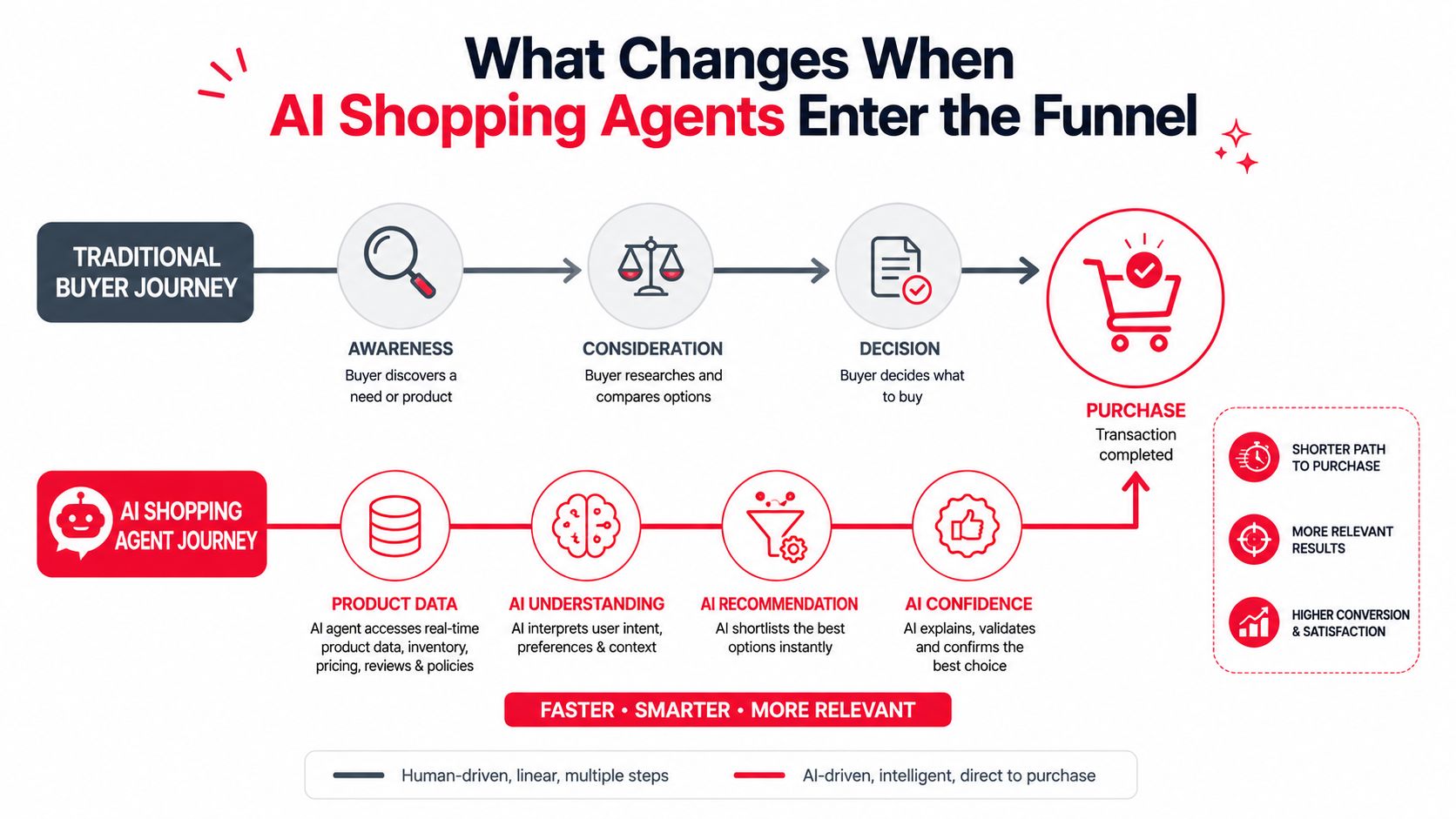
What Changes When AI Shopping Agents Enter the Funnel
AI shopping agents are a new buyer sitting between the shopper and your store. They don't browse like humans do. They parse intent, filter options, compare products, and may take the final step into cart or checkout if the system allows it.
That changes the funnel in four ways. Interoperability matters because the agent can only act on data it can read and trust. Discovery math changes because ratings, reviews, and placement influence agent choice more aggressively than many teams expect. Conversion economics shift toward the merchant that can be understood and transacted with cleanly. Governance becomes a revenue issue because a misrepresented price or unavailable SKU stops being a UX bug and turns into a transaction problem.
The buyer is now partly software
A human still has intent. The agent now does a lot of the shopping work. That means your catalog feeds, attribute normalization, and checkout path are no longer back-office concerns. They sit upstream of revenue.
AWS describes the core pattern clearly, the agent interprets a request, retrieves live catalog data, ranks options, and can hand off to checkout when permitted. That's why stale feeds or lagging inventory APIs create bad outcomes fast. A polished landing page can't fix a product that the agent can't verify.
Practical rule: if a product can't be read, matched, and priced reliably by software, it's already behind in agent-mediated buying.
For a team that wants a practical starting point, the most useful frame is to treat AI shopping agents as a machine buyer first and a marketing surface second. That's the same mindset behind Stimulead's agent commerce work, where the question is whether software can understand and act on the offer, not just admire it. Once that shifts, the roadmap changes too. You stop asking only how to get recommended and start asking how to stay purchasable.
How AI Shopping Agents Operate
The stack is straightforward in concept and unforgiving in execution. A shopper enters a natural-language request. The agent parses intent, turns that into constraints, retrieves live product data, compares candidates across merchants, and then either hands off to checkout or completes the purchase if the policy layer allows it.
The model is rarely the bottleneck
The hardest part is usually not the language model. It's the data plumbing around it. If your product feed is stale, the agent may recommend an unavailable item. If your pricing endpoint and catalog disagree, the agent can surface the wrong price. If inventory doesn't sync quickly, the agent's answer becomes untrustworthy even when the wording sounds confident.
That matters because agents can do more than chat. They can call tools, query databases, and take actions. AWS's architecture for shopping agents, built around retrieval over catalog data and tool calls, shows why retrieval-augmented generation and access to live systems are core requirements, not add-ons. You can't fake current availability with better copy.
Recommendation engines and agents are different tools
A recommendation engine scores items against prior behavior. An agent handles a task. That difference is operational, not theoretical. Traditional recommendations optimize for relevance based on history, while an agent can respond to open-ended intent like “find a lightweight rain jacket for travel” and then narrow the field by budget, delivery window, or brand preference.
Here's the board-level version:
- Recommendation engine: suggests.
- AI shopping agent: filters, compares, and may transact.
- Bad data feed: breaks both, but it breaks the agent first.
If you need a technical refresher on how product data gets prepared for this kind of retrieval layer, NanoPIM's agentic AI workflows guide is a useful companion. It is the kind of reference that helps engineering and ecommerce teams talk about structured attributes, retrieval, and ranking without drifting into vague AI language. It also shows why teams that want to transform product data with agentic AI have to treat catalog structure as part of the transaction path, not just a content project.
The Interoperability Gap Most Articles Miss
Most coverage tells merchants to optimize content for AI. That advice is incomplete. A better description is that AI shopping agents reward machine-readable commerce, and content only matters when the catalog can support it.
What the agent actually needs
A product needs more than a nice description. It needs structured attributes, real-time availability, current pricing, transaction signals, and agent-ready APIs. Google's agentic commerce guidance points in that direction, and Criteo's coverage makes the same point from a retail operations angle, visibility depends on structured product information, enriched attributes, current availability, pricing, and governance around how agents represent the brand. If those fields are weak, the product may as well be invisible inside the ranking pipeline.
The Yale and Columbia study summarized by Kantar changes the conversation. AI shopping agents respond like super consumers. Kantar says one leading AI behaved as if a product had gotten the equivalent of a 67% price cut when its rating rose by just 0.1 points. That's a massive reminder that small data improvements can create outsized selection effects in agent-mediated shopping. Kantar's summary of the study is worth keeping close if you're arguing for catalog quality work.
Why governance belongs in the same meeting
Operational readiness is the missing half of the story. Many retailers still can't see how third-party agents represent their prices, products, or trust signals. That's a governance problem as much as a data problem. If your team can't track whether an external agent is showing stale data or an incomplete offer, you don't really control the commerce surface.
If the catalog is inconsistent, the agent doesn't “infer” the truth. It picks from what it can verify.
Independent testing of five AI shopping assistants across 2,500 interactions found that 71.8% of evaluated steps failed to achieve complete product-truth reliability, where product truth meant SKU-level accuracy across identity, ingredients or components, hazard classifications, regulatory warnings, merchant status, and geo-specific constraints. The Smarter Sorting test summary makes the operational point bluntly, the agent can only be as accurate as the data it can verify. For leaders, that means the first audit should ask whether the product is machine-readable, current, and auditable, not just whether the page copy is good.
Use Cases and KPIs for Growth-Stage Companies
Growth leaders don't need a generic AI story. They need the right KPI for the business model they run. The metric changes depending on whether the agent is helping a shopper discover products, helping a buyer evaluate software, or changing comparison behavior in a marketplace.
DTC apparel, B2B SaaS, and marketplace flows do not behave the same
In DTC apparel, the agent sits closest to product discovery. Track add-to-cart rate, average order value, and return propensity by source. Rithum says 53% of shoppers trust AI tools, including AI shopping assistants, as much as brand websites, and only 5% verify AI recommendations on retailer or brand sites. The same source says 64% of shoppers ages 18 to 27 are likely to buy from an AI recommendation without checking elsewhere, while AI-referred visitors convert 42% higher than non-AI traffic. Rithum's verification data tells you why apparel teams should treat agent traffic as a real conversion stream, not a curiosity.
In B2B SaaS, the agent shows up earlier. It helps buyers gather vendor details, compare offerings, and compress the research phase. The KPI here is usually qualified demo rate or content-assisted pipeline from agent-influenced sessions. In practice, that means your product pages, comparison pages, and implementation docs need to be written for machine retrieval as well as human review. Stimulead's AI agent use cases resource fits naturally here if your team wants a broader map of revenue-driving agent workflows.
In marketplaces, the agent changes which listings survive comparison. Track win rate in shortlist, agent-referred conversion, and merchant-level visibility consistency. If ranking is driven by structured attributes, review signals, and freshness, then the marketplace operator has to monitor those fields the same way finance monitors margin.
| AI Shopping Agent Use Cases by Business Model | Primary KPI | Data Work Required | Realistic Delta |
|---|---|---|---|
| DTC apparel discovery | Add-to-cart rate | Clean product attributes, current price, live inventory, review data | Higher intent-driven conversion quality |
| B2B SaaS research | Qualified demo rate | Comparison pages, schema, FAQ retrieval, product docs, governance | More machine-readable top-of-funnel demand |
| Marketplace comparison | Shortlist win rate | Listing quality, merchant feeds, freshness, trust signals | Better placement in agent-driven comparisons |
For operators who want a retailer-specific reference point, the AWS Agentic Shopping Assistant material shows how brands can combine their own data, business rules, and voice with agent workflows. Amazon also says the retail assistant helped power sessions that convert at 3.5 times the rate of traditional keyword search, which is directionally useful when you're deciding whether agent-assisted commerce deserves a KPI on the dashboard. AWS's retailer overview is the most practical benchmark in the material I reviewed.
A Prioritized 90-Day Readiness Roadmap
Teams often try to build the agent before they've made the catalog legible. That usually burns time. The better sequence is to fix the data layer first, then tune discovery, then connect the transaction path.
Weeks 1 to 3, clean the data foundation
Start with catalog hygiene, schema completeness, inventory sync, pricing accuracy, and taxonomy cleanup. AI shopping agents either get enough truth to rank your products or ignore them. If you can't pass a freshness audit, don't spend the quarter on custom agent orchestration.
Weeks 4 to 6, make discovery usable
This is the AEO layer, answer-engine optimization for LLM-driven discovery. Tighten product explanations, comparison pages, FAQs, and structured answers that can be retrieved cleanly. At this stage, the content team and the ecommerce team need the same vocabulary, because the agent is reading both.
Weeks 7 to 9, personalize around intent
Once the data layer is stable, map intent signals to recommendation logic. That means aligning browse behavior, buying context, and catalog attributes so the agent can match a shopper's goal to the right product set. Many teams overbuild at this stage. If the data isn't ready, personalization just adds noise.
Weeks 10 to 13, add agent-commerce operations
This is the governance and monitoring layer. Set up tracking for agent traffic, measure how products are represented, and define escalation rules for pricing or inventory discrepancies. If you need a practical way to think about price control, WebscrapingHQ's price tracking pipeline resource is a useful operational reference because it keeps the conversation grounded in freshness, monitoring, and alerting instead of vague AI talk.
Build the transaction spine before you decorate the interface.
That order matters. Teams that skip straight to fancy agent experiences usually discover too late that the catalog can't support them. If the structure is right, the agent layer becomes a manageable extension of your commerce stack, not a science project.
Vendor Evaluation Criteria and the Three Pitfalls That Waste Budget
The vendor market is noisy. Most demos look similar until you ask what happens when the catalog changes, the inventory shifts, or the agent has to prove how it made a recommendation. That's where the differences show up.

The six questions that matter
Look at data freshness guarantees, protocol and interoperability support, governance and audit capabilities, pricing model alignment with revenue, integration depth with your commerce stack, and lock-in risk. If a vendor can't answer those cleanly, the feature list doesn't matter much. The system may be good at talking and weak at transacting.
Stimulead's vendor evaluation work sits in this category as a practical external review option, because the cost of one wrong platform choice is usually more than the cost of an audit. That's especially true when the platform sounds impressive but can't explain how it handles stale inventory, third-party representation, or checkout handoff.
The three budget traps
- Chat surface only. The tool can talk, but it can't retrieve or act on live commerce data.
- Closed protocol model. The vendor keeps you in a walled garden, which limits interoperability and future flexibility.
- Governance after launch. Teams wait until there's a pricing mismatch or brand misrepresentation before they build monitoring.
The cleanest buying motion is to ask for a live test against your own catalog, with stale data, missing attributes, and a real checkout path if that's in scope. If the system can't handle that, it's a demo, not infrastructure. That distinction saves budget faster than any roadmap slide.
What CEOs, CMOs, and CROs Should Do Next Quarter
The decision is simple when you reduce it to ownership. The CEO decides whether to build, buy, or wait based on data readiness and revenue concentration. The CMO owns AEO and catalog quality, and tracks agent-driven traffic quality. The CRO owns the conversion math and tracks agent-referred conversion lift against human-referred baselines.
If your catalog can't pass a freshness audit, the answer is wait and fix the data. If the catalog is ready and revenue concentration is high in a few product lines, build or buy a controlled pilot. If the business depends on discovery surfaces, the CMO should prioritize machine-readable content and schema cleanup immediately.
For teams wanting a fast operating model, start with one product line, one agent-facing KPI, and one governance owner. Bring in a fractional CAIO when the work spans catalog, analytics, and vendor selection, because that's where internal teams usually lose time. A good 30-day plan is simple, audit the catalog, instrument agent traffic, and decide whether your next dollar should go into data quality, AEO, or transaction readiness.