
Sales productivity is broken because reps spend about 70% of their time on nonselling work (Salesforce). The wrong response is to buy another tool and ask managers to absorb the change. The right response is to remove low-value work, simplify the operating model, then add AI only where the economics justify it.
Improving sales productivity in 2026 means treating workflow redesign as the primary move, not a side project. If you keep stacking software onto a fractured process, you just create more logins, more handoffs, and more retraining.
Table of Contents
- Why Adding More Tools Will Not Fix Your Sales Productivity
- Diagnosing Where Time and Conversion Actually Leak
- The Clean-Sheet Workflow Argument
- Running Productivity as a Quarterly Program
- Measuring Leading Indicators Before Revenue Surprises
- A 90-Day Sequencing Example From a Client Engagement
- When Content Libraries Become the Productivity Bottleneck
Why Adding More Tools Will Not Fix Your Sales Productivity
The core problem is time, not intent. Salesforce's 2023 data showed reps spending about 28% of their week selling, and a later Salesforce report put about 70% of time into nonselling work (Salesforce). That number has barely moved in years, which tells you the issue is structural, not motivational. The drag sits in admin, CRM upkeep, research, and internal churn.
More software rarely fixes that. It adds another login, another handoff, and another layer of task switching. If your stack already includes engagement tools, conversation intelligence, sequencing, forecasting, and AI notetakers, each new tool raises adoption cost and slows ramp.
Practical rule: if a new tool does not remove a full step from the rep's day, it belongs in the later bucket.
Use a harder test. If a platform does not cut manual work, reduce handoffs, or lower reporting overhead, it is not a productivity fix. It is a new expense wrapped around an old process.
The right sequence is clear. Remove low-value work first, simplify the operating model next, then apply AI where the economics make sense. If you want a workflow-first example, the increase sales output with automation piece points in the same direction.
Diagnosing Where Time and Conversion Actually Leak
The first mistake CROs make is guessing. A stage can feel painful and still convert well, so the job is to pull the data before anyone proposes a fix. We use a stage-by-stage diagnostic aligned to the Forrester-style view that productivity should be measured by stage, yield, and improvement separately (Forrester).

Run four diagnostic passes
Time on task by stage. Pull CRM activity logs and map hours to each funnel stage. You want to see which stage eats the most rep time per opportunity, not which stage produces the loudest complaints.
Stage-to-stage conversion with cycle time. A slow stage and a leaky stage are different problems. If conversion is fine but cycle time drags, the fix is process speed, not lead quality.
Activity-to-outcome ratios. Track calls-per-meeting, demos-per-opportunity, and similar ratios. High activity with weak progression usually means the team is busy, not productive.
Win-loss by segment. Split the analysis by ICP, deal size, and segment. Patterns often show that one motion is healthy for mid-market while another is wasting time in enterprise.
A useful companion resource is the KPI impact of revenue acceleration, because the right metrics matter more than another dashboard. Use that framing with the signal-based selling framework if your team already has data but no discipline.
Pull the numbers first. If you redesign the wrong stage, you only make the process harder to recover later.
One-page diagnostic template
Use this in week one.
- Stage label
- Average hours per opportunity
- Conversion to next stage
- Average days in stage
- Top failure reason
- Owner
- Recommended action
That one page is enough to stop opinion-led debates and force a real prioritization conversation.
The Clean-Sheet Workflow Argument
Most sales stacks were assembled by accretion. That means your workflow probably reflects vendor choices made years ago, not how buyers buy today. A clean-sheet redesign starts with the desired buyer journey, assigns each step a clear owner, and only then chooses the technology that supports it.
New AI adoption data supports that stance. Salesforce's 2026 reporting says 9 in 10 sellers are betting on AI and agents as their top growth tactic, and they expect agents to reduce prospect research time by 34% and content creation time by 36% (Salesforce). The catch is obvious, if the workflow is confusing, AI gets used shallowly or bypassed entirely.
| Dimension | Stack-More-Tools Default | Clean-Sheet Redesign |
|---|---|---|
| Starting point | Existing stack and team habits | Desired buyer journey and revenue motion |
| Tool choice | Add software to fix friction | Remove steps before adding software |
| Team role | Managers police adoption | Owners redesign the flow |
| AI use | Everywhere at once | Only where economics change |
| Outcome | More complexity | Fewer handoffs and cleaner governance |
A one-week redesign sprint is enough to produce a target-state map and a deltas list. Sales, marketing, and RevOps should be in the room. The output should say what gets retired, what gets consolidated, and where AI belongs because it changes the work.
We have done this kind of work in client engagements. The fastest gains came from retiring overlap, simplifying routing, and limiting AI to a small set of steps where the time saved was real enough to matter.
Running Productivity as a Quarterly Program
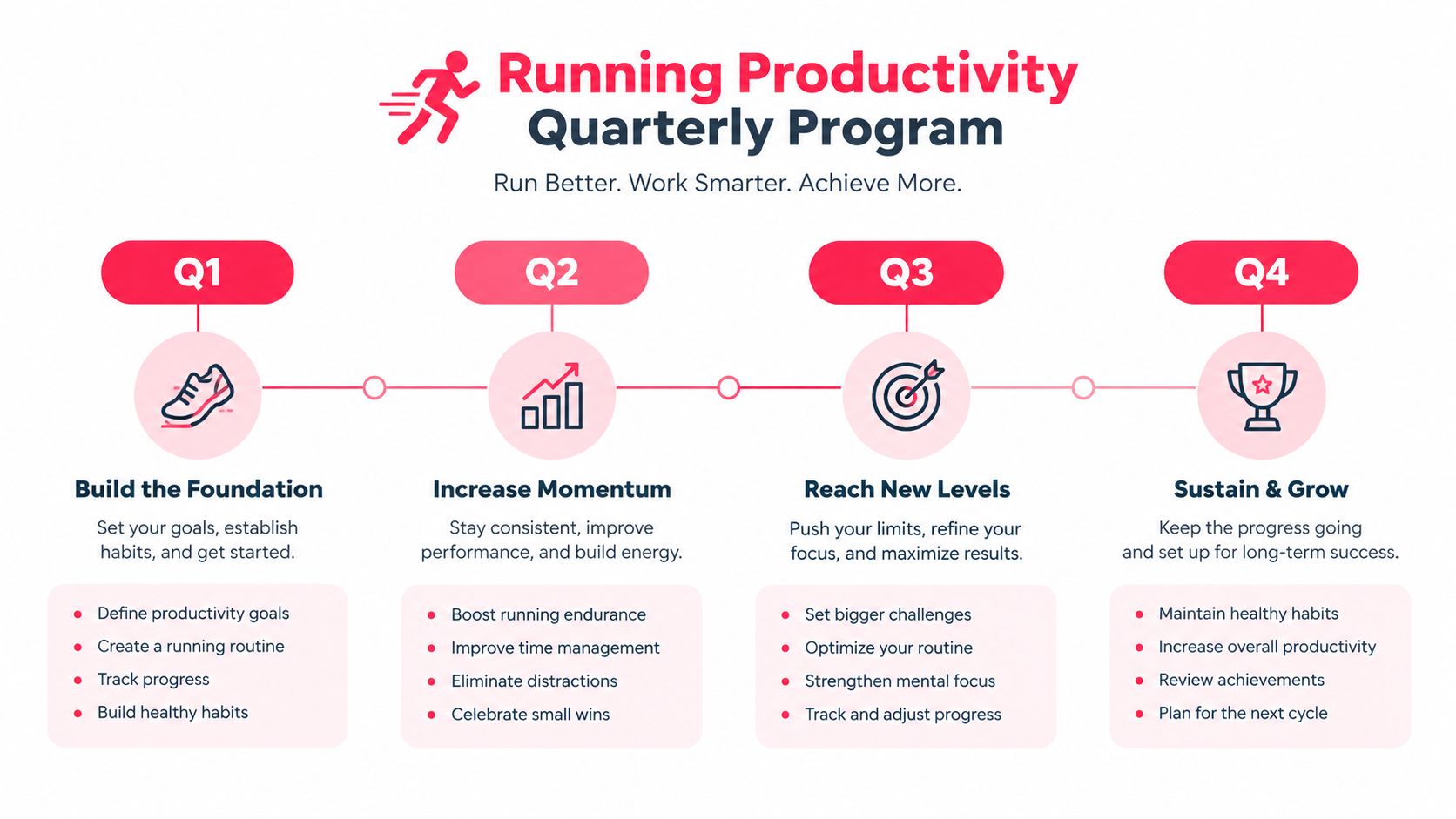
Productivity work dies when it is treated like a workshop. It needs a cadence, a sponsor, and a small team with authority to kill dead processes. McKinsey recommends a small productivity-improvement team, technology funding, quarterly sprints, and monthly KPI tracking, which is the right operating rhythm for a CRO who wants actual change (McKinsey).
The team and the cadence
The smallest useful squad is one ops lead, one commercial analyst, two frontline sellers rotating through the work, and a CRO-level sponsor. The sponsor needs authority to remove steps, not just approve them. If no one can kill a process, the program turns into a committee.
A clean 12-week sprint looks like this:
Weeks 1 to 2, diagnose. Run the funnel audit, time-allocation audit, and stack inventory. Lock the three gaps with the biggest time savings before anyone starts redesigning.
Weeks 3 to 8, redesign and pilot. Fix one or two funnel stages, retire overlap, and test the new motion with a small group. Keep the scope narrow enough that managers can coach it.
Weeks 9 to 12, measure and codify. Review the KPI movement, document the new playbook, and decide what gets expanded next quarter.
The governance rhythm should stay simple. Use a 30-minute weekly standup for blockers, a 60-minute monthly steering review for leading indicators, and a quarterly business review for impact. The team should target a maximum of three changes per quarter, because anything more turns into adoption theater.
Onboarding is where ramp time quietly leaks
Training Industry's onboarding research is hard to ignore. With formal onboarding, 60.7% of reps reached full productivity within 6 months and 85% within 11 months, versus 42.8% and 67.8% without it (Training Industry). Coaching was a core part of the effective model, ahead of classroom training and mentoring.
That is the comparison CROs need to make. Structured ramp is defined, milestone-based, and manager-led. Content-only enablement is a wiki, a video library, and hope. The latter creates self-serve confusion and leaves new hires to copy whatever habit they see first.
For a useful reference on implementation discipline, the productivity guide for SaaS teams is a practical companion. Sequencing is where most programs fail, which the next example shows.
If you want ramp to improve, coach the first live deals. Do not just dump material into a portal and call it enablement.
Measuring Leading Indicators Before Revenue Surprises
Revenue tells you what already happened. By the time the quarter is off track, the fix is late. Gartner's tiered KPI framing is useful because it separates leading indicators, coincident indicators, and lagging indicators into different review rhythms (Gartner).
| Tier | Cadence | Example Metrics | Review Forum |
|---|---|---|---|
| Tier 1 | Daily or weekly | Discovery call-to-next-step conversion, account response rate, seller activity against plan, pipeline coverage | Sales manager review |
| Tier 2 | Weekly or monthly | Stage-to-stage conversion, average sales cycle length, demo-to-opportunity rate | Monthly steering forum |
| Tier 3 | Quarterly | Quota attainment, ARR booked, win rate | QBR |
The practical move is to pick two Tier 1 metrics that map to your leakiest stage, then tie manager incentives to those numbers. If discovery is the problem, reward next-step conversion and response speed. If qualification is weak, reward stage progression and qualification quality.
That shifts behavior inside 60 days. Revenue alone cannot do that because it arrives too late and too mixed with other variables. Managers need inputs they can coach weekly, not just a quarterly verdict.
A 90-Day Sequencing Example From a Client Engagement
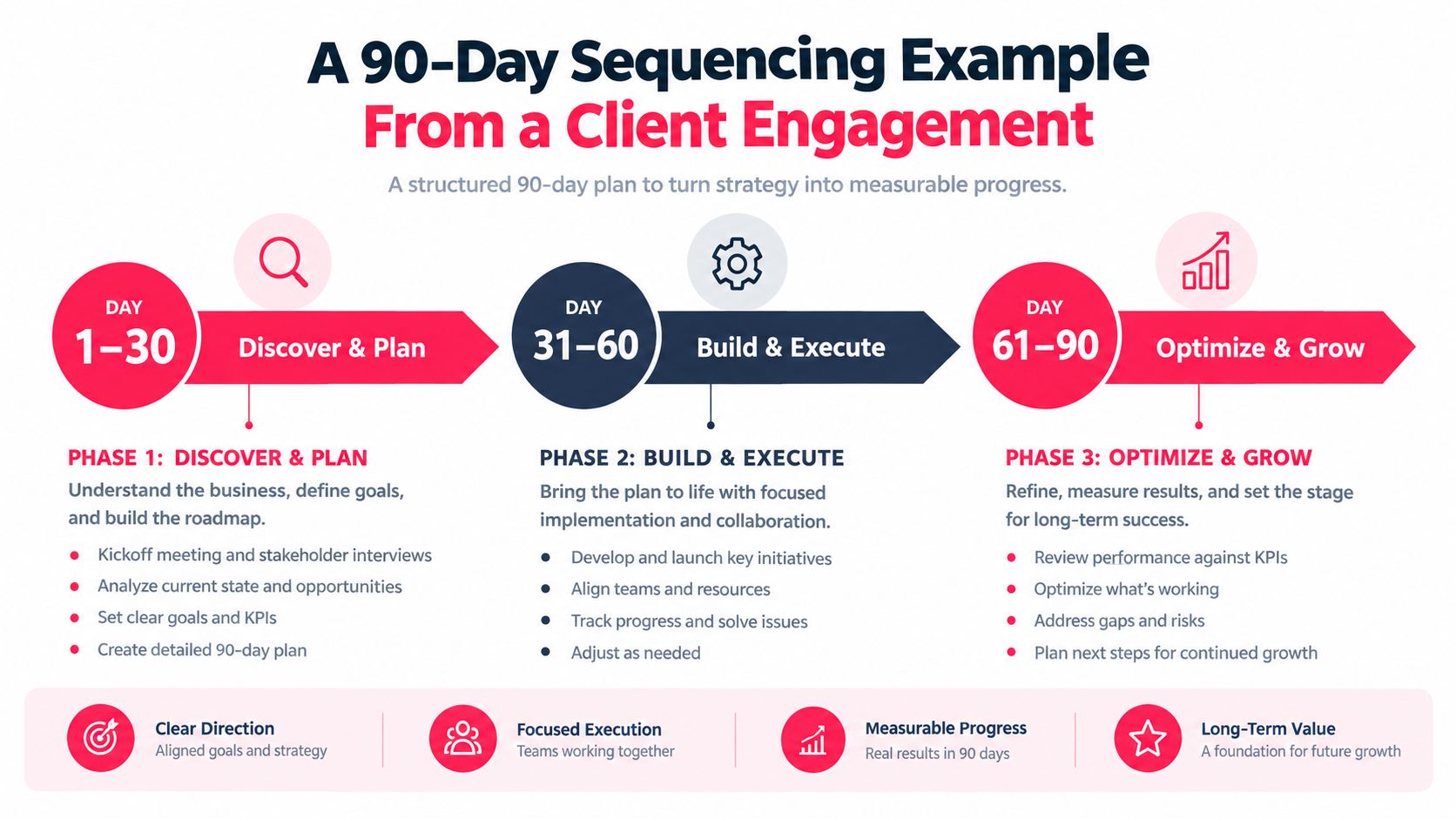
A representative Series B SaaS engagement works best when the CRO accepts trade-offs early. We start with a tight diagnostic, move into one or two workflow fixes, then layer AI after the process is cleaner. That sequencing matters more than tool count.
Weeks 1 to 2
We ran the funnel diagnostic, a time-allocation audit, and a stack inventory. The leadership team agreed on the three highest-impact gaps, then killed two debates that were tempting but not urgent. There was no reason to argue about a CRM migration before the routing logic was clean.
Weeks 3 to 6
The team redesigned the qualification stage, retired two overlapping tools, and consolidated enablement content into one searchable layer. The CRO accepted a short-term pipeline dip because the old motion had too much friction to keep scaling. That was the right trade.
Weeks 7 to 10
AI-assisted prospecting and personalized outreach came in after the workflow was simplified. At the same time, four newly hired AEs moved through structured onboarding with clear checkpoints. The clean-sheet logic paid off, because AI supported a cleaner motion instead of masking a bad one.
Weeks 11 to 13
We locked the KPI dashboard, handed the sprint cadence to the VP of Sales Ops, and documented the playbooks. We documented the handoff using the same sequencing logic as the Stimulead AI implementation roadmap, which kept ownership clear and the transfer to Sales Ops unambiguous. The result was a cleaner operating model with owners, metrics, and fewer places for leakage.
When Content Libraries Become the Productivity Bottleneck
A lot of teams answer productivity pressure by producing more content. That instinct is wrong. If reps already struggle to find, trust, and reuse what exists, adding more decks and battle cards just increases retrieval time and confusion.
Recent reporting says 84% of sales executives see content search and utilization as the biggest productivity gap (Spotio). That makes the fix obvious. The library needs curation and context, not more volume.
Retire before you create
- Collapse duplicates. If three assets say the same thing, one of them has to go.
- Retag by buyer pain. Organize around the problem the buyer is trying to solve, not your internal product structure.
- Surface inside the CRM and email client. Reps should not have to leave the tools they already use.
- Retire the bottom tier. If something is never used, it is only clutter.
The hard part is discipline. Teams often keep creating because it feels like progress, while cleanup looks invisible. That is backwards.
For content governance that supports AI search and retrieval, the internal article on optimize content for LLMs is a good companion. It fits the same principle, reduce noise first, then let systems find the right answer faster.
If you're a CRO, the next move is simple. Run the diagnostic, pick one leaky stage, and strip out the work that doesn't help a rep move a deal. Then layer AI onto the cleaned-up process, not the other way around.