
Only 0.75% of B2B marketing-qualified leads become closed-won revenue, so GTM strategy consulting works when it treats that bottleneck as a system to engineer, not a marketing problem to fix. At that conversion level, the actual work is making the whole revenue path easier to move through, from ICP choice to handoff rules to measurement.
GTM consulting matters now because the gap between strategy and execution is still wide, and AI agents can close parts of that gap if they're wired into the operating cadence, not treated as a novelty.
Table of Contents
- Why GTM Strategy Consulting Is a Revenue Operating Problem
- How We Apply AI and Agents to GTM Strategy
- Where Most GTM Plans Fail Before They Scale
- The Cross-Functional Model That Makes GTM Stick
- Engagement Models for GTM Strategy Consulting
- What to Do Next if Your GTM Is Stalled
Why GTM Strategy Consulting Is a Revenue Operating Problem
The starting point is uncomfortable. Forrester's 0.75% B2B MQL-to-closed-won rate, the 11-stakeholder median buying committee for enterprise SaaS purchases, the 17% share of the buying cycle spent meeting suppliers, and the 77% of B2B buyers who describe their last purchase as complex or difficult all point in the same direction, the bottleneck is structural, not cosmetic. GTM strategy consulting earns its keep when it improves the path between demand, qualification, consensus, and revenue.
What we actually mean by GTM work
At Stimulead, we treat GTM as an operating system. That means market segmentation, ICP refinement, messaging, channel choice, pricing and packaging research, launch sequencing, sales enablement, and reporting all sit inside one working model instead of separate decks owned by different teams.
Practical rule: if a GTM plan can't survive weekly scrutiny in CRM, marketing automation, and pipeline reviews, it isn't a plan yet.
The difference between theory and execution shows up fast. Harvard Business Review Analytic Services found that 83% of 522 B2B leaders said go-to-market strategy is very important, but only 38% rated execution as very effective, and Forrester's Q2 2024 sales and marketing alignment survey found 65% of sales and marketing professionals see a lack of alignment between the functions. That's why our work focuses on shared definitions, handoff rules, and measurement cadence, because misalignment suppresses funnel performance and forecast quality. HBR and sales-marketing alignment findings
The category is also getting more formal. The go-to-market services market is projected to rise from USD 42.1 billion in 2025 to USD 70.23 billion by 2031, with a 9.31% CAGR across 2026 to 2031, which signals that leaders are budgeting GTM as a recurring function rather than a one-time launch event. For growth-stage CEOs, CMOs, and CROs, that's a useful reminder that the work belongs in operating reviews, not just planning offsites. GTM services market projection
How We Apply AI and Agents to GTM Strategy
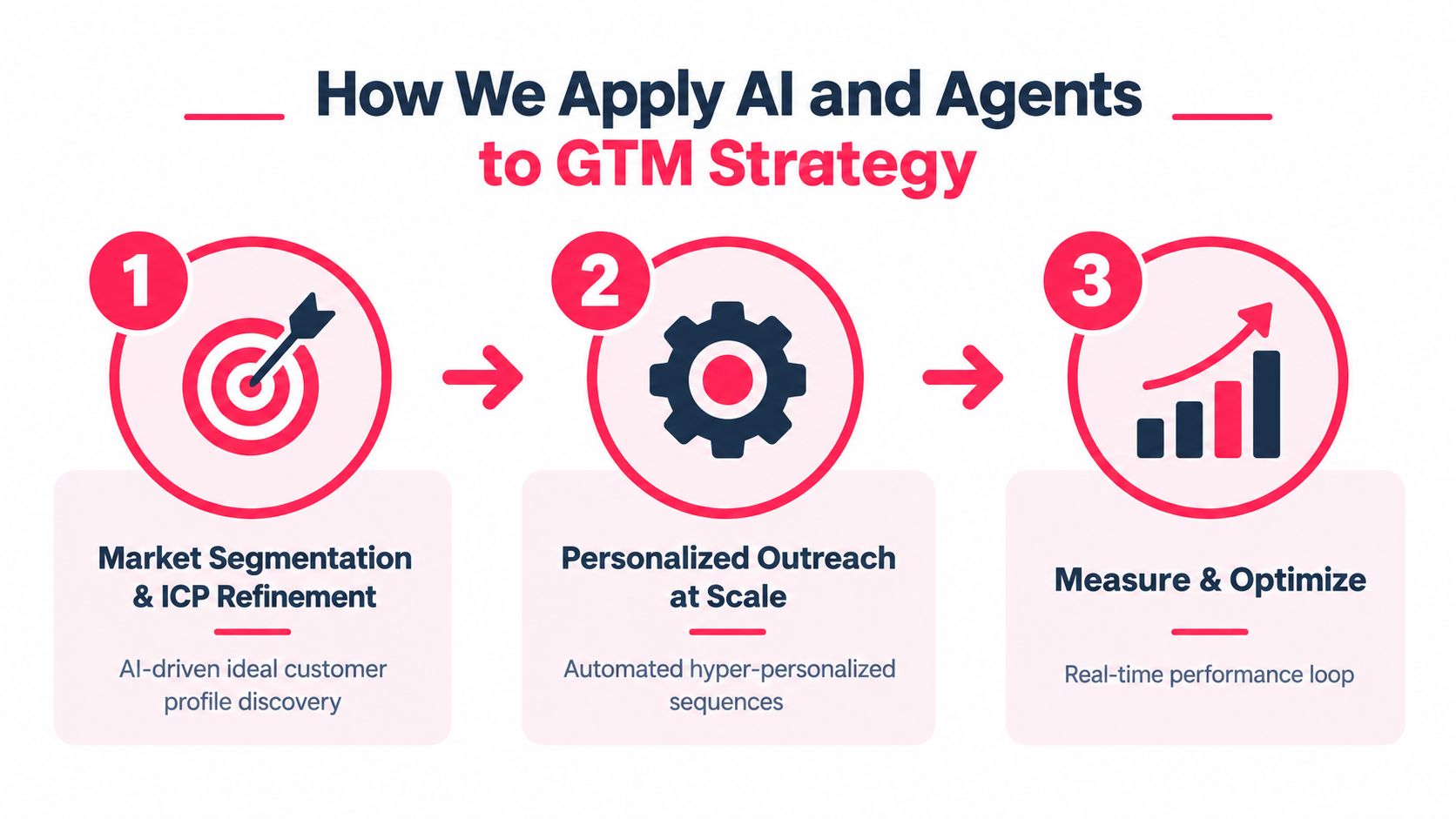
AI helps most when it removes slow, repetitive work from GTM research and coordination. We use agents to gather market signals, cluster accounts, draft testable hypotheses, and monitor metric drift, then humans decide what to launch, what to kill, and what to adjust. The point is shorter learning loops, not more automation for its own sake.
Where agents fit in production workflows
The first use case is segmentation and ICP refinement. Agents can scan CRM histories, website intent, review patterns, enrichment fields, and outbound response data to surface which account types move, then compare those findings with the assumptions in the current ICP. We've seen this save time on manual list wrangling, but the bigger gain is discipline, because the agent forces the team to defend segments with evidence.
The second use case is pricing and packaging research. AI can help summarize calls, cluster objections, and compare how prospects react to different offers across segments. That makes it easier to test whether a package is too broad, too narrow, or too early for the market, without pretending the machine can price a product on its own.
For execution, AI agents can draft channel-specific messaging, pull account context into outreach, and generate launch checklists tied to a target segment. That's where GEO Agency is a useful adjacent resource, especially for teams comparing AI search and discovery work with broader GTM motions.
Good agent design does one job well, reads from the same source of truth as the rest of the stack, and hands exceptions back to a human fast.
We usually wire this into existing CRM, marketing automation, and sales engagement tools rather than replacing them. Our AI agents approach works best when data quality is acceptable, ownership is clear, and someone owns the final decision on segment, sequence, or escalation.
A short internal video can also help teams see how the workflow behaves in practice.
The key trade-off is simple. AI raises testing velocity when the inputs are clean and the decision rules are explicit, but it creates noise when field values are sloppy, enrichment is stale, or nobody knows who approves a motion. The best use of agents is not to replace the team's judgment, it's to make each decision cheaper and faster to test.
Where Most GTM Plans Fail Before They Scale
Most GTM plans fail after the strategy work looks finished. The deck is strong, the positioning is clear, and the launch plan sounds tight, but the operating model is weak enough that execution drifts within weeks. In practice, the failure mode is usually ownership, timing, or measurement.
The hidden friction points
A 2026 survey of 511 B2B professionals found that only 37% define go-to-market as an integrated, cross-functional revenue framework, while about 21% say their organizations either lack a formal GTM strategy or have no clearly defined ownership for it. The same benchmark reports average B2B tech GTM planning cycles at 4.2 months, rising from 3.1 months at seed stage to 5.8 months at Series C and later, and companies with planning cycles longer than 6 months showed 14% lower revenue achievement than faster-cycling peers. GTM strategy benchmark report
Long planning cycles create drift because the market changes before the motion is live. They also push teams to defend the plan longer than they test the plan, which is the wrong order for growth-stage companies.
Here are the failure patterns we keep seeing after engagements:
- Vague ownership: nobody owns the line between strategy, launch, and follow-through.
- Misread signals: sales and marketing use different definitions for the same account stage.
- Vanity metrics: impressions and activity volume get reported while pipeline quality stays flat.
- Slow change cycles: teams wait for quarterly resets instead of using pilot feedback.
If a team can't say who changes the motion on Tuesday when the pilot fails, the motion is already at risk.
A different problem appears when teams obsess over top-of-funnel activity. A practical GTM scorecard should combine leading indicators such as account engagement, buying-group coverage, intent, and meetings with lagging outcomes such as pipeline, win rate, revenue, retention, and expansion. That keeps teams from mistaking movement for progress. GTM scorecard guidance
This is also where pipeline sufficiency matters. A widely used benchmark is 3x to 4x coverage of the revenue target, while enterprise teams are often held to 4x to 5x coverage, so GTM planning has to ask whether the pipeline math works before anyone debates channel preference. Pipeline coverage benchmark
The Cross-Functional Model That Makes GTM Stick
A GTM motion only holds when the whole revenue team shares the same rules. Marketing, sales, product, finance, and customer success need one set of definitions, one reporting rhythm, and one view of which motions are worth scaling.
Roles and rituals that hold the system together
Marketing should own audience quality, message tests, and content that maps to live buying stages. Sales should own qualification discipline, next-step clarity, and feedback from live conversations. Product should inform packaging, proof points, and implementation friction. Finance should validate the unit economics, and customer success should surface expansion and retention signals early.
A weekly pipeline review works when it's narrow and operational. We review segment-level stage conversion, velocity, and exceptions, then decide whether the issue is a sourcing problem, a qualification problem, or a handoff problem.
| Function | Owns | Weekly question |
|---|---|---|
| Marketing | demand quality and message tests | which segment reacted to the latest motion |
| Sales | qualification and progression | where did the deal stall and why |
| Product | packaging and proof | what claims need proof in the field |
| Finance | unit economics | does the motion still work on paper |
| Customer success | retention and expansion | which accounts are ready for the next offer |
A shared cadence also makes agent-based pilots easier to run. We've found that the cleanest experiments are time-boxed, matched to a similar audience, and measured on pipeline, conversion, and velocity. Anything else can turn into a traffic report disguised as a test. Testing new motions
A practical consequence is that the stack matters less than the rules around it. Slack, HubSpot, Salesforce, Marketo, Apollo, Outreach, and enrichment tools all work better when the team agrees on the same funnel language and the same handoff triggers. For readers who want a deeper look at the people side of that work, our internal note on sales and marketing alignment covers the operating details.
Engagement Models for GTM Strategy Consulting
Not every team needs the same level of support. The right model depends on whether the problem is clarity, capability, or cadence.
| Engagement model | Best fit | What it delivers | What it asks from the client |
|---|---|---|---|
| Executive advisory | leaders who need direction and decision support | audit, roadmap, vendor evaluation, governance | internal owner who can act quickly |
| Team training | teams that need repeatable skills and better habits | workshops, workflows, enablement, live coaching | time from marketing, sales, and RevOps |
| Fractional CAIO partnership | teams that need sustained execution support | ongoing prioritization, agent design, KPI tracking, iteration | access to data, tools, and decision makers |
Executive advisory works when the team already has talent but lacks clarity on sequencing. Team training fits when the company has a decent plan and needs a common operating language. Fractional CAIO support is the better choice when the company needs someone to keep the motion moving week after week, especially if AI workflows, reporting, and experiments need active oversight.
Price is only part of the decision. The bigger question is whether internal people have the time and authority to implement the changes. If they don't, a light advisory engagement often becomes expensive advice that never makes it into the workflow.
For teams comparing vendors or building their own data layer, tools for AI lead enrichment workflows is a useful reference point for the research and tooling side of the stack. Our own AI strategy consulting work sits in the same decision space when the issue is broader than a single campaign or channel.
Buy support for the problem you actually have, not the service package you wish sounded more ambitious.
What to Do Next if Your GTM Is Stalled
Start with the numbers that reveal whether the system is leaking. Audit pipeline coverage, stage conversion, average cycle length, and the number of accounts that move from engagement to qualified opportunity. If those numbers are fuzzy, the first job is measurement cleanup, not more demand generation.
Then test one motion, not five. Pick a matched audience, define a 30 to 90 day pilot, set one owner, and judge the result on pipeline and velocity instead of vanity activity. If the pilot improves only awareness and not movement through the funnel, stop it early and inspect the handoff rules.
Use external help when the internal team can name the problem but can't create the cadence to solve it. That's common in growth-stage B2B companies that have enough complexity to need structure, but not enough spare capacity to design it alone. It's also where AI agent work tends to pay off fastest, because the task is often orchestration rather than invention.
For most CEOs, CMOs, and CROs, the next decision is simple. If the issue is strategy clarity, start with an audit. If the issue is execution discipline, bring in operating support. If the issue is both, install the system before you scale the motion.
If your GTM plan looks sound but the pipeline still stalls, book a working session with Stimulead and map the first pilot, the measurement rules, and the ownership model before the next quarter starts.