
The GEO market was valued at $848 million in 2025 and is projected to reach $19.8 billion by 2034, with Enterprise Brands at 44% ($373 million) and SaaS Platforms at 60% ($508.8 million), according to Market Intelo's GEO market report. That's the wrong headline if you're a CEO.
The primary headline is revenue access.
When buyers use ChatGPT, Perplexity, Gemini, and AI Overviews to shortlist vendors, compare products, and pressure-test claims, your website stops being the first point of contact. The answer does. If your company isn't present in that answer, your pipeline shrinks before your sales team ever gets a shot.
I treat generative engine optimization as a revenue channel. It sits next to paid acquisition, SEO, outbound, partner motion, and CRO with AI. It affects discovery, consideration, conversion quality, and eventually agent commerce readiness. If you run a growth-stage company, this belongs in the same operating conversation as forecast accuracy, CAC efficiency, and win rate.
Table of Contents
- Why Generative Engine Optimization Is a Board-Level Concern
- What GEO Is and Why It Is Not Just New SEO
- The Four Pillars of a Winning GEO Strategy
- Technical Readiness for LLM Ingestion
- Measuring What Matters With GEO KPIs and ROI
- A 180-Day GEO Implementation Roadmap
- Your Next Step to Capture AI-Driven Revenue
Why Generative Engine Optimization Is a Board-Level Concern
The market size matters because capital follows channels that reshape buyer behavior. Market Intelo projects the GEO market from $848 million in 2025 to $19.8 billion by 2034. Companies don't spend into a category like that unless distribution is shifting.
For leadership teams, the issue isn't whether marketing should test a few AI tactics. The issue is whether the company is visible when machines become the first filter between buyer intent and vendor selection. That changes revenue mechanics. It changes who enters the consideration set. It changes which claims get repeated, and which never get seen.
Revenue risk shows up before traffic drops
Many in the industry still look at search through a website lens. Sessions. rankings. clicks. Those still matter. But AI answers create a new choke point upstream from all of them.
A buyer asks for the best category options, implementation risks, pricing models, migration steps, or top tools for a use case. The model returns a synthesized answer. If your brand appears with accurate positioning, you're in the deal. If a competitor appears and you don't, you're fighting from behind. If nobody from your team is tracking that visibility, the loss won't show up clearly until pipeline quality degrades.
Practical rule: If AI systems mediate discovery in your category, absence is a revenue issue, not a content issue.
This is why CEOs, CMOs, and CROs need a shared view. The CEO cares about channel risk. The CMO cares about demand capture. The CRO cares about whether AI is pre-framing the deal before the first meeting. This is also where governance matters. If your teams are publishing fast without controls for factual accuracy, source quality, and positioning consistency, AI systems can spread the wrong narrative at scale. A useful starting point is this guide to AI governance best practices.
The moat is narrative control
Traditional search let you compete for a click. Generative engine optimization lets you compete for the summary that shapes demand. That's a stronger position.
The companies that win this channel do three things well:
- They shape category language: Their terms, frameworks, and comparisons appear in AI answers.
- They control brand representation: Their product is described accurately, with fewer distortions.
- They connect visibility to revenue: They treat AI presence as a measurable input to pipeline creation and conversion quality.
Board-level attention is appropriate because this sits between market visibility and market share. If leadership waits until this channel is “fully mature,” competitors will already own the answers buyers see first.
What GEO Is and Why It Is Not Just New SEO
Generative engine optimization became a defined discipline in 2023, when researchers at Princeton University published the foundational paper that coined the term and framed it as a method to improve visibility within generative engine responses, as summarized by Digital Agency Network's GEO statistics roundup.
That distinction matters. SEO was built for ranked lists. GEO is built for synthesized outputs.

Use a simple mental model
Use this with your leadership team.
SEO is the paper map. It helps people find routes.
AEO is the GPS. It surfaces the best direct answer.
GEO is the self-driving car. It doesn't just point to information. It assembles the answer and, in some cases, moves the task forward.
That's why standard SEO thinking breaks down if you stop there. Ranking highly in Google can still help, but rank alone doesn't guarantee that ChatGPT, Perplexity, or Gemini will cite or represent your content well. GEO asks a different question: can a model extract your facts, trust your structure, and use your material inside a generated answer?
If you want a practical companion piece on adjacent answer-focused work, Contesimal has a useful guide on how to improve AI summaries.
SEO vs AEO vs GEO At a Glance
| Dimension | Traditional SEO | Answer Engine Optimization (AEO) | Generative Engine Optimization (GEO) |
|---|---|---|---|
| Objective | Rank pages in search results | Win direct answer placements | Become a cited and trusted source in AI-generated answers |
| Primary metric | Organic rankings and clicks | Answer visibility for target questions | AI citation frequency, share of voice in AI answers, brand representation accuracy |
| Content strategy | Topic coverage, intent match, backlinks, crawlability | Concise direct answers, structured Q&A, snippet-friendly formatting | Extractable facts, strong attribution, entity clarity, machine-readable structure |
| Revenue impact | Drives site visits and demand capture | Improves answer visibility for high-intent queries | Shapes consideration, influences pipeline quality, supports GTM engineering and future agent commerce |
AEO and GEO overlap. Both care about clear answers. Both benefit from strong structure. But the operating model is different. AEO often aims for a direct answer box or summary format. GEO aims to feed the model with material worth citing, reusing, and trusting across many prompts and tasks.
GEO changes the unit of competition from page rank to answer inclusion.
That's why I tell leadership teams to stop treating this as “SEO with new branding.” It's closer to a distribution shift. Your content is no longer competing only for visits. It's competing to become part of the machine's output.
The Four Pillars of a Winning GEO Strategy
A GEO program fails when teams reduce it to publishing more blog posts. The work is broader. The winning playbook usually rests on four pillars that connect content quality to conversion quality.

Pillar one prompt engineering for content
Start with buyer prompts, not keywords.
Your demand team probably knows the headline terms already. That's not enough. You need the actual prompts buyers type into AI systems when they are evaluating options, comparing vendors, or checking risk. Those prompts are longer, more specific, and closer to purchase.
Examples of useful commercial prompt themes:
- Comparison prompts: Best tools for a specific use case, team size, or budget context
- Switching prompts: Alternatives to an incumbent vendor, migration questions, implementation effort
- Proof prompts: ROI evidence, integration depth, security posture, compliance fit
- Decision prompts: Which platform fits a certain business model, sales motion, or stack
When I build these programs, I map prompts to funnel stages and sales objections. Then content gets written to satisfy those exact retrieval moments. That's where GEO starts to support GTM engineering instead of floating as a side project.
For a solid outside perspective on AI answer visibility, AISEOGrow has a practical piece on how to get your business surfaced in AI answers.
Pillar two high-density factual content
Here's one of the clearest signals in the space. A 2024 study of 10,000 real-world queries found that pages with quotes and specific statistics saw 30% to 40% higher visibility in AI-generated responses than pages without them, according to Semrush's GEO guide.
That tells you what models prefer. They prefer material they can extract cleanly and reuse with confidence.
This doesn't mean stuffing pages with random numbers. It means writing content with proof. Product specifics. Named methodologies. Credible quotes. Source-backed claims. Clear comparisons. If your page says “fast onboarding,” that's weak. If it says how your onboarding works, what's included, and what technical constraints apply, the model has something usable.
Buyers don't convert because you published more words. They convert because the answer they saw reduced uncertainty.
Pillar three entity and semantic optimization
Keywords still have a role, but entities matter more in AI retrieval. Your company, product names, founder names, category terms, integrations, and use cases all form a semantic graph. If those signals are inconsistent across your site and the wider web, AI systems get a fuzzy read on who you are and where you fit.
Focus on consistency:
- Brand language: Use the same category framing, product descriptions, and feature terminology everywhere.
- Relationship clarity: State who the product is for, what it replaces, what it integrates with, and where it should not be used.
- Author authority: Tie expert content to real operators, SMEs, and leadership where that improves trust and interpretability.
Many teams lose their way in this scenario. They chase volume while their core entities remain poorly defined.
Pillar four agent commerce readiness
The next step after answer visibility is transaction support. AI systems are moving closer to recommending, comparing, and helping complete commercial tasks. That changes content requirements.
Your product data, policies, pricing explanations, implementation details, and support materials need to be machine-usable. Sales collateral starts to matter outside the sales process. Demo pages, product FAQs, buyer guides, and comparison pages all become source material for AI-mediated buying.
For Stimulead, AI search optimization, CRO with AI, GTM engineering, and agent commerce readiness converge. The content that earns citations should also reduce friction once a buyer lands on-site. If those two motions live in separate silos, you'll get attention without efficient conversion.
Technical Readiness for LLM Ingestion
Even strong content won't get used consistently if the technical layer is sloppy. Consequently, many GEO programs stall. The team rewrites pages, publishes new content, and still gets weak visibility because machines can't parse the site cleanly.
What your technical team needs to ship
One of the clearest implementation details comes from DevPro Journal's write-up on GEO. It states that using JSON-LD FAQPage schema and concise, bulleted summaries under semantic H2/H3 headings can increase the likelihood of citation selection by 25-30% in engines like Perplexity.
That's operationally useful because it converts a vague content discussion into concrete production requirements.
Give your team this checklist:
- Schema first: Add JSON-LD where it clarifies the page, especially FAQ structures.
- Semantic headings: Use plain H2 and H3 labels that match the user's question or decision task.
- Bulleted summaries: Put extractable takeaways directly under key headings.
- Clean page architecture: Keep critical content visible without forcing a model to interpret cluttered layouts or buried copy.
AI crawlers also need permission to access the content. If bots like GPTBot, PerplexityBot, or Claude-Web are blocked, the visibility problem isn't editorial. It's technical. In practice, that means your team should audit machine access before they spend months rewriting copy.
If you're formalizing the operational side of that audit, use an AI readiness assessment to surface gaps across content, data, access, and internal workflow.
What usually breaks
The most common failure points are boring:
- Content hidden in awkward templates: Good copy exists, but the structure is hard to parse.
- Schema deployed inconsistently: Some templates have it, some don't.
- Crawl access blocked by policy decisions: Legal or security teams approved settings that remove visibility.
- Writers working without technical feedback: Editorial publishes pages that look good to humans but read poorly to models.
If the machine can't read it, the market can't see it.
For teams trying to scale content operations around these constraints, this piece on how to build an autonomous content engine is a useful operating reference.
Measuring What Matters With GEO KPIs and ROI
GEO gets dismissed when teams measure it with the wrong dashboard. If you only track sessions and last-click conversions, you'll miss the leading indicators that tell you whether AI systems are including your brand in buyer-facing answers.

Track presence before traffic
The first KPI I want in place is share of voice in AI answers. For your commercial query set, how often does your brand appear versus competitors?
Then track AI citation frequency. That measures how often your domain is cited as a source in generated responses. After that, audit brand representation accuracy. Are the models describing your company, product, and positioning correctly?
HubSpot also makes a useful point in its KPI guidance: measure AI answer inclusion even when there's no direct citation or link. That captures whether your brand is present in the answer itself, beyond straightforward attribution, as explained in HubSpot's GEO KPI article.
A practical executive scorecard usually includes:
| KPI | What it tells you | Why leadership should care |
|---|---|---|
| Share of voice in AI answers | How often your brand appears for target prompts | Competitive visibility in demand capture |
| AI citation frequency | How often your domain is cited | Source trust and retrievability |
| Brand representation accuracy | Whether AI describes you correctly | Message control and sales efficiency |
| AI answer inclusion | Whether you appear even without a direct citation | Presence in zero-click decision moments |
How to think about RoGEO
The financial lens is Return on Generative Engine Optimization, or RoGEO. The formula is simple: net profit attributed to GEO divided by total GEO investment cost.
According to ABM Agency's guide to measuring B2B GEO ROI, a mature B2B GEO program starting from month 7 can deliver RoGEO of 400–800% or more.
That figure gets leadership attention for a reason. It gives you permission to treat GEO as a managed growth investment rather than an experimental content line item.
In practice, attribution won't be perfect. That's fine. Start with a working model:
- Define the query set: Focus on prompts tied to pipeline and purchase intent.
- Measure baseline visibility: Brand presence, citations, and accuracy.
- Track influenced demand: AI-referred sessions, self-reported attribution, pipeline sourced from pages optimized for GEO.
- Estimate net profit contribution: Use your existing gross margin and pipeline attribution logic.
- Compare against total investment: Content, technical work, monitoring, and team time.
This is the point where GEO moves from “interesting” to fundable.
A 180-Day GEO Implementation Roadmap
Most companies don't need a huge transformation program. They need a disciplined rollout with baseline, pilots, and operating cadence.
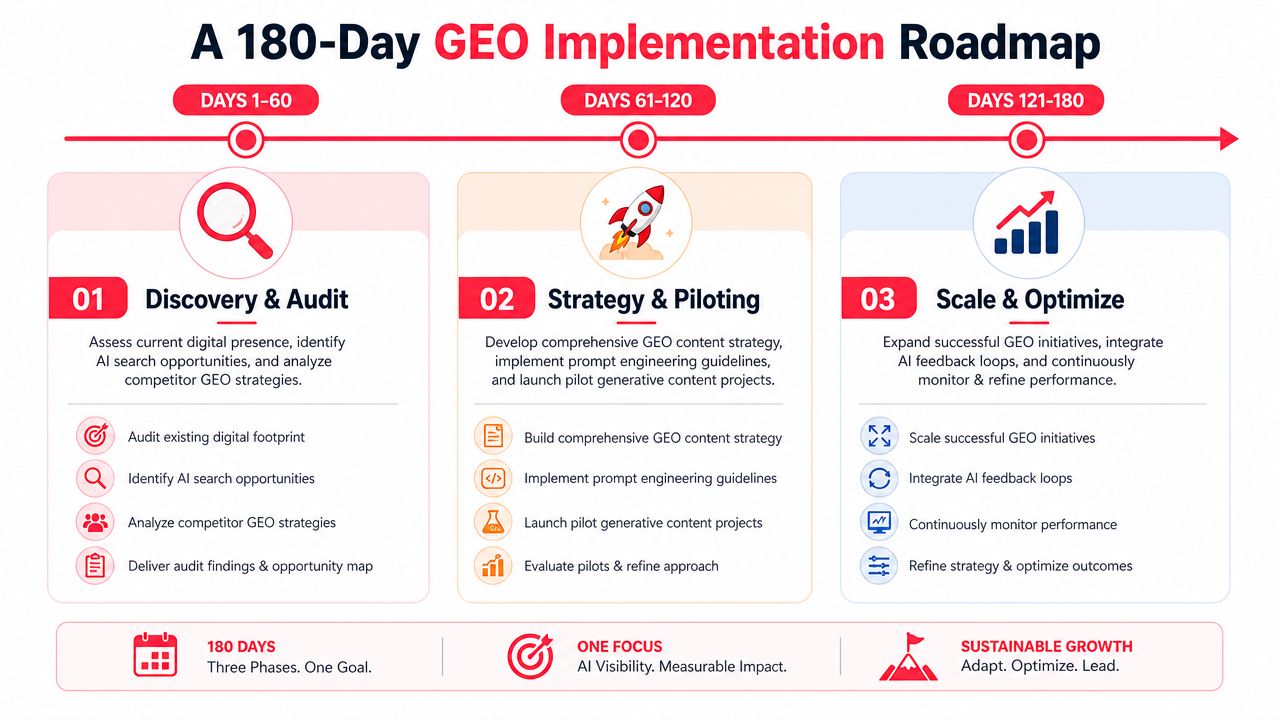
Days 1 to 30 audit and baseline
Start with a commercial query set. Pick the prompts that map to category demand, product comparison, objections, migration concerns, and implementation questions.
Then document three things manually across ChatGPT, Perplexity, and Gemini:
- Brand appearance: Are you present at all?
- Citation status: Are you cited directly?
- Accuracy: Is the product described correctly, or is a competitor owning the framing?
Run the technical audit in parallel. Check crawler access, schema coverage, page structure, FAQ opportunities, and template issues. If your team needs a broader sequencing model for cross-functional rollout, this AI implementation roadmap is a good reference point.
Days 31 to 90 foundational fixes and pilots
Do not spread effort across the whole site yet.
Pick a small set of high-value pages. Usually that means category pages, comparison pages, product pages, implementation pages, and a few strong FAQ or buyer-guide assets. Rewrite them using the prompt and factual methods covered earlier. Add schema where appropriate. Clean up headings. Make summaries extractable.
I'd also put sales and customer success into the loop here. They hear the objections, comparison language, and evaluation questions first. Those become high-value GEO inputs fast.
Fix the pages that sit closest to revenue first. Leave the broad thought leadership refresh for later.
Days 91 to 180 scale and operating cadence
Once the pilots show better inclusion, cleaner citations, or more accurate AI representation, move GEO into normal content operations.
That means:
- Editorial workflow: Every new high-intent page gets reviewed for extractability and factual structure.
- Technical QA: Templates include the machine-readable layer by default.
- Revenue reporting: GEO metrics sit beside pipeline and conversion reporting.
- Refresh rhythm: Sales, product marketing, and content review the commercial prompt set on a recurring basis.
This phase is where companies either build a compounding asset or drift back into ad hoc publishing. The difference is operating discipline. GEO works best when it becomes part of your revenue system, not a one-off campaign.
Your Next Step to Capture AI-Driven Revenue
Do one thing today.
Take your 10 most important commercial-intent queries and run them manually in ChatGPT, Perplexity, and Gemini. Use the exact phrases your buyers use when they are close to selecting a vendor.
For each query, document:
- Whether your brand appears
- Whether your domain is cited
- Whether the description is accurate
- Which competitors appear instead
- What source types the model seems to trust
This takes about an hour. It gives you a baseline. That baseline is what you need to decide whether GEO deserves budget, ownership, and executive attention.
If your company is missing from those answers, the problem is already live. If your company appears but is framed poorly, the problem is still live. Either way, you now have something concrete to act on.
If you want an expert-led next step, contact Stimulead for a formal AI Visibility Audit. We'll turn that first manual check into a working revenue plan across AI search optimization, CRO with AI, GTM engineering, and agent commerce readiness.