
In 2026, 81% of research teams were already using AI-led customer research, and the median time-to-insight fell from 26 days to 3.2 days, a drop of roughly 88% (state of AI customer research in 2026). That kind of speed changes the job. The bottleneck is no longer collecting more opinions, it's deciding which AI-generated themes are worth putting in front of revenue.
Customer research with AI works when you treat it as a hypothesis generator with a validation gate, not as an insight engine that can be trusted on its own. I've seen teams produce cleaner summaries, better clustering, and faster synthesis, then stall because nothing in the output tied back to conversion rates, pipeline quality, retention, or experiment results. The teams that win use AI to move faster through the messy middle, then force every useful idea to survive contact with real customer behavior and operating data.
Table of Contents
- Why AI Research Still Fails Without Decision-Grade Validation
- Building the Data Foundation Across Fragmented Sources
- Running AI Interviews and Prompt Chains That Deliver Results
- Validating AI Insights Against Revenue and Conversion Data
- Integrating Research into CRO and GTM Workflows
- Pitfalls, Compliance, and Your 30-Day Launch Plan
Why AI Research Still Fails Without Decision-Grade Validation
In 2026, AI customer interviews cut median time-to-insight from 21 days to 1.8 days in a 500-plus-hour dataset, a reduction of roughly 91% (AI customer interview report). That kind of compression is real. It's also where a lot of teams get sloppy, because speed makes weak inference feel productive.
Fast synthesis creates false confidence
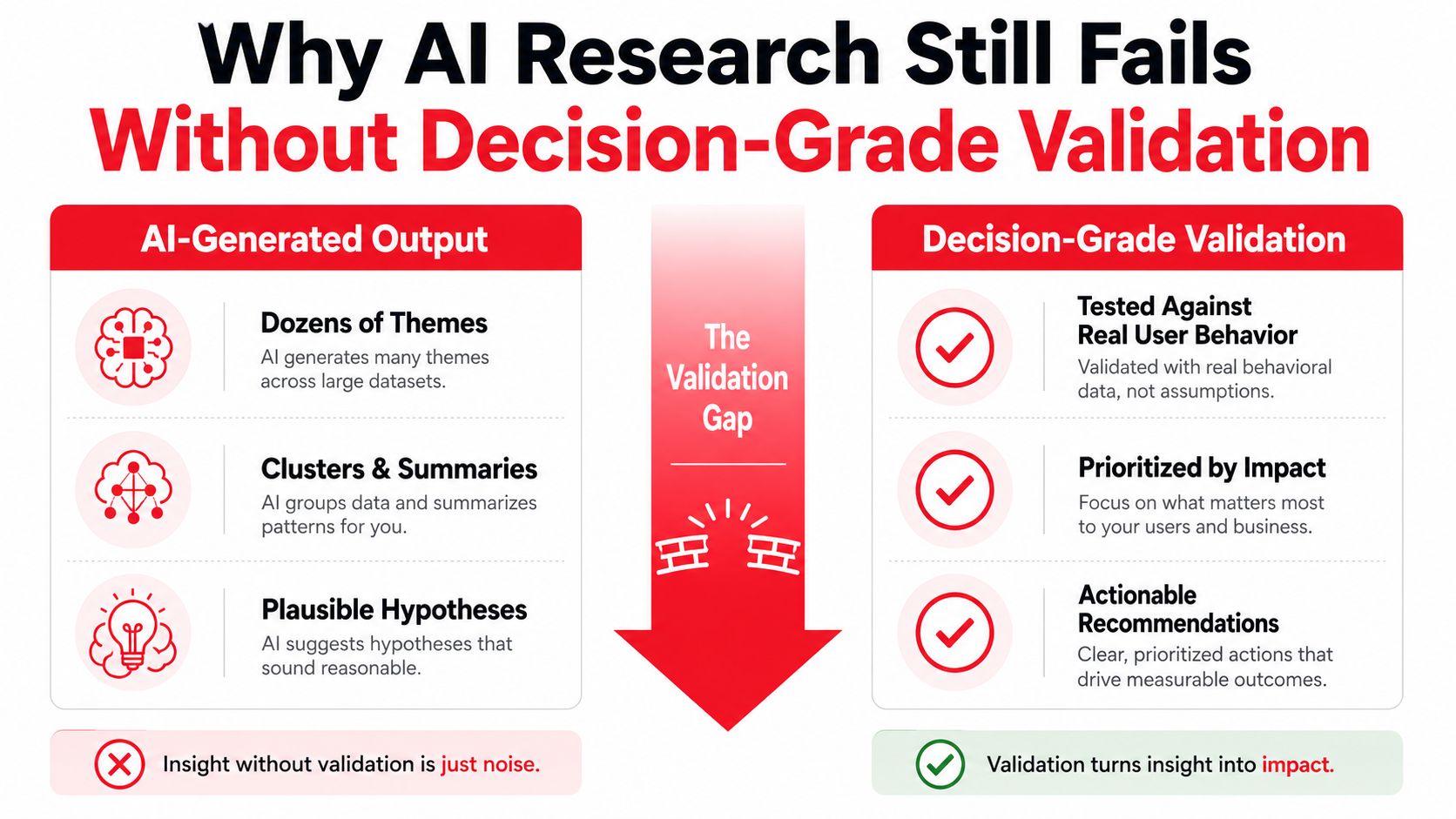
The hard part of customer research with AI isn't generating more themes. It's separating the themes that sound right from the ones that can survive a product decision, a pricing test, or a GTM change. Columbia's overview of generative AI in market research frames the workflow as opportunity design, data collection and analysis, and reporting, but the missing layer is decision proof, the step where a theme gets tied back to a revenue metric or an experiment outcome (Columbia generative AI market research overview).
Practical rule: if a theme can't change a roadmap bet, a message test, or a sales motion, it's still a hypothesis, not an insight.
That sounds strict, but it saves time. Teams that skip the validation step end up filling slides with plausible summaries while the CRO queue, lifecycle team, and product group all make different interpretations of the same output. The result is cleaner reporting and weaker decisions.
Use AI to widen the funnel for ideas
The best mental model is simple. Let AI widen the funnel, then let the business decide what belongs at the top of the stack. A useful output might be a cluster around onboarding confusion, trust concerns, or hidden buying objections. A decision-grade output is one that survives pressure from funnel data, retention behavior, support volume, or test results.
That's why customer research with AI fits revenue leadership best when it sits inside the operating cadence, not in a one-off research project. The point is to move faster from raw customer language to testable claims. If AI finds twelve plausible reasons for churn, the job isn't to admire the synthesis. The job is to pick the two that deserve an experiment this week.
Building the Data Foundation Across Fragmented Sources
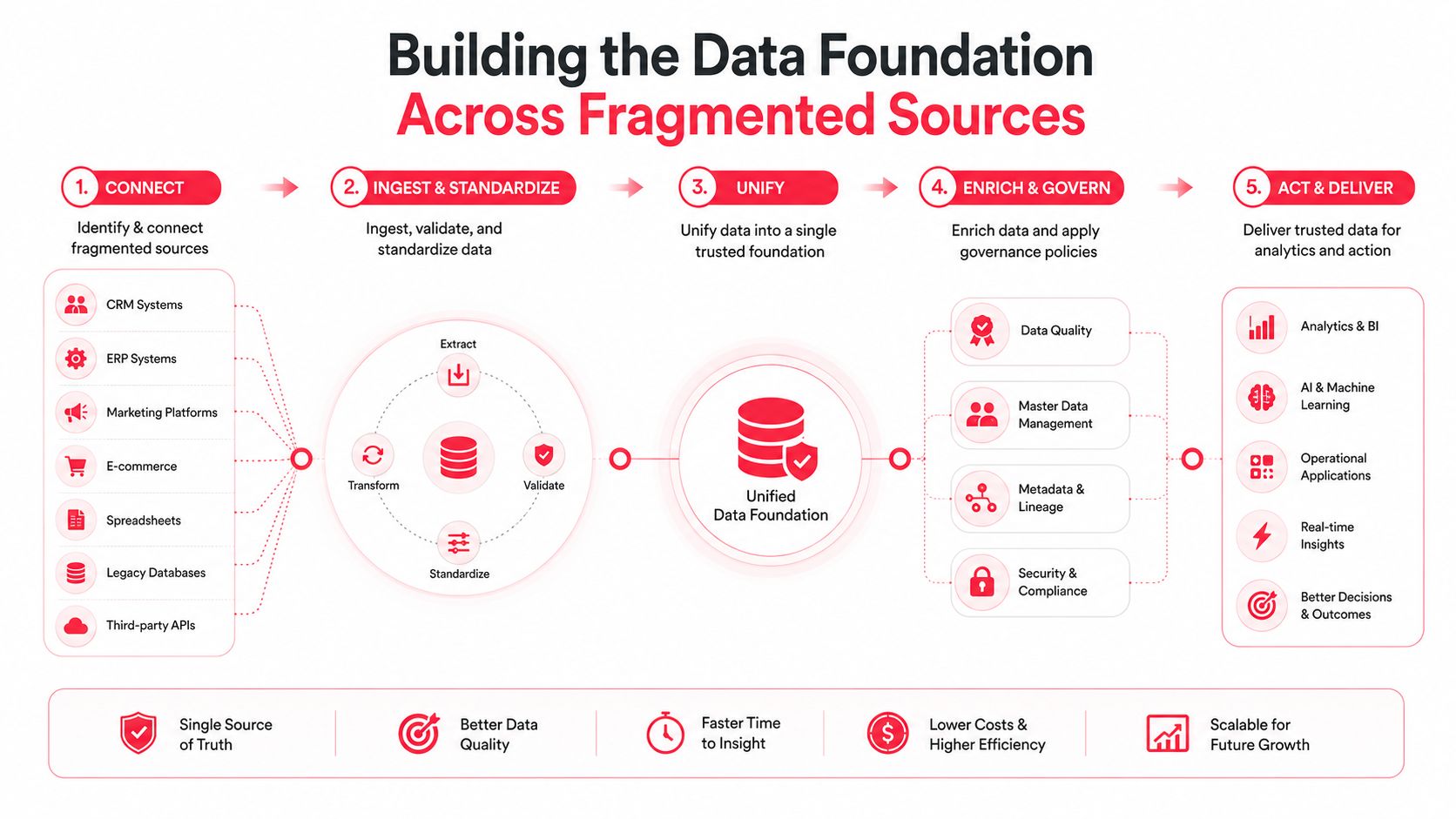
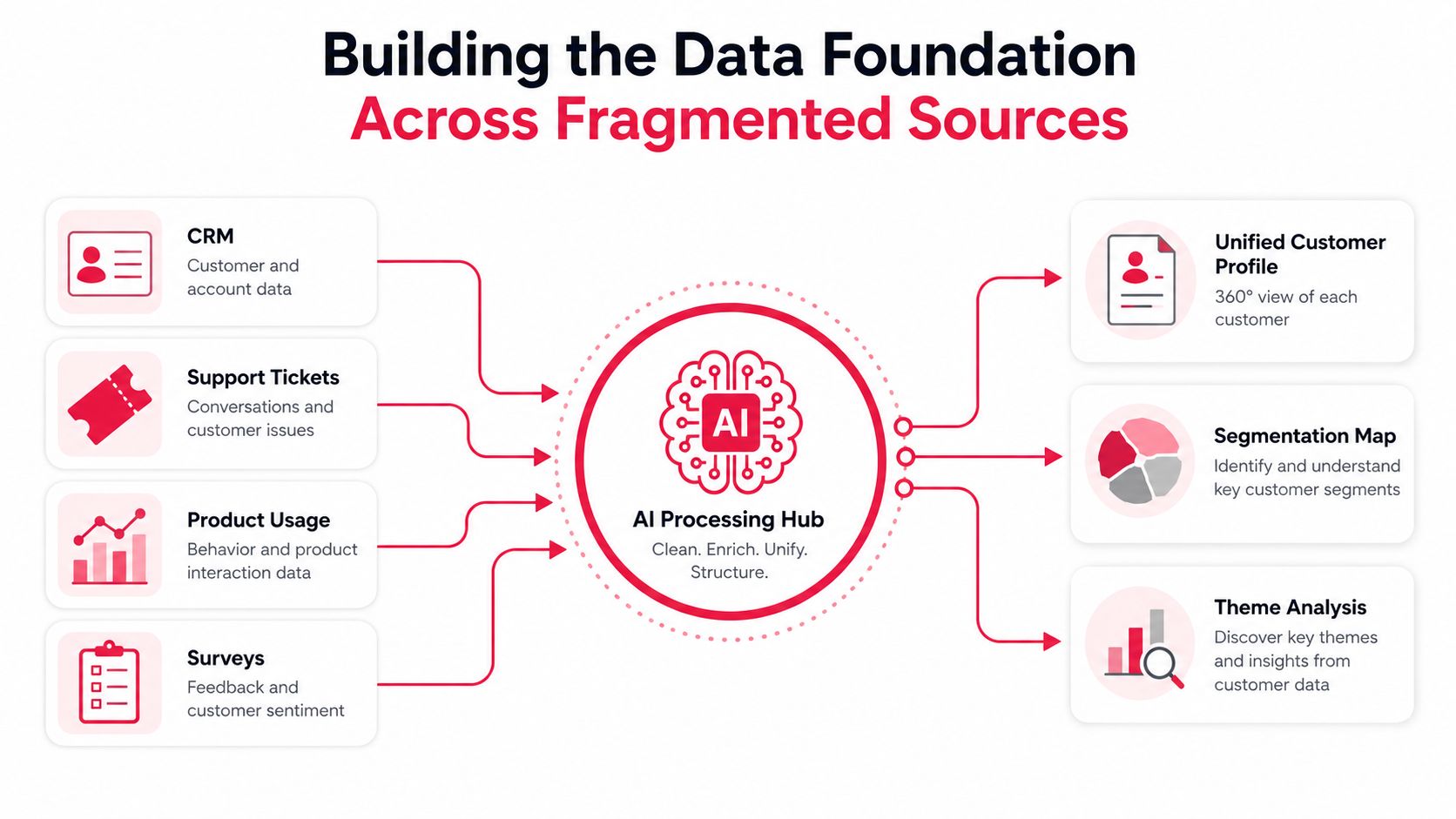
AI research gets stronger when the input goes beyond surveys and interviews. The key advantage comes from cross-domain synthesis, where what customers say is checked against what they do. That means bringing CRM notes, support tickets, product analytics, session replays, and sales call transcripts into one research corpus, then letting the model surface overlap and contradictions.
Start with the sources that already shape revenue
For most growth teams, the minimum useful stack stays small. Pull in CRM notes first, because they carry objections, deal blockers, and buying language. Add support tickets next, because they show friction after the sale and during onboarding. Then layer in product analytics and session replays so the team can see whether the language matches actual usage patterns.
The reason to start there is straightforward. These sources already exist, and they already map to revenue behavior. You do not need a six-month data platform project to begin. You need a clear schema, a repeatable export cadence, and a field that identifies the customer, account, or segment across systems.
Keep the first pass narrow. Do not try to ingest every log, every transcript, and every note from day one. Focus on the data that answers the same business questions every week, like why trials stall, why demos do not convert, or where retention starts to crack.
A messy but current corpus beats a perfect corpus that arrives too late to influence a test cycle.
For teams that need a practical readiness check before wiring this up, a structured audit like the one at Stimulead's AI readiness assessment helps surface what data is usable now and what needs cleanup.
Structure the corpus for traceability
AI output becomes trustworthy when every insight can be traced back to raw evidence. That means each record should carry source type, date, segment, stage, and a link to the original artifact when possible. You want the model to answer questions across documents, and you also want a human to jump back to the transcript, ticket, or note within seconds.
Use lightweight normalization, not heavy transformation. Convert transcripts, notes, and tickets into consistent text blocks. Add metadata fields for customer type, acquisition channel, product area, and lifecycle stage. Then store the corpus in a way that supports embeddings and topic modeling without forcing a full warehouse rebuild.
The biggest opportunity sits here. What customers say in interviews often diverges from what they do in product usage or support behavior. Those gaps are usually where the most valuable backlog items live. In practice, that means a complaint that never appears in surveys but spikes in tickets, or a feature request that sounds minor in calls but shows up in abandoned flows.
Set a weekly operating cadence
A one-off export will not build trust. The workflow needs a cadence. Refresh the corpus weekly, review the top repeating themes, and keep a short list of evidence snippets attached to each theme. If a theme does not recur, it stays low confidence until the next cycle.
That cadence also makes the data usable for adjacent teams. GTM, product, and customer success can all read the same source set, which cuts the normal argument about whose version of the customer is correct. For teams working on AI prospecting, that is especially useful, because the same corpus can inform outbound messaging and objection handling. A relevant resource on the adjacent strategy side is hiring AI teams for product strategy.
Running AI Interviews and Prompt Chains That Deliver Results
AI-moderated customer interviews work best at repetitive conversational probing. In the 500-plus-hour dataset, the AI interviewer achieved an 87% completion rate versus 34% for human-led video interviews using the same recruit pool, asked 3.2x more clarifying follow-ups per session, and cut median time-to-insight from 21 days to 1.8 days (AI customer interview report). The throughput is real, but the prompts and validation gates decide whether the output is useful.
Use a staged interview chain
The cleanest workflow starts with segment generation, then moves into outreach, interviewing, and synthesis. NYU Entrepreneur recommends using AI to generate 3 to 5 plausible early-adopter segments, draft a non-salesy outreach email for a 15 to 20 minute conversation, create 10 to 15 open-ended questions focused on past behavior, and synthesize notes after 5 to 10 interviews before refining the hypothesis and repeating the cycle (NYU Entrepreneur customer discovery with AI).
That sequence works because it keeps the model inside a narrow job. First it proposes segments. Then it helps recruit. Then it interviews. Then it summarizes. The prompts should reflect that progression, and they should stay close to the evidence you already trust from support logs, CRM notes, and product usage.
A simple interview chain looks like this:
- Segment prompt: ask for early-adopter segments that are plausible given the current product, current customer base, and current objection pattern.
- Outreach prompt: ask for a short invitation that sounds like research, not sales.
- Interview prompt: ask for open-ended questions tied to past behavior, recent decisions, and current workarounds.
- Synthesis prompt: ask for themes, evidence snippets, confidence level, and a short list of contradictions.
Insert checkpoints that block hallucinated patterns
Teams lose quality when they let the model cluster text before any human reviews the raw evidence. That creates polished nonsense. The fix is simple. After the first synthesis pass, force the model to show the exact transcript lines or ticket excerpts supporting each theme. Then ask for at least three independent sources that support or contradict the claim, because if it can't do that, the claim stays weak.
Practical rule: every theme needs evidence, a counterexample, and a decision owner before it reaches a roadmap meeting.
That same discipline matters for outbound work. If the interview chain surfaces the phrases buyers use, sales and marketing can turn those phrases into sharper messaging, and the handoff into AI prospecting becomes much cleaner. The research output and the outbound language should come from the same evidence base.
Synthetic respondents have a place, but only in narrow jobs like stress-testing interview guides, exploring segment language, or testing message variants before a live recruit cycle. For anything tied to pricing, churn, or product direction, live customer evidence still has to win. That is the difference between speed and credibility, and it is the line that keeps teams from confusing a plausible hypothesis with a decision they can defend. If a team is building hiring AI teams for product strategy, this is the operating standard that keeps the research useful instead of decorative.
Validating AI Insights Against Revenue and Conversion Data
The most useful question in customer research with AI is simple. Which insights change a decision? A theme that sounds sharp in a synthesis document means little if it doesn't move conversion, pipeline quality, retention, or test design. Decision-grade validation is the filter that keeps AI work tied to revenue.
Pressure-test themes against operating data
Start with the funnel. If a theme says prospects don't understand value, check demo-to-close behavior, trial activation, and page-level drop-off. If a theme says onboarding friction is the issue, inspect retention cohorts, support volume, and product usage after signup. If a theme says pricing is the blocker, look for patterns in discounting, deal slippage, or step-down requests.
The point is to compare AI output with the data the business already trusts. That can include conversion rates, pipeline velocity, CAC/LTV ratios, and experiment results. A strong insight should show some consistency across at least two of those surfaces, or it should stay in the hypothesis pile.
Productify's guidance is useful here because it insists that important claims be traceable back to inspectable evidence, and that the model should be asked to list the exact sources behind each claim and find multiple independent sources that support or contradict it (Productify on better market intelligence with AI).
Use confidence gates before the roadmap
There's a trap here. Teams often treat AI output as a finished answer because the writing is polished. It's safer to classify each theme as weakly supported, moderately supported, or decision-ready. Weakly supported means there's some signal, but the evidence is thin or inconsistent. Decision-ready means the theme lines up with operating data and has a clear test owner.
A useful benchmark from the 2026 synthesis is that teams crossing 60% decision coverage reported 2.3x higher confidence in roadmap bets (AI customer interviews in 2026). That's a strong clue that the value is in connecting research to decisions, not in producing more themes.
Here's the gate I use in practice:
| Checkpoint | What to ask | What good looks like |
|---|---|---|
| Evidence | Can we inspect the raw source? | Transcript, ticket, note, or log is attached |
| Agreement | Does the theme show up in more than one source type? | Interview and operational data point in the same direction |
| Revenue link | Does the theme map to a funnel or retention outcome? | It changes a metric or test hypothesis |
| Actionability | Who owns the next step? | CRO, product, lifecycle, or sales has a named owner |
If a theme can't clear that sequence, it stays in research. It doesn't get a roadmap slot, and it definitely doesn't get treated like settled truth.
Integrating Research into CRO and GTM Workflows
Validated research is only useful if it reaches the people running tests and launches. Otherwise it becomes a polished artifact that gets read once and forgotten. The teams that get real value move research straight into CRO queues, outbound sequencing, AI search work, and agent-commerce planning.
Map each theme to a test or asset
Every validated theme should end in a handoff. For CRO, that means a theme-to-test map with the hypothesis, target page, primary metric, and expected behavior shift. For GTM engineering, it means a message validation scorecard that pairs persona language with channel-specific variants. For AI search optimization, it means a content or FAQ gap mapped to the phrases buyers use when they ask an AI tool for recommendations.
The handoff has to be clean enough for execution. A CRO lead doesn't need the whole research corpus. They need the top theme, the evidence, the risk level, and the test design. A sales leader doesn't need a long memo. They need objection patterns, language to avoid, and a short list of proof points that match buyer concerns.
Keep the cadence tight
Quarterly research doesn't move weekly testing velocity. A weekly loop does. That loop can be simple. Refresh themes, review the top five repeated patterns, attach evidence snippets, assign one action category per theme, and review what repeated the next week. Viktor's workflow recommends exactly that structure, and it's strong because it forces repetition to matter more than novelty (AI for customer research weekly loop).
That cadence also fits Stimulead's core focus areas. CRO with AI needs continuous message and page testing. GTM engineering needs a constant feed of language, objections, and segment detail. AI search optimization, or AEO, needs the same customer phrases showing up in content, FAQs, and product pages. Agent commerce readiness depends on the same discipline, because AI-mediated buying will reward teams that can present clear, machine-readable proof of fit.
Research earns its keep when it changes the next experiment, the next message, or the next page.
If you want a practical companion for conversion work, the page on split testing landing pages fits naturally beside this workflow. The point is coordination, research informs the test, the test validates the theme, and the result feeds back into the corpus.
Build the handoff artifacts once
Don't create a new format for every team. Use three reusable artifacts:
- Theme-to-test map: one theme, one hypothesis, one owner, one metric.
- Message validation scorecard: audience segment, objection, proof point, and channel fit.
- Persona enrichment template: language, buying trigger, trust signal, and risk blocker.
When those artifacts are standard, research stops being a meeting topic and becomes an operating system.
Pitfalls, Compliance, and Your 30-Day Launch Plan
The fastest way to kill an AI research program is to ignore consent, data handling, and review discipline. Customer transcripts often contain sensitive commercial details. Support tickets can include personal data. Sales notes can be messy, incomplete, and biased toward deal narratives. If the system can't handle that responsibly, it doesn't belong in production.
Treat governance as part of the workflow
Consent needs to cover AI-moderated sessions and storage of transcripts. Access should be limited by role, especially if the corpus includes customer-specific revenue details. Hallucination risk matters more in regulated industries, where a confident but unsupported theme can create compliance exposure or a bad product decision.
A good operating standard is simple. Every important claim should be traceable back to a document, dataset, or transcript you can inspect, and every unsupported claim should be labeled weakly supported. That standard is consistent with the validation approach in IdeaSignal's AI-driven idea validation framework, which is a useful adjacent reference for teams that want structured proof before acting.
A practical 30-day launch plan
For a $1M SaaS team, start with one source cluster, usually CRM notes plus support tickets, and run one interview loop per week. Build the evidence tagging habit first. Then add product analytics once the team is disciplined about reviewing raw snippets.
For a $50M e-commerce operation, start broader. Connect returns, support, onsite behavior, and customer service notes, then assign a weekly owner to validate themes against conversion and retention behavior. The scale is bigger, but the principle stays the same, one corpus, one cadence, one decision gate.
A clean 30-day rollout looks like this:
- Days 1 to 7, Foundation and compliance. Define data sources, consent rules, access roles, and the evidence format.
- Days 8 to 21, Pilot and validate. Run one interview or synthesis loop, then compare the output against revenue or conversion data.
- Days 22 to 30, Scale and operationalize. Turn the best themes into recurring handoffs for CRO, GTM, and product.
Use a narrow success metric in the first month. If the system is working, teams should spend less time arguing about what customers mean and more time deciding what to test next.
If you want help wiring this into CRO, GTM engineering, AEO, or agent-commerce readiness, start with a focused audit and a working backlog, then bring Stimulead in for the roadmap, implementation oversight, and team training that turns customer research with AI into weekly revenue decisions.