
AI prospecting has crossed from side project to operating system. In the latest 2026 compilation, 81% to 87% of sales teams use AI in part of the sales process, and 41% of enterprise B2B teams already run at least one AI SDR in production, up from 12% a year earlier source. That shift matters because the best teams aren't using AI to send more noise. They're using it to find better accounts, time outreach faster, and keep reps focused on live buying signals.
I've seen the same pattern across growth-stage SaaS pilots. The team starts with a list-based outbound motion, gets buried in weak research, then tries to fix the problem by sending more email. The better move is to build a signal-based pipeline and use AI to compress the work before the first contact. If your main goal is to build a predictable sales pipeline, AI prospecting can do that, but only when the process is tight.
Table of Contents
- Introduction to AI Prospecting Roadmap
- Define Goals and KPIs for Prospecting
- Prepare Data and Target Segments
- Select and Integrate Prospecting Tools
- Build Research and Outreach Workflows
- Optimize with A B Testing and Prospecting Velocity
- Measure Governance and Next Steps
Introduction to AI Prospecting Roadmap
A CMO with a lean SDR team usually feels the pain first. Reps are busy, the CRM is full, and outbound volume looks fine on paper, yet pipeline still lags. AI changes that equation when it's used to decide who to contact, when to contact them, and what context belongs in the message.
IBM describes the stack as machine learning, algorithms, NLP, and predictive analytics that work across multiple data sources to find target audiences, prioritize high-quality leads, and personalize outreach while reducing manual work IBM on AI sales prospecting. That's the right mental model. The point isn't faster typing. The point is less waste before a rep ever sends a note.
Practical rule: if the workflow doesn't change who gets contacted, it's just a writing tool.
A practical rollout starts with a narrow pilot, then expands once the signals prove useful. Growth-stage teams should think in terms of target accounts, research time, meetings booked, and pipeline created, then move step by step through data prep, tool integration, outreach, and governance. That's how you get from experimentation to something the CRO can trust in a board deck.
Define Goals and KPIs for Prospecting
Start with revenue, then work backward. If the target is pipeline growth, the metrics need to connect directly to meetings, response quality, and pipeline per dollar. Raw touch volume is easy to report, but it doesn't tell you whether the motion is creating actual opportunity.
A useful way to frame AI prospecting is to map a pipeline target into operational KPIs. For example, if you want more meetings booked, the question becomes how many qualified meetings each rep needs to create, how many signals they must review, and how much time each step consumes. That's also where teams get distracted. More touches look productive until you compare them with meetings and opportunity creation.
| Sample Prospecting KPI Table | Formula | Target Example |
|---|---|---|
| Meetings booked per rep | Qualified meetings ÷ reps | Set by team capacity |
| Response rate | Replies ÷ outbound sends | Set against baseline |
| Time spent on account research | Research minutes per account | Reduce with AI-assisted workflow |
| Pipeline per dollar | Pipeline created ÷ spend | Compare pilot cohorts |
| Signal-to-meeting rate | Meetings from signal-triggered outreach ÷ signals acted on | Track by signal type |
For a formal measurement framework, tracking key performance indicators gives a useful reference point for the structure, even though your prospecting dashboard should stay closer to revenue than vanity activity. The best KPI set usually has one output metric and a few input metrics that can be changed by the team next week.
Practical rule: meetings booked per rep is a better operating metric than touches sent, because reps can influence it directly.
The discipline here is simple. Pick one primary goal, define the math that supports it, and stop adding metrics unless they change a decision. If you can't explain how a KPI affects pipeline, it doesn't belong in the pilot.
Prepare Data and Target Segments
Most pilots fail in the data layer, long before anyone argues about prompts. AI can only work cleanly when CRM records, enrichment data, and intent feeds are unified enough to support actual targeting. If your CRM is full of duplicates, stale titles, and half-complete company records, the model will happily speed up bad outreach.
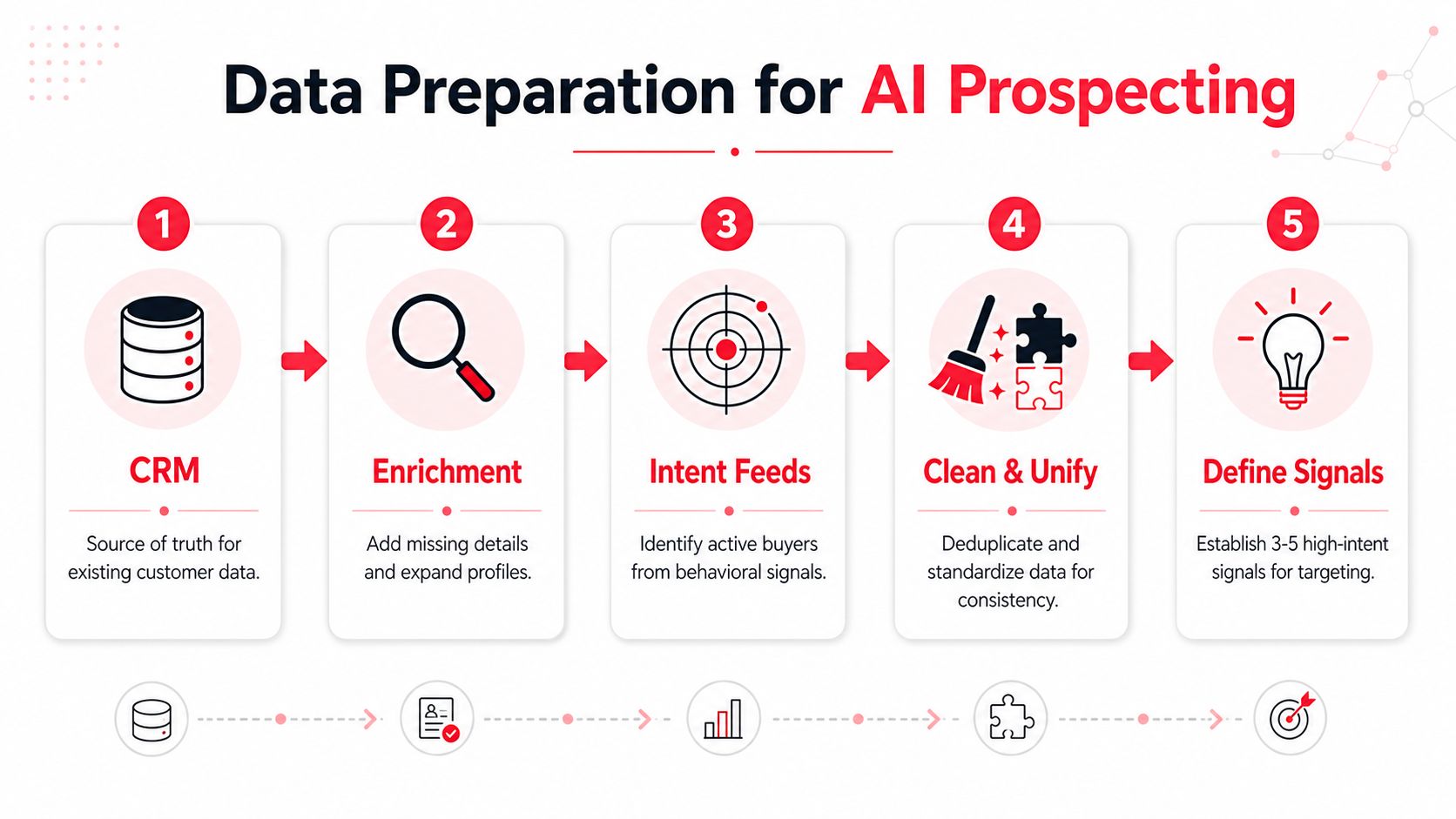
A five-step setup keeps the workflow sane. CRM is the source of truth, enrichment fills the gaps, intent feeds surface activity, cleaning and unification remove conflicts, and then the team defines a small set of signals that matter. That sequence matters because AI should query data, not invent context from thin air.
Organizations using signal-qualified leads see 47% better conversion rates, 43% larger average deal sizes, and 38% more closed deals per quarter than traditional lead scoring approaches Autobound on signal-qualified leads. Those gains come from better targeting quality, not more volume.
The practical move is to define 3 to 5 high-intent signals and map them to ICP micro-segments. Pricing-page visits might matter in one market, comparison-guide downloads in another, and hiring spikes in a third. A team selling to security buyers, for example, may care much more about active research behavior than broad firmographics.
The cleaning step needs a governance owner, not just a RevOps task queue. Deduping, title standardization, and account matching should happen before AI scoring ever touches the record. That's also where Stimulead's AI readiness assessment is relevant if you want to pressure-test whether your data and ICP are ready for a pilot.
A simple rule works well in practice. Keep the first segment set tight, use only the signals you can explain to a rep, and reject any audience definition that feels broad enough to “cover more ground.” Broadness is how teams end up automating irrelevance.
Select and Integrate Prospecting Tools
Tool selection should follow the workflow, not the other way around. The stack usually breaks into three buckets, signal-intelligence platforms, enrichment engines, and outreach automation tools. Each one solves a different problem, and the wrong combination creates sync gaps that make the AI layer look worse than it is.

Signal-intelligence platforms are strongest when you need buyer timing. They surface activity, prioritize accounts, and help reps focus on live opportunities. Enrichment engines are better when data completeness is the blocker, especially for missing titles, company attributes, or contact fields. Outreach automation tools are the execution layer, where sequences, branching logic, and follow-up live.
| Tool category | Best use case | Integration effort | API maturity |
|---|---|---|---|
| Signal-intelligence platforms | Identify buyer intent and market change | Moderate | Developing to mature |
| Enrichment engines | Update and expand prospect profiles | Easy to moderate | Mature |
| Outreach automation tools | Send personalized campaigns at scale | Moderate to complex | Mature |
Video walkthroughs can help teams compare workflows before implementation. This one is worth reviewing if your sales ops team needs a fast visual model of how tool layers should sit together:
For product evaluation, I usually look at three things first, integration burden, API quality, and hallucination risk. If the tool can't sit cleanly inside your CRM and engagement stack, the pilot slows down. If it can't query verified data, the output becomes pretty text with weak accountability. For a broader vendor scan, Stimulead's AI sales prospecting tools guide is a helpful companion when you're comparing stack options.
Build Research and Outreach Workflows
The best AI prospecting workflow is signal-based, not list-based. The operational sequence is consistent, monitor a small set of high-intent signals, run account research, map the decision maker, generate anchored outreach, then measure conversion. That order keeps the AI focused on action, not open-ended browsing.

A good cadence is compact. Fifteen minutes go to reviewing AI-surfaced signals, then thirty minutes go to acting on the top three accounts. That's enough structure for a daily habit without turning the motion into a second job.
Practical rule: if a rep can't explain why an account was chosen in one sentence, the signal is too weak.
When I run pilots, I keep the prompts direct. For research, the prompt asks the model to summarize the company, recent trigger events, likely buying committee, and one or two relevant pain points. For decision-maker mapping, the prompt asks which role is most likely to own the budget and which adjacent roles will influence the deal.
For email drafting, the best templates use a signal anchor first, then connect it to a short value statement. A useful opener might sound like this in structure, “I noticed the pricing-page activity and thought this might matter for your team's evaluation process.” That framing keeps the message grounded in observable behavior instead of generic personalization. If your workflow needs clean contact discovery before that step, finding email addresses for outreach can be useful as a support resource for operational teams.
I've found that the strongest prompts don't ask for creativity. They ask for disciplined synthesis. The model should only work from verified records, the named signal, and the ICP definition, then produce one clear draft the rep can edit. That keeps research fast and avoids the common trap of letting AI fill gaps with confident nonsense.
Optimize with A B Testing and Prospecting Velocity
Volume deserves skepticism until you've tested message quality. Once AI starts scaling touches, the easy mistake is to assume more sends will fix weak conversion. In practice, the teams that win are the ones that treat A B tests as a control system, not a copywriting exercise.
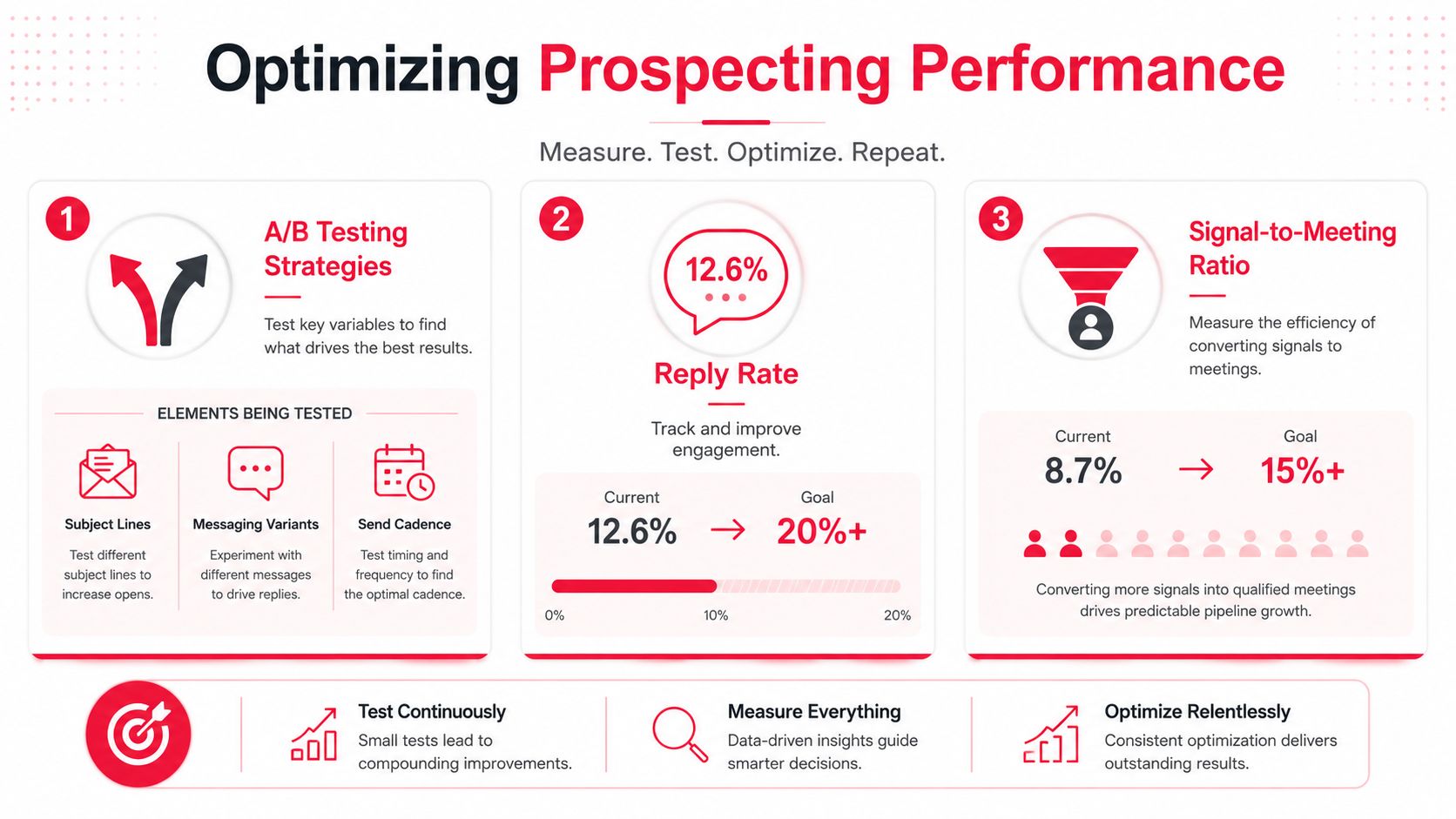
The cleanest tests start with subject lines, messaging variants, and send cadence. Then you watch reply rate, meetings booked, and signal-to-meeting lift by segment. If one variant wins on opens but loses on meetings, it's the wrong winner.
Signal-based outreach can achieve 5% to 25% reply rates versus roughly 3% for traditional outbound, and teams report booking 2 to 3 times more meetings per rep while reducing manual research time by over 50% Nooks on AI prospecting strategies. The same general direction shows up when the workflow is built correctly, the AI is strongest when it's tied to a real signal and a real account fit.
That volume-quality trade-off shows up fast. One 2026 industry compilation notes that AI-augmented outbound can scale activity from about 1,150 monthly touches in a human baseline to 7,400 on average, but reply rates can fall from 4.7% to 2.9% if volume gets pushed too far Overloop on AI prospecting statistics. That's the warning label. More activity without a tighter signal model can easily flatten performance.
A useful decision rule is simple. If reply rate drops while touches rise, stop scaling volume and tighten personalization. If meetings per rep rise and manual research time falls, you've earned the right to expand the segment.
The fastest way to waste AI prospecting is to treat it like a send-multiplier instead of a qualification system.
Prospecting velocity should be measured in speed from signal to outreach and from outreach to meeting, not just in emails sent per day. That's the metric that tells you whether your team is responding to live buying intent or just moving faster through a weak list.
Measure Governance and Next Steps
AI drifts when nobody audits the outputs. HubSpot warns to check for algorithmic bias and ICP drift when the system keeps recommending the same familiar titles, industries, or geographies, and to run regular audits so the team doesn't scale the wrong audience HubSpot on AI prospecting tools. This is indeed a governance risk. A team can improve throughput and still damage pipeline quality.
The control system should be clear. One person owns model review, one person owns segment quality, and one person owns outcome tracking. If reply rates flatten, the first question is whether the model is favoring past winners over current market fit. If a segment starts producing meetings that don't convert, the signal itself may be noisy.
A practical dashboard only needs a few views. Track signal-to-meeting rate by signal type, time-to-engage on Tier 1 accounts, and downstream pipeline quality. Set a manual override rule for accounts where senior reps know the market better than the model, because some false positives are cheaper than letting bad recommendations harden into policy.
For governance structure and audit discipline, Stimulead's AI governance best practices is the right next read if you're formalizing ownership and review cadence. The point is to make AI decisions inspectable, not opaque.
The next step is to run a small, clean pilot on a narrow ICP, then expand only when the signal quality holds. Keep the prompt library short, keep the review step visible, and keep the KPIs tied to meetings and pipeline. If you want help designing the pilot, auditing your data, and building the handoff between AI research, outreach, and governance, reach out to Stimulead and ask for a fractional CAIO roadmap review built around your current GTM motion.