
Ask five conversion optimization agencies to describe their work and you'll get five versions of the same sentence: more tests, faster. That pitch has become the standard way firms sell, and it's the least useful thing a buyer can compare.
The decision in front of you is a measurement decision. Two agencies can run an identical number of experiments and produce wildly different value depending on whether those experiments were aimed at the event your business gets paid on, and whether the evidence behind a winner was still valid when the read-out landed. Testing volume tells you nothing about either. Most buyers compare it anyway.
Table of Contents
- What a Conversion Optimization Agency Sells
- Metrics That Show a Test Actually Worked
- How a Testing Engagement Runs From Audit to Read-Out
- Where Conversion Work Pays Off First
- Why B2B Pipeline Tests Mislead Teams
- Where AI-Driven Testing Loses Its Validity
- When Not to Buy Testing Yet
- Choose an Agency or Alternative Partner This Quarter
What a Conversion Optimization Agency Sells
Agencies package the same six or seven activities under different names, which is why comparing service descriptions wastes a procurement cycle. Compare scope instead: what gets produced, who owns the data behind it, and which number each line is supposed to move.
| Service | Typical deliverable | Best fit | Price range |
|---|---|---|---|
| Conversion audit | Analytics and heuristic review with a prioritized test backlog | Sites with traffic but flat conversion | Quote-based |
| A/B and multivariate testing program | Test roadmap, variant builds and weekly read-outs | Teams with steady monthly traffic | Quote-based |
| Checkout and form optimization | Field-level friction fixes, validation and early cost disclosure | Ecommerce and long lead forms | Quote-based |
| Landing page and sales page rebuilds | Variant builds, message match and offer tests | Paid traffic landing on weak pages | Quote-based |
| Analytics and tracking setup | Event instrumentation and funnel reporting | Teams without reliable conversion data | Quote-based |
| Personalization and AI-assisted testing | Segmented variants and automated testing engines | Mature programs with clean data | Quote-based |
Published price ranges for these lines are thin, so treat any figure quoted in a sales call as an opening position. Ask for a written price against a named scope with the deliverables listed, the review cadence stated, and the exit terms spelled out.
Buy a service line only when the audit shows a specific leak in that line.
A typical retainer bundles three things: an audit, a testing program and a measurement layer. Project-only work on checkout or a single landing page is narrower and cheaper, and it pays off when the audit already points at that page rather than at your offer or your traffic quality.
Testing volume is what most firms put in the proposal because it's easy to count. The audit and the analytics setup decide whether those tests were worth running, and they're the two lines buyers trim first to hit a budget.
Some firms fold AI-assisted work into the same retainer: conversion strategy and roadmap advisory, training in AI testing workflows, and automated testing or personalization engines applied across ads, landing pages, sales pages, websites and emails. That's a scope question, not a differentiator on its own. If a store runs on Shopify, the ServeApps guide to Shopify CRO covers the platform constraints worth raising before the first call, including theme limits, app conflicts and what checkout extensibility allows you to test at all.
Ask two questions of every line item. Which metric will this move, and who owns the underlying data when the engagement ends. An agency that answers the first with a conversion rate and the second with its own dashboard is selling a dependency, not a capability.
Metrics That Show a Test Actually Worked
Conversion rate per session is a screening number. It tells you whether a page deserves investigation; it does not tell you whether a test produced money.
| Metric | What it shows | Use it when | Common failure |
|---|---|---|---|
| Conversion rate per session | Share of sessions that complete the goal | Early screening of pages | Hides lead quality and order value |
| Completed orders per checkout start | Checkout completion among users who started | Ecommerce checkout tests | Ignores payment failures and refunds |
| Qualified opportunities per 1,000 visitors | Lead-quality-adjusted yield | B2B lead generation | Needs CRM stage mapping before it's reliable |
| Average order value and refund rate | Value and quality guardrails | Any offer, price or flow change | Often left unmonitored in agency reports |
| Median landing-page conversion rate (6.6%) | Baseline for choosing audit targets | Setting audit priorities | Industry medians differ and B2B data is thin |
Set audit targets against a baseline you can defend. Unbounce's 2024 benchmark of more than 41,000 landing pages reported a median landing-page conversion rate of 6.6%, according to this conversion rate optimization glossary entry. Use it to rank which pages deserve attention first, then expect the B2B figure to land somewhere else entirely, because lead-generation benchmarks are thinner and rarely separate form fills from qualified form fills.
Why the sample size comes first
A few percent of relative lift on a page converting at 3% needs a large audience before the result separates from noise. Ask for the sample-size calculation before launch, in writing, with the baseline rate, the minimum detectable effect and the traffic the test will receive each day. An agency that can't produce that calculation in a day is guessing and will report a winner regardless.
When you need the arithmetic, our explainer on statistical significance walks through what a confidence interval does and doesn't tell you.
Predeclare one primary metric and two or three guardrails. Google measured users spending 9.2% more on mobile when experiences got faster, which is exactly why order value belongs in the guardrail set rather than the headline (Milliseconds Make Millions). A win on the primary metric alongside a fall in lead quality or a rise in refunds is a loss, and the read-out should say so in its first line.
Then ask who signs off on the primary metric, and whether that person sees pipeline or order data rather than the testing tool's dashboard. If the sign-off sits with someone who can't see whether the orders were profitable, your program optimizes for the tool's convenience.
How a Testing Engagement Runs From Audit to Read-Out
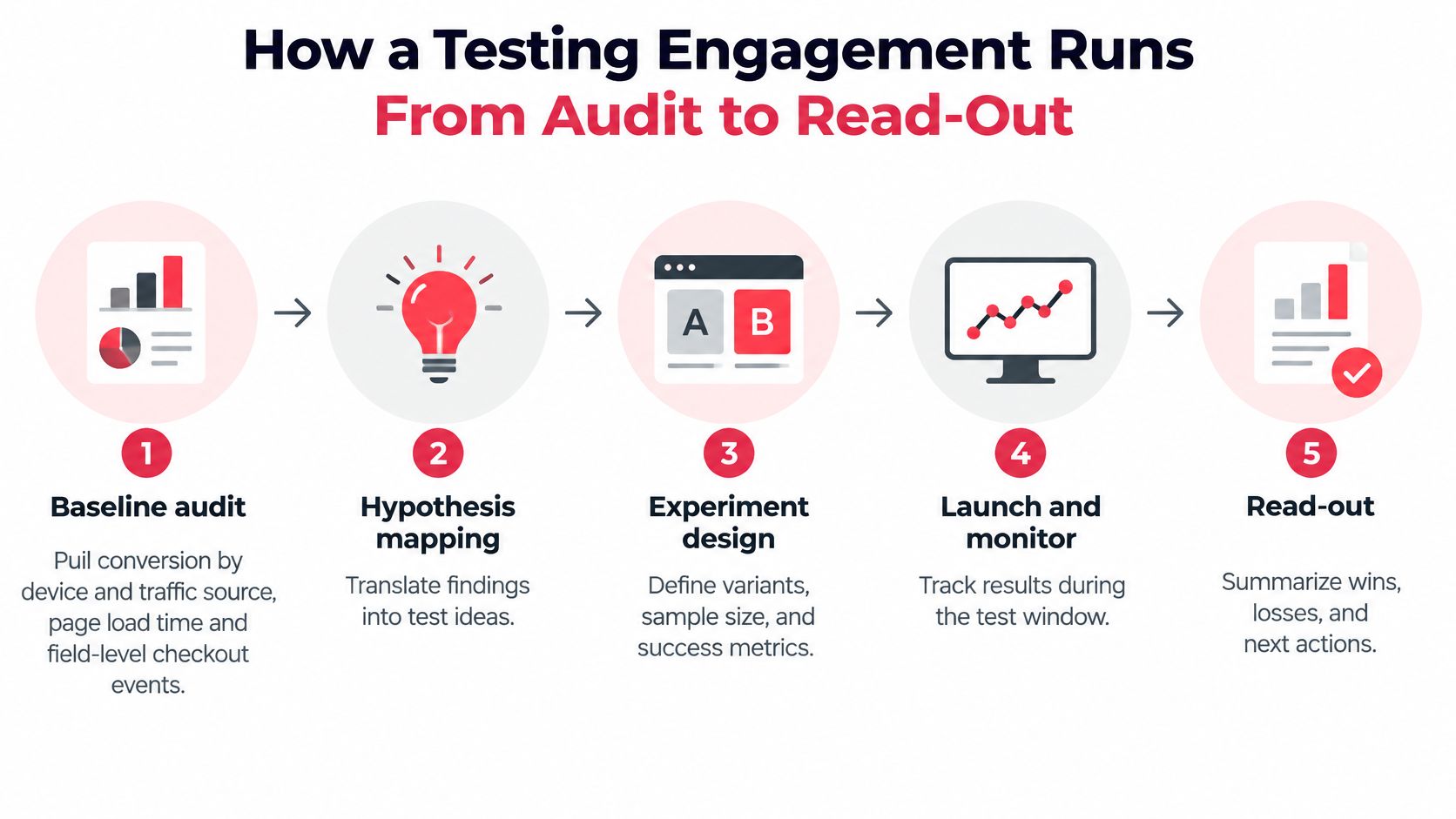
A testing engagement is a governance chain: every step either protects the decision you will make at read-out or makes that decision worse. Judge a proposal by whether it names the owner, evidence standard, and handoff for each step below.
Baseline audit. Pull conversion by device and traffic source, load time per template, and field-level events in forms and checkout. Speed belongs in this first pass because the starting point is often worse than assumed: Google's analysis of approximately 900,000 mobile websites found the average page took 22 seconds to fully load, against a rough benchmark of 2 seconds (Google's mobile site speed playbook). The common slip is an audit that stops at analytics screenshots and never opens the checkout.
Hypothesis backlog. Score each idea as affected sessions multiplied by value per conversion, then rank. A headline tweak on 200 monthly sessions loses to a shipping-cost disclosure on 30,000. Add a confidence note for tracking quality, so a weak event does not outrank a real leak.
Test design. Fix the decision rule before anything ships: primary metric owner, minimum run length, stop conditions, guardrails and what evidence expires when traffic mix changes. Picking the metric after data arrives stays invisible in the final report. Our guide to A/B testing best practices covers the design mechanics.
Build and QA. Check every variant across browsers, devices and tracking events before traffic splits. Require a QA log that shows each event fired once, under the right conditions, with revenue or lead fields intact.
Run and read out. Report confidence intervals and segment results next to the winner, with sales present when the conversion event is a lead. The first line should state the decision: ship, iterate or kill, plus which guardrail moved.
Ship, log and feed back. Deploy the winner, record the loser with the reason it failed, then reorder the backlog. Losing tests that vanish from the record get repeated by the next agency you hire.
A workable cadence is a weekly read-out and a monthly roadmap review. The deliverable from step one inside the first month is a ranked list of leaks with estimated affected sessions. When the baseline points at the cart, fix checkout drop-off leaks before spending a test on button copy. Stimulead runs that first pass across conversion, search visibility, sales process and data readiness, with output detailed enough for engineers, marketers and agencies to build from while your existing partners keep doing the building.
Where Conversion Work Pays Off First
Checkout is where the numbers are clearest. Baymard's benchmark of 344 leading US and European ecommerce sites found that 65% had mediocre-or-worse checkout UX and only 2% rated as good (Baymard checkout usability research). Its testing estimates about 32 actionable improvements on the average large site and a potential 35% conversion-rate increase from checkout design changes alone. Treat that 35% as a potential average across sites, not a forecast for yours.
Shoppers explain the gap themselves. Baymard's research found 17% of surveyed online shoppers had abandoned a purchase during checkout in the prior three months because the process was too long or complex (Baymard checkout benchmark).
The distance between the mediocre middle and the good end of that benchmark is why checkout leads almost every engagement. The traffic is high, the conversion event is unambiguous, and revenue lands in the same session. Lead-gen pages rarely give you all three.

Ranking the fixes
Instrument each checkout step, then classify failures by field, validation error, shipping-cost disclosure, payment method and guest-login friction. Rank the list by affected sessions multiplied by revenue per completed order. That ordering beats a design opinion every time, and it gives you a number to defend when the roadmap gets cut.
Field count is the most concrete hypothesis available. A lean checkout needs far fewer fields than the default flow most shoppers are shown, and the field-level data will show you which ones earn their place. Progressive disclosure, autofill and earlier total-cost communication are the first experiments to run, split by device and traffic source so a mobile payment method doesn't hide inside a desktop average.
Where the payoff disappears
Too few sessions. A checkout with 400 monthly starts cannot resolve a 5% change. Fix the obvious friction and stop pretending you're testing.
The checkout is a sales call. In B2B deals where the buying step is a procurement review or a security assessment, the page isn't the constraint. Route the work to the sales process.
Friction that differs by payment method. If three payment methods behave differently, an aggregate result will cancel itself out. Segment before you declare anything.
Watch completed orders per checkout start, with payment-failure rate and refund rate as guardrails. Those two guardrails catch the classic bad win: more orders completing because the new flow stopped offering the payment method that generated the disputes.
Why B2B Pipeline Tests Mislead Teams
A demo-form variant removes the phone field and lifts submissions by a visible margin. Sales rejects half of the extra leads on fit, win rate falls, and the test lost money while its dashboard showed a win. That sequence is common enough to design against rather than discover.
The measurement gap behind it is well documented. Demandbase's 2025 report found only 6 in 10 B2B marketers track pipeline generated, while 52% measure marketing cost per dollar of pipeline and 48% measure cost per opportunity (Demandbase State of B2B Marketing). If the team selling you tests doesn't report at that level, it is measuring the wrong event by default.
The chain to instrument
Connect every experiment to four stages, not one: visitor to lead, lead to sales-accepted opportunity, opportunity to win, and time to close. A test that improves the first and degrades the fourth is a failed experiment, whatever the local conversion rate says. This is why a decision metric agreed before launch matters more than the test design itself.
Buying behavior reinforces the point. McKinsey's 2024 B2B Pulse survey found buyers use an average of ten interaction methods across the purchasing journey, with preferences at each stage splitting roughly into thirds between in-person, remote and digital self-service, and more than half wanting to switch channels without friction (McKinsey on B2B growth). The same research reports one in five B2B decision-makers willing to spend between $500,000 and $5 million in a single remote or self-service interaction (McKinsey's B2B growth equation). Forcing every account into a demo request is a design choice that also decides what you can measure.
Be honest about the limits. Evidence on B2B pipeline attribution is thin and often vendor-dependent, and long cycles, anonymous visitors and buying committees all restrict user-level tracking. Directional evidence, cohort comparisons, incrementality tests and modeled attribution are frequently more defensible than one A/B test claiming revenue. Put sales in the read-out, and if you route intent signals into sales motion, our piece on signal-based selling covers how to assign them to an owner.
Where AI-Driven Testing Loses Its Validity
Faster testing is not the same as trustworthy testing. Industry reporting describes AI-driven experimentation cutting test cycles from roughly 4 to 6 weeks down to 5 to 9 days (2025 B2B SaaS marketing benchmarks). Treat that as early evidence from parties with something to sell.
The compression is real. The governance around it usually isn't.

What to define before launch
Six items, in writing, before a single AI-generated variant goes live:
Control group share. How much traffic stays in the control, and who can change that number mid-test.
Minimum evidence threshold. The sample or evidence level required before anyone is allowed to call a result.
Stopping rules. The conditions that end a test early, agreed in advance by the person who signs off on the metric.
Guardrail metrics. The events that can veto a win, named before the data arrives.
A change log. Every model, prompt and eligibility-rule edit recorded with a date, because a personalization model that changes mid-test invalidates the comparison.
A rollback procedure. Who switches it off, how fast, and what the fallback experience is.
AI earns its place first in hypothesis generation, segmentation, QA and analysis. A human reviewer should still declare the winner. To separate a genuine incremental lift from an algorithm learning which users would have converted anyway, keep a holdout group and compare it against the treated population, not against last month.
Where the approach fails is predictable: low traffic, where AI generates more variants than the sample can ever resolve; personalization built on thin data, which mostly re-serves the same visitors their own history; and overlapping tests nobody documented, which contaminate each other. Ask in the first meeting who declares the winner and how the holdout group is protected. The answer tells you whether you're buying a process or a demo.
When Not to Buy Testing Yet
A good partner will talk you out of a retainer in five situations. Each has a cheaper first step, and none of them requires a contract.
Traffic too thin. If a page can't reach the sample size inside a reasonable window, split traffic and you'll get noise with a report attached. Run a usability review and fix the obvious leak instead.
No reliable conversion event. When the form, the CRM stage or the order record is unreliable, every test reads the wrong number. Fix tracking first, and pay for that work specifically.
The buying step is a sales call. In deals that close through procurement, security review or a solution-design workshop, a page test measures the wrong thing. Move the spend to the sales process.
The audit finds no leak. If the funnel converts close to benchmark for its segment and the gaps sit in pricing or product fit, a testing retainer adds cost without moving revenue. Say so and spend the money on the product.
No one owns the decision metric. Without a named owner who sees pipeline or order data, the team will declare wins that sales reverses a quarter later. Assign the owner before you assign the budget.
The pattern behind all five: testing is a measurement purchase, and it only pays when the measurement is already trustworthy and someone acts on it.
Choose an Agency or Alternative Partner This Quarter
Run the same six checks against every candidate, including the one you like most.
Ask for test history. The number of tests run, the share that won, and how losing tests were logged. A firm with a 70% win rate is either brilliant or defining wins loosely.
Confirm data ownership. Tracking should live in your analytics account and your CRM. Ask what happens to the raw experiment data if you leave.
Check the measurement plan. One primary metric, named guardrails, sales present at the read-out, and a sample-size calculation in the proposal rather than the first read-out.
Compare pricing models. Retainer, per-project or outcome-linked fees, with scope and exit terms in writing before the audit starts.
Request two references in your segment. Plus one example where the agency recommended no test at all. The second answer is more informative than the first.
Buy a paid audit before signing a long retainer. Thirty days of diagnostic work will tell you more than three reference calls.

The three routes on the table are not interchangeable, and they differ most in who carries the measurement risk.
| Option | Who runs the tests | Who owns measurement | Best fit | Price range |
|---|---|---|---|---|
| In-house CRO team | Internal analysts and developers | Internal, with CRM access | Steady monthly traffic and a named tooling owner | Salaries plus tooling |
| Conversion optimization agency | Agency testing team | Shared, so confirm data sits in your accounts | Teams that need execution capacity quickly | Quote-based |
| Fractional Chief AI Officer advisory | Existing teams and agencies build | Client, with advisory oversight | Established businesses with teams that need direction and a KPI roadmap | Quote-based |
In-house is a real option more often than buyers assume. Funnel and Ravn Research found that 55% of in-house marketers conducted A/B or multivariate testing in April 2024 (eMarketer testing coverage), so the capability isn't exotic. What in-house teams usually lack is a decision metric everyone has agreed to, and that's an advisory problem rather than a headcount problem.
That's where Stimulead sits. We set direction, decide which tools are production-ready, and write the specifications your existing team and agencies act on, while those partners keep doing the building. The AI Growth Partnership is built for established businesses that already have teams and agencies, and it starts with a deep-dive audit and a prioritized roadmap with KPIs. We're paid for strategy and outcomes, and we work with whichever team or agency does the building, so we're the wrong call if you need the work built and have nobody to build it. If you're weighing this against an execution partner, it's worth understanding what a SaaS growth agency takes on versus what an advisory retainer leaves with your team.
One operational detail before you shortlist: if test traffic will route into sales or support conversations, AI customer support for digital agencies covers how that handoff gets staffed, which affects how fast you can read out results.
Six questions, one paid audit, and a decision metric in writing. That's the whole procurement.
Book one paid audit before you sign a retainer, and put the six checks above into the brief you send three partners. If the audit shows the constraint isn't the page, spend the money elsewhere and skip the program for a quarter. If you'd rather have someone decide which workstream to fund first, our AI Growth Partnership opens with a deep-dive audit and a prioritized roadmap with KPIs, then continues as a fractional CAIO retainer directing your existing team and agencies. Write the scorecard this week and book the audit inside two weeks.
