
The first follow-up is where most of the money sits. In major cold-email benchmarks, 58% of all replies come from step one, while the remaining 42% come from follow-up steps in Instantly's 2026 report on cold email performance (benchmark report). Saleshandy's 2026 analysis of 53 million cold emails points the same way, with 44% of positive replies coming from follow-up emails and the first follow-up alone generating 26% of positive replies (same benchmark family).
That changes where good teams spend time. The opener matters, but the first follow-up is often the highest-yield touch in the sequence, so the template work belongs there first. If your outbound motion is tied to pipeline, this is the part that moves meetings, especially when the rest of the sequence adds fresh value instead of repeating the pitch. For a practical cold outbound framework, Stimulead's Cold Emails series fits naturally alongside the template work here.
Treat the first follow-up as your real opener.

If you want one outside resource to sanity-check your own sequence, improve your email responses by comparing where your replies cluster by step, then build the sequence around that reality.
Table of Contents
- Why the Follow Up Beats the First Email
- The Five-Part Anatomy of a Follow Up That Earns a Reply
- Cadence and Timing Math for 2026
- Seven Battle Tested Follow Up Templates by Intent and Stage
- AI Driven Personalization for Signals and Inbox Triage
- Metrics and A B Tests That Actually Move Replies
- Your 14 Day Rollout Plan and Next Step
Why the Follow Up Beats the First Email
The business case is simple. Most prospects don't answer on the first touch, and the data says a meaningful share of replies arrive after that initial send. Instantly's 2026 benchmark shows 58% of replies from step one and 42% from follow-up steps, while SalesBread reports that 57.2% of replies arrive after the first follow-up email based on data from 1 million cold emails (Instantly benchmark, SalesBread follow-up data). Those numbers point to the same operating truth, the first follow-up is where a sequence starts to earn its keep.
Why operators should care
A lot of teams still overwork the opener and underwork the sequence. That's backward. If the first follow-up captures the largest share of post-opener replies in your market, then the template, timing, and angle of that message matter more than polishing another line in the first email.
Practical rule: if the first follow-up is weak, the sequence is weak.
That's also why a good cold email follow up template has to do more than remind. It needs to re-enter the conversation with a new reason to care, because the prospect already had a chance to ignore the opener. Mailwarm's guidance on why emails don't get replies is useful context here, because reply failure usually comes down to relevance, friction, or timing, not just wording.
The broader sequence story matters too. SMB Sales Boost notes the old benchmark that 80% of sales require five or more follow-ups, while many reps still give up after one attempt (follow-up guide). That gap is where pipeline sits. Good teams build for persistence, but they do it with new value each time, not repetition.
The fastest path to more meetings is usually this. Keep the opener tight, then make the first follow-up the sharpest message in the thread. Everything else in the sequence should support that move, including the cadence and the angle you use when silence continues.
The Five-Part Anatomy of a Follow Up That Earns a Reply
A follow-up earns a reply when it feels like a useful next message, not a recycled pitch. ColdReach's structure is the one I use most often because it forces the message to answer five mechanics, a short reference to the prior email, a new reason to write, a specific pain or trigger, one low-friction ask, and an easy exit for the wrong contact (ColdReach framework). That keeps the message short and makes the prospect's next step obvious.
The five parts that matter
Reference the prior email. Keep it brief. One sentence is enough to preserve context and tell the reader this sits in an existing thread.
Give a new reason. Most templates fail here. If the message only repeats the first email, it reads like noise.
Name the pain or trigger. Use one specific observation tied to the account, the role, or a change in the company. Generic pressure points get ignored.
Ask one simple thing. The ask should be easy to answer in a single sentence or with a short reply.
Offer a clean exit. If the prospect is not the right contact, make that easy to say.

The five questions before send
Before I send any follow-up, I run it through five checks.
- Why this account: Why does this company belong on the list now?
- Why now: What changed, or what signal makes the timing relevant?
- What pain is active: What problem feels current enough to deserve attention?
- What are they doing today: What workaround, vendor, or habit are they using right now?
- What one-sentence question can they answer: Can they reply without a meeting?
That checklist cuts a lot of weak mail before it leaves the account. It also keeps you from falling back into the easiest bad habit in outbound, which is sending a “follow-up” that says nothing new. The included video below is worth a look if you want another angle on structure and tone.
If a message can't pass those five checks, I rewrite it before I touch the subject line. That discipline matters more than style. Prospects don't reply because a sentence sounds polished, they reply because the message gives them a clear reason to engage.
Cadence and Timing Math for 2026
The sequence has to breathe. Practical guidance now clusters around 3 to 5 follow-ups over roughly 14 to 21 days, with the first follow-up usually landing after 2 to 3 days or about 3 to 4 days depending on the motion (SMB Sales Boost, ColdEmailPick cadence guidance). That timing fits that a prospect may miss the opener, but still have enough context to recognize the thread a few days later.
Keep the thread and keep the angle moving
Send the follow-up in the same thread. That preserves context, shortens the mental load for the reader, and keeps the thread from feeling like a new cold pitch. ColdEmailPick also advises staying extremely brief, often 50 to 80 words, or 3 to 4 sentences, which is about right for a busy inbox (same guide).
The important rule is freshness. Martal notes that follow-ups that only repeat the prior email are 15 times less likely to book a meeting, which is a strong warning against copy-paste cadences (Martal follow-up guidance). Every touch needs a new angle, a new proof point, or a new trigger. Otherwise the sequence becomes a louder version of the same message.
Practical rule: same thread, new reason, one ask.
Recommended 2026 Follow Up Cadence
| Touch | Day | Channel | Primary Purpose |
|---|---|---|---|
| Initial email | 0 | Open the conversation | |
| First follow-up | 2 to 3 | Email in same thread | Add a new angle and ask once |
| Second follow-up | 5 to 7 | Email in same thread | Bring fresh value or a trigger |
| Third follow-up | 10 to 14 | Email in same thread | Use a clear break-up or close-the-loop note |
| Final follow-up | 14 to 21 | Email in same thread | Last attempt or re-route to the right contact |
A break-up email belongs near the end of the sequence, usually around day 10 to 14 if there's still no reply. Use it to close the loop cleanly, not to scold the prospect. The best sequences feel measured, persistent, and easy to scan. The worst ones feel like a repeated nudge from someone who never learned anything new about the account.
Seven Battle Tested Follow Up Templates by Intent and Stage
The easiest way to make a cold email follow up template work is to match the message to the reason for silence. A generic “just checking in” line usually fails because it brings no new value, no new reason, and no new context. The templates below each use a different angle, so you can keep the thread alive without sounding repetitive.
1. Gentle bump after silence
Subject: Quick question on [company name]
Hi [First Name], I'm circling back on the note about [specific outcome].
I thought one detail might be more relevant now, [new reason].
Worth a quick reply if this is on your radar?
This works when the opener was relevant but didn't land. Keep it short and resist the urge to explain too much.
2. New value add
Subject: Thought this might help
Hi [First Name], I saw [resource, case study, or useful insight] and thought of your team.
It connects to the [specific pain] I mentioned earlier.
Would it be useful if I sent over the short version?
This is the right move when the first email was fine, but the prospect likely needed more proof.
3. Relevant trigger event
Subject: Congrats on [trigger]
Hi [First Name], saw the news about [trigger event].
That often changes how teams think about [relevant problem].
Open to a quick reply if it makes sense to compare notes?
Use this after funding, hiring, product launches, or other account movement. The trigger gives the email a reason to exist.
4. Referral or warm intro ask
Subject: Right person for this
Hi [First Name], I reached out about [specific topic].
If you're not the right person for that, who owns it on your side?
Happy to route it there and keep this brief.
This template saves time when the contact is real but the owner is unclear. It's a cleaner ask than pretending the original thread was lost.
5. Pain-focused reframe
Subject: A different angle on [pain]
Hi [First Name], one thing I left out in my last note was [specific pain].
Teams usually feel it when [trigger or current condition].
Does that show up for you as well?
This one works when the original message was feature-heavy and the prospect needs a sharper business reason.
6. Break-up email
Subject: Should I close the loop
Hi [First Name], I haven't heard back, so I'm assuming timing may be off.
I'll close this out unless there's a reason to revisit [topic].
If it's someone else on your side, I'd appreciate the redirect.
This protects the relationship and gives the prospect an easy exit.
7. Re-engagement after 60 plus days
Subject: Reaching back out on [topic]
Hi [First Name], we spoke about [topic] a while back.
I'm reaching out again because [new reason or signal].
Should I keep you in the loop here?
Use this when a cold lead has gone quiet for a long time. The new reason matters more than the old thread.
For a broader sequence view, the Cold Email Sequence Structure resource from Mailadept is useful because it keeps the follow-up order and purpose visible while you build your own stack. The main rule stays the same across all seven templates, never waste a slot on a bland check-in.
AI Driven Personalization for Signals and Inbox Triage
AI changes both sides of follow-up. On the send side, it gives you faster ways to collect account signals, then turn those signals into a fresh reason for contact. On the receive side, prospects increasingly sort inboxes through shared mailboxes, assistants, and AI triage layers, which means your message often has to survive a first pass before a human ever reads it. That's where generic follow-ups die.
Build the signal workflow first
The workflow I use starts with signal collection, then a human review step, then drafting. AI can scan for hiring posts, pricing changes, product launches, funding news, and tech stack clues, but the final angle still needs a person who understands relevance. Stimulead's work around GTM engineering fits here because this is a systems problem, not a copy problem.
A useful prompt pattern is simple. Ask the model to extract the signal, map it to one business consequence, and write one sentence that explains why the outreach belongs now. That keeps the message grounded in context instead of flooding the thread with auto-generated fluff.
Practical rule: every AI-assisted follow-up still needs one human judgment call before send.
Write for triage, not just for the primary inbox
When a prospect uses delegation or mailbox triage, the first screen often decides whether a human ever sees your note. That makes subject lines and opening lines matter in a different way. Short, specific, and context-rich subject lines survive better than vague check-ins because they give the reader or delegate a reason to keep going.
This is also where AI search optimization and AEO thinking show up in outreach. The same discipline that helps a brand answer a search intent with a precise page also helps a follow-up answer a live account signal with a precise message. Stimulead's AI for Email Marketing resource sits in that same operational lane, because the point is to make the message fit the context the prospect sees.
A final detail matters here. If the account uses assistants or delegated inboxes, a follow-up that reads like a generic persistence play is easy to file away. A follow-up that names a concrete signal, a relevant account change, or a specific operational pain gives the delegate a reason to forward it. That's how AI-aware sequences stay useful in crowded inboxes.
Metrics and A B Tests That Actually Move Replies
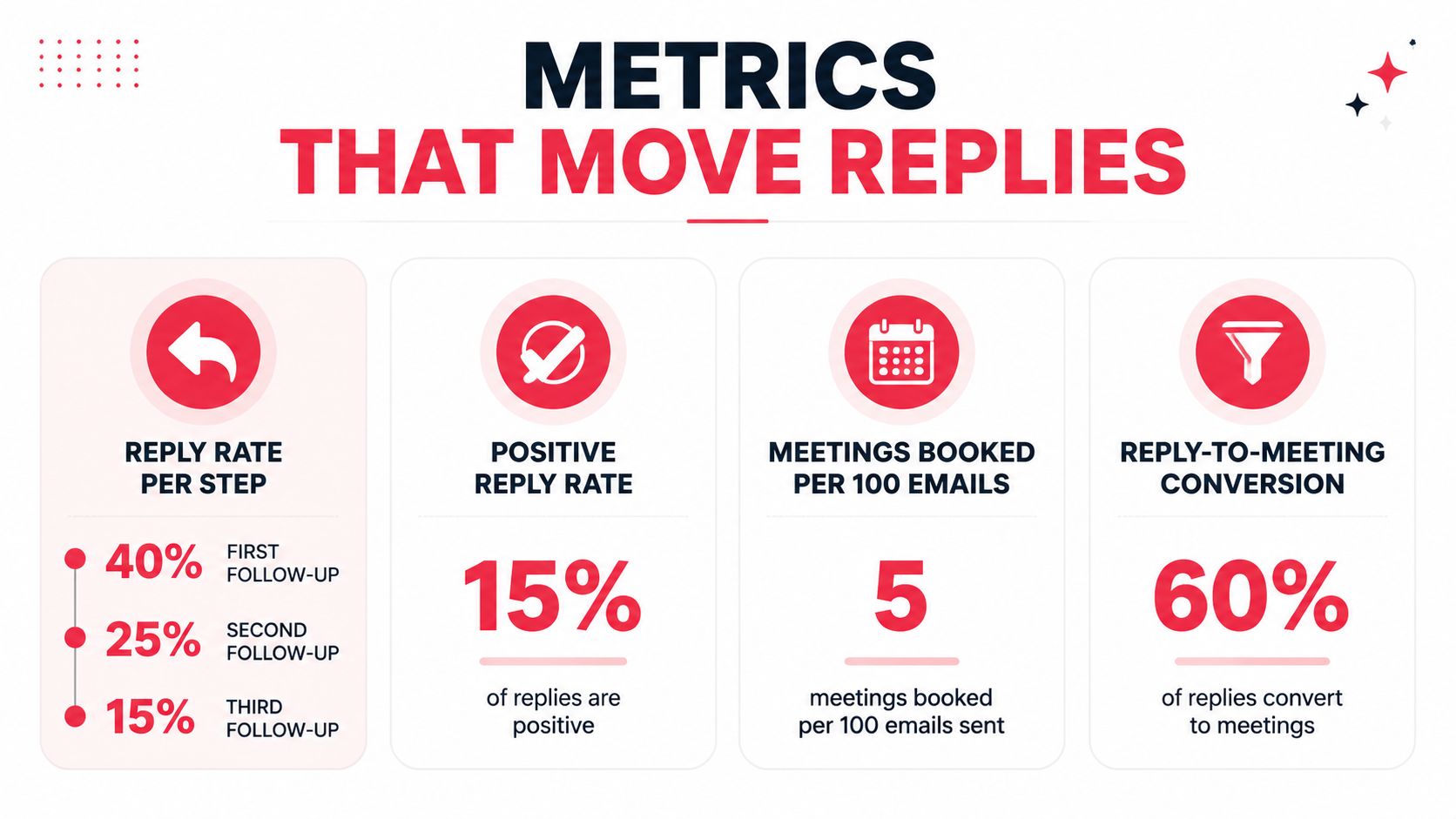
You only need a few metrics to know whether the sequence is working. I track reply rate per step, positive reply rate, meetings booked per 100 emails, and reply-to-meeting conversion. Those four numbers tell you where the sequence breaks, whether the reply was worthwhile, and whether the ask is too heavy or just right.
The tests worth running
Subject line pattern. Test a plain reply-to thread subject against a more specific subject tied to a signal. This usually moves open quality and downstream replies.
First follow-up timing. Test day 2 to 3 against day 4 to 5 for the first follow-up. This affects whether the thread feels timely or stale.
Single CTA versus multi-CTA. A single ask usually lowers friction. Multiple asks often confuse the reader and reduce clean replies.
Signal-anchored versus generic pain lines. A line tied to a hiring post, pricing change, or product launch should outperform a vague business pain statement when the signal is real.
The benchmark you want is practical, not perfect. A weak test often looks like a message-level improvement with no downstream lift in meetings. That means the copy got nicer, but the sequence didn't get better.
If you want a testing workflow with stronger process discipline, Stimulead's AI A/B Testing resource maps well to outbound because it keeps the experiment tied to a real business metric instead of vanity changes.
What to watch before you iterate
A low reply rate on one step can be normal noise if the sample is tiny. What matters is whether the sequence starts booking fewer meetings after you change timing or message structure. When that happens, go back to the angle and the ask before you touch the design or the sender identity.
Your 14 Day Rollout Plan and Next Step
A follow-up often carries more of the reply load than the opener, because it reaches prospects after the first message has had time to sit. Outbound teams see that effect most clearly when the first email gets skimmed and the next touch lands with a sharper reason to answer. If you want the highest-yield move in a cold sequence, start there.
Days 1 to 2, audit the current sequence. Look for repeated angles, long bodies, weak asks, and any follow-up that reads like a copy of the opener. Days 3 to 5, rewrite the sequence around the five-part anatomy, then tighten each message so it can be read fast on a phone or in a crowded inbox.
Days 6 to 9, build the signal workflow. Pull a source list for trigger events, decide how AI will draft the first pass, then keep a human review step before send so the message still matches the account and the moment. Inbox triage matters here too, because a strong follow-up still loses if it lands in the wrong folder or gets buried under lower-priority mail.
Day 10, launch with tracking in place for reply rate per step, positive replies, and meetings booked per 100 emails. Day 12, run the first A/B test on timing or subject line, and keep the test narrow enough that you can read the result without guessing. Day 14, review the sequence against its current baseline and cut anything that is adding noise.
If you want a team to build the research and outbound workflow with you, Stimulead's GTM engineering and AI personalization work is the right next conversation for growth-stage teams that need this live faster than a self-serve rollout can usually move.
If you are sending cold email this month, rebuild the first follow-up before you do anything else. Take one sequence, rewrite the follow-up with a new reason and one ask, then test it against your current version on the next send block.