
The loudest advice on AI A/B testing is usually wrong. Faster variant generation doesn't fix weak experiments, and it definitely doesn't fix contaminated data. If your assignment logic is messy, your events are incomplete, or your model changes mid-test, all the generated copy in the world just gives you faster false confidence.
The core bottleneck is evidence quality. Classic experimentation already struggles to produce clear winners, with 19.1% of 2,288 audited A/B tests reaching statistical significance in one benchmark, while 50.5% produced some kind of winner, which still leaves a lot of noise in the pipeline (ConversionTeam benchmark). AI raises the stakes because the variant itself can change multiple behaviors at once, and the system behind it can leak signals across groups if your instrumentation is loose.
For CEOs, CMOs, and CROs, that means the job isn't to test more ideas. It's to build an experiment system that can survive stochastic outputs, model drift, and reporting contamination. That's where AI A/B testing becomes useful, and that's where many teams get it wrong.
Table of Contents
- Why Most AI Testing Programs Fail Before They Start
- Three Approaches to AI-Powered Experimentation
- Instrumentation and Data Engineering for Valid Experiments
- Rollout Strategy and Risk Management
- Tooling Decisions for Growth-Stage Companies
- Your 90-Day Implementation Roadmap
Why Most AI Testing Programs Fail Before They Start
The hidden reason AI tests fail early
Many teams believe AI simplifies experimentation by rapidly generating variants. This is a misconception. The quicker the variant production, the easier it becomes to overwhelm an ineffective test program with unreliable ideas, leading to a confusion between activity and meaningful signal.
The old statistical discipline still matters. A widely used rule of thumb is 80% statistical power, with about 3,000 to 4,000 conversions per variation over 3 to 4 weeks to support segment-level analysis and reduce false conclusions from noise or seasonality (CXL on A/B testing statistics). That baseline matters even more in AI A/B testing, because AI changes can affect copy, ranking, intent matching, and downstream behavior at the same time.
Practical rule: If you can't explain the experiment in one sentence, you're probably testing too many things at once.
The most common failure modes are operational, not creative. Prompt drift changes the treatment mid-test. Model versioning changes the treatment mid-test. Shared logging or shared training data lets one group contaminate the other, and then the uplift looks real when it's really leakage.
A mature team understands that the bottleneck is evidence quality, not idea volume. That means prioritizing fewer, bolder experiments and giving each one a clean measurement path. Otherwise, you just get more activity and the same bad decisions.
What breaks in production
In production, the breakage usually shows up in the boring places. Traffic assignment lives inside the AI logic when it should sit outside it. Event IDs disappear between systems. Someone reuses a feature flag for two experiments and the reporting stack merges them.
AI systems add another layer of fragility because outputs aren't deterministic. You can't safely treat the variant as static if the underlying model, prompt, or retrieval layer shifts during the run. That's why the historical rules around fixed horizons, full weeks, and complete business cycles still matter so much.
The hard lesson is simple. AI does not reduce the need for statistical discipline. It raises the cost of skipping it.
Three Approaches to AI-Powered Experimentation
Choosing the right method for the job
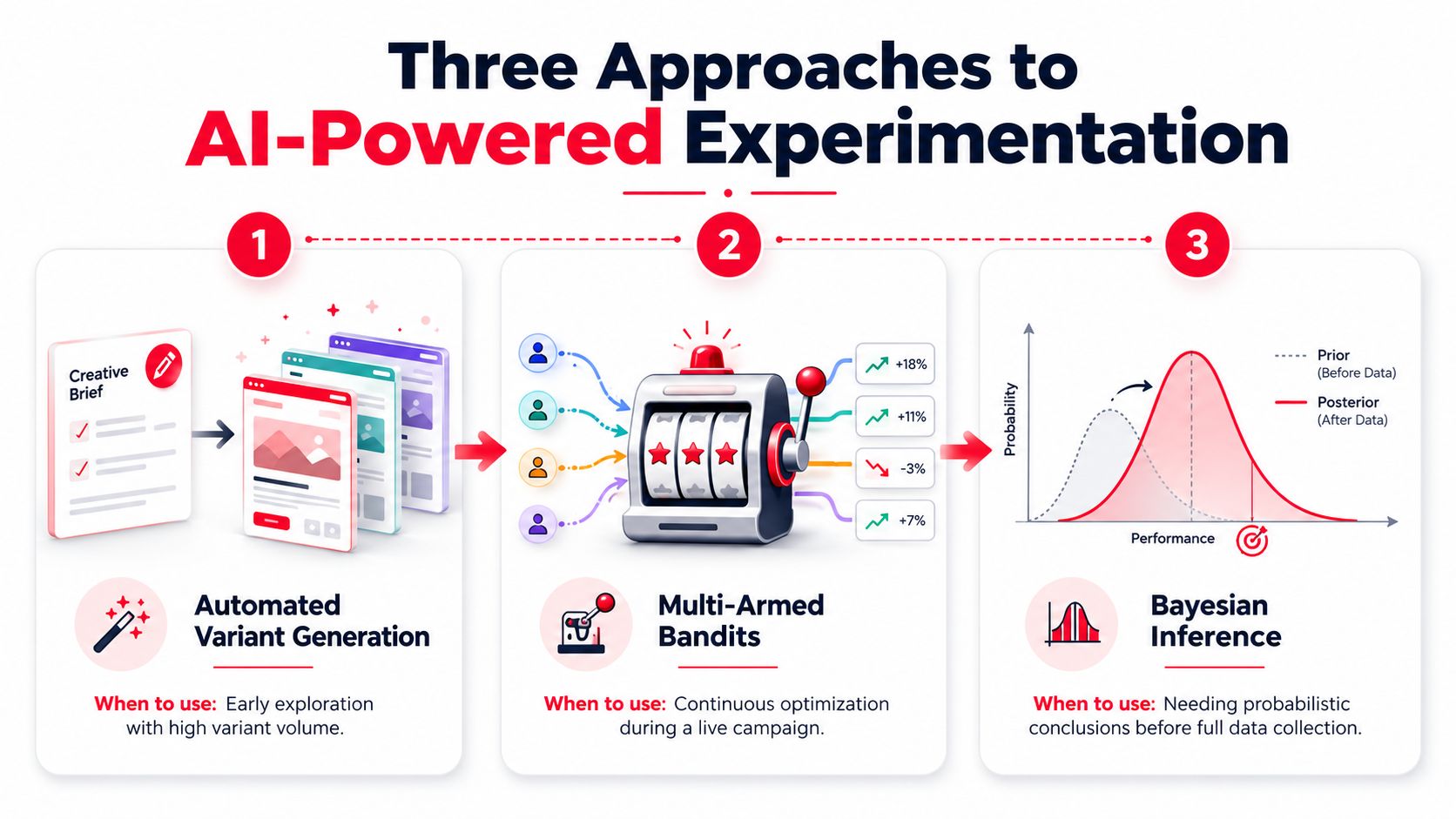
Automated variant generation is the entry point many teams notice first. It helps when creative volume is the bottleneck, especially for ads, subject lines, CTAs, and landing-page copy. You still need a proper test design, because AI-generated ideas don't buy statistical credibility by themselves.
Multi-armed bandits suit live campaigns where the business can tolerate exploration costs in exchange for faster traffic shifts. They work best when the conversion signal is clear and the team wants the system to steer volume toward stronger performers while the test runs. That makes sense for ongoing campaigns, but it can get dangerous when the KPI is slow-moving or when the AI is optimizing a proxy that's easier to move than revenue.
Bayesian inference is the cleanest option when sample sizes are limited or when prior knowledge matters. It gives decision-makers a way to reason probabilistically before full data collection, which is useful for pricing, recommendation ranking, and enterprise flows where every visit counts. The trade-off is that your priors and assumptions need to be disciplined, or the answer becomes too convenient.
A useful way to think about the three methods is this, automation creates variants, bandits move traffic, Bayesian methods frame decisions. Each one solves a different problem.
Use the method that matches the decision, not the method that sounds smartest in a slide deck.
When each approach pays off
The choice should follow the economics of the test. If the primary constraint is creative throughput, automated generation wins. If the primary constraint is conversion efficiency during a live campaign, bandits make sense. If the primary constraint is decision quality under uncertainty, Bayesian methods are often better.
That logic maps cleanly to GTM work. AI ad creative testing benefits from variant volume, but the final call should still respect significance and replication discipline, especially when budget changes are on the line. For product and revenue flows, the model often needs enough behavioral context to justify a personalized decision rather than a blunt global winner.
For teams using Stimulead's AI conversion rate optimization work, the practical split is straightforward. Creative-heavy tests can move quickly, while AI search optimization and agent-commerce readiness usually need stricter measurement because the system is changing the user journey itself. The underlying question is always the same, what decision are you making, and how much evidence do you need before money moves?
See Stimulead's AI conversion rate optimization approach
Instrumentation and Data Engineering for Valid Experiments
The data path that keeps tests honest
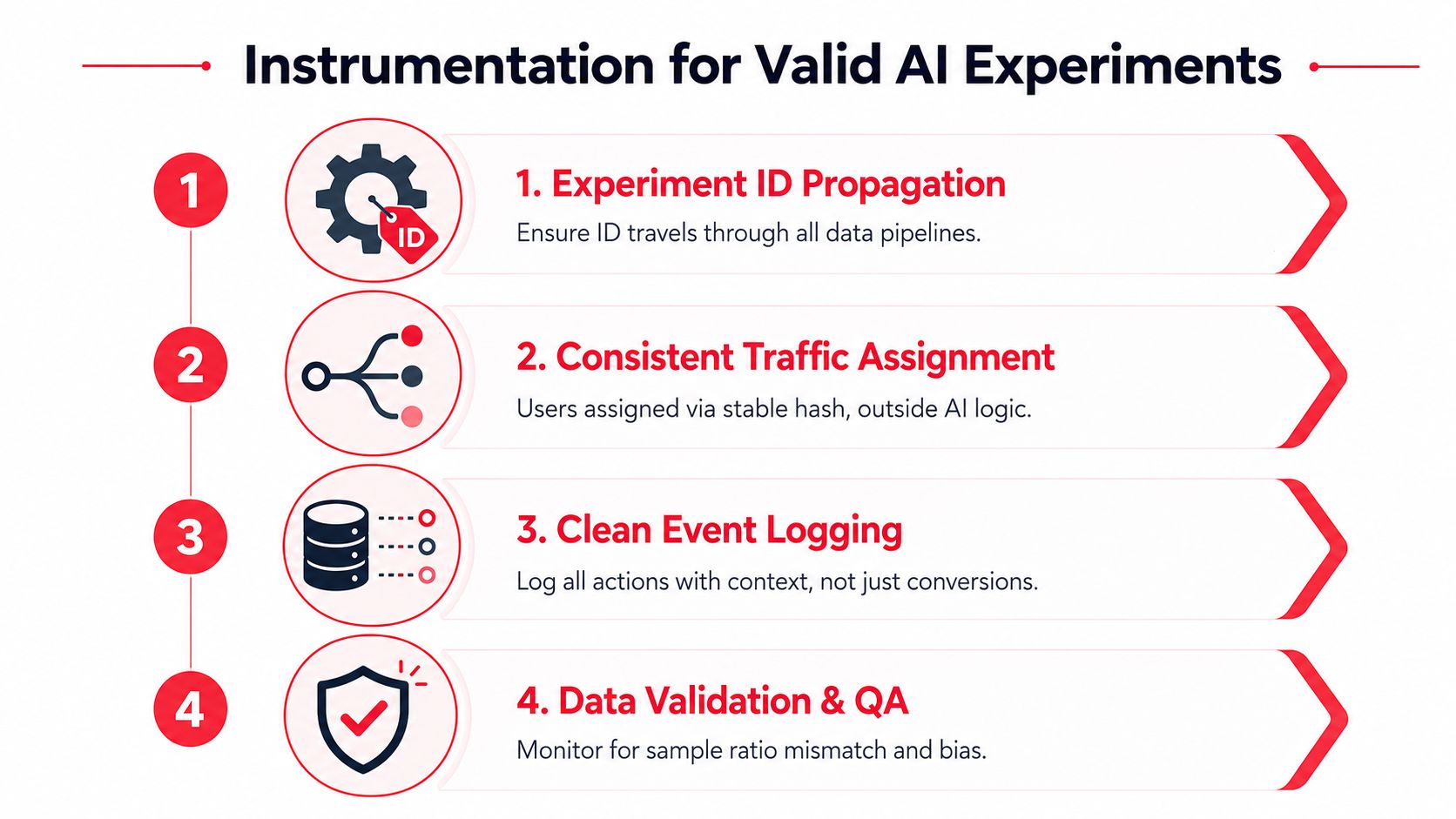
The cleanest AI experiment is boring in the best way. Every event carries an experiment ID. Traffic assignment happens outside the AI system. Group isolation is enforced at the training layer, not just at serving time. If those four pieces aren't true, you're probably measuring contamination.
Many teams encounter challenges here. Search and recommendation systems can leak cross-group signals through shared logs, shared retraining loops, or copied prompts. When that happens, uplift can look real because the model learns from both groups, while the experiment itself is no longer isolated.
A practical way to structure the stack is to treat the AI layer like a component inside a governed experiment harness, not the experiment itself. Feature flags decide exposure. An AI gateway standardizes cost and latency measurement across variants. The event pipeline records user actions, quality signals, and treatment metadata in the same path, so downstream analysis can reconstruct what happened.
For teams measuring marketing effectiveness, this discipline matters because attribution and experimentation can't live in separate silos. If the AI test changes search intent, recommendation rank, or sales-routing behavior, your measurement stack has to follow that change all the way through the funnel. This guide on how to measure marketing effectiveness is a useful companion when your test touches more than one channel.
Metrics and guardrails that matter
The metric stack should start with one primary business outcome and then add guardrails. Latency belongs there. Safety belongs there. Zero-result rate belongs there if the AI is involved in search, retrieval, or recommendations. Hallucination, toxicity, and PII leakage deserve their own dashboards when the system can produce open-ended outputs.
If the primary metric moves and the guardrails don't, you still don't have a win.
The hardest part is keeping the data path stable enough to trust. Every logging change during a test is a possible confounder. Every retraining job that sees both control and treatment data is a possible leak. Every dashboard that omits context is a decision trap.
Teams that get this right usually treat observability as part of experiment validity, not just operations. That's the difference between a test that informs the roadmap and a test that only creates internal debate.
Nuxie's paywall testing walkthrough is a useful reference if you want to see how a tightly scoped monetization experiment can be instrumented without losing the thread between exposure, engagement, and conversion. The mechanics differ from AI search, but the measurement discipline transfers well.
Rollout Strategy and Risk Management
How to expand safely
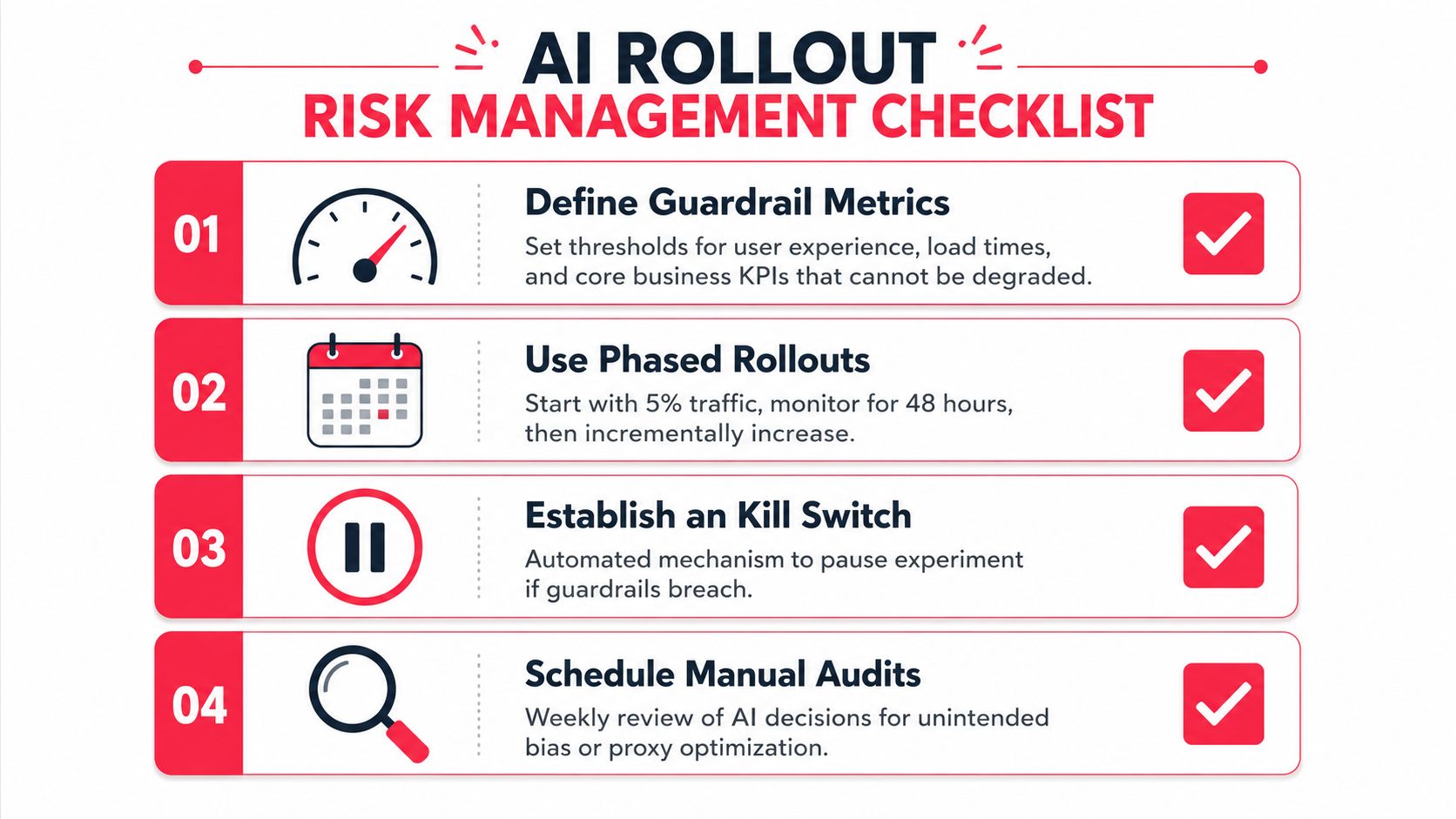
AI rollout should start small. Practical guidance for AI and LLM experiments recommends 1% to 5% initial enrollment, with balanced control and treatment splits inside the experiment group and feature flags or gateway controls used to ramp only after guardrails stay stable (Maxim AI). That staged approach matters because AI can optimize proxy signals faster than the business metric you care about.
I've seen teams get seduced by early click-through wins and ship too fast. The model looked better on the dashboard, then retention softened a week later, and nobody could explain why. That's usually a sign the test was rewarding a shallow proxy, or the rollout outran the measurement window.
A disciplined rollout uses separate dashboards for the outcomes that can hurt you. Cost. Latency. Hallucination. Toxicity. PII leakage. If those stay healthy, the experiment can expand. If they wobble, the right move is usually to pause and inspect the data path before adding traffic.
Halo AI's multi-source data integration guide is a useful adjacent read when your AI rollout depends on stitching together product, CRM, and support data without creating a mess in the experiment layer.
When to stop, pause, or reroute
The stop rule should be explicit before the test begins. If a guardrail breaches, the kill switch should pause exposure automatically. If the experiment produces a strong business result but the quality floor slips, the win is not usable yet.
Sequential monitoring helps most when the risk surface is uneven. That's common in AI search optimization and agent commerce readiness, where one segment may tolerate a behavior while another segment rejects it. Manual audits still matter here because the model can optimize for the wrong proxy while the charts look calm.
The clean decision tree is blunt. Expand when the guardrails hold. Pause when the system drifts. Stop when the treatment creates more operational risk than revenue upside. That's the grown-up version of experimentation.
Tooling Decisions for Growth-Stage Companies
What to build and what to buy
Growth-stage teams usually don't need a giant platform. They need the right parts in the right place. Assignment logic, metric calculation, and the AI gateway are usually worth building or owning closely because they define experiment integrity and cost control. Variant generation, statistical analysis, and reporting dashboards are often better bought unless the team already has strong internal infrastructure.
| Category | Build When | Buy When | Examples |
|---|---|---|---|
| Experiment assignment | You need stable hashing, custom routing, or tight control over treatment exposure | Your team is moving fast and wants a proven rollout layer | Feature flag systems, internal assignment services |
| Metric calculation | Your funnel is unusual or spans product, CRM, and revenue systems | Standard business metrics are enough for decision-making | Internal SQL models, warehouse-native metrics |
| AI gateway | Cost, latency, and prompt tracing matter across variants | You need standardized observability without building middleware | Gateway layer, observability tooling |
| Variant generation | Your team has strong prompt and copy ops | You want more creative output with less manual work | LLM copy tools, prompt workflows |
| Statistical analysis | You need custom decision rules or Bayesian logic | Your analysts want ready-made reporting | Bayesian engines, experiment analysis platforms |
| Reporting dashboards | You need executive views tied to proprietary KPIs | You want fast rollout with minimal maintenance | BI dashboards, experiment reporting tools |
The main trade-off is maintenance burden. A custom stack gives more control, but every extra service becomes another thing that can break during a live test. Managed tools reduce internal overhead, but they can also hide the exact logic that makes a test trustworthy.
For teams of 5 to 200, the practical rule is to own the parts that can invalidate the experiment. If assignment, event integrity, or gating logic are wrong, the rest of the stack is lipstick on a broken test. Buy the parts that help you move faster without changing the rules of the experiment.
Your 90-Day Implementation Roadmap
A practical sequence for the next quarter
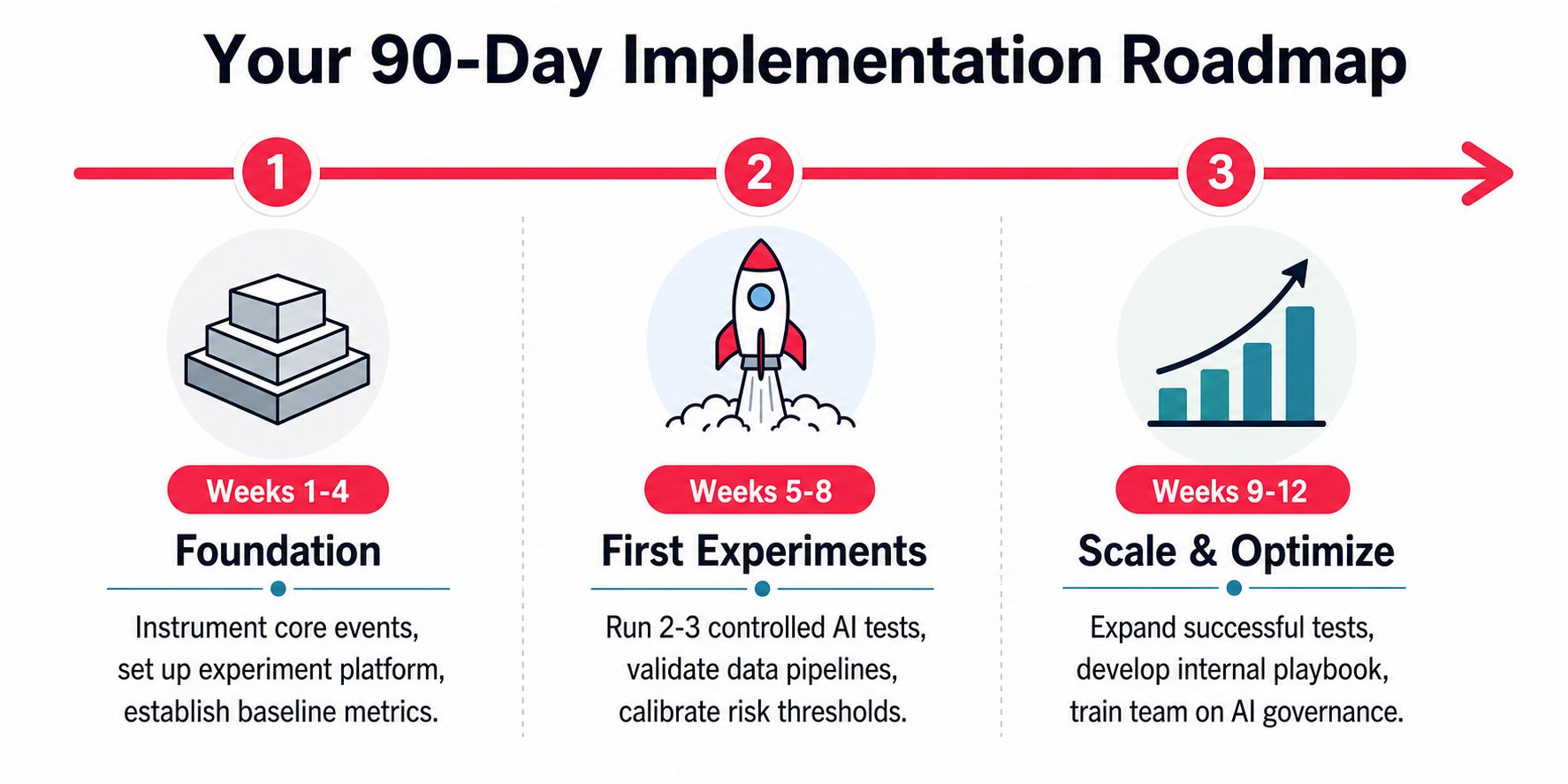
The first month should be about trust. Instrument the core events, confirm experiment ID propagation, and verify that treatment assignment lives outside the AI logic. Baseline your business metric and your guardrails before anything else touches production.
Weeks 5 through 8 should stay narrow. Run 2 to 3 controlled AI tests, keep enrollment low, and validate that the data pipeline is clean end to end. This is the phase where the team learns whether the logging, routing, and QA checks hold under pressure.
Weeks 9 through 12 is where the system earns its keep. Expand only the tests that have passed guardrails, write down the internal playbook, and train the broader team on governance rules. If the organization can't repeat the process, the experiment program won't survive the next quarter.
Stimulead's AI implementation roadmap maps well to this kind of rollout if you're trying to connect experimentation discipline to a broader AI operating model. The point isn't more AI activity. It's cleaner revenue decisions.
For most growth-stage companies, the next step is simple. Pick one AI surface, one primary metric, and one owner. Then have engineering wire the experiment IDs through the stack before you launch the next variant.