
Your team already has AI tools in play. Marketing is testing copy generators, sales has a prospecting app, ops is asking for cleaner data, and the board wants to know why all of it still feels disconnected. That gap is exactly where a Chief Digital and Artificial Intelligence Office earns its keep, because the job is turning scattered experiments into a governed revenue system, not adding another title to the org chart.
At a growth company, the symptom is easy to spot. Pipeline stalls, AI outputs look clever but don't ship, and every function is buying something different. The fix is a single owner for data, analytics, and AI, plus a clear set of priorities that force the work back to revenue. The DoD built its CDAO around that logic, saying the office exists to accelerate adoption “from the boardroom to the battlefield” and to create decision advantage across the enterprise AI.mil. For a SaaS or e-commerce team, that translates cleanly into conversion, outbound velocity, and better use of the data you already have.
If you're trying to figure out whether your company needs a formal owner or just a better stack, start with this practical overview of AI implementation roadmap. The wrong move is buying more tools. The right move is building an operating model that makes the tools pay for themselves.
Table of Contents
- When a Growth Leader Realizes AI Pilots Are Not Producing Pipeline
- What the Chief Digital and Artificial Intelligence Office Actually Is
- Org Design and Roles Inside a Lean CDAO
- The Four Core Capabilities That Drive Revenue
- KPIs and Governance Rituals That Keep AI Honest
- A 90-Day, 6-Month, and 12-Month Maturity Roadmap
- Five Pitfalls That Kill Most CDAO Programs
- Your 30-Minute CDAO Readiness Audit
When a Growth Leader Realizes AI Pilots Are Not Producing Pipeline
The pattern shows up fast. Marketing launches AI copy tests, sales runs a separate enrichment platform, and someone in product builds a notebook that nobody else can run. Each effort has a sponsor, none has a shared owner, and the result is a pile of activity with no clean line to pipeline.
That's the moment a growth leader realizes the company needs an owning function. The absence of a Chief Digital and Artificial Intelligence Office means every team optimizes its own workflow, while no one is responsible for the full path from data quality to conversion impact. The work gets spread across people who mean well, but the company still lacks a single place to make trade-offs.
For CEOs, CMOs, and CROs, the question isn't whether AI is useful. It's whether the company can move beyond isolated pilots into repeatable commercial systems. The DoD's own framing matters here, because its CDAO was designed as a central mechanism for data, analytics, and AI adoption across the enterprise, with an explicit mandate to create decision advantage DoD CDAO first-year release. That same structure is what growth teams need when AI work starts touching every part of revenue.
Practical rule: if three teams are buying three tools to solve the same problem, you don't have a tooling issue. You have an ownership issue.
A lean version of the solution is simple. One executive owns the system, the use cases, the data standards, and the rollout rhythm. The rest of the company stops improvising and starts shipping toward shared metrics. For companies that want a practical starting point, this is the same reason a do I need a Chief AI Officer decision should be made around revenue work, not title gravity.
What the Chief Digital and Artificial Intelligence Office Actually Is
A Chief Digital and Artificial Intelligence Office is a senior owning function for data, analytics, and AI. In the DoD model, that office was created by consolidating the DoD Chief Data Officer, the Joint Artificial Intelligence Center, the Defense Digital Service, and the Advancing Analytics Office, then reaching full operational capability in June 2022 DoD Directive 5105.89. That matters because it shows the role is meant to unify fragmented capability, not sit above the work and observe it.
Commercially, I'd define the role this way. The CDAO sets policy, owns the lifecycle, and builds reusable infrastructure so the company doesn't rebuild data pipelines, prompt workflows, or model controls in every department. That's different from a CIO, who usually owns core IT systems and security posture, and different from a traditional CDO, who may focus more narrowly on data governance. A CAIO title can fit when AI is the main priority, but the broader CDAO frame works better when data and analytics are part of the same operating problem.
The DoD directive is useful because it makes the staff-advisor role explicit. It assigns the office primary staff-assistant and advisor authority for the adoption and integration of data, analytics, and AI, plus responsibility for code, APIs, applications, training, and best practices DoD Directive 5105.89. That's the commercial lesson. A useful AI office doesn't just approve projects, it creates the shared assets that make the next project cheaper and faster.
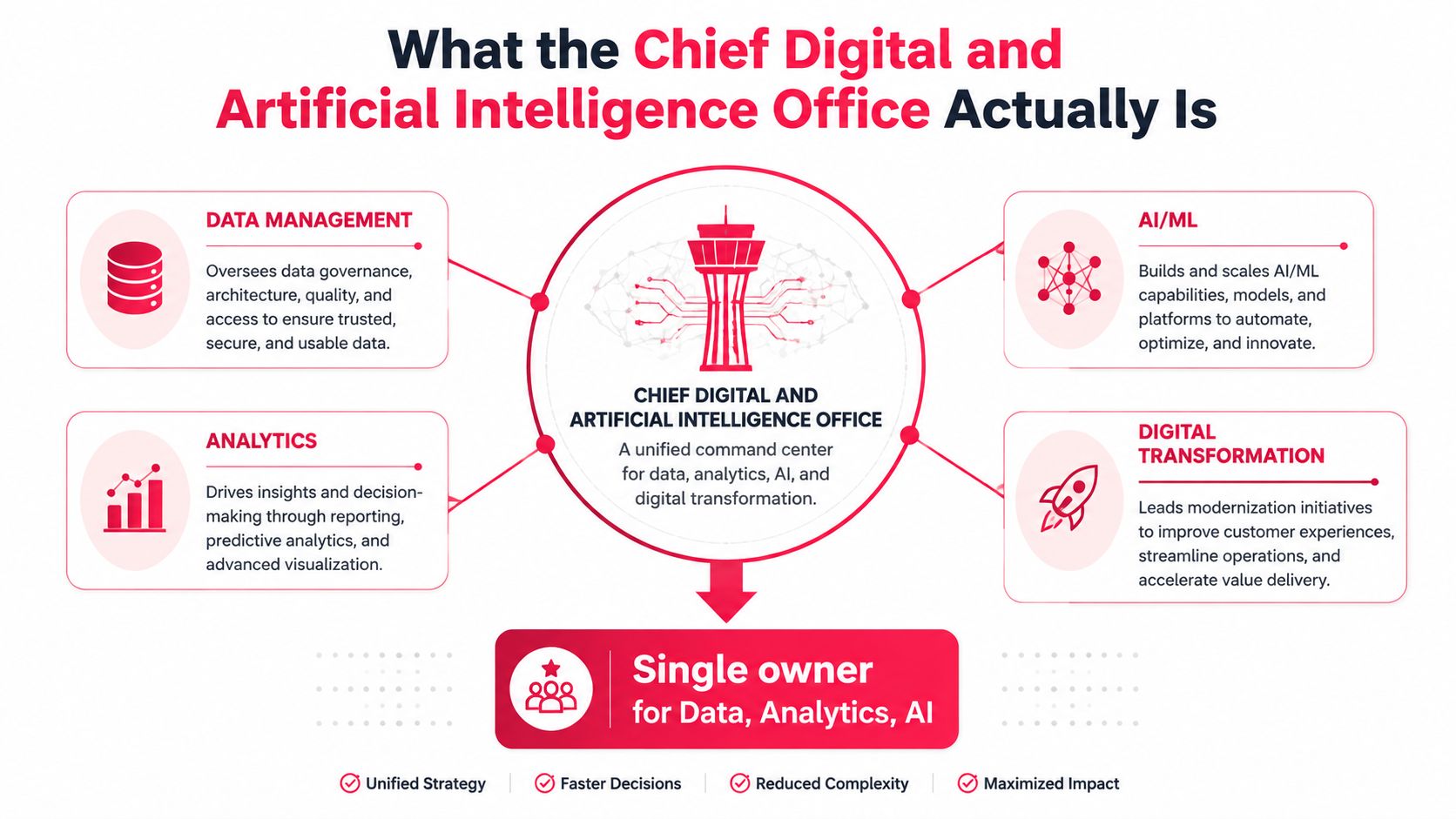
For a board, the explanation can be brief. A CDAO is the executive owner of the company's data and AI operating system. If the title is missing, responsibility gets spread across teams and the stack fragments.
If you're deciding how formal the role needs to be, it helps to compare it with adjacent structures in a startup context. The startup structure for founders lens is useful because it reminds you that reporting lines should follow bottlenecks, not vanity titles.
Org Design and Roles Inside a Lean CDAO
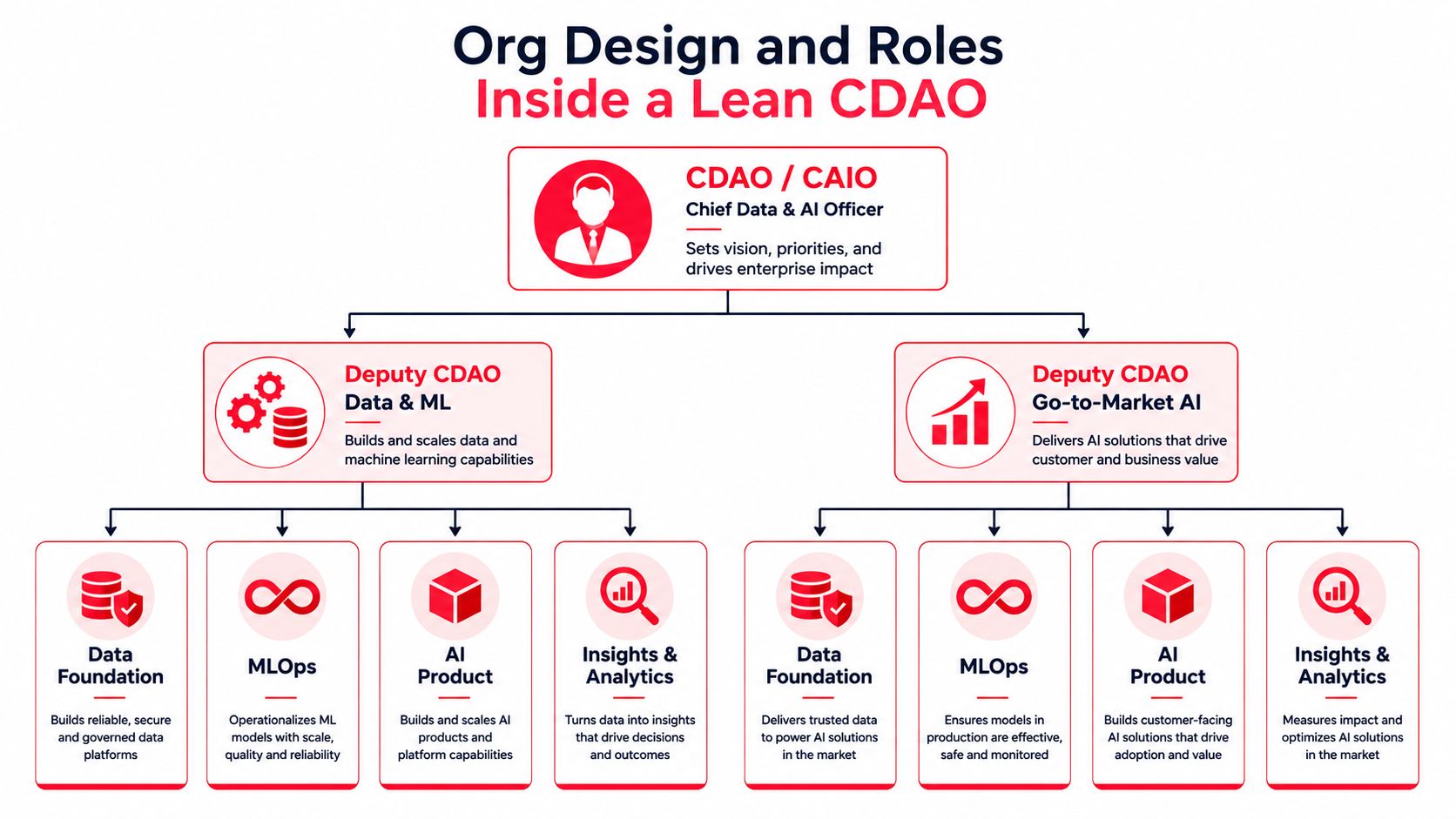
A growth-stage company can't copy a federal org chart, and it shouldn't try. The lean version is one CDAO or CAIO, two deputies, and four operational pods that map directly to revenue work. I've found that structure works best when the CEO owns the appointment, while the CRO and CMO get dotted-line input on priorities.
The first deputy owns data and ML. That person keeps the data foundation usable, owns model quality, and runs the cadence on engineering dependencies. The second deputy owns go-to-market AI, which means CRO workflows, content operations, sales research, AI search, and outbound automation. One role protects the machine, the other puts the machine into revenue motion.
A clean way to staff it looks like this:
- Data Foundation: owns source-of-truth tables, naming, access, and definition hygiene.
- MLOps: owns deployment, monitoring, drift checks, and rollback discipline.
- AI Product: owns the internal and customer-facing AI use cases that hit conversion or retention.
- Insights and Analytics: owns dashboards, attribution logic, and experiment readouts.
The CDAO should report to the CEO in a 5 to 200 person company. Dotted-line reporting into the CRO and CMO makes sense because AI touches both pipeline and brand, but a shared owner is what keeps the priorities from getting split. If you want a practical comparison for hiring design, the GTM engineer vs SDR distinction helps clarify why AI engineering should sit closer to workflow automation than to traditional prospecting alone.
Fractional, full-time, and advisory models all have a place. A fractional CAIO works well when the company needs prioritization, vendor review, and implementation oversight before hiring a full-time operator. A full-time CAIO makes sense once the company has enough use cases and internal complexity to justify a permanent owner. Advisory is enough when the main need is direction, not execution.
The Four Core Capabilities That Drive Revenue
Most CDAO plans fail because they list too many capabilities. The useful version fits on one page and ties directly to revenue. The four that matter most for growth-stage teams are data and analytics foundation, MLOps for production AI, AI search optimization, and GTM engineering.
Start with the data foundation. If the company can't trust the fields, the model work downstream won't matter. The deliverable is a consistent set of source-of-truth tables, naming conventions, and access rules that marketing, sales, and ops can all use. That capability moves experiment quality, attribution clarity, and reporting trust.
MLOps comes next because demos don't create value by themselves. Production systems need deployment rules, monitoring, drift checks, and rollback paths. The deliverable is a governed release process for AI that can survive contact with live customers and real sales cycles. That's where reliability replaces theater.
AEO matters because buyers are increasingly asking machines for recommendations before they visit a site. The deliverable is content, structure, and entity coverage that make the company more likely to surface in AI-assisted discovery. For teams that sell into a crowded category, that can matter as much as rank tracking used to. Stimulead's work on AI for business operations is a useful adjacent reference point because the same discipline applies when you're organizing AI work around business outcomes.
GTM engineering is the final piece. It uses AI to compress research, list building, segmentation, and outreach preparation. The deliverable is a repeatable motion that lets sales and marketing spend less time assembling inputs and more time in market. In practice, you see cleaner handoffs, faster campaign launches, and better personalization.
If you're choosing where to begin, use this sequence:
- Stabilize the data.
- Ship one production model or workflow.
- Make your content visible in AI search.
- Automate GTM prep where reps lose the most time.
The fastest path to revenue is usually the least glamorous one. Fix the data, then fix the workflow, then scale the surface area.
KPIs and Governance Rituals That Keep AI Honest
A CDAO without governance becomes a demo factory. A useful KPI stack has to show whether AI is improving the company's ability to test, sell, and ship. The monthly report should include testing velocity, pipeline contribution from AI-sourced or AI-enriched outbound, model performance and drift, data quality, and cost per inference.
I'd keep the governance rhythm tight. Weekly is for the operating team. Monthly is for model review and use-case review. Quarterly is for the board. Anything less frequent and the company starts discovering failures after they've already become expensive.
| CDAO KPI Stack and Governance Rhythm | ||
|---|---|---|
| KPI | Target Signal | Reporting Rhythm |
| Testing velocity | More experiments reaching decision faster, with a mature program aiming for a 10x uplift in CRO experiments | Weekly and monthly |
| AI-sourced or AI-enriched pipeline | Clear contribution from outbound, routing, or content systems | Monthly |
| Model performance and drift | Stable output quality, low surprise behavior, clear rollback triggers | Weekly and monthly |
| Data quality scores | Fewer broken fields, cleaner definitions, fewer manual fixes | Weekly |
| Cost per inference | Controlled spend per use case and channel | Monthly and quarterly |
The rituals matter because they force accountability. A weekly standup keeps blockers visible. A monthly review forces trade-offs between use cases. A quarterly board read-out keeps the work tied to business outcomes instead of tool churn.
For teams building from scratch, I've found a one-page slide works best. Put the KPI, the target signal, the current state, the owner, and the next decision in one view. If a metric can't be explained in under a minute, it probably doesn't belong in the operating review.
A 90-Day, 6-Month, and 12-Month Maturity Roadmap
The first 90 days should be about audit and focus. List every AI tool in use, every place AI touches the funnel, and every data set that feeds those workflows. Pick the top three revenue use cases, then choose the leadership model, fractional, full-time, or advisory, based on how much execution the company can absorb right now.
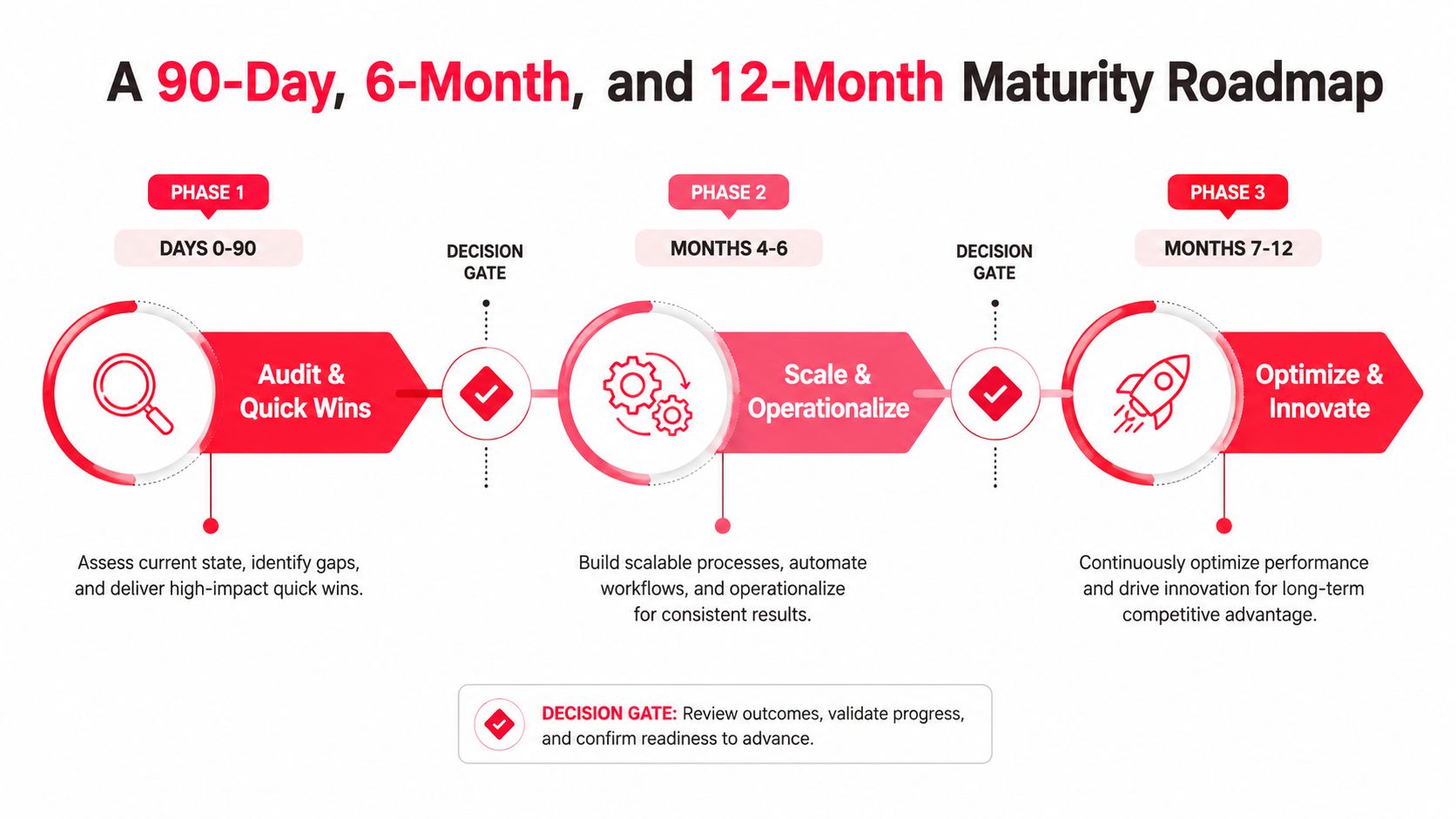
Months 4 to 6 should move the first two use cases into production. By then, the KPI stack needs to be live, the data foundation needs to be stable enough to trust, and the team should run a CRO velocity sprint plus an AEO baseline. The decision gate here is simple. If the first two use cases aren't producing usable operational signals, pause expansion.
Months 7 to 12 are for expansion and cleanup. Add agent commerce readiness, which means preparing for AI-mediated buying flows, handoffs, and assisted checkout. Retire the bottom-quartile use cases that are creating noise, and shift the CDAO from project mode into operating-system mode.
The structure only works if each phase has one gate. Audit before you build. Prove before you scale. Remove before you add. That keeps the office from becoming another layer of reporting with no commercial edge.
Five Pitfalls That Kill Most CDAO Programs
The first failure is hiring a CAIO without a mandate. The title sounds good, but the role becomes a think tank if the executive can't set priorities or enforce standards. The fix is simple. Give the office explicit ownership of use-case selection, data quality, and rollout rules.
Vendor sprawl comes next. Every function buys its own AI tool, then the company ends up with overlapping features and no clear owner. The symptom is duplicated spend and conflicting workflows. The fix is a single intake process and a common approval path.
Skipping the data foundation breaks everything downstream. If the fields are messy, models and dashboards both turn unreliable. The one-line fix is to treat data definitions and access as part of the AI program, not a side project.
Ignoring AI search and AEO is another mistake. Buyers are already using LLMs to compare options, and the companies that structure content for those systems are starting to show up where buying decisions begin. The fix is to assign ownership for AI search visibility the same way you assign ownership for demand gen.
The fifth pitfall is skipping governance. That's how drift, cost creep, and compliance problems pile up. The fix is the monthly review rhythm described above, with a real rollback path when a model or workflow stops behaving.
A useful rule of thumb is this. If a CDAO program can't tell you what it will stop doing, it probably won't ship what it promised.
Your 30-Minute CDAO Readiness Audit
Take one page and answer five prompts. How many AI tools are live across marketing, sales, and ops. Who owns the data. Where does AI touch the funnel today. What's the last model or workflow in production doing. Are you winning any LLM recommendations yet.
Score each area red, yellow, or green. Red means no owner or no process. Yellow means partial ownership. Green means the work is already producing a repeatable outcome. That gives you a simple readiness view without turning the exercise into a strategy project.
If most boxes are red, start with a fractional CAIO advisory model. If the company has a clear backlog, multiple active use cases, and internal teams that can execute with oversight, an AI Growth Partnership makes more sense. If the operating complexity is already high and the company needs permanent ownership, hire full-time.
The decision should map back to the four capabilities and the roadmap above. If data is weak, fix data first. If the stack is stable, push into production AI and GTM engineering. If buyers are starting their journey in LLMs, make AEO part of the plan this quarter.
Run the audit this week, assign one owner, and pick one use case that can touch revenue inside the next 90 days. If you want help pressure-testing the result, schedule a working session with Stimulead and bring your current tool list, funnel map, and one live dashboard.