
Most advice on GTM engineer vs SDR starts from the wrong assumption. It assumes pipeline is a staffing problem, so the answer is more reps.
That logic worked when outbound scaled with volume and manual follow-up. It breaks when your bottleneck is system design, data flow, speed-to-lead, routing, enrichment, and message quality across channels. At that point, adding another SDR often adds activity without fixing the machine.
For a CEO or CRO, this isn't a hiring comparison between two job titles. It's a choice between linear pipeline growth and non-linear pipeline growth. One model adds output by adding people. The other builds systems that keep producing after the build work is done.
Teams that treat this as a simple replacement debate usually miss the operating question underneath it. Where does your next dollar create more pipeline: another rep on the sequence, or a builder who fixes targeting, automation, enrichment, handoffs, and conversion paths across the funnel?
Table of Contents
- Your Next Pipeline Hire Is Not Another SDR
- Linear vs Non-Linear Growth Models
- Role Breakdown GTM Engineer vs SDR
- The Economic Case for GTM Engineering
- Building a Hybrid Model That Works
- Your Hiring Decision Framework
- Example Job Descriptions You Can Use
Your Next Pipeline Hire Is Not Another SDR
The default answer in growth-stage SaaS has been simple for years. Need more pipeline. Hire more SDRs.
That answer is getting weaker. SDR headcount at VC-backed SaaS companies has declined approximately 30% since 2023, while spending on GTM automation tools has increased 180%. The same analysis says companies that once hired 10 SDRs now hire 3 SDRs plus 2 GTM Engineers to produce more pipeline at lower cost, according to this breakdown of the shift in SDR hiring.
That change matters because it signals a different operating model. Leaders aren't removing human sellers from the motion. They're shrinking the amount of manual prospecting and moving headcount toward system builders.
If you're still mapping headcount the old way, review your outbound design before you hire another SDR. In many teams, the rep isn't the first failure point. The failure point is weak segmentation, stale data, poor routing, slow follow-up, disconnected tools, and no feedback loop from booked meetings back into targeting.
Practical rule: If the motion breaks when one rep leaves, you don't have a scale problem. You have a systems problem.
A lot of CROs already know this instinctively. The reason outbound stalls isn't always rep quality. It's often that the playbook can't support more volume without hurting relevance. If that sounds familiar, this guide to building an outbound B2B lead generation team is a better place to start than another rushed requisition.
Linear vs Non-Linear Growth Models
The core GTM engineer vs SDR decision starts with one question. How do you want pipeline to scale?
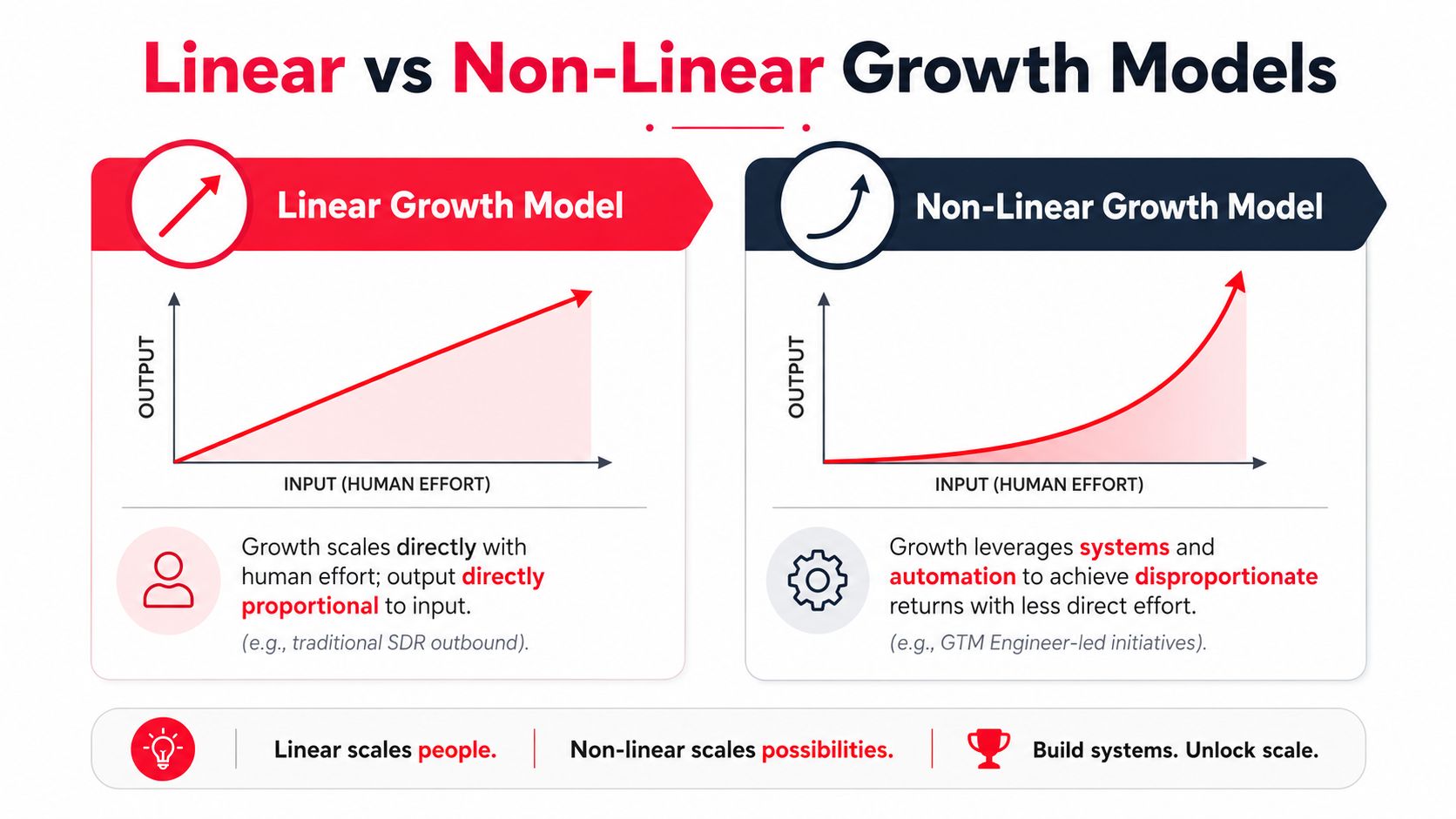
An SDR model scales through human effort. A GTM engineer model scales through systems. That distinction affects cost, speed, consistency, and how quickly you can test new motions.
What linear growth looks like in practice
Linear growth is straightforward. More reps usually means more touches, more follow-up, and more meetings. The limits show up fast. Coordination overhead grows. Coaching load grows. Variance between reps grows.
That's the core weakness of the classic SDR-heavy model. SDR output scales linearly with headcount, while a GTM engineer can build a system producing 5 to 10 times the pipeline of an SDR team because automation executes the work instead of human labor, based on this GTM engineering analysis.
If you've managed a team like this, you've seen the pattern. One rep writes good prompts. Another rep ignores CRM hygiene. A third works leads too slowly. Pipeline becomes a management tax problem.
What non-linear growth changes
A GTM engineer changes the equation by building assets that keep compounding. Think lead routing logic, signal-based triggers, enrichment flows, account scoring, message generation, QA checks, CRM syncs, and channel orchestration across tools like Clay, HubSpot, Salesforce, Apollo, Smartlead, Instantly, Make, Zapier, or n8n.
The output no longer depends only on how many people you can hire and manage. It depends on whether the system keeps getting better.
Here's what I've seen hold up in practice:
- When targeting improves, SDR effort gets spent on better accounts.
- When enrichment improves, personalization quality rises without more manual research.
- When routing improves, response time drops and hot accounts stop sitting untouched.
- When feedback loops improve, the system learns from replies, meetings, and objections.
Pipeline doesn't become easier. It becomes more repeatable.
That's why the linear view misses the point. Headcount adds capacity. Systems add capacity and improve decision quality. If your funnel still looks linear on the spreadsheet, this piece on why growth funnels look linear, but they're not will feel familiar.
Role Breakdown GTM Engineer vs SDR
Job titles are noisy. Responsibilities are what matter.
An SDR executes a motion. A GTM engineer designs and maintains the motion. On strong teams, those roles complement each other. On weak teams, they get confused and everyone ends up owning half a process.
GTM Engineer vs SDR at a glance
| Dimension | GTM Engineer | SDR (Sales Development Representative) |
|---|---|---|
| Primary job | Builds systems for pipeline generation | Executes outbound and follow-up within the system |
| Main focus | Targeting, automation, enrichment, routing, workflow design, conversion paths | Prospecting, outreach, qualification, objection handling, meeting booking |
| Core skills | Data logic, APIs, no-code automation, CRM architecture, testing, messaging systems | Written and verbal communication, persistence, qualification, follow-up discipline |
| Typical tools | Clay, HubSpot, Salesforce, Make, Zapier, n8n, Apollo, Smartlead, Instantly, enrichment APIs | Sequencers, dialers, CRM, LinkedIn, email, call tools |
| Success metrics | Pipeline quality, system throughput, routing accuracy, testing velocity, handoff quality | Meetings booked, reply quality, conversion from conversation to meeting |
| Best use case | Fixing scale constraints and building repeatable outbound infrastructure | Handling live conversations and converting interest into scheduled sales activity |
| Failure mode | Overbuilding without enough commercial judgment | High activity on weak lists and broken processes |
Where each role creates value
The GTM engineer sits closer to revenue architecture. This person decides how lists are built, how accounts are prioritized, what signals trigger outreach, how lead data gets cleaned, and how systems push context into the rep workflow. The work looks technical because it is. But the best GTM engineers are commercial operators first.
The SDR sits closer to buyer interaction. This person works the queue, qualifies interest, handles objections, follows up, and books meetings. Great SDRs can save bad systems for a while. They can't do it forever.
That distinction changes KPIs. The SDR gets measured on activity quality and meeting creation. The GTM engineer should get measured on system performance. Are better accounts entering the flow. Are handoffs clean. Are reps wasting less time. Are tests getting shipped weekly. Are more conversations coming from the same base effort.
For teams refreshing their stack, a strong sales engagement platform guide helps clarify what belongs in sequencing versus what belongs in orchestration. A common issue is overinvesting in sequencing software at the expense of connective tissue.
What usually fails
A bad GTM engineer hire looks smart on paper and ships complicated workflows nobody trusts. A bad SDR hire works hard inside a bad process and creates false confidence because activity numbers look healthy.
The friction usually shows up in four places:
- Ownership gaps. Nobody owns list quality, routing logic, or prompt QA.
- Tool sprawl. Data lives in one system, outreach in another, notes in another, and nobody reconciles the mess.
- Metric mismatch. Leaders reward volume when the limiting factor is conversion quality.
- No feedback loop. SDR objections, no-show reasons, and deal patterns never reach the person building the system.
Strong teams treat SDR feedback as product feedback for the revenue engine.
If you're already tightening enablement and process quality, these sales enablement best practices connect well with a GTM engineer-led motion. The best systems reduce rep guesswork. They don't create more dashboards for reps to ignore.
The Economic Case for GTM Engineering
The budgeting mistake is treating this as a title comparison. It is a growth model decision.
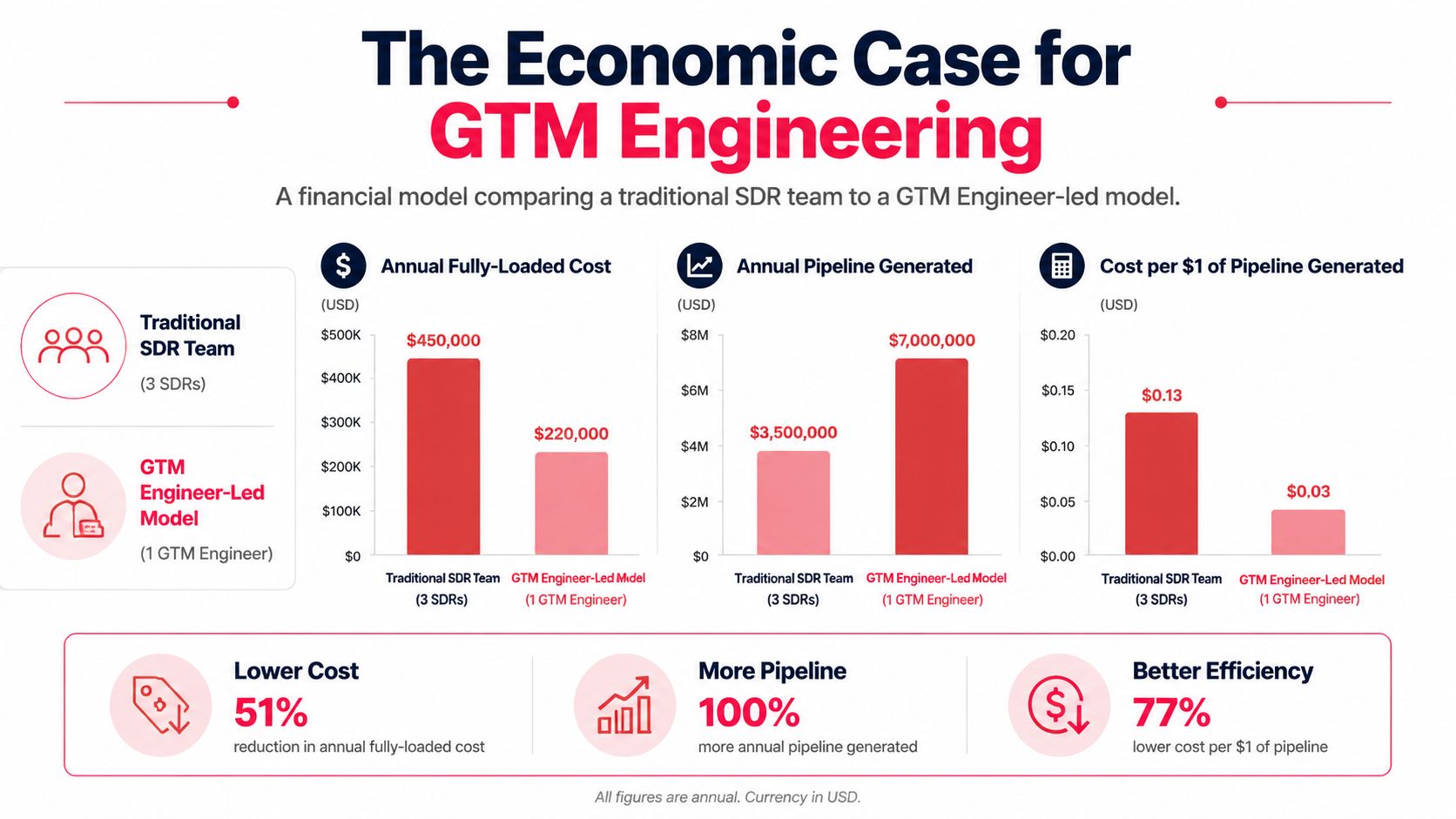
An SDR-heavy motion buys more activity in a roughly linear way. Add reps, get more touches, meetings, and manager load. A GTM engineer changes the shape of output by improving targeting, routing, enrichment, sequencing logic, and data quality across the whole motion. That is the non-linear case. The system keeps producing after the hire is made.
The cost structure favors systems when process is the bottleneck
A fully loaded 4-person SDR team costs $540K to $650K annually, while a mid-level GTM AI engineer plus a verified API and tool stack runs about $240K fully loaded, according to this ROI and cost comparison. If the current constraint is poor list quality, weak prioritization, broken routing, or stale sequencing, that cost gap matters because extra SDRs usually amplify waste before they improve pipeline.
That is the part many hiring plans miss.
The spreadsheet usually includes salary and software. It often excludes manager time, rep churn, ramp, QA on outbound copy, CRM cleanup, and the opportunity cost of slow experimentation. A GTM engineer does not erase those costs. The role changes where money goes. Less spend on repeated manual work. More spend on system design that improves every rep who touches the process.
The upside shows up later in the quarter, not just on day one. One benchmark shows that by month 9, a single GTM engineer setup generates about $59,850 in monthly revenue versus $38,850 from a 5-person SDR team, with $718,200 versus $466,200 in annual recurring revenue and 900% pipeline coverage versus 525% in that comparison, from this cited revenue model on LinkedIn.
A short walkthrough is worth watching before you commit budget:
Why finance leaders care
The board-level question is simple. Which hire produces more qualified pipeline per dollar over the next two to four quarters?
The same Yalc benchmark reports 343% ROI by Q3 for the GTM engineer setup versus 14% for the traditional SDR team. That spread changes the conversation because it reframes headcount from coverage capacity to capital efficiency. If one hire improves list quality, sequence logic, handoff quality, and reporting discipline for the whole team, the return is not tied to that person's individual output alone.
That does not mean every company should pause SDR hiring. It means SDR headcount is a poor first fix when the underlying issue sits in the system. I usually advise CROs to hire the engineer first when three conditions are true: outbound data quality is inconsistent, managers are acting as human middleware between tools, and reps spend too much time deciding who to contact instead of working live opportunities.
The failure mode is also different. A weak SDR hire burns budget linearly. A weak GTM engineer can create expensive complexity. That is why role design, scope, and operator quality matter more here than they do in a standard SDR req. This primer on avoiding costly hiring mistakes is relevant because the wrong first hire creates salary waste, tooling waste, and missed quarters at the same time.
Building a Hybrid Model That Works
The best answer often isn't GTM engineer or SDR. It's a smaller SDR pod running on a better machine.
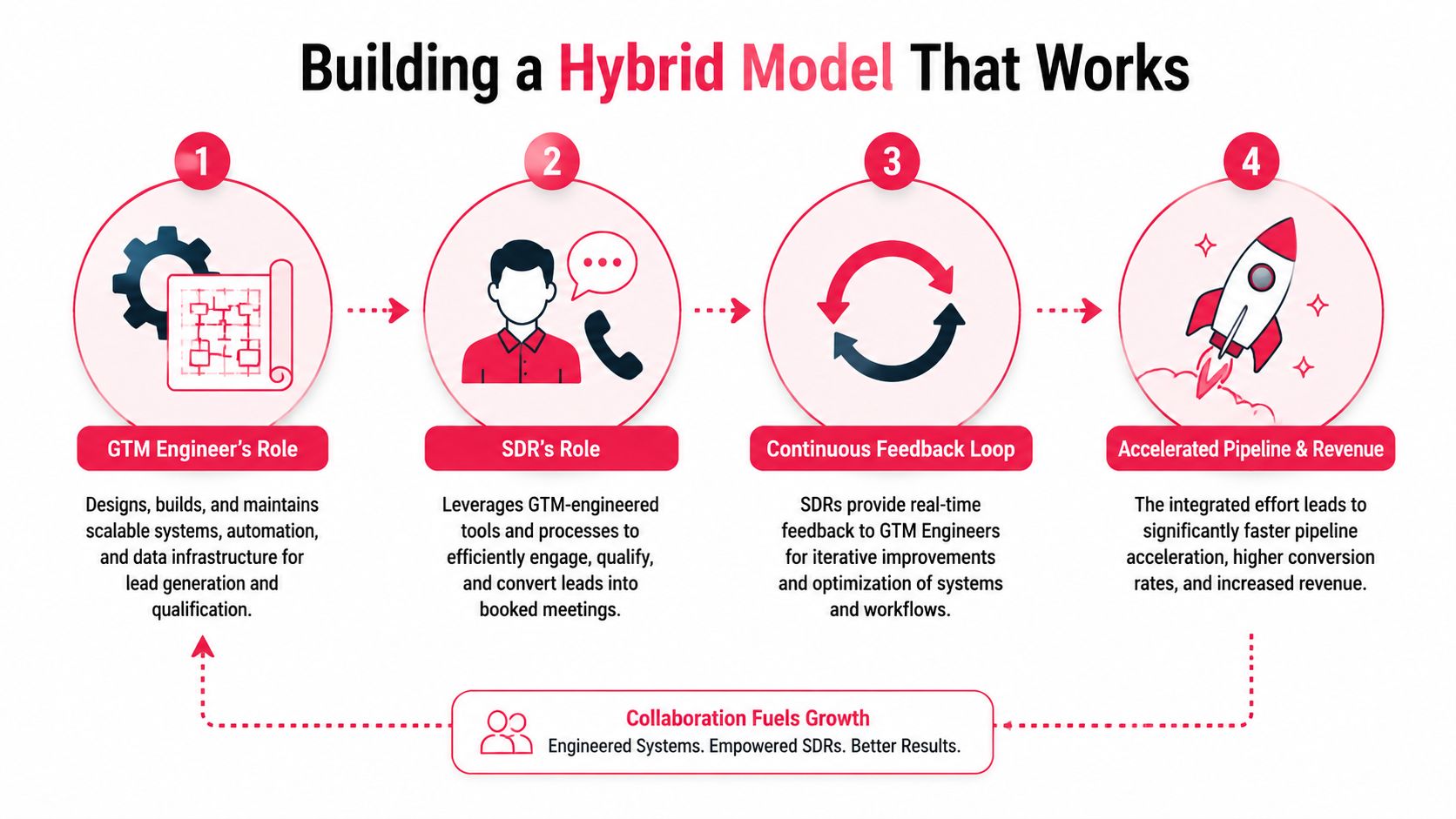
That model works because each role stays in its lane. The GTM engineer builds targeting, enrichment, routing, sequencing logic, triggers, CRM workflows, and reporting. SDRs handle the conversations where tone, judgment, persistence, and timing still matter.
A workflow that actually holds up
One benchmark says a single GTM engineer can enable 3 to 5 SDRs to perform like 8 to 10 by building the automation, sequences, targeting, and the full revenue system, according to this GTM11 comparison. That's the hybrid model most growth-stage teams should evaluate first.
A clean version looks like this:
- The GTM engineer defines the ICP and signal logic. This includes CRM fields, enrichment rules, suppression logic, routing, and intent triggers.
- The system generates and prioritizes work. Accounts enter the queue with context attached, not just a name and title.
- SDRs work high-context conversations. They focus on warm outbound, follow-up, qualification, and meeting conversion.
- Feedback goes back into the system. Objections, bad-fit patterns, reply quality, and handoff issues feed the next iteration.
The key is discipline. SDRs shouldn't spend their day fixing lists. GTM engineers shouldn't own every live conversation. When teams blur that line, both roles underperform.
A hybrid model wins when the engineer owns throughput and the SDR owns conversion from live interaction.
Where this connects to CRO and AI search
This model improves more than outbound. Once your GTM engineer is wiring signal logic and feedback loops, marketing can use the same structure for CRO testing, lead scoring, and intent-based routing from content, product, or paid traffic.
The same operating habit also matters in AI search optimization and agent commerce readiness. If your data, messaging, and offer logic are fragmented, your outbound motion suffers first. Your discoverability in AI-assisted buying environments suffers next. Teams that clean up one usually improve the other.
Your Hiring Decision Framework
The hiring call is simpler than teams make it. Choose the role that changes your pipeline model.
An SDR increases output in a mostly linear way. Add one rep, get more conversations, then manage the usual trade-offs in ramp time, coaching, and rep-to-rep variance. A GTM engineer changes how work gets created, scored, routed, and improved. That is a non-linear bet. The upside is higher throughput from the same headcount base. The downside is that weak operators can burn time building workflows that never affect revenue.
Use the framework below the same way you would evaluate a major systems hire. Start with the constraint that is costing pipeline now, then match the role to that constraint.

Hire a GTM engineer first if
A GTM engineer is the better first hire when the revenue problem sits inside the system, not inside call volume.
- Your team has lead flow but weak execution between signal and meeting. Reps spend time on research, list cleanup, routing fixes, and manual admin instead of selling.
- Your stack exists, but the operating logic is thin. CRM, enrichment, sequencing, and handoff rules are disconnected or manually maintained.
- Results depend too much on individual rep effort. One SDR produces because they built their own workarounds. The rest of the team cannot repeat it.
- Testing is slow and expensive. New segments, triggers, and messaging require too many manual steps to launch or measure.
In those conditions, another SDR usually adds cost faster than pipeline. A GTM engineer can improve list quality, reply quality, routing speed, and rep focus across the whole team. That is the non-linear outcome. One operator improves the output of multiple sellers instead of only adding one more unit of selling capacity.
Hire an SDR first if
An SDR-first decision works when the system is already doing its job and the queue needs coverage.
- Targeting, routing, and messaging are stable. The team knows who to contact, why they matter, and how leads should move.
- Prospects are responding, but follow-up capacity is thin. Meetings are being missed because there are not enough skilled reps to work the volume.
- Early human qualification matters more than more automation. Some categories need live conversation quickly to separate curiosity from real buying intent.
This is a linear investment, and that is fine when the economics support it. If one more rep can reliably convert an existing backlog into qualified meetings, the fastest path to more pipeline is usually another rep.
Choose a hybrid model if
This is the right answer for many growth-stage teams because their problem is mixed. Part system. Part conversation.
- You have proof of demand, but inconsistent execution. Enough inbound or outbound traction exists to justify process work, but too much friction remains to scale cleanly.
- You need efficiency and human judgment. That is common in B2B motions where account selection can be automated, but qualification and objection handling still need a strong rep.
- You are hiring for the next stage, not just this month's target. The engineer builds repeatability. The SDR turns that repeatability into meetings and feedback.
The cost logic matters here. A hybrid pod costs more than a single hire, but it often lowers waste faster than adding two SDRs into a broken system. One common pattern is simple. The engineer raises account quality, prioritization, and speed to launch. The SDR then spends more hours in live selling and fewer hours patching process gaps.
If you need one sentence to make the decision, use this test.
If the bottleneck is coverage, hire an SDR. If the bottleneck is throughput quality, hire a GTM engineer. If both are true, build the hybrid model and assign clear ownership so the engineer owns system output and the SDR owns conversation conversion.
Example Job Descriptions You Can Use
GTM Engineer
Own the design and operation of our outbound revenue system. Build workflows for ICP targeting, enrichment, routing, signal-based outreach, sequencing, CRM sync, and reporting across tools such as Clay, HubSpot or Salesforce, Apollo, Smartlead, Instantly, Make, Zapier, or n8n. Work with sales and marketing to improve data quality, message relevance, and handoff quality. Success looks like better throughput, faster testing, cleaner routing, and more qualified pipeline from the same effort base.
Modern SDR
Own high-quality conversations generated by our outbound and inbound systems. Work prioritized accounts, qualify interest, handle objections, follow up across email, LinkedIn, and calls, and convert qualified interest into booked meetings. Capture feedback on message quality, targeting issues, competitor mentions, and disqualification reasons so the GTM engineer can improve the system. Success looks like strong meeting quality, disciplined follow-up, and clean feedback into the revenue engine.
If you're deciding between a GTM engineer, an SDR, or a hybrid pod, the next step is to audit the bottleneck before you open a req. Stimulead helps growth teams do that across CRO with AI, GTM engineering, AI search optimization, and agent commerce readiness. Start with a clear system review at Stimulead.