
Most advice on this topic is backward.
The usual line is: AI is strategic, so you need a Chief AI Officer. For most growth-stage companies, that's the wrong first move. A new title doesn't fix weak conversion paths, slow testing, messy GTM execution, or the fact that your team bought five AI tools and none of them touch pipeline.
If you're asking Do I need a Chief AI Officer?, ask a better question instead: what is the cheapest way to add AI leadership that moves revenue this year. That's the standard. Not optics. Not board theater. Revenue.
I've worked with CEOs, CMOs, and CROs in companies where sales needed faster research, marketing needed more test volume, and the site needed to convert better before anyone needed another executive title. In those situations, the winning move wasn't a full-time CAIO. It was getting the function in place first: someone who owns priorities, picks the use cases, keeps the team out of tool chaos, and ties every AI project to funnel math.
Table of Contents
- Don't Hire a Chief AI Officer (Yet)
- What a Growth Stage CAIO Actually Builds
- Clear Signals You Need AI Leadership
- Four Models for Acquiring AI Leadership
- A 90-Day Roadmap for AI Implementation
- Your Next Step to Generate Revenue from AI
Don't Hire a Chief AI Officer (Yet)
If you're between early traction and scaled execution, don't start with a full-time CAIO search. Start with a business problem list.

A growth-stage company rarely loses because it lacks a formal AI executive. It loses because no one owns AI across marketing, sales, and revenue operations. So experiments stall. Vendors overpromise. Teams automate random tasks. The site still leaks conversions. SDRs still spend too much time on account prep. Your category still doesn't show up well in AI search.
That's why I tell most CEOs to pause before creating the title. Buy clarity first. An AI readiness assessment will tell you more than a recruiting brief ever will.
The expensive mistake
A full-time executive hire creates pressure to justify the hire with a big roadmap. That often leads to broad internal initiatives, long vendor evaluations, and very little movement in the revenue engine.
You don't need a manifesto. You need someone who can answer questions like these:
- If paid acquisition is getting more expensive, where can AI improve conversion before you add budget?
- If your sales cycle is slowing, where can AI remove prep work and tighten follow-up?
- If buyers are using ChatGPT, Perplexity, Gemini, or Claude to evaluate vendors, what content and product proof needs to exist so your brand gets recommended?
- If your team is already using AI tools, who decides which workflows stay, which get cut, and which deserve process changes around them?
Practical rule: Hire the title only after you've proved the function has recurring commercial value.
What I recommend instead
For most companies in the audience for this article, the first need is AI leadership without full-time executive overhead. Someone has to connect CRO with AI, GTM engineering, AEO, and agent commerce readiness. But that person doesn't need to sit on payroll as a permanent C-suite addition on day one.
Get the operator. Prove impact. Then decide whether the title belongs on the org chart.
What a Growth Stage CAIO Actually Builds
This role is often described too vaguely. I won't.
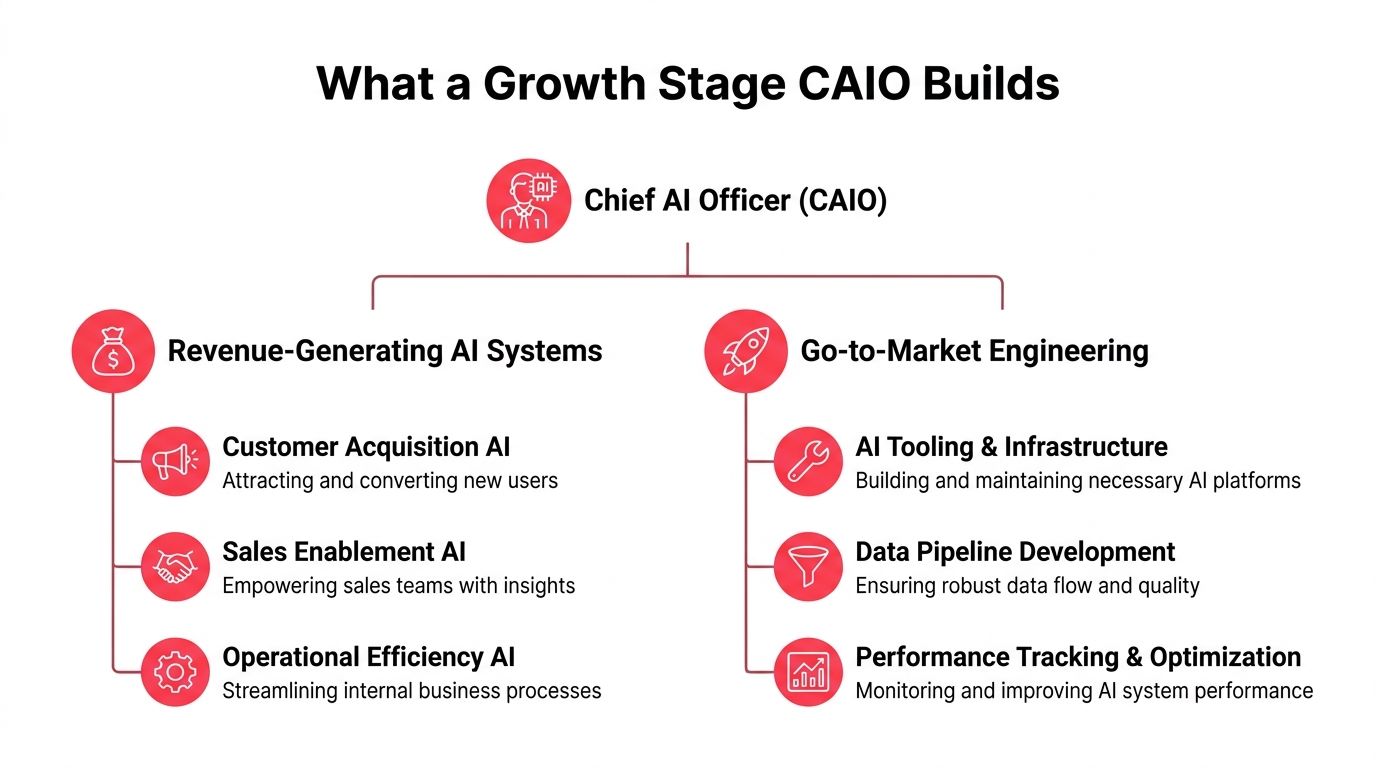
A growth-stage CAIO builds systems that push revenue forward. If that isn't the mandate, you've hired the wrong person.
The job is revenue systems
The first build is usually AI-assisted CRO. That means faster hypothesis generation, faster creative and copy variation, faster landing page iteration, and tighter analysis across funnel steps. Good teams already test. An effective AI lead changes the pace and coverage of that testing so your team learns faster from the traffic you already have.
The second build is GTM engineering. I mean the actual operating layer for outbound and pipeline support. Account research workflows. Persona-based messaging drafts. rep assist for call prep. Follow-up sequencing tied to CRM state changes. Enrichment rules. Routing logic. Human review where it matters. In this operational layer, AI stops being a novelty and starts behaving like sales infrastructure.
A third build is AI search optimization, sometimes framed as AEO. Buyers increasingly ask AI systems which vendors they should consider. If your site, content, proof points, and structured information are weak, you don't show up well in those answers. A real AI lead will coordinate content, product marketing, and technical implementation so your company becomes easier for AI systems to cite and recommend. If that's a priority, Stimulead also publishes related guidance on AI search and revenue operations across its site.
Later comes agent commerce readiness. That matters when software agents increasingly assist buyers with comparison, shortlisting, repeat purchase, and task completion. If your pricing, catalog, product information, policies, and transaction paths are hard for software to interpret, you create friction in a channel that's becoming more relevant.
A lot of teams also need a governance layer around customer-facing automation. If that's on your roadmap, Averta's piece on securing enterprise AI agents is worth reading because governance becomes real the moment an agent touches customer communication or internal decision support.
Here's the role in plain English.
- Own use-case selection: Pick the few workflows that can move pipeline or conversion soon.
- Build operating rules: Decide where AI drafts, where humans review, and where automation can run.
- Connect tools to process: HubSpot, Salesforce, Clay, Apollo, Gong, Notion, CMS workflows, analytics. None of that matters if the process stays broken.
- Report on business impact: This role should speak in funnel movement, sales efficiency, conversion friction, and CAC pressure.
Here's a useful visual summary before going deeper.
Where this role sits
This role isn't your CTO. The CTO owns product and engineering priorities. It also isn't your head of data unless your data leader already knows how to drive commercial execution with AI across marketing and sales.
The right AI lead for a growth company behaves more like a revenue operator with technical judgment than a pure technologist.
That's the distinction CEOs miss. You aren't buying research. You're buying applied judgment.
Clear Signals You Need AI Leadership
You don't need intuition here. You need pattern recognition.
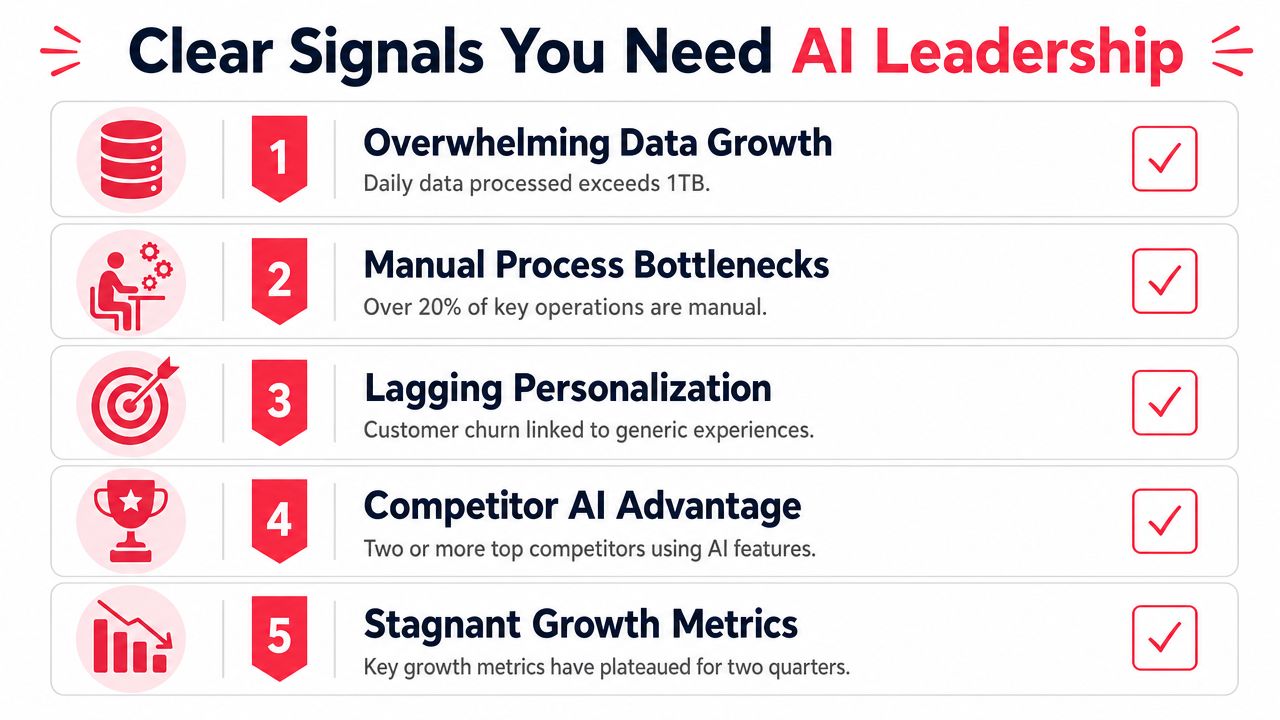
Commercial symptoms that matter
I've seen the need show up in the same places over and over.
- Marketing spend keeps rising while efficiency stalls: You add budget, add channels, add people, and results flatten. When that happens, AI often belongs inside conversion work, offer testing, audience segmentation, and post-click experience before you spend more at the top of funnel.
- Sales reps do too much manual prep: If your AEs or SDRs are still hand-building account context, rewriting first-touch messages from scratch, and chasing internal data before every meeting, you're paying sellers to do analyst work.
- Your CRO program is slow: If the web team can only manage a small number of tests at a time, learning slows. AI can help your team create and ship more variants, but only if someone owns the system and quality bar.
- Competitors appear in AI answers and you don't: This one matters more than many teams think. If buyers ask AI tools for options in your category, and those tools repeatedly surface competitors, you've got a discoverability problem.
- Your AI tools live in silos: Marketing has one writer tool. Sales has another assistant. Ops has a chatbot pilot. Support has a knowledge base add-on. Nobody can tell you what those tools do together for pipeline, close rate, or retention.
If two or more of those feel familiar, AI leadership isn't optional. You have a coordination problem.
The organizational side matters too. A lot of teams think they have an AI tooling issue when they really have a capability issue. That's why I often point leaders to this article on the AI skills gap in go-to-market teams. It explains why tool access alone doesn't create output.
What these signals mean in practice
Let's make this less abstract.
A CMO sees ad performance level off. The instinct is to refresh creative and expand budget. The better move may be to rebuild landing page testing, message matching, and lead form paths with AI-supported workflows so the existing spend produces more opportunities.
A CRO sees reps missing activity targets and assumes it's a discipline problem. Sometimes it is. Sometimes the issue is that reps are doing too much low-value research and manual personalization with no shared workflow.
A CEO sees several teams experimenting with AI and assumes progress is happening. Progress isn't tool usage. Progress is when one owner can tell you which AI systems touch acquisition, where the data comes from, which KPIs matter, and what gets scaled next.
If your teams are experimenting and nobody owns prioritization, you're paying tuition, not buying results.
The companies that wait too long usually do the same thing. They spread AI across departments before they put an operator in charge. Then they spend months cleaning up inconsistency.
Four Models for Acquiring AI Leadership
Once you've admitted the need, the next question isn't philosophical. It's operational. Who should own it, how much should you spend, and how fast do you need movement?
The real tradeoff is speed versus commitment
There are four common ways to add AI leadership. They are not equal.
Full-time CAIO makes sense when AI is already becoming a standing executive function. This model fits companies with a bigger budget, mature internal systems, and enough ongoing AI work to justify a permanent C-level owner. The upside is continuity and authority. The downside is commitment. If the hire is wrong, you don't just lose money. You lose time.
Fractional CAIO is the model I recommend most often for growth-stage firms. You get senior judgment, execution oversight, vendor scrutiny, use-case prioritization, and board-ready communication without making a full-time executive bet before the function is proven. It's especially useful when the need sits squarely in marketing and sales performance.
Advisor only can work if your team already executes well and just needs strategic direction. This is lighter touch. It helps with roadmap decisions, prioritization, and risk review. It usually won't move fast enough if your team also needs workflow design and hands-on implementation support.
Internal upskilling sounds cheap because it uses existing people. It can work if you have a strong operator in marketing ops, rev ops, or growth who already has the trust of leadership and enough room in their workload. The usual failure point is simple. The person still owns their old job, and AI becomes side work.
If you're debating infrastructure decisions at the same time, this guide on build or buy AI tools is useful. It frames the decision the way operators should. Around maintenance burden, flexibility, and speed, not vanity.
AI Leadership Model Comparison
| Model | Annual Cost | Time to Impact | Strategic Oversight | Execution Capacity | Best For |
|---|---|---|---|---|---|
| Full-Time CAIO | High | Slower at first because hiring takes time | High | Medium to high, depends on team under them | Companies with sustained AI demand across multiple functions |
| Fractional CAIO | Moderate | Fast | High | High when paired with your existing GTM team | Growth-stage firms that need traction now without executive overhead |
| Advisory | Lower | Medium | Medium to high | Low | CEOs who need direction before committing to execution |
| Internal Upskilling | Lower cash outlay, higher hidden time cost | Slowest | Medium | Medium if the internal lead has support | Teams with a strong operator who can absorb the role |
A few direct recommendations:
- Pick full-time CAIO if AI already touches multiple departments, leadership wants one clear owner, and you can support the hire with data, ops, and budget.
- Pick fractional CAIO if you need commercial outcomes soon and your current team can execute with strong oversight.
- Pick advisory if your main problem is decision quality, not execution horsepower.
- Pick internal upskilling only if you accept a slower path and you're willing to protect that person's time.
Board-level view: If you can't name the first revenue use case, don't hire a permanent executive yet.
The biggest mistake in this section is easy to state. Companies choose based on title prestige instead of implementation risk. Don't do that.
A 90-Day Roadmap for AI Implementation
Good AI leadership should produce visible movement inside one quarter. If it doesn't, the problem isn't patience. It's focus.
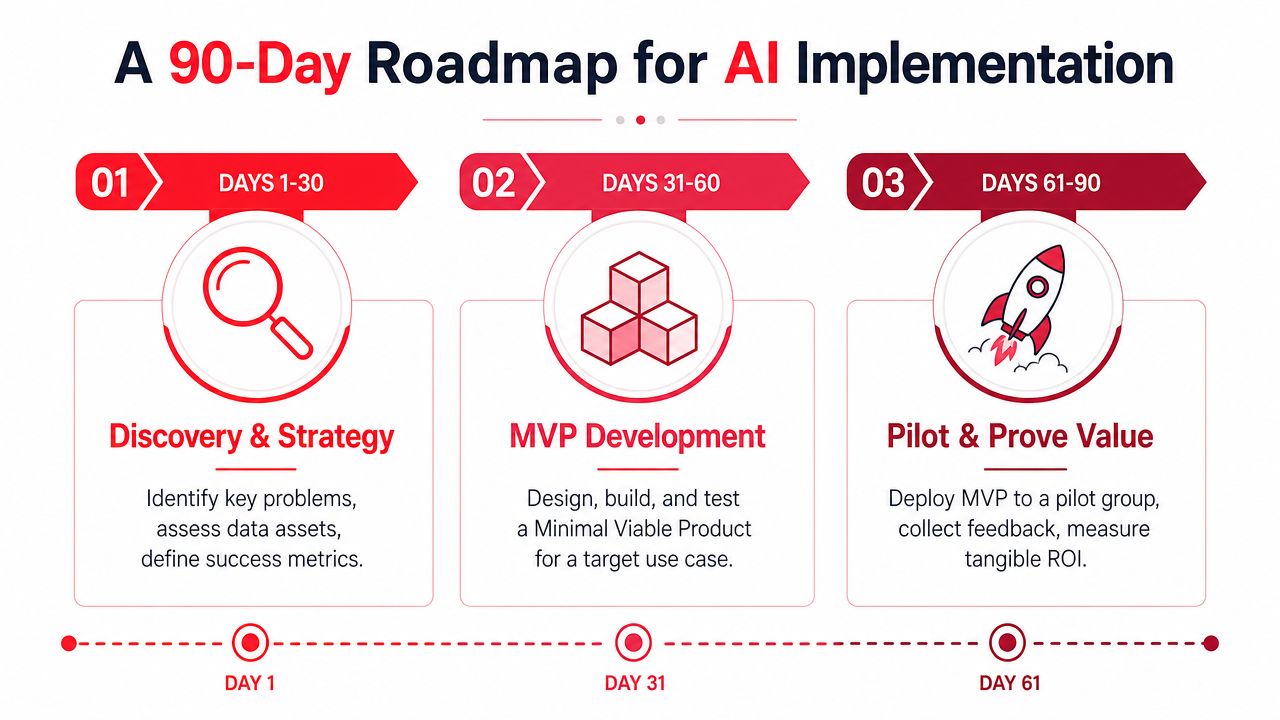
Days 1 to 30
Start with an audit, but keep it commercial.
Review your acquisition funnel, sales workflow, CRM hygiene, site conversion paths, current AI tooling, and content assets that affect AI search visibility. Look at where humans spend time, where leads slow down, and where your team keeps repeating work.
The output should be simple:
- A ranked use-case list: one primary pilot, one backup, one later-stage opportunity
- A KPI sheet: define what business outcome matters before anybody builds
- A workflow map: inputs, outputs, systems touched, owner, review points
- A risk note: where legal, compliance, or brand review is needed
This is also where executive alignment matters. If the CEO wants revenue impact but the team starts with internal productivity experiments that don't touch pipeline, you've already gone off course. For leadership teams that need that alignment first, AI training for executives can compress the learning curve and stop bad pilot selection.
Days 31 to 60
Build one pilot. One.
That pilot could be an AI-supported landing page testing workflow, a sales research and personalization engine, an AEO content refresh process for bottom-funnel pages, or a narrow customer-facing assistant with strict guardrails.
The key is scope control. You want something useful enough to matter and narrow enough to ship.
A common pilot checklist looks like this:
- Choose one owner: marketing ops, rev ops, growth, or sales enablement
- Define review rules: what AI can draft, what humans must approve
- Instrument the process: track output quality, adoption, and business effect
- Set a weekly review cadence: fix workflow issues while the pilot is live
If your team needs a practical implementation lens, this article on how to maximize business ROI with AI is a solid companion because it keeps the focus on operational rollout instead of generic transformation talk.
Pilot one workflow that touches revenue directly. Leave broad automation programs for later.
Days 61 to 90
By this point, you should have enough evidence to decide whether the pilot deserves expansion.
Review three things. First, did the team use the workflow? Second, did it change speed, quality, or throughput in a way that matters? Third, what broke under real use?
Then make one of three calls:
- Scale it if adoption is real and the business case is clear.
- Fix and rerun if the use case is sound but the workflow design was sloppy.
- Kill it if it looked good in a meeting and weak in production.
The discipline here matters more than enthusiasm. AI projects fail when leaders keep weak pilots alive to avoid admitting they picked the wrong first use case.
This is also the point where the staffing decision becomes easier. If the pilot works and the next queue of use cases is obvious, you've earned the right to decide whether a permanent role, fractional leadership, or focused team upskilling is the better path.
Your Next Step to Generate Revenue from AI
Don't spend another quarter discussing titles.
If you're still wondering, Do I need a Chief AI Officer, use this rule. If AI is already affecting pipeline, conversion, outbound efficiency, and discoverability in AI search, then yes, you need AI leadership. But you probably do not need a full-time CAIO first.
You need the smallest commitment that gives you accountable ownership.
Here's my advice by situation:
- You need a board-ready direction fast: Choose an advisory model. Get a short diagnostic, a clear use-case order, vendor guidance, and an operating plan.
- You have a capable GTM team but weak AI execution: Train the team on practical workflows for CRO with AI, GTM engineering, AEO, and agent commerce preparation.
- You need action now and somebody to own it: Use a fractional CAIO model. One option is Stimulead's AI Growth Partnership, which combines audit, prioritized roadmap, KPI definition, and execution oversight with your existing team.
- You already know AI will become a standing executive function: Start the search for a full-time leader, but only after you've defined the initial mandate in business terms.
A bad next step is a broad AI committee. Another bad next step is buying more tools.
The right next step is smaller and more useful. Pick one revenue use case. Assign one owner. Set one review cadence. Tie it to one outcome that the CEO, CMO, and CRO all care about.
Book a short working session with whoever will own this decision. Bring your funnel, your current AI tools, and your top three GTM bottlenecks. By the end of that call, you should know whether you need advisory support, team training, or a fractional CAIO. If you can't answer that yet, you are not ready to hire a Chief AI Officer.