
AI adoption in customer experience reached nearly 70% in 2026, yet only 2% of AI-using organizations reached the highest Center of Excellence tier, while 70% remained in the lowest Experimental tier (2026 CX AI adoption report). That gap should change how growth companies think about an AI Center of Excellence.
Buying AI tools is easy. Moving a marketing or sales workflow into production, measuring its effect on pipeline, and assigning someone responsibility for the result is harder. CEOs, CMOs, and CROs don't need another committee that reviews pilots. They need an operating system that turns AI work into faster testing, better conversion, more qualified pipeline, and traceable revenue.
Table of Contents
- Why Most AI Centers of Excellence Stall at the Experimental Stage
- Choosing the Right Operating Model for Your Team Size
- Building a Charter with Clear Decision Rights
- Selecting Pilots That Prove Revenue Impact Fast
- Staffing and Tooling Without Overhead You Cannot Sustain
- Your 90 180 365 Day Rollout Plan with Revenue KPIs
Why Most AI Centers of Excellence Stall at the Experimental Stage
Most companies confuse AI usage with AI capability. Teams add ChatGPT, Claude, Salesforce Einstein, HubSpot AI, or an agent platform, then count content, sales sequences, training sessions, and licenses as adoption. None of those activities proves that customer work or revenue has improved.
The 2026 CX index shows the gap clearly. Adoption rose from 54% in 2024 to nearly 70% in 2026, yet only 2% of AI-using organizations reached the report's highest Center of Excellence tier. Seventy percent remained in the Experimental tier. The framework assessed measured outcomes, operating maturity, training sophistication, production trust and control, and ROI discipline (CX maturity findings).
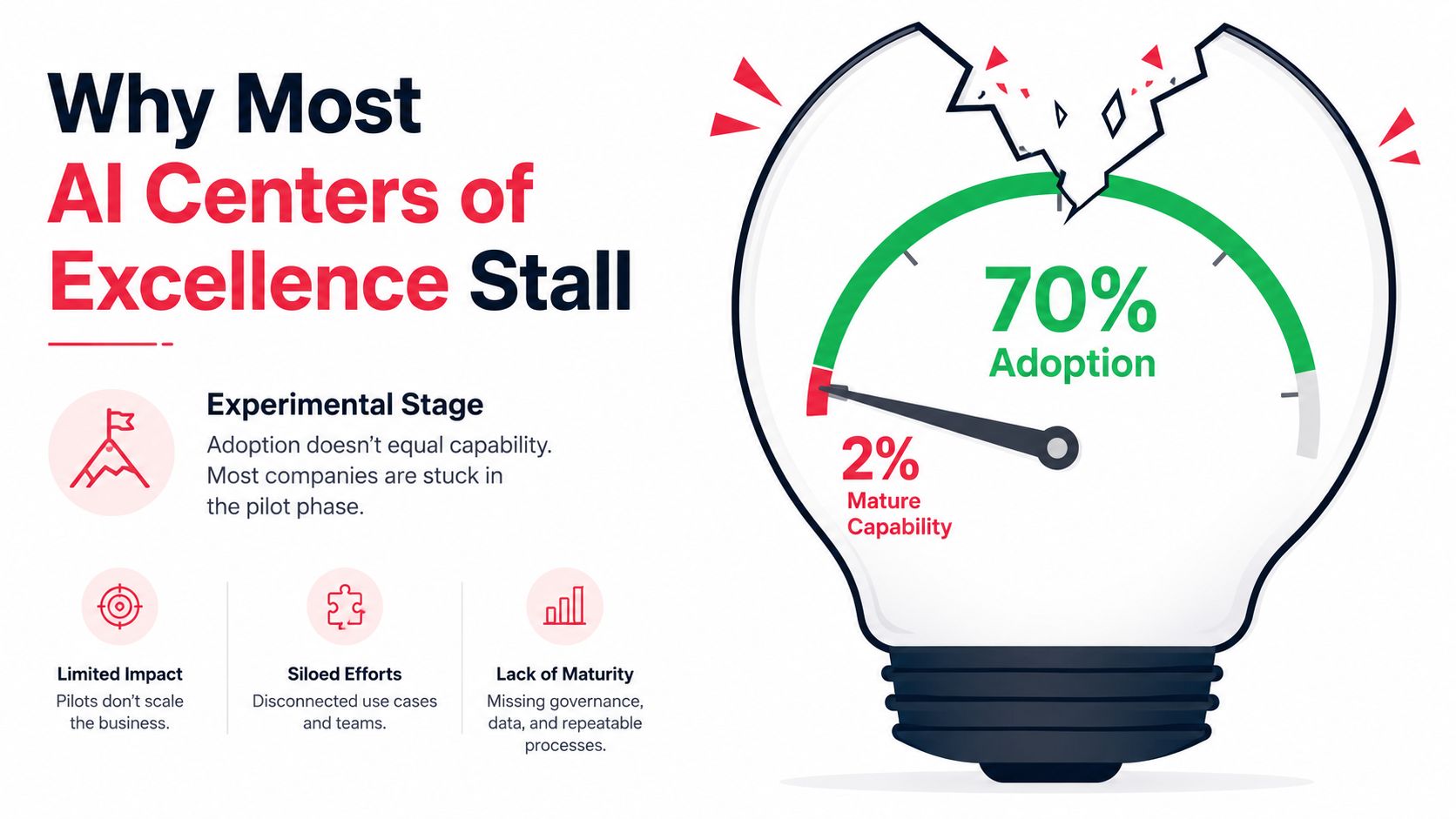
Activity creates the illusion of progress
A typical CoE dashboard reports training hours, pilot counts, tool licenses, prompts written, or models approved. Those measures can increase while production deployment stays flat. Conversion rates, qualified opportunities, sales-cycle speed, and revenue attribution may remain unchanged.
A steering committee can discuss risk, a technical group can review vendors, and business units can continue using disconnected tools. The missing role owns the full path from use-case intake through production monitoring and commercial measurement. Without that ownership, governance becomes a record of activity rather than a mechanism for better decisions.
A working CoE tracks the economic chain:
- Workflow adoption: Are the intended marketers and sellers using the system in live work?
- Production reliability: Does it deliver acceptable quality with escalation paths and auditability?
- Commercial movement: Does it increase testing capacity, improve conversion, create pipeline, lower cost per lead, or support attributed revenue?
- Time to evidence: How quickly can leadership decide whether to continue, change, or stop the initiative?
Practical rule: If a CoE cannot connect a production workflow to a business baseline, it has not proved value.
Skills shortages, budget limits, and unclear ownership make this measurement harder. Evaluation can also mislead. Data contamination, benchmark saturation, inconsistent scoring, and noisy metrics may make a system appear better without showing that customer results or revenue improved (AI CoE measurement risks).
Before formalizing the structure, run an AI readiness assessment across marketing, sales, data, operations, and leadership. Rank workflows by owner, baseline, data requirements, and decision date. The useful test is whether the CoE moves work from experimentation into accountable production, with operating metrics that show the change.
Choosing the Right Operating Model for Your Team Size
The operating model determines who owns the rules, who builds the workflow, and who monitors it after launch. Microsoft describes three patterns for agent Centers of Excellence: centralized, federated, and a common scale pattern with a central platform and federated delivery (Microsoft operating models).
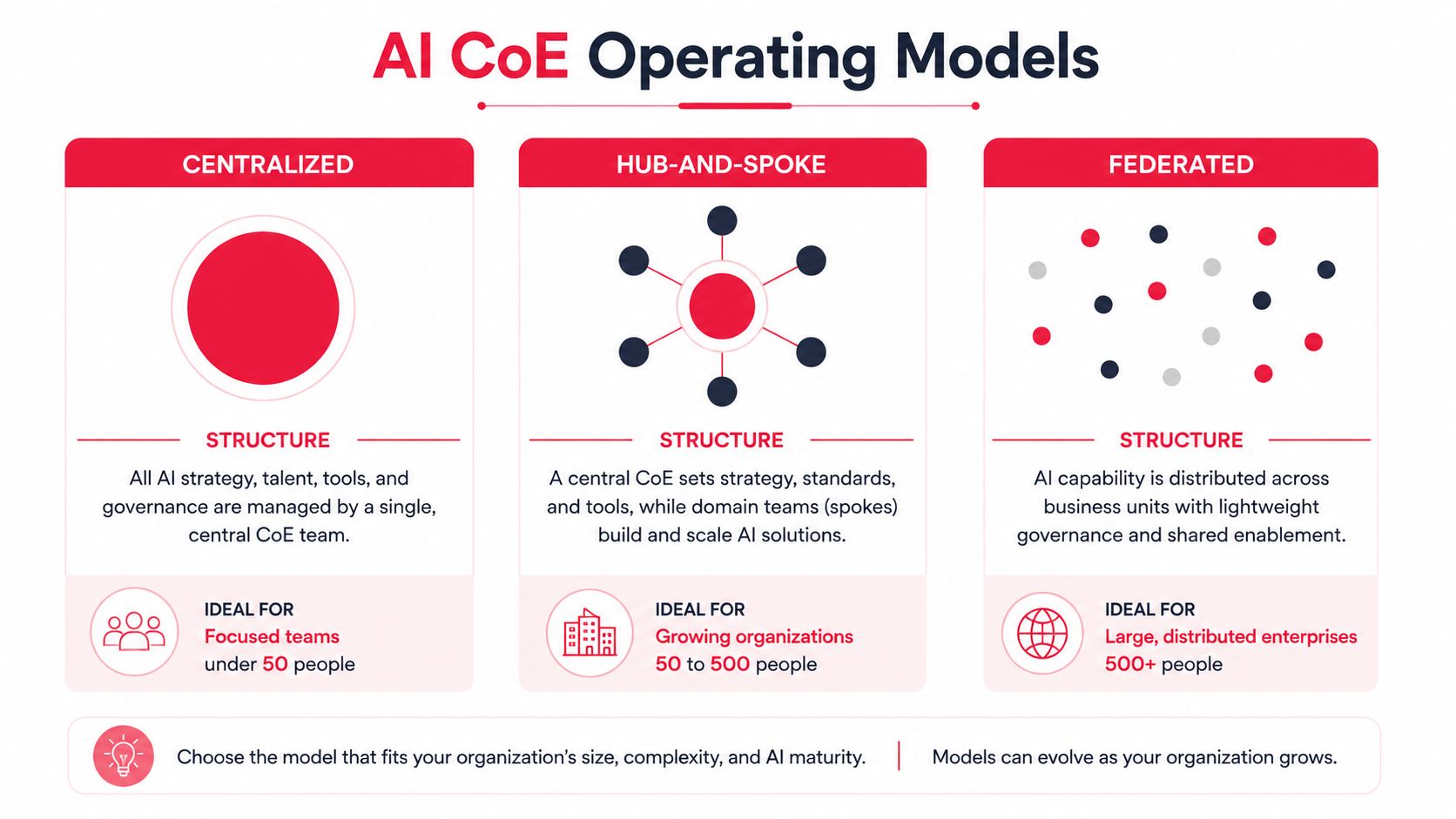
Centralized
A centralized CoE keeps strategy, build work, standards, and production monitoring in one team. This can work for a focused company with a small number of high-priority workflows. It gives leaders one intake queue, one technical owner, and consistent controls.
The trade-off is speed. Marketing and sales wait for the central team to understand their context, prioritize their request, build the workflow, and maintain it. A central group can also become a service desk that collects requests without owning commercial outcomes.
Use this model when your team has limited AI experience, fragmented data, or meaningful risk around customer-facing automation. Give the central team a narrow mandate. A small group that owns one revenue workflow is more useful than a broad group that promises to support every department.
Hub-and-spoke
The hub owns shared platforms, identity, security standards, approved tools, intake, and measurement. Marketing, sales, and customer teams act as spokes that bring domain knowledge and execute workflows.
This model usually fits growth companies that need control without removing ownership from the people closest to the customer. The hub can define how an outbound agent accesses data. The sales spoke can decide which account signals matter and how representatives review output.
Support automation provides a useful measurement pattern. Teams building a CoE can study KPI tracking for support automation to see how operational metrics connect workflow performance to service outcomes.
Federated
A federated model puts delivery ownership inside business units. The CoE sets guardrails and governs by exception. This gives teams autonomy, but the company needs shared identity, logging, model approval, and a reliable registry of production systems.
For growth-stage companies, federated delivery works best after standards are already clear. Starting federated too early creates duplicate tools, conflicting policies, and unclear accountability.
The practical choice is usually a small central platform with federated delivery. The CoE owns the baseline. Revenue teams own the workflow result. That division prevents the central team from becoming a bottleneck while preserving minimum controls.
Building a Charter with Clear Decision Rights
A charter shouldn't read like a policy archive. It should tell people who can approve a use case, who owns the business result, who can change a production system, and who receives the escalation when something fails.
A practical charter has three authority layers. Executive sponsorship comes first because it provides budget, authority, and organizational credibility, as described in guidance on building an AI Center of Excellence (charter structure and sponsorship).
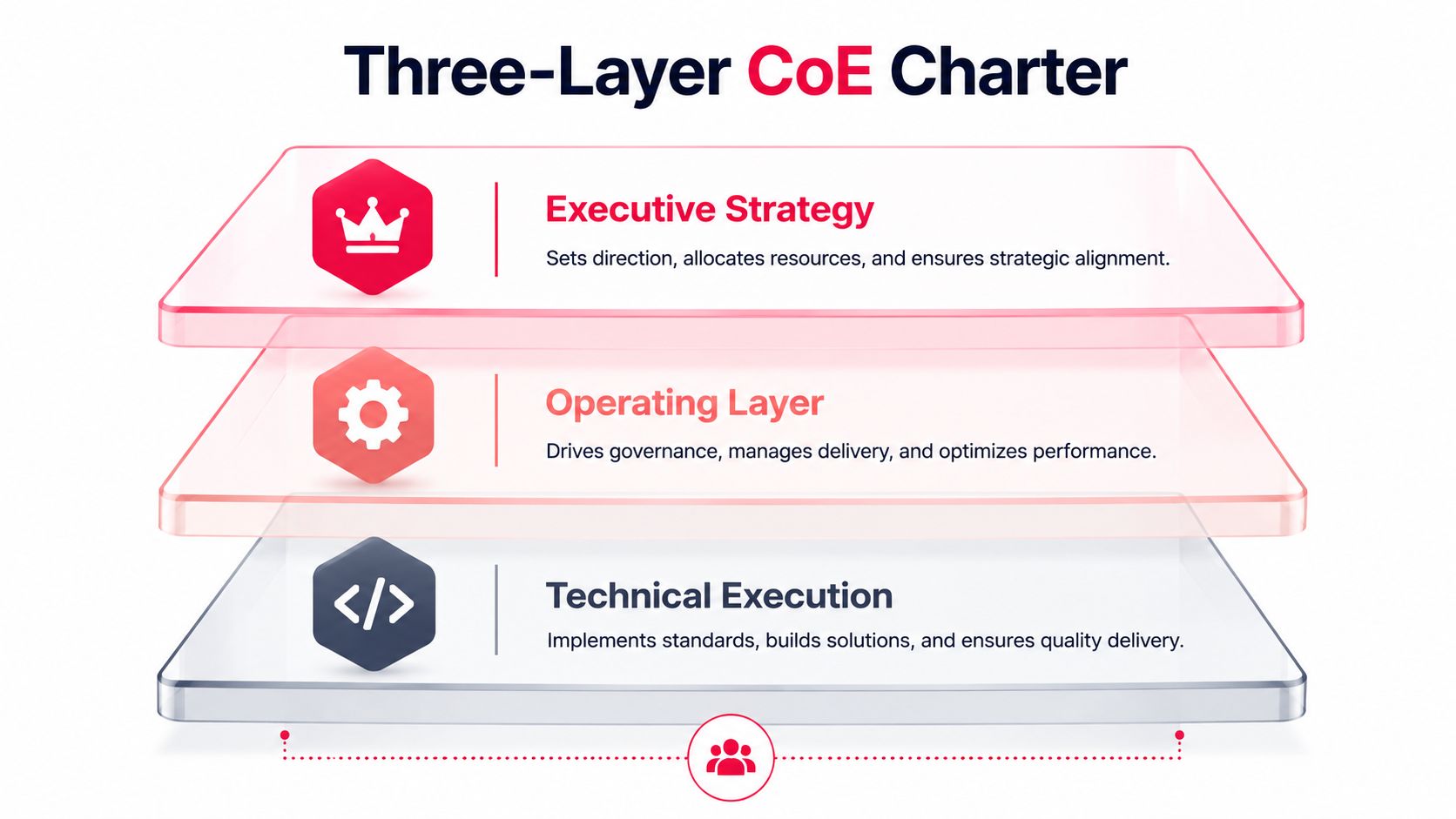
Executive strategy
The executive sponsor sets the commercial priorities and approves funding. For a growth company, that might mean prioritizing conversion rate optimization, pipeline creation, or agent commerce readiness over internal experimentation.
The sponsor also resolves conflicts. If marketing wants a content agent and sales wants a prospecting agent, the sponsor decides which work earns capacity based on expected revenue proximity and operational readiness.
Operating layer
The operating lead manages the intake queue, baseline metrics, use-case ranking, risk classification, training plan, and go or no-go decisions. This person needs enough authority to stop a pilot that has no credible measurement plan.
Assign one accountable role to each governance function. Shared accountability often means nobody owns the decision. The operating layer should maintain a simple matrix:
| Decision | Accountable role | Required input |
|---|---|---|
| Strategic priority | Executive sponsor | Revenue and functional leaders |
| Use-case acceptance | CoE operating lead | Workflow owner and data owner |
| Risk classification | Risk or compliance owner | Technical lead |
| Production approval | Technical platform owner | Security and workflow owner |
| Business KPI | Functional owner | Finance or revenue operations |
| Incident response | Production owner | Security and operating lead |
Technical enforcement
The platform owner turns policy into controls. That includes model risk classification, agent identity, least-privilege permissions, tool-call oversight, audit logging, and traceability. Trussed's governance structure recommends assigning exactly one accountable role to each governance function (AI governance decision rights).
A marketing agent should have access only to the approved systems and fields it needs. A sales agent should log the sources used for account research and provide a human review path for customer-facing messages. Those controls belong in the platform and workflow design, not in a document that users must remember.
Use a short charter, a decision matrix, and a production register. Review them when the company adds a new workflow or changes a system of record.
Marketing leaders can also adapt an AI policy page for marketers into team-level rules for content, data handling, approvals, and customer communication.
Selecting Pilots That Prove Revenue Impact Fast
A pilot proves commercial value only when its baseline, owner, and decision threshold are clear. Choose workflows that can produce evidence quickly. A project that takes months before anyone can judge its effect is a poor first test for a growth company.
Rank use cases against four conditions:
- Manual effort: How much repetitive work does the team perform today?
- Automation potential: Can a system complete a defined step with clear inputs and outputs?
- Data accessibility: Can the workflow use reliable, permissioned data without a major infrastructure project?
- Revenue proximity: Can the team connect the result to conversion, pipeline, sales capacity, or customer value?
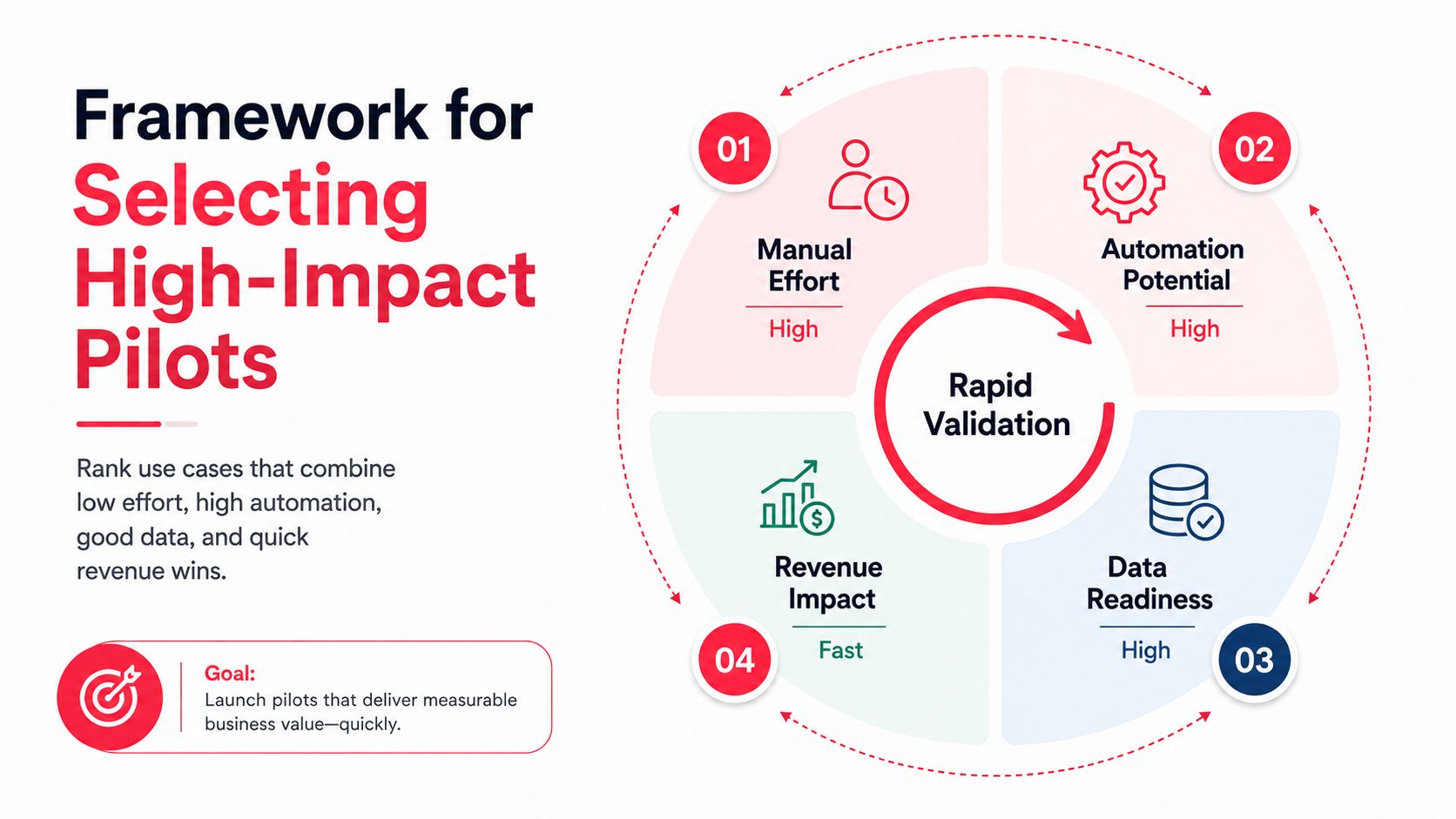
Start with a narrow commercial loop
CRO is often a strong first candidate because its baseline is visible. Define the page, offer, audience, conversion event, and current testing process. Measure how quickly the team can create, launch, and learn from experiments. Stimulead focuses on CRO with AI, GTM engineering, AI search optimization, also called AEO, and agent commerce readiness. These areas keep the first CoE workflow close to buyer behavior.
GTM engineering can work when the company has usable account, industry, intent, and CRM data. A system can support research and draft personalized outreach, while sellers approve the final message. The KPI is not the number of drafts. Track movement from target account to qualified conversation and pipeline.
AEO needs a different baseline. Check whether company pages, product information, and proof points are available and useful to systems that generate recommendations. A brand mention in an answer does not prove commercial impact. Connect the work to qualified visits, assisted conversions, and sales opportunities where attribution is possible.
Use a staged delivery plan
Start with a one to two week discovery sprint. Audit workflows, assess AI readiness, rank use cases by manual effort, automation potential, and data accessibility, then set the baseline before building.
From weeks three through fourteen, take one proof of concept to production readiness. Build the smallest workflow that can run with defined permissions, human review, monitoring, and a commercial KPI. A useful AI proof of concept should end with a decision, not an indefinite pilot.
Over months four through six, scale to three to five workflows while adding governance, team training, monitoring, and optimization. A staged operating model keeps expansion tied to evidence rather than activity. Stop if the first workflow has no trusted baseline, no owner, or no path to production. Add the next workflow only when the team can explain what changed in business terms.
Staffing and Tooling Without Overhead You Cannot Sustain
A company with fewer than 200 people should not copy an enterprise AI staffing model. Build around accountable leadership, workflow owners in marketing and sales, technical support for production controls, and specialist access when internal expertise is missing.
Talent scarcity makes a fully embedded team difficult. Separate 2026 coverage reports found that AI and machine learning demand in India exceeds supply by 3x overall and 4x for senior roles (India AI and ML talent coverage). India GCCs are also investing in agentic AI and GenAI faster than they are establishing fully embedded cybersecurity or governance Centers of Excellence. Experimentation is outrunning operating capacity.
Staff the decisions before the org chart
Use a fractional CAIO or equivalent executive advisor when leadership needs a roadmap, vendor evaluation, implementation oversight, and board-ready reporting, but not a permanent AI executive. A practical guide to how much does a fractional AI head costs can help frame that decision.
Keep workflow ownership inside the business. The CMO or CRO should appoint the owner. Revenue operations should define measurement and attribution. Marketing and sales practitioners should test the workflow in daily work. An internal platform owner or technical contractor should manage access, logging, monitoring, and incident response.
Measure staffing by operating output, not headcount. Track time from use-case approval to production, workflow adoption, review completion, incident resolution, and commercial results. If those measures do not improve, adding specialists is creating overhead rather than capacity.
Training should use live workflows. Teach marketers to create and evaluate CRO variants, sellers to review research and approve outreach, and revenue operations to inspect attribution and data quality. Tool training without a business task produces familiarity, not adoption.
Control the tool budget
Buy only the capabilities required by a defined production workflow:
- Model access and orchestration: Use approved providers and one consistent method for prompts, context, routing, and permissions.
- Data and retrieval: Fix source quality, ownership, and access before adding complex retrieval systems.
- Monitoring and evaluation: Track output quality, failure modes, usage, latency, cost, and business results.
- Workflow integration: Connect the system to the CRM, analytics stack, CMS, or support platform where the work already happens.
License sprawl signals weak intake. Before buying another tool, compare it with the current stack using the criteria in build versus buy for AI tools. Keep a short approved list. Retire any tool without an owner, production use case, or measurable commercial value. The CoE is leaving the experimental tier only when its people and tools shorten delivery, increase adoption, and produce results leadership can verify.
Your 90 180 365 Day Rollout Plan with Revenue KPIs
A rollout earns more funding only when each phase produces evidence that leadership can verify. The operating test is simple: has the CoE moved a workflow into production, improved a commercial metric, and made the result repeatable?
| Phase | Timeline | Primary KPIs | Go/No-Go Gate |
|---|---|---|---|
| Foundation | First 90 days | Baseline conversion rate, testing velocity, pilot adoption, production reliability, initial pipeline tracking | Go when one workflow has a named owner, approved controls, a live baseline, and a production measurement path |
| Expansion | By 180 days | Conversion rate lift, testing velocity, pipeline generated, cost per lead reduction, workflow usage, incident rate | Go when three to five workflows operate with monitoring, training, governance, and repeatable reporting |
| Operating model | By 365 days | AI-assisted revenue attribution, pipeline contribution, conversion performance, cost per lead, production adoption, ROI discipline | Continue when executives can review commercial impact and operating risk through one trusted report |
First 90 days
Run the discovery sprint, approve the charter, select one revenue-adjacent pilot, and deploy it with monitoring. Suitable workflows include CRO testing, qualified account research, and sales follow-up. Capture the pre-launch baseline and define attribution before the system enters production. Otherwise, a later lift cannot be separated from normal campaign or sales variation.
The first gate requires four conditions: a business owner, a technical owner, a review path, and a KPI leadership already understands. If any condition is missing, fix the operating path before adding another use case.
By 180 days
Scale to three to five workflows only after the first workflow produces reliable operational and commercial evidence. Add governance, training, monitoring, and optimization as usage expands. Review testing velocity, conversion rate lift, pipeline generated, cost per lead, workflow adoption, and production incidents in the same report.
A time-saving workflow can still deserve support, particularly if it removes a recurring bottleneck. It should not receive the same funding priority as a workflow tied directly to pipeline or conversion unless its capacity gain is measured and converted into revenue activity.
By 365 days
The CoE becomes a durable operating structure when it can prioritize work, enforce controls, train teams, and report AI-assisted revenue attribution with confidence. Board reporting should identify live workflows, accountable owners, affected business baselines, unresolved risks, and the evidence supporting further investment.
Approve the next year's budget when production workflows have changed how marketing and sales create revenue. Pilot volume alone is not a business result.
Book a working session with Samuel J. Woods at Stimulead to map marketing and sales workflows, rank initial AI pilots, define revenue KPIs, and build a 90-day CoE plan the existing team can execute. Start through the Stimulead AI advisory service.