
A benchmark set reports that AI-assisted lead generation has been associated with 37% to 67% higher conversion rates, alongside a 52% lower cost per lead in one cited study and an 85% reduction in manual prospecting time in another, as documented by The Starr Conspiracy's 2025 AI lead generation benchmarks. That sounds like a tooling decision, but for a growth-stage B2B company the harder decision is operational: which AI output reaches sales, which waits for a person, and which gets discarded before it pollutes the funnel.
We've implemented AI-powered lead generation systems where the model was fast and the pipeline still deteriorated. The differentiator in 2026 is governance, qualification routing, and human review, because low-intent output can make activity dashboards look healthy while SDR capacity, buyer trust, and MQL-to-SQL performance weaken.
Table of Contents
- The Governance Decision Behind AI Powered Lead Generation
- Four Operational Layers of an AI Lead System
- Signal Based Personalization Versus Generic Outbound
- Predictive Scoring That Learns From Your Pipeline
- Where AI Lead Generation Breaks Down
- Vendor Platform Versus In House Build
- Sequencing the Implementation in 90 Days
- Measuring Pipeline Lift and the Next Decision
The Governance Decision Behind AI Powered Lead Generation
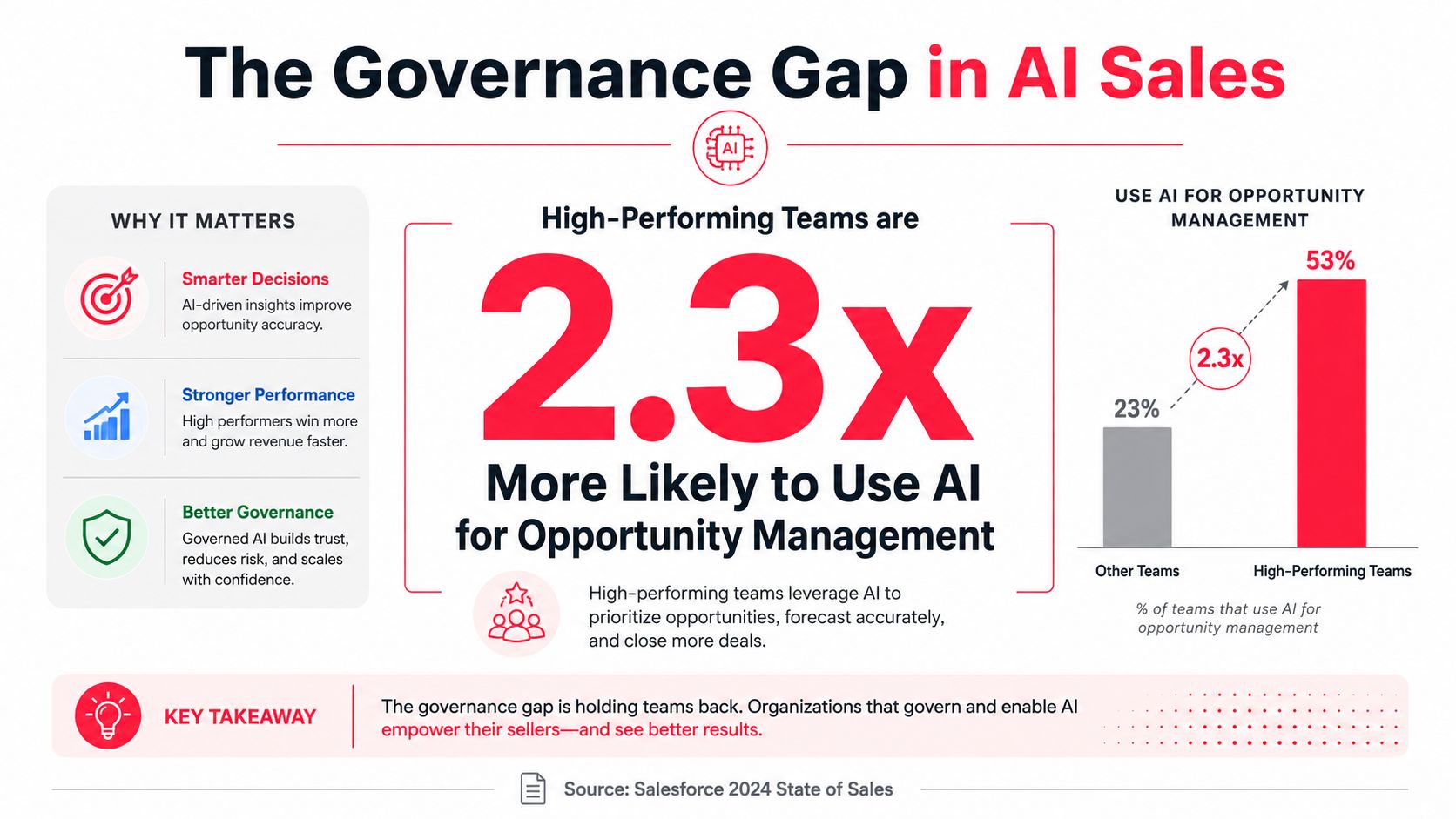
Salesforce's 2024 State of Sales reporting says high-performing sales teams are 2.3 times more likely to use AI for opportunity management. The supplied benchmark brief reports that 41% of sellers lack a documented policy for AI-generated outreach, a control gap that should concern any CRO. Adoption is advancing faster than the operating rules that decide whether AI produces qualified pipeline or automated noise. An infographic titled The Governance Gap in AI Sales highlighting how high-performing teams use AI for opportunity management.
Throughput is no longer the main constraint in AI-powered lead generation. The constraint is whether qualification logic, routing rules, data controls, and human review can withstand inspection after a bad lead reaches an AE, a prospect challenges a claim, or a compliance owner asks why a contact entered an automated sequence.
Digital Applied's 2026 lead generation coverage reports that 67% of B2B marketers use AI for lead qualification and scoring, while 73% use AI for lead generation activities. It also reports an MQL-to-SQL median of 13% and a top-quartile result of 28%. Those figures make the operating gap visible. A system that creates more records without improving qualification can increase activity while weakening sales capacity and buyer trust.
The supplied benchmark coverage reports that 64% of buyers can identify AI-generated outreach within the first sentence. That makes review standards part of pipeline management, not a copy-editing preference. Teams considering the execution layer can also review increase sales with AI lead gen for a broader view of AI-supported prospecting workflows.
The routing decision a CRO has to make
A workable policy assigns every AI output to one of three paths:
- Direct shipment: Verified enrichment, low-risk account research, and internal prioritisation can enter the CRM automatically when the source and timestamp are recorded.
- Human review: Generated messages, unusual qualification decisions, compliance-sensitive segments, and accounts with conflicting signals should wait for an SDR, AE, or RevOps reviewer.
- Model-only use: Weak intent, uncertain identity matches, and unverified claims can influence internal ranking without appearing in customer-facing communication.
The test is operational ownership. Each output needs an approver, a logged decision, and a clear override path for sales representatives. Without those controls, AI lead generation produces volume that is difficult to defend and expensive to route.
Four Operational Layers of an AI Lead System
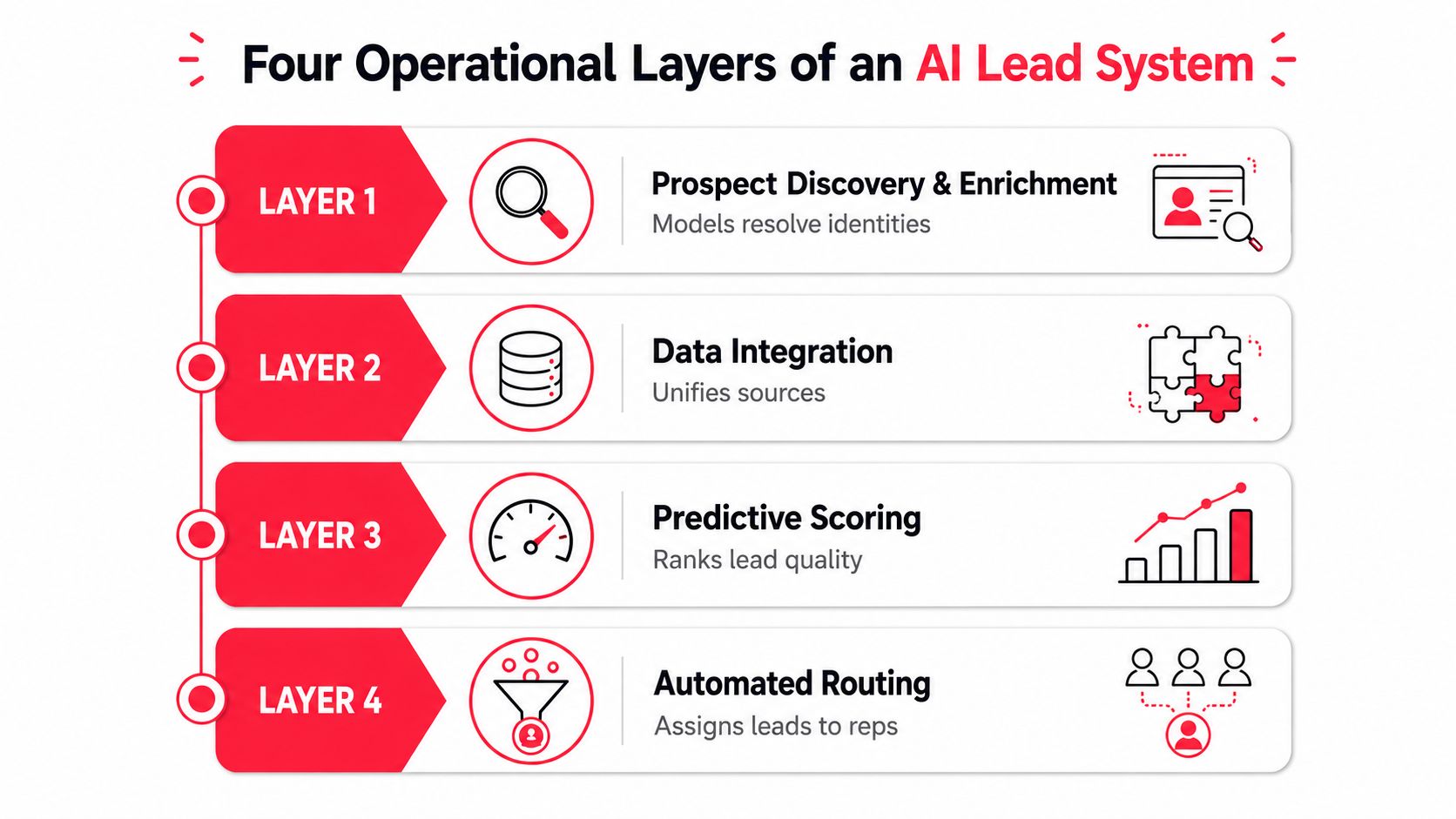
An AI lead system has four connected layers. Each produces an output that becomes another layer's input, so a defect in discovery can look like a scoring problem later.
Discovery and enrichment
The first layer resolves who the account and contact are. Tools such as ZoomInfo, Apollo, Cognism, Clay, and UpLead can combine firmographic, technographic, job-change, and contact data, but enrichment doesn't make an identity certain. Duplicate companies, outdated roles, conflicting employee counts, and stale technology records can poison every downstream decision.
The audit trail should preserve the original provider, retrieval time, confidence status, and the field changed. We recommend treating unverified enrichment as a suggestion until a second source or first-party interaction confirms it.
Signal capture and intent inference
The second layer collects first-party behaviour, third-party intent, and contextual triggers. Pricing-page revisits, product comparisons, hiring activity, funding announcements, and technology changes can help a model rank accounts, but intent is a weak prior, not proof of an active buying process.
A signal queue should show the event, its age, source, account, and confidence. If an intent vendor's feed becomes the only reason an account is marked “hot,” sales will eventually discover that the queue describes content consumption rather than buying readiness.
Message generation
Large language models can produce useful variants when they work inside a controlled system. That system needs an approved prompt library, brand constraints, prohibited claims, source links for factual assertions, and a review threshold based on risk.
The model can draft an opening based on a verified technology change. It shouldn't invent a business priority because the prompt asks for a persuasive angle. The reviewer should approve the factual basis before judging tone.
Scoring and routing
The final layer ranks and assigns. A score can route an account to an SDR, an AE, a nurture track, or a human qualification queue, but every route needs an explanation that a sales manager can inspect.
Teams can build a qualified outbound pipeline while keeping a clear boundary between prospect research and customer-facing automation. RevOps should own field definitions and routing rules, while sales leaders own acceptance criteria. The system needs version history so a later conversion change can be tied to a model or rule update.
Signal Based Personalization Versus Generic Outbound
Personalization only earns its place when it changes the message's reason for being sent. A first name, company token, or familiar industry phrase doesn't establish relevance. A verified pricing-page revisit, G2 comparison, job-change trigger, or technology migration can.
The supplied 2026 outbound benchmarks report generic cold outreach at about 3% to 5% reply rates, signal-personalized outreach at 15% to 25%, and multi-signal outreach at 25% to 40%. Another benchmark summary reports 18% to 22% for AI-assisted outreach compared with 8% to 10% for generic outbound, as reported by Brilo's AI SDR outbound trends. These bands aren't a promise for your segment. They show why verified context deserves a separate workflow.
| Outbound Approach | Average Reply Rate | Top Quartile Reply Rate | Best Use Case |
|---|---|---|---|
| Generic cold outreach | 3% to 5% | Not supplied | Broad coverage when signal volume is low |
| Signal-personalized outreach | 15% to 25% | Not supplied | Verified trigger events and focused account lists |
| Multi-signal personalization | 25% to 40% | Not supplied | Accounts with several current, corroborated buying signals |
The trade-off is capacity. Generic sending may create more meetings in absolute terms when the signal pool is small, while signal-led work usually reduces send volume and increases research requirements. We've seen teams make the wrong comparison by judging a small, high-context cohort against a much larger generic campaign without accounting for researcher time or account coverage.
What buyers detect
Buyers can identify AI-generated outreach within the first sentence, according to the supplied benchmark coverage, which reports 64% detection. Recycled paragraph structures, generic case-study references, exaggerated familiarity, and identical transitions create the tell. Extrovert's signal-based GTM guidance is useful for thinking about trigger selection, while our own signal-based selling guidance covers the operating shift from static lists to current buying context.
Keep the human reviewer focused on whether the signal is true, recent, and commercially meaningful. Let the model handle research synthesis and variation only after those checks pass.
Predictive Scoring That Learns From Your Pipeline
Predictive scoring becomes defensible when the model learns from your CRM's closed-loop outcomes instead of a static list of firmographic preferences. Useful features can include account attributes, technology, engagement depth, stage progression, disqualification reasons, and the time between meaningful interactions.
A recent Frontiers in Artificial Intelligence study of B2B predictive lead scoring used a real CRM dataset covering January 2020 to April 2024. Its Gradient Boosting model outperformed 14 other classifiers on accuracy and ROC AUC. The practical lesson is narrower than “Gradient Boosting always wins.” Model choice changes prioritisation quality when features represent observed pipeline behaviour.
Build the label before choosing the model
Start with the decision you need the model to support. “Lead quality” is too broad. MQL-to-SQL acceptance, SQL-to-opportunity progression, and opportunity creation are different labels with different failure costs.
Then remove leakage. A feature recorded after sales acceptance can't be used to predict sales acceptance. Similarly, a field populated only after a discovery call may produce impressive offline performance while offering no value at routing time.
| Model Family | Typical AUC Range | Best Use Case | Operational Risk |
|---|---|---|---|
| Logistic regression | Not supplied | Transparent baseline and limited data | Misses nonlinear relationships |
| Naive Bayes | Not supplied | Fast benchmark for simple feature sets | Assumptions can misfit CRM behaviour |
| Gradient Boosting | Not supplied | Ranking from mixed behavioural and account features | Harder to explain without feature reporting |
| Rules plus model | Not supplied | Governance-sensitive routing | Rule conflicts can obscure ownership |
The supplied evidence supports comparing models on accuracy and ROC AUC, but it doesn't provide universal AUC ranges. Don't import a vendor's score into your operating plan without checking calibration, lift by cohort, and the actual conversion rate at the proposed threshold.
Turn ranking into a work queue
The model's job isn't to impress a data scientist. It should tell the SDR manager which scored accounts the team can work with current capacity, what evidence produced the score, and when the model should be overridden. Hold back an exploratory group so the company can detect new segments the existing customer profile would miss.
A weekly review should inspect false positives, false negatives, score distribution, and conversion by route. If the team can't connect those findings to a rule change, data repair, or retraining decision, the scoring layer is reporting rather than operating.
Where AI Lead Generation Breaks Down
The first failure usually sits in governance, not model quality. Organisations let AI produce customer-facing outreach before defining what evidence is acceptable, who reviews it, and when automation must stop.
The supplied benchmark coverage reports that 64% of buyers can identify AI-generated outreach within the first sentence. That trust tax arrives before a meeting is booked. Generic wording can make a prospect ignore the message, doubt the sender's research, or associate the company with automated spam.
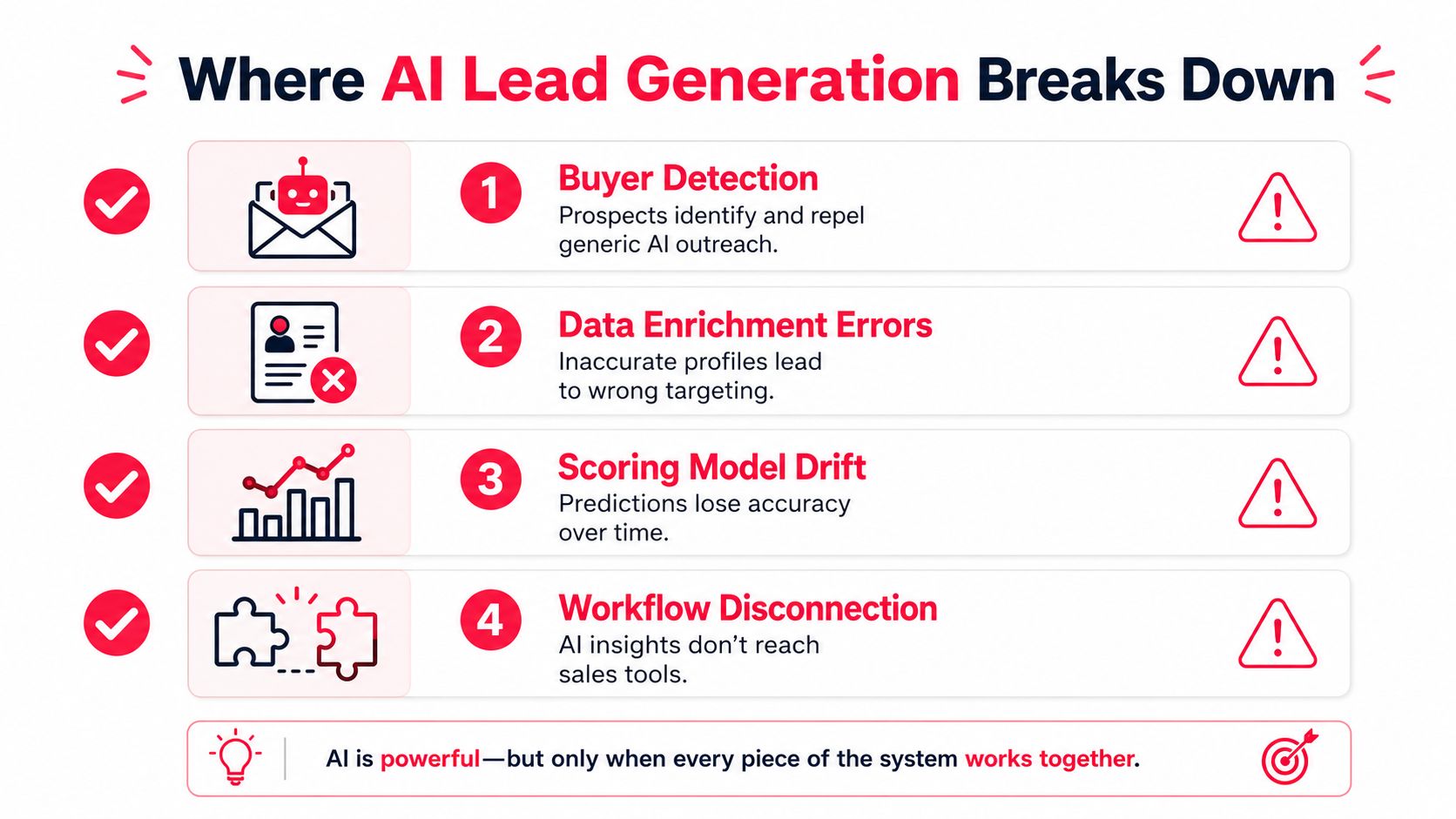
False-positive routing creates a second failure. The previously cited benchmark reports a 13% median MQL-to-SQL conversion rate and 28% at the top quartile. Those figures make qualification routing a governance problem, not just a scoring problem. Sending every high-scoring record to an SDR can fill the queue with contacts who appear active but lack authority, timing, or a relevant problem.
The failure modes we inspect first
- Bad identity resolution: Duplicate and stale records produce contradictory scores and send messages to people who no longer hold the role.
- Unverified firmographic claims: A model can convert an uncertain enrichment field into a confident sentence. That sentence damages credibility and contaminates CRM notes.
- Signal decay: Intent data loses value as events age or multiple vendors act on the same feed. A category surge does not prove an account is evaluating your product.
- Model drift: Buyer behaviour changes, win rates shift, and useful features weaken. Without monitoring, the score still looks precise while its routing value falls.
- Workflow disconnection: An insight trapped in a vendor dashboard is not operational intelligence. It must reach Salesforce, HubSpot, Outreach, or the manager's queue with its supporting context.
- Compliance exposure: Automated contact selection and outreach require review against consent, privacy, retention, and regional requirements. GDPR and state privacy rules make data provenance part of the workflow.
Governance test: If a rep cannot see why a lead was routed, challenge the score, and record the outcome, the automation is incomplete.
Tooling without those controls produces automated spam with better grammar. Teams also monitor reply rates while ignoring lead acceptance, opportunity creation, and rep time. That dashboard rewards conversation volume even when the conversations do not belong in the sales funnel.
Vendor Platform Versus In House Build
The build-versus-buy choice depends on what your company can maintain after launch. Qualified, 6sense, Clay, Apollo AI, and ZoomInfo Copilot can shorten deployment and provide integrations, enrichment operations, and vendor-maintained models. They also introduce recurring platform costs, usage limits, per-seat charges, data dependency, and switching friction.
An internal system gives your team more control over proprietary features, model behaviour, and warehouse architecture. It also makes your company responsible for data engineering, monitoring, retraining, security review, documentation, and every broken connector.
| Dimension | Vendor Platform | In House Build | Hybrid |
|---|---|---|---|
| Speed | Faster deployment through packaged workflows | Slower because data and workflows must be designed | Fast start with room for custom control |
| Cost | Recurring license and usage fees | Internal engineering and maintenance capacity | Vendor fees for commodity functions, internal spend for differentiation |
| Control | Limited by vendor configuration and roadmap | Full control over features, thresholds, and storage | Control over scoring and governance where it matters |
| Switching risk | Data and process dependence can be high | Internal knowledge can become concentrated | Easier replacement when interfaces and ownership are documented |
| Best fit | Standard prospecting, enrichment, and engagement needs | Proprietary data and unusual sales motions | Most growth-stage B2B companies |
Growth-stage companies should usually buy commodity data and execution, then build the governance layer around them. That means defining CRM field ownership, storing event history in a warehouse, versioning score logic, and keeping the option to replace a vendor without rebuilding the entire operating process.
Our build versus buy AI tools guide is useful when the decision involves more than a feature checklist. Stimulead can also support executive advisory, vendor evaluation, implementation oversight, and hands-on team training, but the right choice may be to delay purchase if your CRM outcomes are too incomplete to train or audit a model.
Sequencing the Implementation in 90 Days
A 90-day cycle is a realistic minimum for accumulating enough operating evidence to judge an AI lead workflow. It isn't a launch promise. The work should pass readiness gates before any model reaches an AE queue.
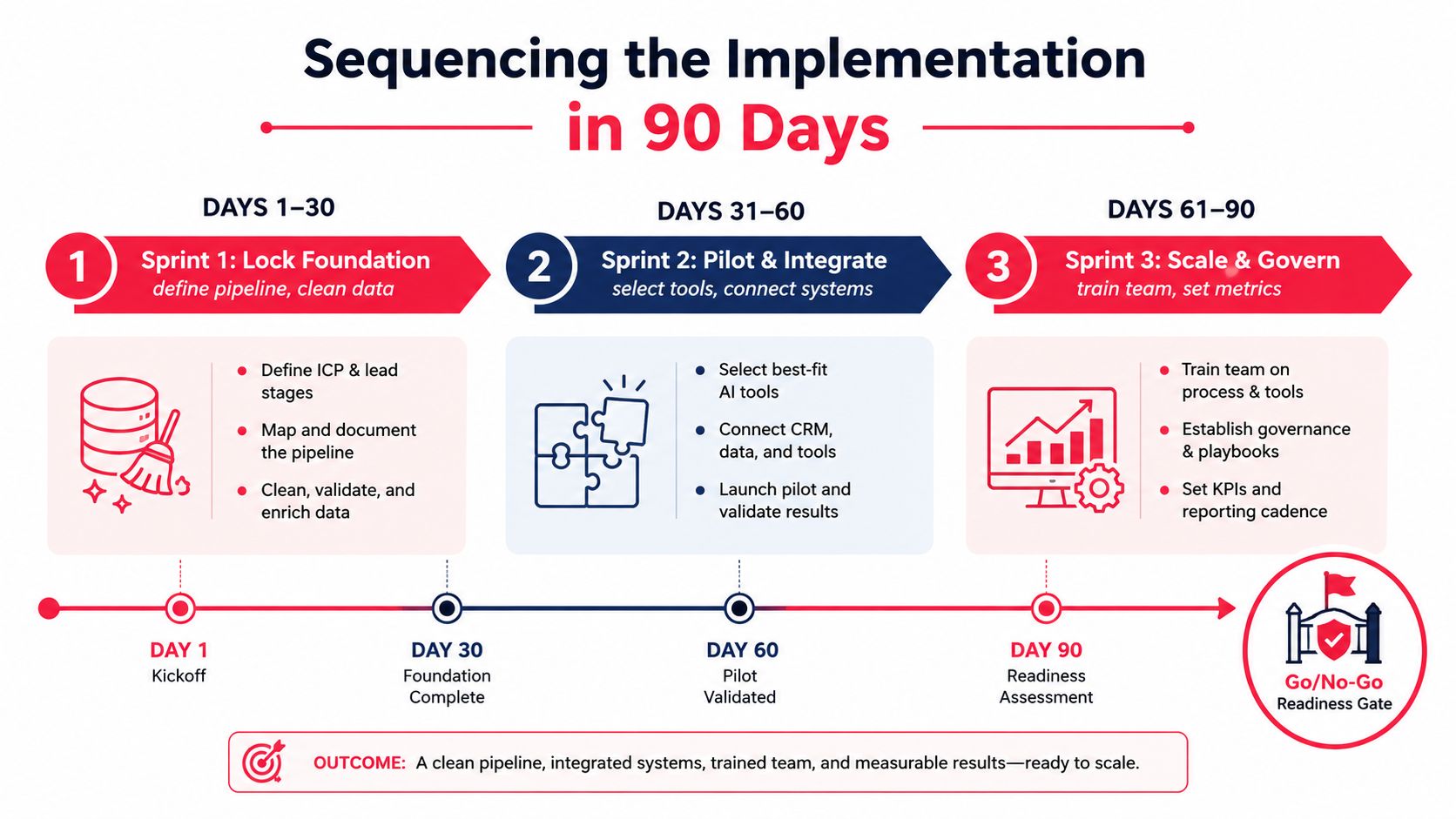
Days 1 to 30, lock the foundation. Define “qualified” with sales, document acceptance and rejection reasons, audit CRM and intent data, and choose one workflow. In most companies, that means inbound scoring or signal-based outbound, not simultaneous automation across every channel. Name the RevOps owner, GTM engineer, CRO, and at least one AE who will review outputs each week.
Days 31 to 60, run in shadow mode. Let the model score or recommend routes without changing the incumbent process. Compare its recommendations with current SDR decisions, inspect contradictory records, and tune thresholds before an AE receives anything. Record every override and the reason, because those decisions are training data for the next iteration.
Days 61 to 90, expand carefully. Add the second workflow only after the first has a clear owner and an accepted measurement method. Instrument one KPI the CRO owns end to end, set the retraining and data-refresh cadence, and establish a go/no-go review based on downstream pipeline quality rather than generated activity.
The governance layer should include a human review threshold, an escalation queue, prohibited claims, data provenance, and a rollback process. Stimulead's AI implementation roadmap provides a related structure for sequencing advisory and delivery work without treating a vendor demo as proof of readiness.
Operating rule: Keep the first workflow narrow enough that one AE can explain what happened to every routed lead.
The weekly meeting should have named owners, a fixed scorecard, and decisions recorded in the CRM or operating documentation. “Cross-functional alignment” isn't an owner. RevOps owns the data contract, the GTM engineer owns integration behaviour, the CRO owns the commercial threshold, and the AE supplies qualification evidence from real conversations.
Measuring Pipeline Lift and the Next Decision
Measure incrementality against the prior quarter's baseline, not raw SQL volume. AI can increase SQL creation while lowering the share that sales accepts, so the dashboard needs to connect qualification, progression, timing, and cost.
The minimum KPI set is deliberately small.
| KPI | Definition | Baseline Source | Review Cadence |
|---|---|---|---|
| MQL-to-SQL conversion | Accepted SQLs divided by MQLs, segmented by route | CRM stage history | Weekly operating review |
| SQL-to-opportunity rate | Opportunities divided by accepted SQLs | CRM opportunity history | Weekly and monthly |
| Pipeline velocity | Time in days from qualification to opportunity or another agreed stage | CRM timestamps | Monthly |
| Cost per qualified meeting | AI tools plus human review time divided by qualified meetings | Finance, vendor invoices, time estimates | Monthly |
A benchmark summary citing 6sense reports 23.4% average MQL-to-SQL conversion for AI-powered scoring, compared with 18.3% for rule-based systems, with top-quartile AI implementations at 31.7%. Review the 2025 AI B2B marketing automation benchmarks alongside your own cohort data, but don't treat a benchmark as a forecast. Your sales motion, market, data quality, and review burden determine whether the model earns expansion.
Reply rate and meetings booked can remain diagnostic metrics. They shouldn't be the CRO's main proof of lift because low-intent outreach can inflate both while opportunity creation falls.
At the next operating review, choose one decision: expand the second workflow, retire the first, or invest in governance. If the model produces more activity but the downstream rates stay weak, stop adding tools. Repair routing, evidence capture, and human qualification first.
Book a working session with Stimulead to audit your CRM signals, define the review thresholds, and select one AI lead workflow for a controlled 90-day implementation. Bring your current MQL-to-SQL and SQL-to-opportunity data, routing rules, and vendor list so we can identify the next decision without relying on a platform demo.