
83% of sales teams using AI experienced revenue growth in the past year, compared to 66% of teams without AI integration, according to a Salesforce study on AI sales forecasting. That's the number leadership teams should anchor on.
Most forecasting conversations still start in the wrong place. They start with model choice, dashboards, or vendor demos. In practice, the issue is simpler. Your current forecast probably reflects rep opinion, spreadsheet lag, and pipeline hygiene problems more than actual revenue probability.
For growth-stage companies, AI for sales forecasting matters because it changes operating decisions. Hiring plans. Paid spend. Inventory timing. Expansion targets. Board confidence. It gives leaders a forecast they can use, even when the data is messy, incomplete, or spread across CRM, support, product, and marketing systems.
Most guides assume you already have clean historical data. That's not how this works in the companies I see. The useful path starts with the data you have, not the data you wish you had.
Table of Contents
- Why Your Current Forecast Is Wrong and How AI Fixes It
- The Three AI Models That Power Modern Forecasting
- Data and Features Your AI Model Actually Needs
- A Practical Roadmap for AI Forecasting Implementation
- Real-World Examples in SaaS and E-commerce
- FAQ for Executive Leaders
Why Your Current Forecast Is Wrong and How AI Fixes It
Most bad forecasts fail in familiar ways. Reps hold onto deals that should have slipped. Managers add judgment calls late in the quarter. Finance rebuilds the number in a separate spreadsheet. By the time leadership reviews the forecast, it's already stale.
That creates a false sense of control. The CRM says one thing, the call notes say another, and the actual buying signals sit in places nobody modeled.
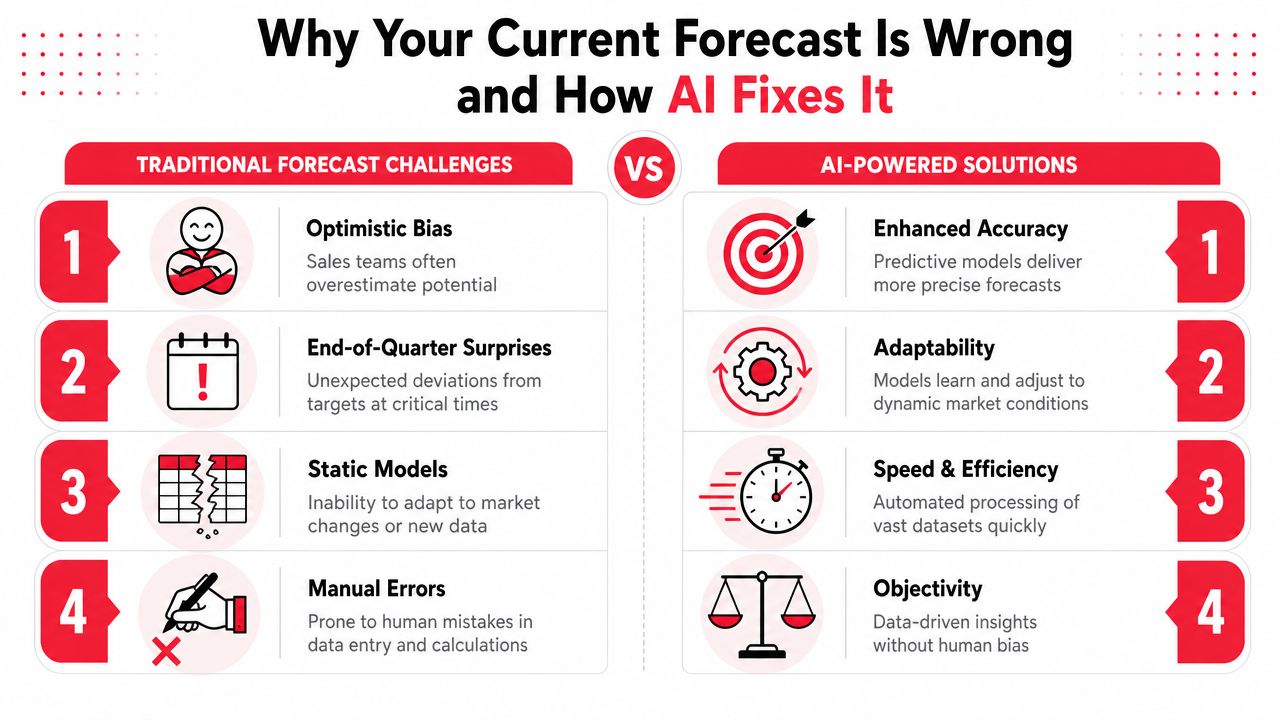
Where traditional forecasts break
Traditional weighted pipeline methods usually over-trust stage probability. They assume every Stage 3 deal behaves roughly the same. That isn't how live pipelines work.
A deal's real close probability changes with signals such as:
- Deal age: A deal that sits too long in one stage usually behaves differently from a fresh opportunity.
- Activity levels: Calls, meetings, and replies often say more than the stage field.
- Rep history: Some reps consistently forecast tighter than others.
- Customer engagement: Buying committees leave patterns in email response, meeting cadence, and stakeholder involvement.
AI-augmented sales forecasting improves forecast accuracy by 20–30% compared to traditional weighted pipeline methods through multivariable analysis of deal age, activity levels, rep history, and customer engagement signals, according to Forecastio's analysis of sales forecasting accuracy.
Practical rule: If your forecast depends on rep updates more than buyer behavior, you don't have a forecasting system. You have a reporting habit.
This matters beyond the number itself. A weak forecast causes hiring mistakes, slow budget decisions, and wasted marketing spend. A CMO can't pace demand gen properly if the pipeline view is inflated. A CRO can't inspect risk early if slippage only appears at quarter end.
Teams also run into a trust problem. Once leadership gets burned by enough late misses, everyone starts carrying shadow forecasts.
For teams working on scaling AI in marketing, forecasting directly connects to GTM execution. Better prediction changes campaign pacing, outbound sequencing, and where sales time goes each week.
What AI changes operationally
AI forecasting models work because they update as pipeline conditions change. They read patterns across CRM records, sales activity, and historical outcomes. They can correct for optimism and sandbagging because they care about observed behavior, not just declared confidence.
That changes the operating cadence.
| Forecast approach | What leadership gets | Common failure mode |
|---|---|---|
| Manual spreadsheet | A periodic snapshot | Lag, formula errors, stale assumptions |
| Weighted pipeline | A cleaner rollup by stage | False confidence from generic probabilities |
| AI forecasting | A live probability model tied to real activity | Bad input quality if process discipline is weak |
The biggest win isn't abstract accuracy. It's decision speed. Leaders can inspect risk sooner, move resources earlier, and stop treating quarter-end surprises as normal.
The Three AI Models That Power Modern Forecasting
When vendors say “AI forecasting,” they may be talking about very different systems. You don't need to become technical, but you do need to know what category you're buying.

Time-series models
A time-series model looks at your own historical pattern and projects forward. To illustrate, consider reviewing your previous race times to estimate your next one. If your business has stable seasonality and a repeatable sales cycle, this can work well.
It's usually the fastest place to start for companies with a simpler motion. Monthly recurring patterns, renewal-heavy books, and predictable seasonality fit here.
Time-series models are useful when the question is narrow. Revenue next month. Renewals this quarter. Demand by region.
Causal and machine learning models
Causal and machine learning models pull in more context. They look at what drives outcomes, not just what happened over time. If a pricing change, a market shift, or a campaign launch affects close rates, this category is more useful.
This is often the sweet spot for growth-stage teams because it reflects how actual pipelines work. Different channels create different deal quality. Different reps progress deals differently. Some segments respond to product usage signals. Others respond to speed-to-contact.
A good vendor should explain what features feed the model, how often it refreshes, and where human review still matters.
Good forecasting models don't replace sales judgment. They force judgment to compete with evidence.
Deep learning and LLM-assisted pipelines
Deep learning models go further. They can capture more complex patterns across larger and messier datasets. LLM-assisted pipelines add another layer by helping structure unstructured inputs such as call notes, emails, and transcripts.
This is useful when a large part of the signal sits outside neat CRM fields. Enterprise sales, multi-threaded deals, and support-heavy renewal motions often fit here.
The trade-off is complexity. These systems usually need more operational discipline, better oversight, and clearer ownership. For most companies, the right path isn't starting with the most advanced model. It's starting with the model that matches their process maturity.
If you're evaluating vendors and want a grounded shortlist of platforms and categories, this guide to best AI sales tools is a practical place to compare what's useful.
Data and Features Your AI Model Actually Needs
The most common excuse I hear is, “Our data isn't ready.” Usually that's true in the strict sense and irrelevant in the practical sense.
Messy data doesn't prevent AI for sales forecasting. It changes how you start.

Start with a minimum viable dataset
A 2026 study by Abedine Group found that businesses using AI in sales forecasting achieve 10% higher accuracy than traditional methods, while 68% of mid-sized firms struggle to deploy AI due to poor data quality, as summarized in this discussion of AI forecasting data challenges. The useful part of that finding isn't the barrier. It's that firms can still start with minimal or noisy data.
That matches what works in practice. You do not need perfect coverage across every tool. You need a stable base layer.
Start with what you already trust most:
- Core CRM fields: opportunity amount, stage, created date, expected close date, owner
- Stage movement history: when deals entered and left each stage
- Win and loss outcomes: even if the reasons are inconsistently tagged
- Basic activity data: meetings, emails, calls, last-touch recency
If that's all you have, you can still build a useful first model.
Field note: The first forecast model should answer one business question well. It should not try to explain your entire go-to-market system.
For leaders thinking about data discipline more broadly, this piece on foundational AI data quality is worth reading because it frames the issue correctly. Data quality is an operating standard, not a one-time cleanup project.
Good better best inputs
The fastest implementations use a phased input strategy.
| Data tier | Typical inputs | What it helps predict |
|---|---|---|
| Good | CRM fields, stage history, outcomes, rep owner | Basic close probability and timing |
| Better | Marketing source, product usage, support tickets, account activity | Segment-level forecast quality, renewal risk, upsell timing |
| Best | Call transcripts, email patterns, buyer committee signals, external market indicators | Deal risk detection, slippage patterns, richer timing estimates |
Newer methods can also help when internal data is thin. The same Abedine Group summary notes that firms can start with minimal or noisy data, and recent federated learning approaches create ways to train models without raw cross-company data sharing. For an early-stage SaaS or B2B team, that matters because it lowers the threshold to begin.
What to audit first
Don't run a giant data project. Audit the few inputs that most affect forecast usefulness.
Focus on these questions:
Do close dates mean anything?
If reps push dates without consequence, the model learns bad timing behavior.Are stages clearly defined?
If “proposal sent” means something different across teams, stage-based signals degrade quickly.Can you track slippage?
Deals that move out repeatedly often tell you more than the current forecast category.Which systems hold hidden signal?
For SaaS, product usage and support data matter. For e-commerce, campaign and merchandising data matter.What can you clean fast?
Start where your rev ops team can improve consistency in weeks.
The practical move is simple. Pick the top 3 to 5 fields that leadership already trusts, make them reliable, and build from there.
A Practical Roadmap for AI Forecasting Implementation
Most AI forecasting projects fail because teams start too wide. They try to fix CRM hygiene, rework pipeline stages, choose a vendor, train managers, and redesign reporting all at once.
Keep it tighter than that.

Audit phase
Start with a business problem, not a tool. “We miss quarterly commits” is a real problem. “We want AI” is not.
In the audit phase, map the current forecasting workflow end to end:
- Who updates the forecast
- Where data enters the process
- Which fields drive executive decisions
- Where manual overrides happen
- How actuals get compared to prior forecasts
SAP notes that AI sales forecasting systems autonomously incorporate real-time data from CRMs, market trends, and economic indicators, and that this automation reduces manual data entry and report generation, which lowers costs, in its overview of how AI redefines sales forecasting.
That's the target state. Before you get there, you need ownership. In most companies, the audit should include RevOps, sales leadership, finance, and one technical lead who can connect systems cleanly.
For teams weighing built-in software against bespoke workflows, this overview of Lynkro's custom AI offerings is useful because it frames when a custom layer makes sense versus when packaged tools are enough.
Pilot phase
Use a contained pilot. One team. One product line. One region. One motion.
A strong pilot has a narrow scope and a hard decision point. Either the model produces a better operating forecast than your current method, or it doesn't.
A pilot should include:
- A baseline: your current manual or weighted pipeline forecast
- A comparison period: enough time to compare predicted versus actual outcomes
- A review cadence: weekly inspection with sales and RevOps
- A trust layer: visibility into why the model flags a deal or segment as risky
Here's a useful way to think about it.
| Phase | Primary owner | Decision to move forward |
|---|---|---|
| Audit | RevOps with leadership input | Data is good enough for a pilot |
| Pilot | RevOps and sales leader | Model beats current process in usefulness |
| Scale | Executive sponsor and ops | Forecast becomes part of normal operating rhythm |
If you need a starting framework for the operational side, an AI readiness assessment helps leadership see where process, data, and team habits will slow rollout.
A short walkthrough can help teams visualize the implementation motion:
Scale phase
Scaling is mostly a governance problem. The model may already work. The harder part is making teams trust it enough to use it in planning.
That means:
- Defining override rules: when managers can challenge the model
- Setting refresh cadence: how often the forecast updates
- Tracking drift: when model behavior starts diverging from actual outcomes
- Standardizing inspection: using forecast risk in deal reviews, hiring plans, and spend pacing
The best rollout I've seen treated forecasting as an operating system change, not a software install.
Real-World Examples in SaaS and E-commerce
This gets clearer when you map it to actual revenue motions.
SaaS example
A B2B SaaS CRO usually has two forecasting problems at once. New logo bookings are noisy, and the installed base carries hidden renewal and expansion risk.
The useful AI model in this environment combines CRM opportunity history with account-level signals from product usage, support activity, and sales engagement. A renewal that looks healthy in the CRM may tell a different story if usage drops, support tickets rise, and executive sponsors stop showing up to calls.
The model doesn't need to replace the account team. It gives the CRO a sharper view of where to inspect. That changes forecast calls from anecdotal updates to risk-based review.
A practical workflow looks like this:
- CRM data sets the commercial context
- Product data shows adoption or decline
- Support data adds friction signals
- Engagement data shows whether the account is still active in the buying motion
That same setup also helps identify expansion timing. When usage grows and engagement rises, the forecast can surface upsell candidates earlier. AI forecasting, in this context, begins to overlap with GTM engineering and conversion work. The same systems that help route better outreach can also improve revenue prediction.
E-commerce example
An e-commerce CMO has a different problem. Campaigns, conversion, and inventory all affect one another, but they often sit in separate dashboards.
A better forecasting setup pulls campaign data, merchandising inputs, demand patterns, and operational constraints into one planning loop. If paid media starts driving stronger interest for a launch SKU, leadership needs more than channel performance. They need a revenue and stock view tied together.
AI-powered CRO and forecasting share a direct connection. If your team is increasing testing velocity on landing pages, offers, and checkout flows, the demand forecast needs to keep up with that pace. A static historical model won't.
The same applies to AI search optimization and agent commerce readiness. As buyer journeys shift into AI-mediated discovery, demand patterns may move faster than your old reporting cadence. Forecasting needs to ingest those signals sooner, especially when campaign intent and purchase readiness change before traditional attribution catches up.
The business impact is clear: 83% of sales teams using AI experienced revenue growth in the past year, compared to only 66% of teams without AI integration, according to Salesforce's AI sales forecasting overview. In SaaS and e-commerce alike, the pattern is the same. Teams that connect prediction to operating decisions move faster.
FAQ for Executive Leaders
Do we need a data science team
No. Most growth-stage companies don't need a full internal data science function to get value from AI for sales forecasting.
You need three things instead:
- An executive owner who cares about business adoption
- A RevOps lead who owns data definitions and workflow
- A technical or vendor partner who can implement and maintain the model
In-house teams make more sense when forecasting becomes a broader decision engine across pricing, marketing, customer success, and planning. Early on, vendor-led deployment or a hybrid model is usually enough.
How should we measure success
Forecast accuracy matters, but leadership should look past that.
Track whether the forecast improves decisions in places such as:
- Pipeline inspection quality: are risky deals identified earlier
- Sales cycle management: are teams reacting faster to slippage
- Win-rate focus: are reps spending more time on likely outcomes
- Budget timing: are finance and marketing pacing spend with more confidence
If the model produces a cleaner number but your operating rhythm doesn't change, the project hasn't done enough.
Boardroom answer: Success means leaders trust the forecast enough to make harder decisions earlier.
What accuracy is useful enough
Usefulness depends on what the forecast is for. A board-level revenue plan needs consistency. A weekly pipeline inspection needs fast directional signal. Don't force one model to serve every layer of the business in the same way.
What matters is whether the model beats your current method with enough reliability that leaders change behavior. In strong implementations, AI-powered sales forecasting tools have demonstrated accuracy rates as high as 98% by combining human input with predictive analytics, as described in this review of sales forecasting tools.
That doesn't mean you should expect that result on day one. It means the ceiling is high when process discipline, model design, and human review work together.
What's the ROI case to present internally
Keep the ROI argument grounded in business mechanics.
The return usually shows up in four places:
- Fewer bad planning decisions from inflated or stale forecasts
- Lower manual reporting load for RevOps and sales managers
- Earlier risk detection in deals, renewals, and segment demand
- Better alignment between sales, marketing, finance, and operations
That's the language executives and boards respond to. Less guesswork. Faster decisions. Cleaner planning.
What should we do next
Run a forecasting audit before you buy another tool. Pull one quarter of opportunities. Review stage movement, close date changes, activity patterns, and forecast overrides. Then choose one narrow pilot where the business impact is obvious.
If you want outside help, Stimulead can support that process through executive AI training for leadership teams, readiness assessment, or ongoing fractional CAIO support focused on revenue work across CRO with AI, GTM engineering, AI search optimization, and agent commerce readiness.
The next step is simple. Pick one forecast you already don't trust and rebuild it with the data you already have. That's where AI for sales forecasting starts paying for itself.