
A neutral market estimate puts the global voice of customer customer analytics market at US$1.696 billion in 2024, with a projection of US$4.6815 billion by 2030, equivalent to an 18.8% CAGR from 2025 to 2030 according to Market Research Future's customer experience analytics market estimate. The decision for a CEO, CMO, or CRO isn't whether to collect more feedback. It's whether your company can route useful customer signals to an owner quickly enough to change conversion, pipeline, retention, or service operations.
Our position at Stimulead is direct. Voice of customer analytics creates value only when it operates as a closed loop tied to business decisions, rather than as a dashboard that reports themes nobody owns. The practical workflow runs from source selection and normalization through analysis, prioritization, action, and measurement against outcomes.
Table of Contents
- Introduction
- What Voice of Customer Analytics Actually Is
- Where VoC Signals Come From and How to Combine Them
- How Text and Speech Analytics Turn Language Into Decisions
- From Insight to Action for CRO Personalization and GTM
- Measuring Impact and Choosing the Right VoC Platform
- What Does Not Work and Your Next Move
Introduction
Growth-stage B2B companies usually have plenty of customer input. It sits across NPS surveys, CRM notes, support tickets, call transcripts, sales calls, product analytics, reviews, and customer success records. The problem is that these signals rarely arrive in one decision system, and even when they do, the people who can act on them often receive summaries without a deadline, a hypothesis, or a measurable outcome.
That creates an expensive form of activity. A team can spend on Medallia, Qualtrics, Sprinklr, a text analytics engine, or a custom data pipeline and still produce little operational change. Collection is visible. Analysis is presentable. Action remains weakly assigned.
We've implemented customer intelligence workflows for B2B teams where the useful question wasn't “What are customers saying?” It was “Which recurring objection should change this landing page, sales sequence, onboarding flow, or product priority, and how will we know the change worked?”
The distinction matters because customer feedback metrics don't predict business outcomes equally. A large study covering 93 firms across 18 industries, 6,649 respondents, and 8,924 firm evaluations found that top-2-box satisfaction and Net Promoter Score were the strongest retention signals, while Customer Effort Score was the weakest and wasn't a significant retention predictor in most settings, as reported in the Journal of Retailing study. That doesn't make CES useless. It means your retention model shouldn't treat every score as interchangeable.
This article argues for a specific operating model. Capture solicited and unsolicited signals, normalize language into usable themes, connect those themes to account and pipeline data, assign owners with service-level agreements, and measure whether an intervention changed the relevant metric. Dashboards can support that workflow. They can't replace it.
What Voice of Customer Analytics Actually Is
The phrase “voice of customer” was coined in a 1993 MIT paper by Abbie Griffin and John Hauser, originally in the context of product development, according to Talkalytics' history of voice feedback. The early practice depended on structured interviews and surveys. Survey-first software such as Qualtrics and Medallia shaped the 2000s, while text analytics in the 2010s made it practical to examine reviews, tickets, social posts, and call transcripts at greater scale.
That history explains the modern distinction. Traditional market research often starts with a designed research question and a controlled sample. Survey reporting usually produces response rates, scores, and verbatim comments. Voice of customer analytics adds an always-available analysis layer across customer language, behavior, account context, and operational outcomes.
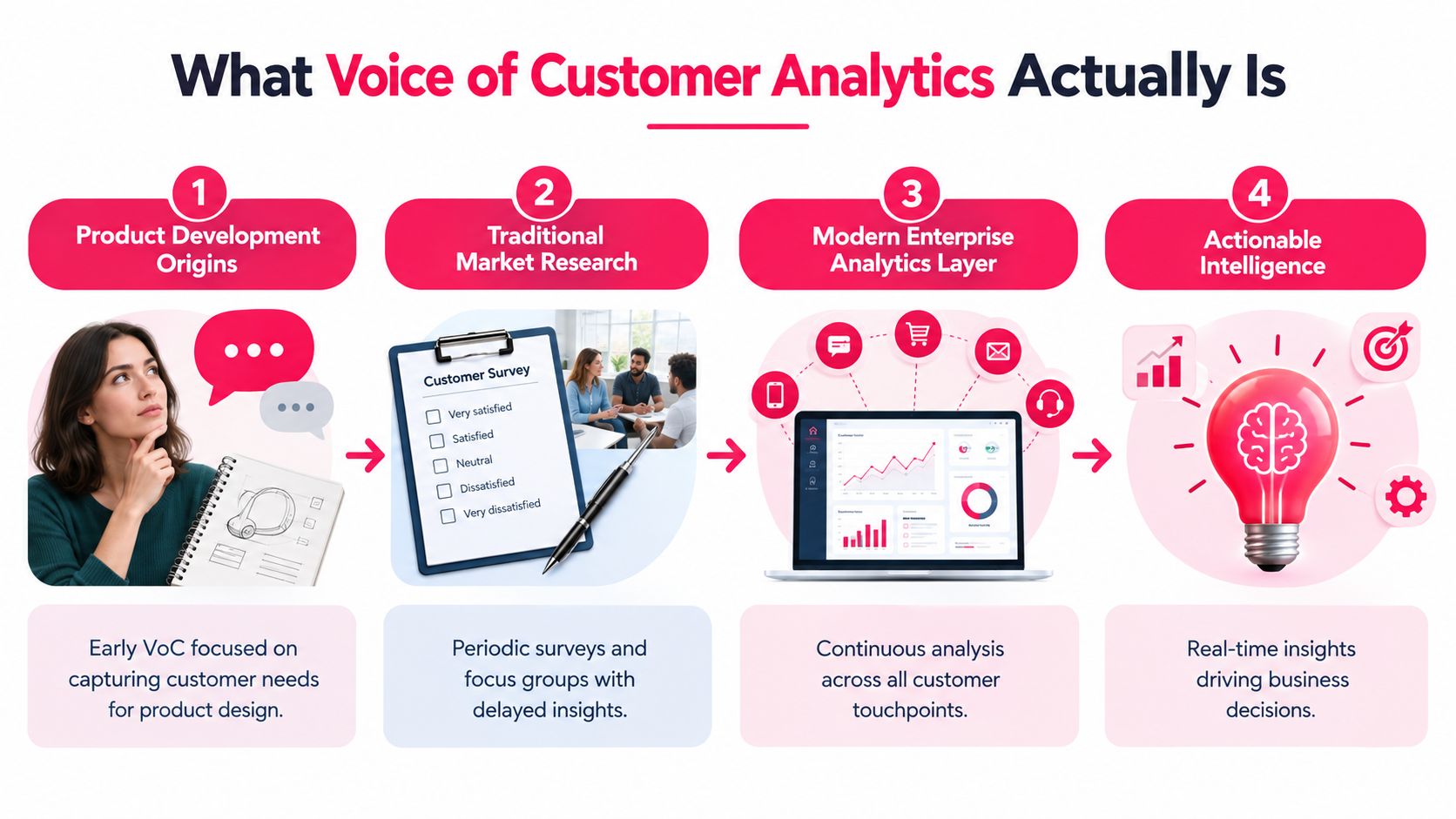
Think of the system as signal processing. Raw language contains useful patterns, but the signal is mixed with duplicated tickets, inconsistent labels, partial transcripts, emotional wording, industry terminology, and uneven participation. Sampling determines who gets heard. Normalization makes language comparable. Theme extraction groups recurring subjects. Account and outcome joins tell you whether a theme matters commercially.
What belongs in the VoC layer
A useful scope includes:
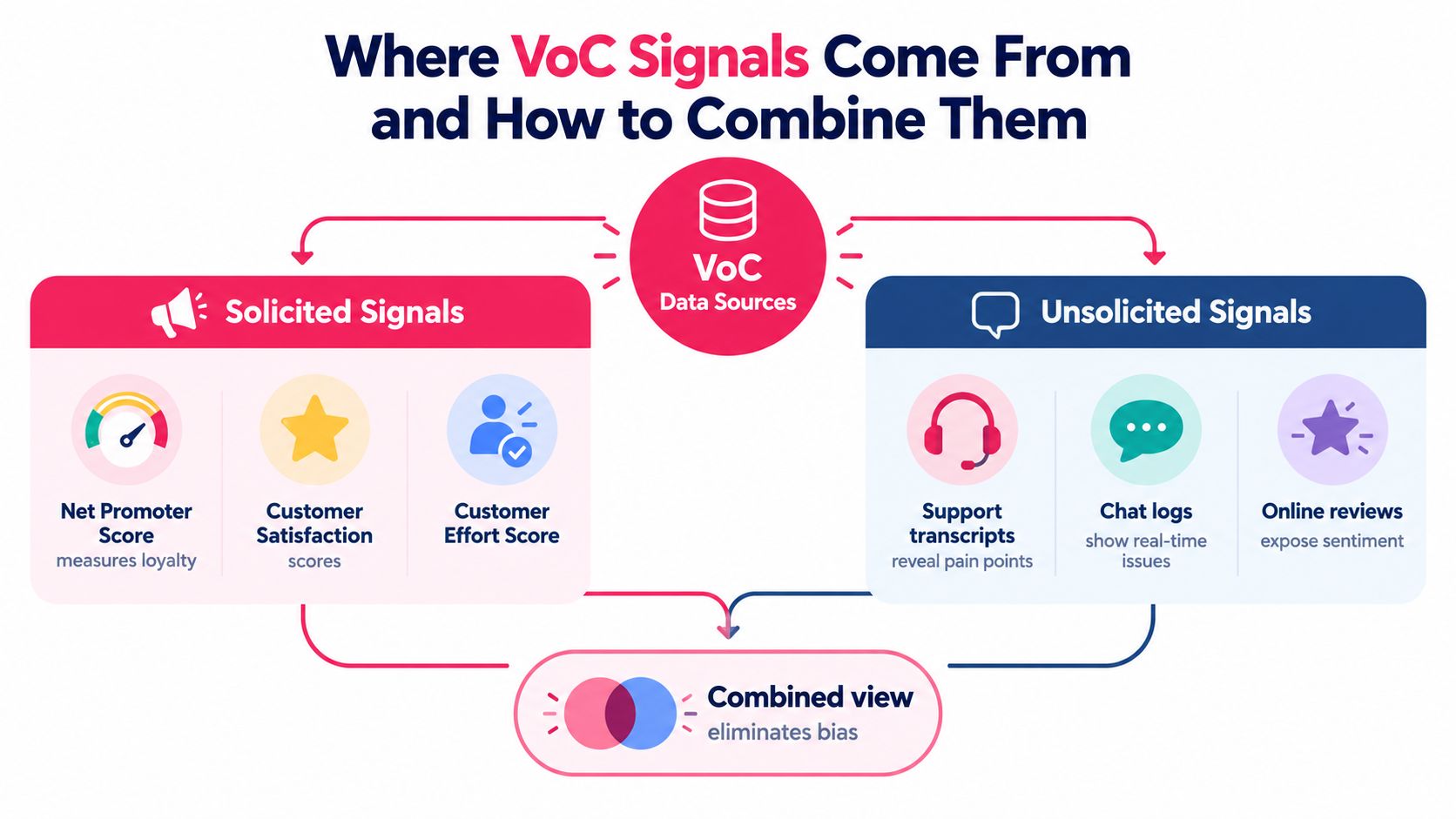
- Solicited feedback, such as NPS, CSAT, CES, open-ended survey comments, win-loss interviews, and renewal interviews.
- Unsolicited feedback, such as support transcripts, chat logs, reviews, social posts, community discussions, sales call notes, and cancellation reasons.
- Contextual business data, including account segment, product usage, opportunity stage, renewal status, expansion activity, support volume, and resolution timing.
- Action records, which show whether a team changed messaging, product experience, onboarding, service process, or account treatment.
Website behavior alone isn't VoC. A session replay can show that a buyer abandoned a form. It can't reliably explain whether the cause was pricing uncertainty, missing proof, poor fit, procurement friction, or a technical failure. Customer language supplies the reason, while behavioral and revenue data help test its importance.
The customer experience analytics category was estimated at US$12.6 billion in 2024 and projected to reach US$55.99 billion by 2035, with a 14.52% CAGR, according to the same Talkalytics source. The category's scale reflects a shift toward an enterprise analytics layer, where customer language must connect to decisions across marketing, sales, product, customer success, and support.
Practical rule: A theme without an owner is an observation. A theme connected to an account, a decision, and a measurement plan is operational intelligence.
Where VoC Signals Come From and How to Combine Them
A survey-only program gives you clean scores and a narrow view. A support-only program gives you rich complaints and a biased view toward customers who crossed the effort threshold required to contact your team. The right design combines solicited signals, where you ask for feedback, with unsolicited signals, where customers describe problems in the normal course of doing business.
Use each source for the decision it can support
| Signal family | Useful inputs | Strongest use | Main limitation |
|---|---|---|---|
| Solicited | NPS, CSAT, CES, open-text surveys | Tracking a defined experience or relationship over time | Response bias and limited context |
| Unsolicited | Support transcripts, chat logs, reviews, social posts, communities | Finding emerging friction and customer language | Uneven coverage and variable data quality |
| Behavioral | Product usage, funnel activity, session replays | Locating where behavior changes | Usually weak on customer intent |
| Commercial | CRM notes, opportunity stages, renewal and expansion records | Testing business impact by segment | Notes can be inconsistent or incomplete |
For B2B teams, NPS is commonly tracked at the account level over time. A benchmark source identifies six core VoC benchmarks, NPS, CSAT, CES, response rate, coverage, and closing-the-loop rate, in this B2B VoC benchmark guide. We'd treat those as a measurement set, not a reason to put six numbers on every executive dashboard.
Sequence collection before adding more sources
Start with an inventory of data you already own. Export a representative set of survey responses, support conversations, sales notes, win-loss records, and cancellation reasons. Check whether each record has a stable customer or account identifier, a timestamp, a source, and enough context to interpret the language.
Then choose the next source based on the decision gap:
- If conversion friction is unclear, combine lost-opportunity notes, sales calls, chat, and form abandonment.
- If renewal risk is unclear, combine account-level satisfaction, support themes, product usage, and renewal outcomes.
- If onboarding is weak, combine implementation calls, support tickets, time-to-resolution, and early product behavior.
- If survey coverage is sparse, test transcript analysis or targeted AI-conducted interviews before increasing survey frequency.
A 2026 synthesis reports that 67% of B2B SaaS VoC leaders piloted voice AI for customer feedback in 2026, up from 11% in 2024, according to Perspective's voice-first VoC report. Treat that as a directional market signal, not proof that voice AI belongs in your stack. AI interviews can expose language that passive surveys miss, while 100% interaction analysis can provide broader coverage with less respondent effort. Both introduce trade-offs around consent, privacy, latency, sampling, and interpretation.
For a wider treatment of how customer signals become operating decisions, driving insights through data analytics is a useful companion resource. B2B operators can also connect this work to signal-based selling when customer language reveals buying intent or account risk.
How Text and Speech Analytics Turn Language Into Decisions
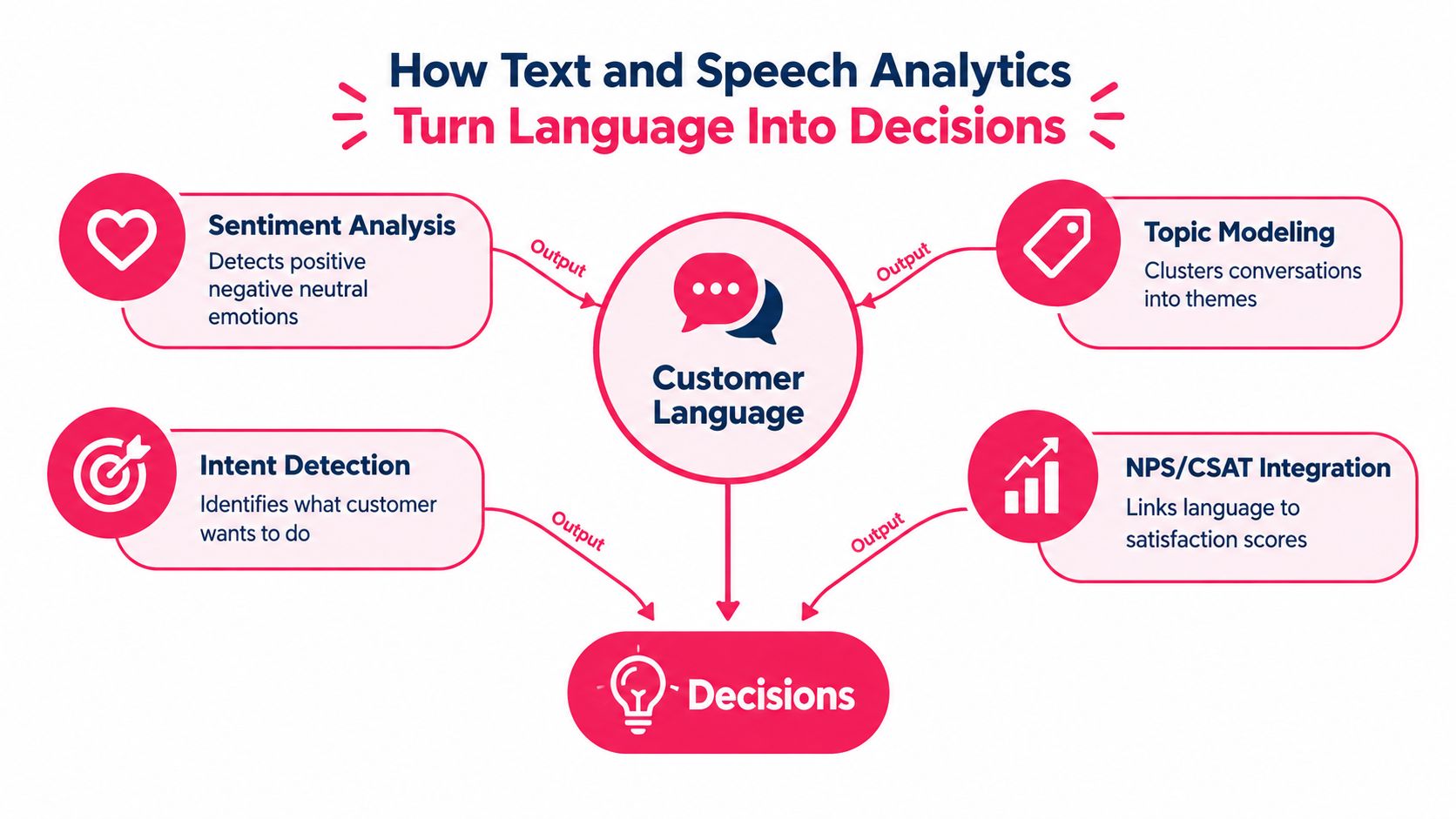
Text and speech analytics are useful because they convert unstructured language into fields that other systems can query. They don't eliminate judgment. They make judgment faster and more consistent by turning repeated patterns into analyzable records.
Start with outputs, not model labels
| Technique | Output | Useful decision | Common failure |
|---|---|---|---|
| Sentiment analysis | Positive, negative, neutral, or graded emotional polarity | Detecting deterioration or comparing themes by tone | Sarcasm, industry language, and mixed sentiment confuse models |
| Topic modeling | Clusters of recurring subjects | Finding themes that deserve investigation | Frequent themes aren't always important themes |
| Intent detection | A predicted customer objective or concern | Routing requests, objections, and buying signals | A single statement can contain several intents |
| Entity extraction | Products, features, teams, competitors, and locations | Identifying what or who the feedback concerns | Naming an entity doesn't prove causality |
| Score integration | Language joined to NPS, CSAT, CES, or outcomes | Testing which themes correlate with retention or conversion | Correlation can be mistaken for an intervention effect |
Sentiment works best as a monitoring layer. Topic modeling helps organize a large corpus. Intent detection can route conversations to sales, success, support, or marketing. None of these outputs should automatically dictate a roadmap or campaign without segment context and a business outcome.
The stronger operational pattern combines sentiment extraction with statistical process control. A research-based complaint-monitoring method found that sentiment analysis can quantify satisfaction and dissatisfaction from review text, while SPC charts detect abnormal complaint shifts early enough to trigger service recovery. The method is described in this ScienceDirect study on sentiment analysis and statistical process control.
Weight metrics according to the decision
For retention analysis, begin with satisfaction and loyalty signals because the large multi-industry study cited earlier found stronger predictive value there. Then validate the relationship by segment, product, industry, customer maturity, and contract type. A metric can be useful for diagnosing effort in a workflow without predicting renewal behavior.
The same discipline applies to CRO. If a prospect says the product is difficult to evaluate, classify the language by buying stage and compare it with demo conversion, opportunity progression, and closed-lost reasons. If an existing customer praises implementation but criticizes reporting, don't turn that into a general brand message. Route it to the product or onboarding owner, then test whether the relevant segment changes behavior after the intervention.
The following video provides a visual explanation of how these techniques can fit into an analytics workflow.
A useful model taxonomy is deliberately modest. Use deterministic rules for known phrases, supervised classification where labels are stable, and large language models where the task requires contextual interpretation or flexible summarization. Store the raw text, the model output, confidence, taxonomy version, and human corrections. Without that audit trail, your categories drift and you can't explain why a trend changed.
From Insight to Action for CRO Personalization and GTM
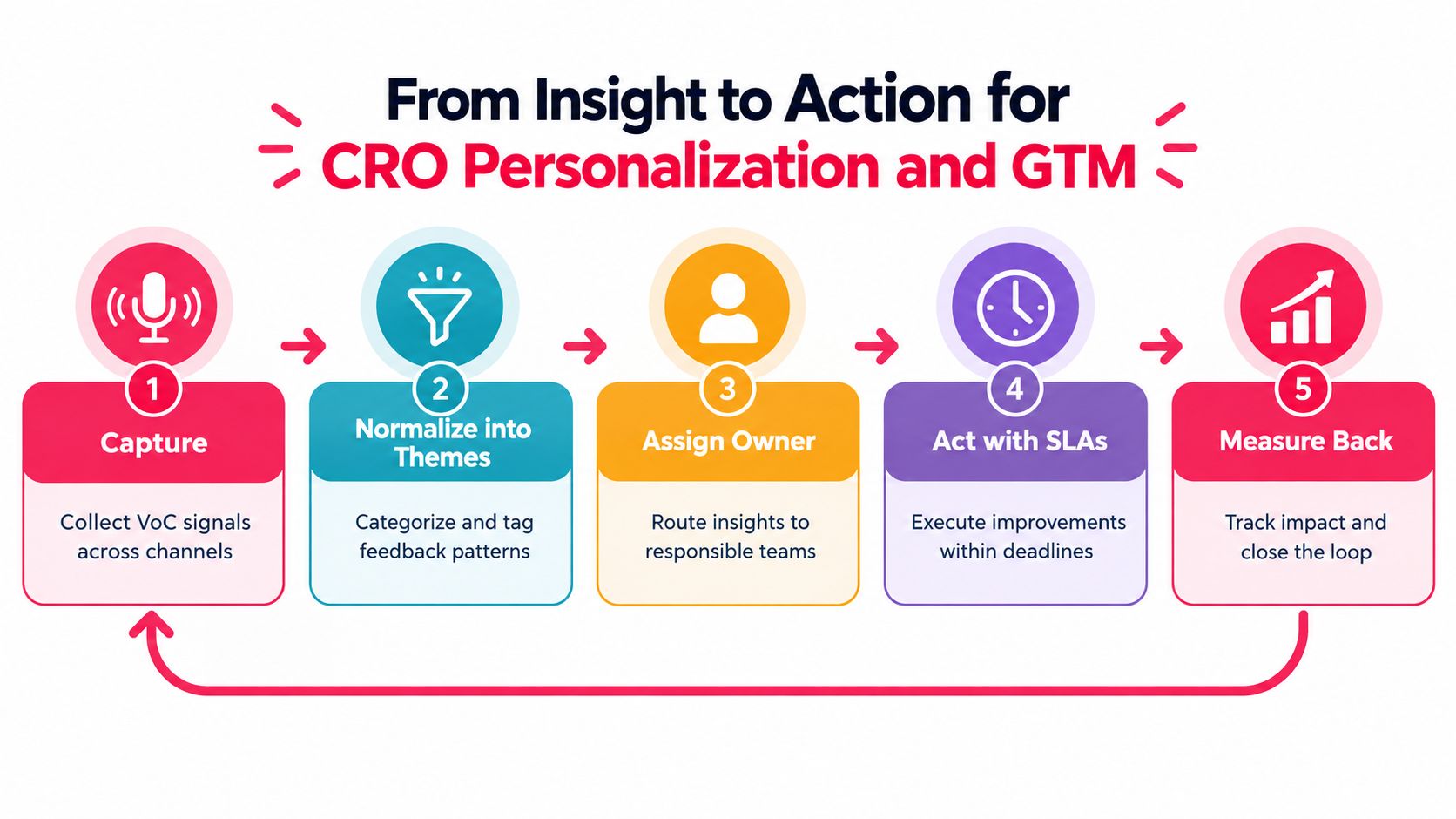
The handoff is where most VoC systems lose their value. We use a closed-loop workflow that makes every meaningful theme answer four questions: who owns it, what action will they take, by when, and which outcome will change if the action works?
Build the loop in five operating steps
- Capture the signal. Ingest surveys, transcripts, reviews, CRM notes, and product context. Preserve the account identifier and source.
- Normalize into themes. Clean duplicate records, standardize terminology, separate product issues from service issues, and tag the customer segment.
- Assign an owner. Route a conversion theme to the CRO or marketing owner, a qualification issue to sales, an onboarding issue to customer success, and a recurring defect to product.
- Act with an SLA. Set a response expectation appropriate to the issue. An urgent service failure and a copy improvement shouldn't sit in the same queue.
- Measure back. Compare the relevant outcome before and after the intervention, then record whether the loop closed.
The closed-loop VoC operating model describes the same core sequence, capture, normalization, ownership, action, and measurement against business outcomes such as churn, expansion, and resolution timing.
Turn themes into testable GTM work
A friction theme should become a hypothesis, not a vague request for “better messaging.”
- CRO: If prospects repeatedly say they can't distinguish implementation effort from competing options, test a clearer implementation section, proof structure, or qualification path on the relevant page.
- Personalization: If intent clusters separate security-led buyers from efficiency-led buyers, route them to different proof points, case material, and sales enablement rather than changing the whole site.
- GTM: If lost opportunities repeatedly mention a missing integration, compare that theme against segment, deal stage, competitor, and contract size before changing positioning.
- AEO: If customer and prospect language reveals that answer engines describe your category inaccurately, create direct comparison, definition, implementation, and objection content using the language buyers use.
- Customer success: If a recurring onboarding theme appears in accounts with later renewal risk, assign it to the onboarding owner and track resolution timing alongside renewal outcomes.
For personalization, keep rules explicit. A model can recommend that an account belongs to a “security evaluation” cluster, but the activation system should retain the evidence, confidence, eligibility condition, and expiry rule. That prevents an old support complaint from permanently changing a buyer's experience.
Our related work on AI website personalization covers the activation side. The important operating constraint is governance. Marketing shouldn't publish a message based on a small, unverified theme. Sales shouldn't treat an inferred intent label as buying consent. Product shouldn't prioritize a loud complaint without checking account value, frequency, severity, and strategic fit.
The action record should live beside the insight record. Store the hypothesis, owner, SLA, launch date, audience, expected outcome, observed result, and decision to continue, revise, or stop.
Measuring Impact and Choosing the Right VoC Platform
Collection metrics tell you whether the system is listening. Action metrics tell you whether the business is responding. The latter deserve executive attention.
Useful action metrics include loop-close rate, time-to-close, theme-resolution rate, follow-up coverage, and churn delta, as identified in Perspective's guidance on closing the VoC loop. Pair them with the business metric that matches the intervention. A landing-page change needs conversion or pipeline measures. A service fix needs resolution timing, repeat contact, or retention measures. An onboarding change needs activation, expansion, or renewal measures.
Compare platforms by operating fit
| Evaluation Criteria | What Good Looks Like | Red Flag |
|---|---|---|
| Theme clustering | Configurable taxonomy, human review, version history | Generic themes that can't reflect your product language |
| Generative AI summaries | Evidence-linked summaries with source records | Polished summaries without traceable comments |
| Driver analysis | Segmentation by account, product, stage, and outcome | A single company-wide score |
| Operational data fusion | CRM, support, product, and revenue joins | Feedback isolated in the survey application |
| Next-step recommendations | Suggested actions with owner and workflow routing | Recommendations that end in a dashboard |
| Governance | Consent controls, permissions, audit trail, retention policies | Unclear data handling for recorded conversations |
| Measurement | Experiment links and outcome tracking | No way to compare intervention with baseline or control |
Build versus buy depends on the constraint. A custom stack can fit your data model and keep control over taxonomy, but it requires engineering, maintenance, evaluation, and ownership. A platform can shorten deployment and provide survey, text analytics, workflow, and reporting in one product, but you may accept weaker joins, limited experimentation, or vendor-specific data structures.
For many B2B teams, the practical answer is hybrid. Keep source systems where they work well, centralize identifiers and outcome data in your warehouse or CRM, and choose a VoC layer that can expose raw feedback and model outputs. Tools such as Qualtrics, Medallia, Sprinklr, Forsta, Chattermill, Thematic, and support-native products serve different starting points. Stimulead can sit in the advisory and implementation layer, helping teams define the operating model, evaluate vendors, and connect customer signals to CRO, GTM, and AI search work.
To prove causal impact, document the intervention before launch. Define the affected segment, the target behavior, the comparison group or baseline, the expected time window, and the decision rule. Don't claim that a positive sentiment shift caused lower churn because both appeared in the same reporting period.
Teams that need a broader measurement framework can use this guide to measuring marketing effectiveness when connecting VoC actions to acquisition and pipeline metrics.
What Does Not Work and Your Next Move
Passive listening fails because nobody is required to respond. A monthly theme report can be accurate and still produce no change if the report doesn't contain a named owner, a due date, and an outcome measure.
Treating every signal with equal urgency creates a different failure. A high-volume complaint may affect a small, low-value segment, while a less frequent objection may block strategic accounts. Prioritization needs severity, frequency, account context, journey stage, and expected business impact.
Adding more sources can also reduce performance. If your routing rules are unclear, more transcripts, reviews, and AI interviews create more queues for the same team. Privacy and consent requirements add another constraint, especially for recorded calls and AI-conducted interviews. Expand collection only when you can explain what decision the new source will improve.
Dashboards without action logic are the most common dead end. Theme extraction gives teams a map of the conversation. It doesn't tell them which page to test, which account to contact, which product issue to fix, or whether the change produced a commercial result.
The test we use: Name one change your company made recently because of something a customer said. If you can't name the owner and outcome, the program is still listening rather than operating.
Audit your current VoC loop now. Measure loop-close rate and time-to-close, choose one recurring theme with a clear CRO, GTM, service, or retention implication, assign a responsible executive owner, and set an SLA for the first action. That decision will tell you more about the readiness of your VoC system than another platform demo.