
A benchmark summary reports 15% to 25% reply rates for signal-based personalization, compared with 3% to 5% for average cold email, when AI identifies a relevant trigger, enriches the account, and drafts the message. Haus Advisors reports that benchmark, but the number alone shouldn't decide your AI investment. The decision is whether better targeting improves cost per qualified meeting, MQL-to-SQL conversion, pipeline velocity, and sales-cycle economics.
At Stimulead, we advise growth-stage B2B teams to start with data readiness and scoring math, then automate only the workflow the evidence can support. AI can expand qualified opportunity volume, improve routing, and reduce manual research. It can also produce faster junk when the CRM is inconsistent, the signals are weak, or nobody reviews the claims before outreach.
Table of Contents
- Why AI Lead Generation Is Now a Pipeline Math Problem
- Adoption Is Not the Differentiator Anymore
- The Data and Governance Work Before Any Tool Goes Live
- Where AI Moves the Funnel
- Prospecting and Personalization Workflows That Produce Pipeline
- Where AI Lead Generation Fails
- Roadmap, KPIs, and the Next Decision to Make
Why AI Lead Generation Is Now a Pipeline Math Problem
AI lead generation is no longer a tooling question. It's a pipeline economics question, and the decision rests on whether automation creates qualified meetings at a cost and conversion rate your sales team can support.
One industry roundup associates marketing automation with 451% more qualified leads and AI-powered nurturing with 50% more sales-ready leads at 33% lower cost per lead. Those figures come from Warmly's lead generation statistics roundup, and they point to the right place to look: scoring, routing, and follow-up, not prospect discovery alone.
The first number your team needs is the baseline cost per qualified meeting. The second is the conversion rate from MQL to SQL. The third is the time from qualified meeting to opportunity. If AI lowers research cost while sales accepts fewer meetings, the system may improve productivity without improving pipeline. If lead volume rises while MQL-to-SQL conversion falls, marketing has created a reporting win and a revenue problem.
The numbers that decide deployment
A useful comparison looks like this:
| Metric | Human-Led Outbound | AI-Assisted Outbound |
|---|---|---|
| Research effort | Manual account and contact research | Automated signal collection with human validation |
| Message production | Rep-written or template-based | AI draft, human approval |
| Qualification cost | Measured through rep hours and meeting cost | Measured through tool cost, review time, and qualified meetings |
| Main risk | Slow execution and inconsistent follow-up | Bad data, generic claims, and false-positive scoring |
| Primary success metric | Qualified meetings and opportunity conversion | Qualified meetings, opportunity conversion, and cost per meeting |
AI-assisted programs have been associated with a reduction in cost per meeting from $312 to $94, a 70% reduction, when AI outreach is paired with human qualification calls, according to AdAI's 2026 statistics summary. Treat that as a benchmark, not a forecast. Your break-even point depends on tooling cost, review time, sales capacity, and downstream conversion.
Practical rule: Never approve an AI lead-generation project without naming the baseline metric it must improve.
Use our guide to measuring marketing effectiveness to connect campaign activity to qualified pipeline rather than stopping at sends, clicks, or MQL volume. Every recommendation in this article should be judged against that same standard.
Adoption Is Not the Differentiator Anymore
AI adoption won't differentiate your company by itself. Reports summarized by Genesis place current marketing AI adoption between 67% and 72%, with adoption at 83% in enterprise organizations and 71% in mid-market firms. One benchmark in the same source describes usage rising from 31% in 2023 to 72% in 2026.
That saturation changes the buyer's inbox. Many prospects now receive AI-written cold emails, AI-researched trigger references, and automated LinkedIn sequences that sound interchangeable. A new AI platform won't solve that problem if your team feeds it the same weak list and the same generic value proposition.
Execution is where the gap appears
The differentiator has moved to four operating decisions:
- Signal selection: Your team chooses whether funding, hiring, product launches, pricing-page activity, or first-party product behavior indicates a buying window.
- Message-market fit: The draft connects the trigger to a specific business problem instead of inserting a company fact into a template.
- Deliverability hygiene: RevOps protects the sender reputation and removes low-confidence contacts before the sequence runs.
- Human credibility: An experienced seller checks whether the message understands the account's context, buying committee, and likely objections.
Teams that add AI as a productivity layer often see more activity without a meaningful change in qualified pipeline. Teams that rebuild scoring, routing, and message review around trustworthy signals have a better chance of improving conversion.
The important distinction is operational. AI can find patterns and generate variants quickly, but your revenue team still owns the definition of a qualified account, the proof required for a claim, and the point at which a prospect deserves a human conversation.
The Data and Governance Work Before Any Tool Goes Live
Data readiness is the gating variable. A 2026 G2 report identifies it as the single biggest constraint on AI prospecting, because poor data limits accuracy, trust, and scale. G2's analysis of AI sales intelligence in prospecting also places the strongest AI value in account prioritization, sequencing, and timing rather than raw enrichment alone.
Before your team gives an SDR agent access to the CRM, complete these workstreams:
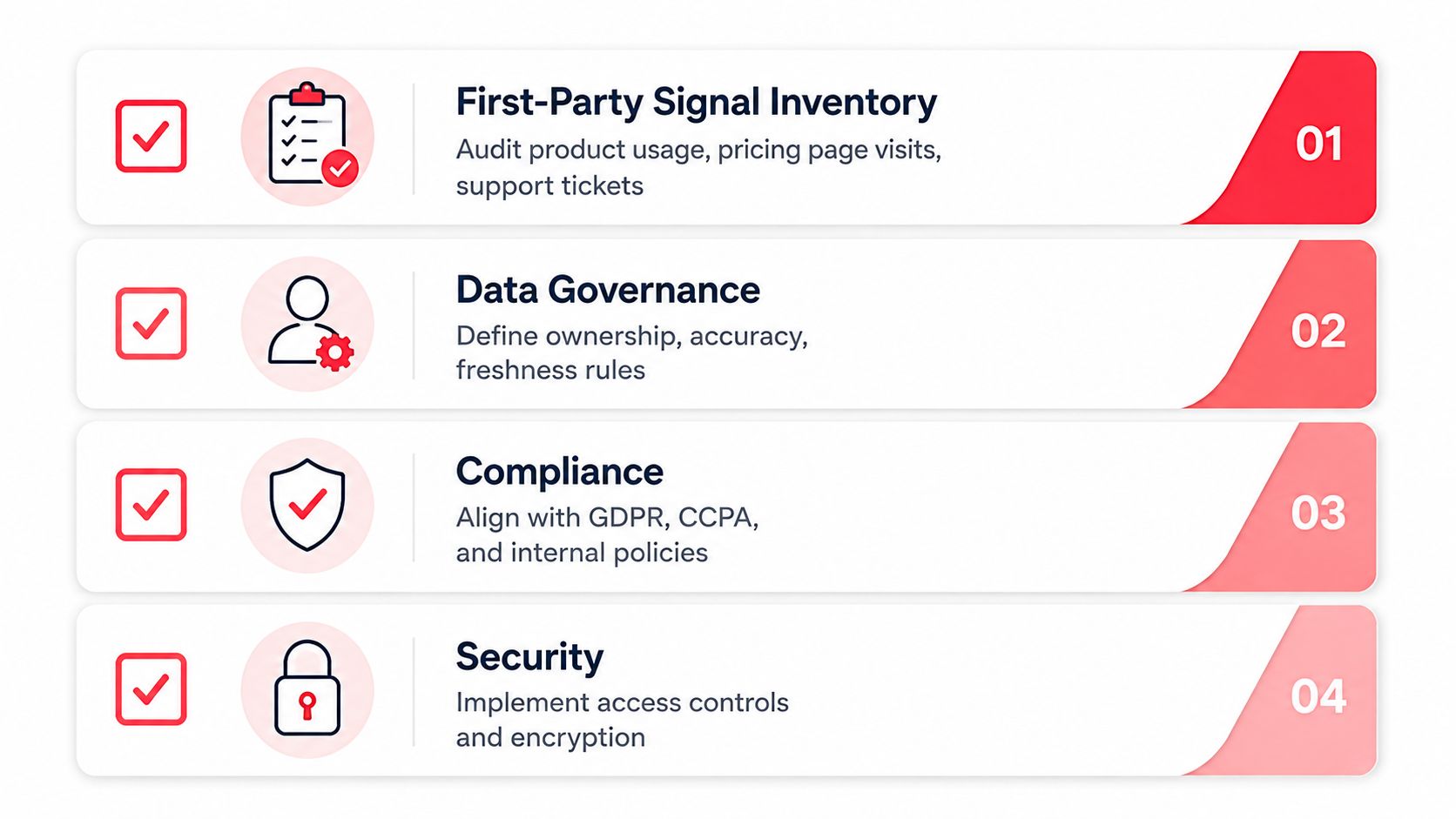
- Inventory first-party signals. Document product usage, pricing-page revisits, support-ticket themes, event attendance, and intent-survey responses. First-party intent signals now account for 54% of high-performing lead-scoring model weight, compared with 31% in 2022, according to G2's summary. Treat those events as more reliable than unverified third-party activity.
- Set enrichment standards. Define which firmographic, technographic, and contact fields are required, which vendors are approved, and what confidence threshold blocks an automated message.
- Clean CRM records. Deduplicate contacts, standardize company names, and preserve source history. Duplicate records can make one account appear more engaged than it is, which distorts both scoring and attribution.
- Protect deliverability. Validate contacts, monitor bounce and complaint signals, and test new sending domains before a sequence reaches a broad audience. Outbound AI-generated cold email volume fell 6% year over year in H1 2025 as deliverability constraints tightened the economics of scale, according to G2's report.
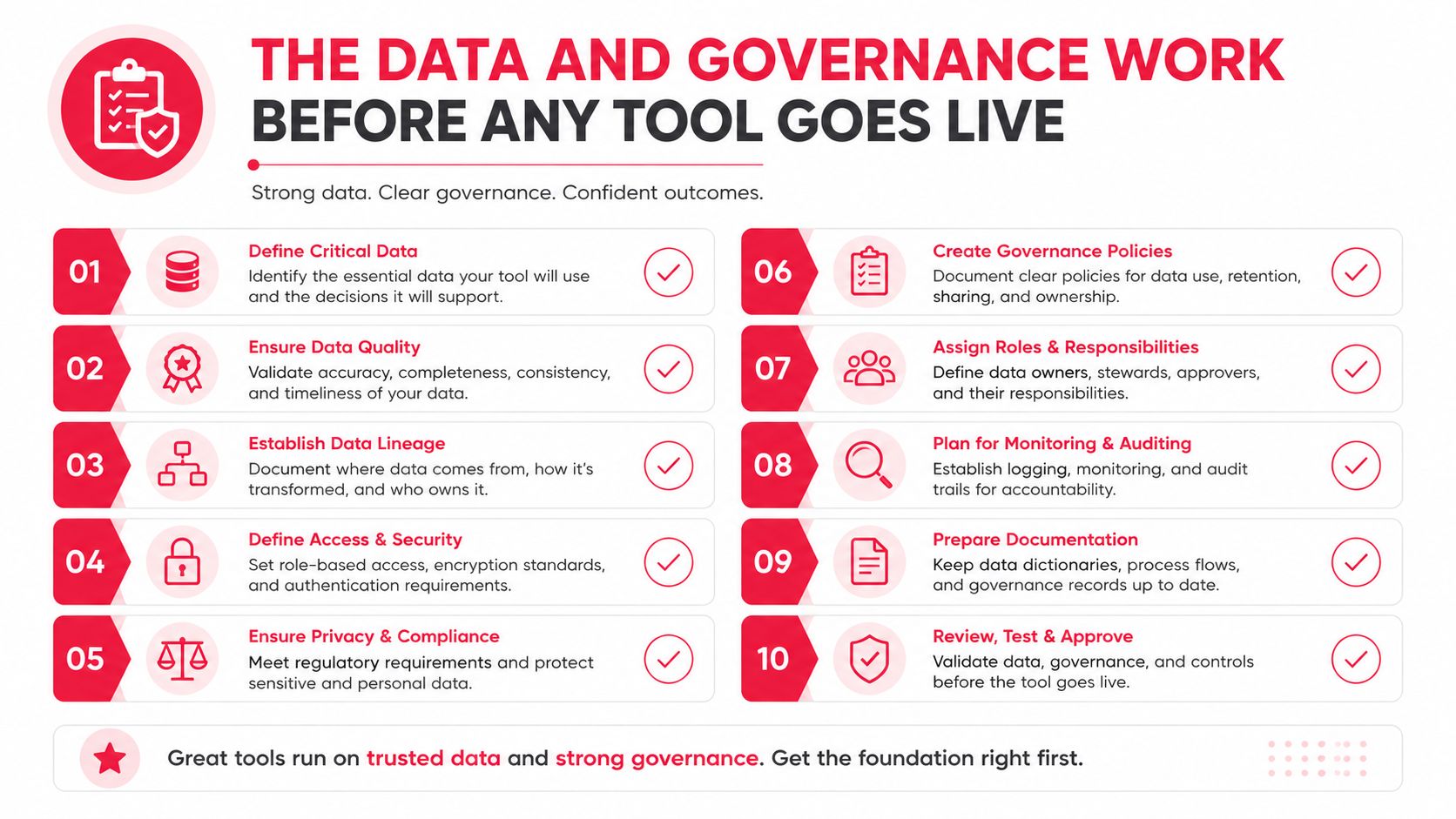
Governance must cover PII access, consent records, retention, model permissions, and the jurisdictions where your company sends outreach. Include GDPR, CCPA, and CAN-SPAM in the policy review, then require human approval before personalized claims leave the platform. Our AI governance best practices guidance covers the controls that keep experimentation from becoming an untracked compliance process.
Your data owner should publish field definitions, freshness rules, source provenance, and an escalation path for errors. If the team can't explain why a lead received a score or where a claim came from, the workflow isn't ready for production.
Where AI Moves the Funnel
The highest-value AI use case sits at an expensive bottleneck, has a measurable baseline, and rests on usable historical data. Start with the cost per opportunity and run a controlled test. A polished demo is not a business case.
| Use Case | Funnel Stage | Primary Metric | Typical Lift / Time Saved | Data Readiness |
|---|---|---|---|---|
| ICP refinement from closed-won data | Targeting | Opportunity conversion | Better account selection | Closed-won and closed-lost history |
| Firmographic enrichment | Prospecting | Research time and record completeness | Less manual research | Approved enrichment sources |
| Intent signal aggregation | Prioritization | Qualified meeting rate | Faster account selection | First-party and verified event data |
| Lead scoring and routing | Qualification | MQL-to-SQL conversion | Higher scoring accuracy | Clean CRM labels and behavioral history |
| AI-assisted SDR copywriting | Outbound | Reply rate | More tested message variants | Verified account context |
| Conversational inbound triage | Inbound | Qualified meeting rate | Faster qualification | Clear qualification criteria |
| Ad targeting and creative iteration | Acquisition | Cost per qualified lead | Faster testing cycles | Conversion and audience data |
| Predictive churn-to-upsell | Expansion | Expansion opportunity rate | Earlier account prioritization | Product and customer outcome data |
AI scoring belongs in the qualification layer only after the team defines a conversion label, trains on CRM and behavioral signals, and validates results against a holdout set. Route high-confidence leads to sellers, then inspect false positives and false negatives. Optimize for qualified pipeline and downstream conversion, not MQL volume.
The best AI lead generation tools should be compared against that operating model. Review prospecting, enrichment, scoring, and workflow features together, then test whether each tool fits your data ownership, CRM process, approval rules, and reporting needs. A broad feature list does not compensate for weak labels or incomplete account records.
The practical sequence is simple: select one bottleneck, define the baseline, set the downstream success metric, and limit the pilot to a traceable cohort. If you cannot name the number the workflow should improve, do not deploy it. Faster activity without better qualification only increases the amount of junk entering the pipeline.
Prospecting and Personalization Workflows That Produce Pipeline
AI prospecting produces pipeline only when research, personalization, approval, and routing connect to a measurable handoff. For a growth-stage B2B team, build these three workflows first.
Turn account research into a seller-ready brief
Start with a defined account list and approved sources. AI can collect firmographic and technographic context, scan trigger sources, and organize findings into a brief with evidence links. Require the brief to answer four questions:
- What changed at the account?
- Which role is likely to feel the operational impact?
- What evidence shows the problem is active now?
- Which claim is verified, and which requires seller review?
Prompt design should enforce evidence discipline. Ask an approved research assistant to “summarize the latest earnings-call comments about operating efficiency, cite the exact passage, and separate management statements from inference.” For buying-committee research, ask it to “identify roles connected to the stated initiative, list the evidence for each role, and mark unknowns rather than guessing.”
Signal-based personalization has been benchmarked at 15% to 25% reply rates, compared with 3% to 5% for cold-email averages, according to Haus Advisors. Another summary reports 25% to 40% reply rates when teams combine two to three signals with behavioral context, as described by Overloop's AI prospecting statistics. Treat these figures as directional. Relevance, list quality, and deliverability determine whether a workflow earns similar results.
Draft, review, then branch the sequence
AI should draft the opener and propose follow-ups. A seller must verify every account claim before sending. Branch the next message by recipient role, response, and observed intent. A CFO discussing forecast accuracy needs a different follow-up from a RevOps leader asking about workflow ownership.
Use this sequence:
- Generate a short opener tied to one verified trigger.
- Have the account owner approve the trigger, value proposition, and proof point.
- Send one controlled variant to a defined cohort.
- Branch the follow-up by role and response.
- Stop when the prospect replies, opts out, or evidence falls below the confidence threshold.
Teams assessing agent support can use an AI sales assistant overview to compare research, drafting, and follow-up functions. Keep the platform subordinate to approval rules, suppression lists, and seller accountability.
Score inbound leads before routing
For each form fill, enrich the company record, compare the account with the ICP, inspect first-party behavior, and route against a defined threshold. High-confidence leads create an SDR task. Unclear records enter nurture or manual review. Record the routing reason in the CRM so sales can challenge a bad decision and improve the model.
Use Stimulead's AI prospecting guidance when setting up the research-to-outreach handoff. Review every personalized claim, test deliverability for each new sending domain, and audit enrichment accuracy weekly.
Where AI Lead Generation Fails
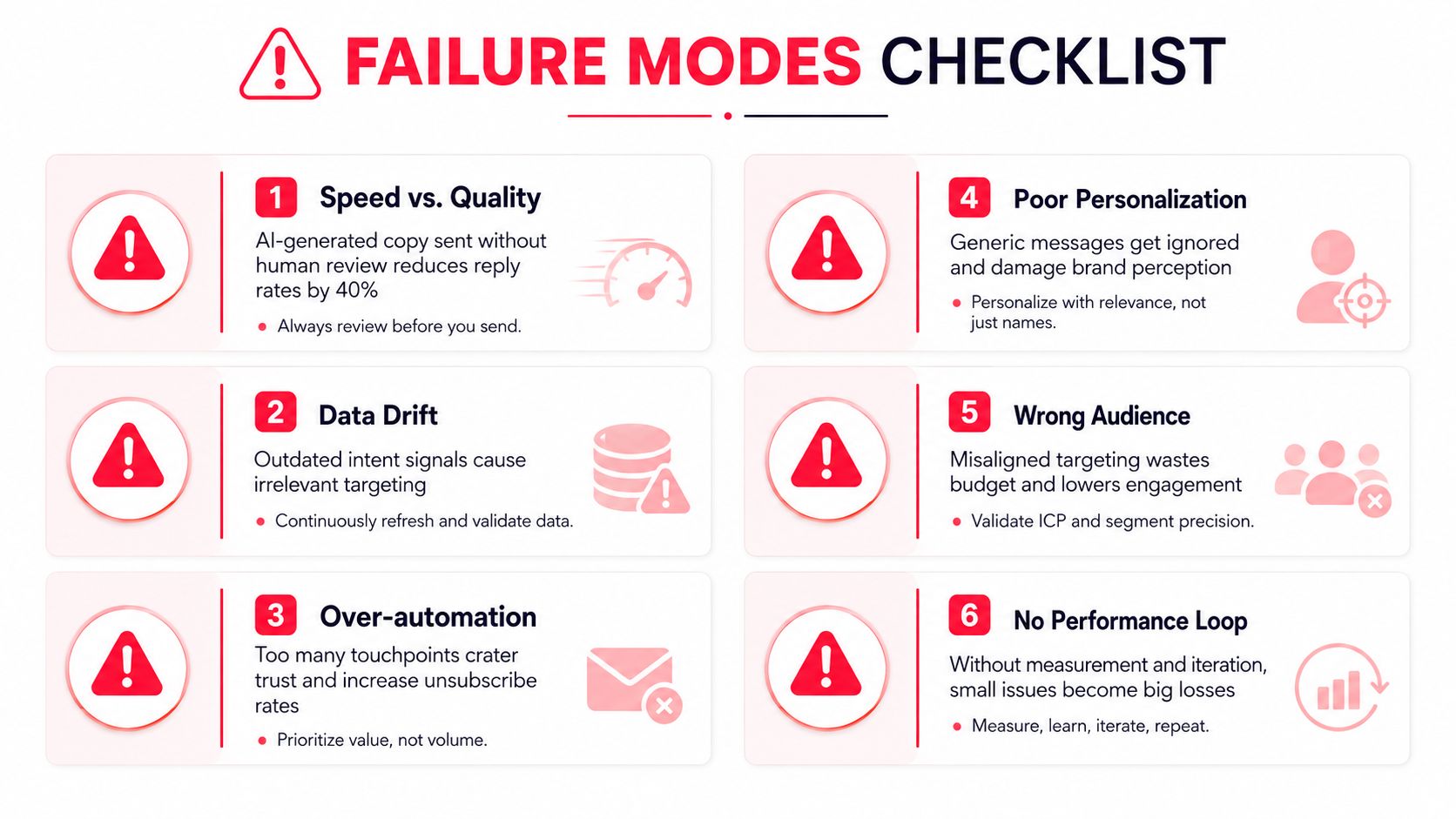
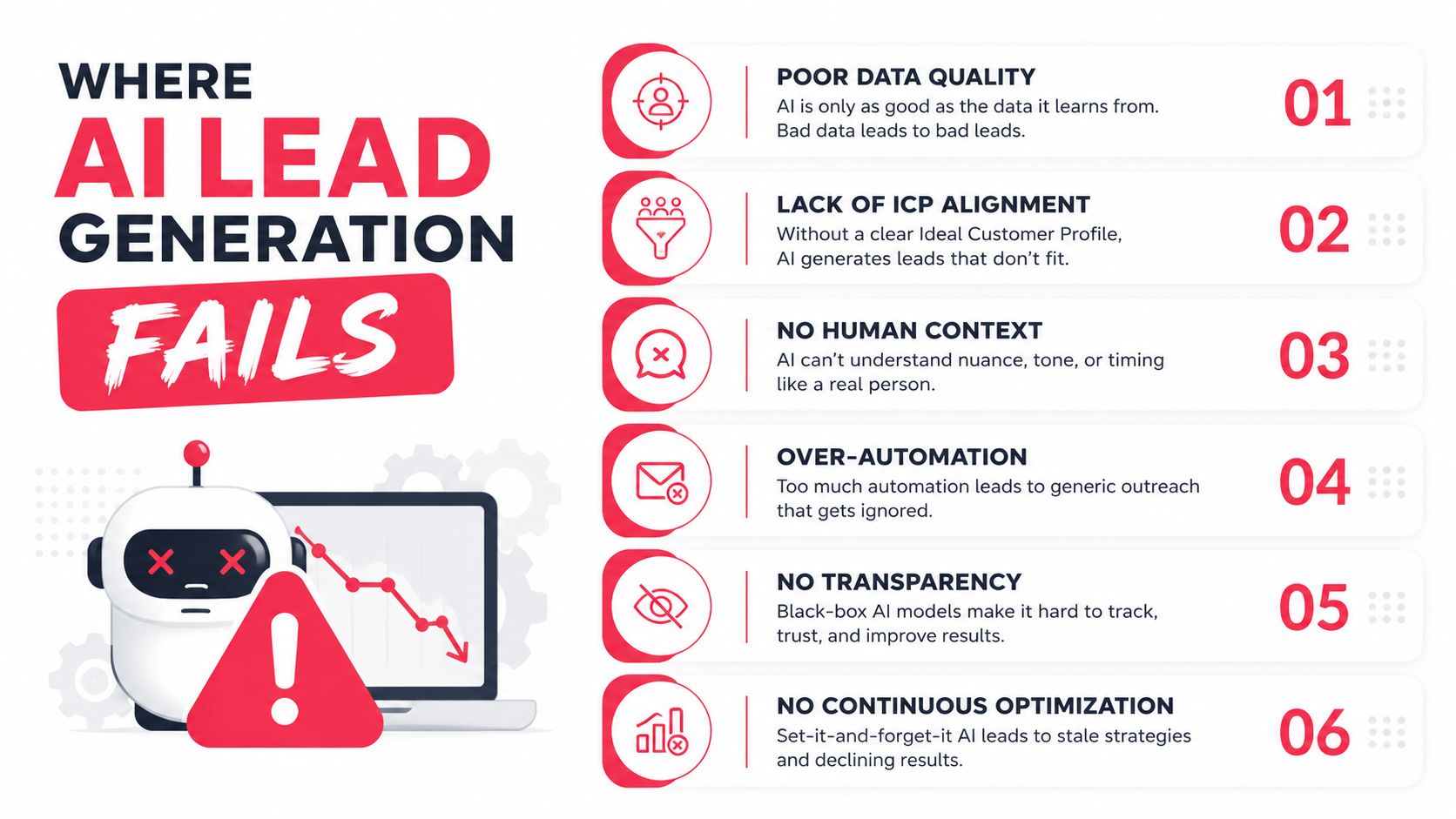
AI lead generation fails when the company measures output instead of qualified pipeline. More records, more drafts, and more sends don't compensate for a falling meeting-to-opportunity rate.
The speed-versus-quality tradeoff is real. A comparative study found that manual searches identified the most companies but produced only two quality leads after 115 hours, while AI tools found fewer leads in much less time. The comparative study shows why research design matters. AI is well suited to broad discovery and prioritization. Human-led research remains stronger when the account requires contextual judgment.
Failure signals to watch
- Hallucinated account facts: A wrong trigger destroys trust and forces the SDR to re-qualify the conversation.
- False-positive scoring: A model trained on biased historical wins can over-rank lookalike accounts and hide net-new segments.
- Channel collapse: Similar AI messages across email and LinkedIn teach buyers to ignore automated outreach.
- Unreviewed copy: A polished draft can still make an unsupported claim about a prospect's strategy or technology.
- Unaudited confidence: A high score means little if nobody checks the model against opportunity outcomes.
- Human displacement too early: Complex buying committees require judgment that pattern matching can't supply.
We won't set a universal annual contract-value threshold for human-led research because the right boundary depends on deal complexity, regulation, and buying-group structure. For high-value accounts, preserve human ownership of account strategy, stakeholder mapping, and message approval.
Look for rising unsubscribe rates, falling meeting-show rates, repeated phrasing across sequences, and model confidence that nobody audits. These are operating signals, not cosmetic issues. Pause the workflow when they appear, inspect the source data, and requalify the target segment before adding more volume.
Roadmap, KPIs, and the Next Decision to Make
A 90-day rollout gives a growth-stage team enough time to inspect the data, run a controlled workflow, and decide whether the economics justify scale. Keep the first test narrow. One account segment and one workflow produce a clearer signal than a company-wide launch.
| Phase | Weeks | Primary Output | Leading KPI | Scale Trigger |
|---|---|---|---|---|
| Readiness audit | 1 to 3 | Data, ICP, governance, and deliverability baseline | Field accuracy and qualified-meeting baseline | Owners accept the definitions |
| Controlled workflow | 4 to 8 | One prospecting and one personalization workflow | Reply rate by tier and cost per qualified meeting | Quality holds under review |
| Expansion and learning | 9 to 12 | Scoring model, CRO tests, and AEO content handoff | Model precision at top decile and meeting-to-opportunity rate | Downstream conversion improves |
The weekly dashboard
Put these seven metrics in front of the CRO, CMO, and RevOps owner:
- Pipeline per SDR hour, to expose whether automation creates productive selling time.
- Reply rate by account tier, because an aggregate reply rate can hide weak targeting.
- Meeting-to-opportunity rate, which keeps qualification connected to pipeline.
- Model precision at the top decile, so the team sees whether the highest-scored leads deserve attention.
- Cost per qualified meeting, including tool cost, review time, and sales qualification effort.
- Deliverability complaint rate, to catch sender-reputation damage early.
- Influenced ARR, reported with a clear attribution definition rather than a loose activity label.
CRO and AEO should receive the same evidence. CRO testing can use qualified-account segments, message variants, and conversion-stage outcomes. AEO work can turn verified customer questions, product evidence, and sales objections into content designed to earn recommendations from answer engines. Keep those handoffs connected to the same account and opportunity taxonomy.
The decision for week one is specific: which single funnel bottleneck will receive the first controlled AI workflow, and who owns the baseline number? Choose slow routing, poor qualification, weak replies, or expensive research. Assign one executive sponsor, one RevOps owner, and one sales reviewer. If the team can't agree on the bottleneck and its measurement, delay deployment and fix that operating gap first.
Book a working session with Stimulead to audit your CRM signals, scoring labels, deliverability process, and qualified-meeting economics. Leave the session with one approved AI workflow, a named owner, and a measurement plan your CRO can review every week.