
AI adoption can be widespread while commercial ownership remains unresolved. In its 2025 survey, Forrester found that 94% of business buyers used AI during their buying process, but that doesn't tell a CEO who should own the changes to discovery, qualification, or measurement. Our recommendation is to buy go to market consulting services around a baseline, a named internal owner, and written decision thresholds before committing to tools or a retainer.
Table of Contents
- What a Go to Market Engagement Covers and What It Does Not
- Choosing an Engagement Model for Your Stage
- Outcomes Worth Writing Into the Contract
- How a Sound Engagement Runs From Audit to Rollout
- Where Go to Market Engagements Fail and Why
- Book a Diagnostic Before Signing a Retainer
What a Go to Market Engagement Covers and What It Does Not
The ownership decision comes first: will the consultant take responsibility for designing a working commercial system, or hand over recommendations that your team must translate into operating instructions? We recommend making that distinction explicit in the statement of work.
The scope should cover segmentation, positioning, pricing, channel design, sales and marketing operations, and measurement. Much of the value sits at the handoffs: whether a positioning test informs outbound messaging, whether qualification rules match the pricing model, and whether sales records enough context to evaluate either.
Scope areas, owners and deliverables
| Scope area | Consultant owns | Internal team owns | Typical deliverable |
|---|---|---|---|
| Segmentation and positioning | ICP definition, segment sizing, message tests | Final positioning sign-off | ICP and message matrix |
| Pricing and packaging | Price test design, packaging options | Pricing decision and discount policy | Price test plan with guardrails |
| Channel and journey design | Channel mix, handoff map, lifecycle stage definitions | Channel budgets and ownership | Journey map with routing rules |
| Sales and marketing operations | CRM data audit, lead routing, scoring model | CRM administration and data entry | Data audit and routing specification |
| AI-mediated discovery | Audit of how LLMs describe the category and brand | Content updates and third-party reviews | Visibility audit across ChatGPT, Claude, Gemini and Perplexity |
| Measurement | KPI model, baseline, attribution rules | Reporting cadence and budget | KPI tree with stop, scale and redesign thresholds |
The consultant should own the specification and its acceptance criteria. Your company retains commercial authority, access permissions, and responsibility for execution unless the contract explicitly assigns delivery elsewhere.
For the sales-side boundary, Outbound Consulting's resource on b2b sales consulting services is useful context when distinguishing sales-process work from broader commercial-system design. Keep that boundary visible when several partners share the same funnel.
AI usage doesn't establish accountability
The Growth Syndicate's 2025 survey found that 91% of B2B marketing teams used AI for content creation, while 31% used it for lead scoring. Those findings describe adoption by use case; they don't establish who owns workflow quality or prove that the work improved opportunity conversion.
AI search optimization belongs in scope when buyers encounter model-generated recommendations before visiting your website. Specify which purchase-intent questions to test, how to record inaccurate descriptions, and who corrects the underlying content.
We leave tool selection out of this buying decision. Choose the workflow and its owner before evaluating software.
Choosing an Engagement Model for Your Stage
Start with the team you have today. An ambitious target doesn't create the internal capacity required to execute a consultant's recommendations.
Engagement models compared
| Model | Best fit | Deliverable |
|---|---|---|
| Project audit | Teams with one funnel problem and no internal owner | Diagnostic and prioritised roadmap |
| Fractional executive advisory | Series A to C companies needing a senior AI owner without a full hire | Strategy, vendor decisions, board-ready direction |
| Embedded sprint | Teams with an owner and one named bottleneck | Tested workflow with acceptance thresholds |
| Ongoing growth partnership | Established businesses with existing teams and agencies | Audit, KPI roadmap, parallel workstream direction |
| Team training | Marketing and sales teams moving from experiments to outcomes | Workflows, custom prompt library, ongoing support |
Don't treat duration or fee basis as established market benchmarks. The sources cited here provide no defensible comparison of engagement prices or delivery periods, so require each proposal to specify its completion conditions, billing basis, and renewal terms.
For procurement, we recommend a fixed acceptance scope for an audit, a bounded delivery commitment for a sprint, and explicit review gates for ongoing advisory. These are buying recommendations, not statements of our pricing or industry-standard terms.
The visual comparison provides another way to assess timing, depth, and team fit.
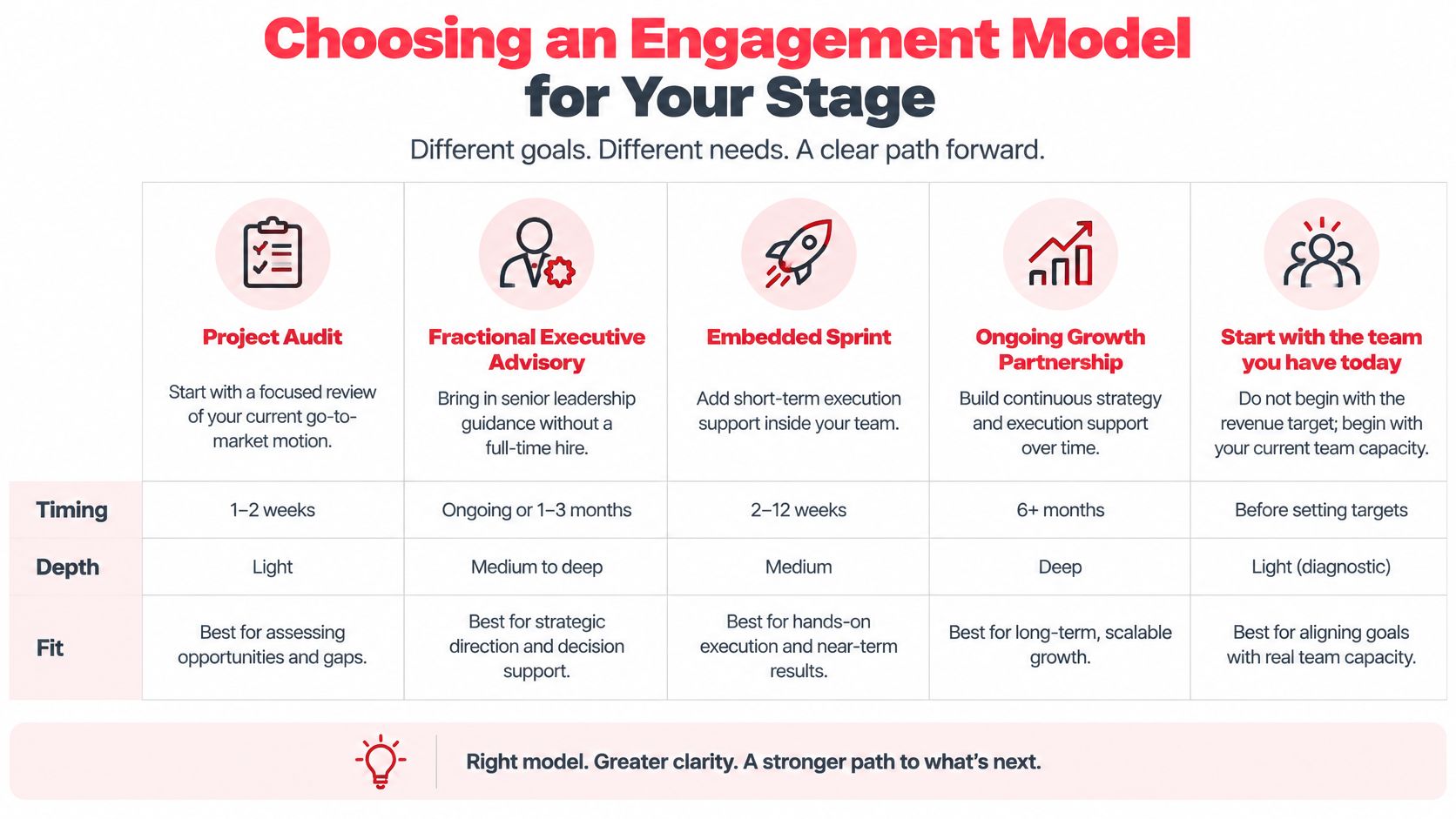
Match leadership support to execution capacity
Our Executive Advisory is a fractional Chief AI Officer partnership for CEOs, CMOs and CROs who need AI in their growth strategy without hiring a full-time AI leader. It suits Series A to C companies and established companies that have execution capacity but need senior direction.
Our Team Training is hands-on work with marketing and sales teams. It covers CRO with AI workflows, GTM engineering with AI, AI-powered content and copywriting, custom prompt libraries, and ongoing skill development and support.
The AI Growth Partnership starts with a deep-dive business audit and a prioritised AI growth roadmap, then moves into an ongoing fractional CAIO retainer that directs execution. Its scope includes implementation-level specifications and direction across parallel workstreams.
The most confused comparison is audit versus partnership. An audit ends with a diagnosis, roadmap, and KPIs; a partnership adds continuing decisions about implementation priorities, dependencies, and acceptance of completed work.
If you can't name the internal person who will run each recommendation, a retainer will produce a roadmap nobody runs.
Buy for your operating stage
A seed or startup company with one growth marketer and contractors should usually buy an audit or training. A broad retainer can outrun the people available to act, especially when the same marketer handles campaign delivery and reporting.
An established company with agencies needs written specifications those agencies can execute. Advice such as improve personalisation is insufficient; the agency needs the eligible audience, approved data fields, review requirements, and measurement definition.
A maturity-stage company with a dedicated growth team should consider embedded sprints around a named constraint. Scope the sprint so it doesn't duplicate existing experimentation or introduce a competing reporting process.
For SaaS leaders deciding how external delivery should fit an existing team, our discussion of the SaaS growth agency model offers related context. The practical question is which decisions your team cannot currently make or execute well.
No published research cited here compares fee outcomes across company stages. Stage-to-model recommendations are our operating judgment, not a proven ranking of consulting returns.
Outcomes Worth Writing Into the Contract
Alexander Group's marketing research, published through Business Wire, reports that 96% of surveyed marketing organisations use AI, yet fewer than half can demonstrate ROI and only 30% trust their marketing-and-sales attribution accuracy. That gap is a reason to purchase measurement architecture before purchasing more activity.
The contract should specify what changes, how you'll measure it, and what evidence permits the next investment. Without pre-engagement records, the consultant can describe an improvement but can't credibly separate it from seasonality, channel changes, or a different account mix.
Outcome layers, example metrics and baselines
The capture periods below are proposed starting points, not research-backed minimums. Extend them when volume is low or the buying cycle makes comparisons unreliable.
| Outcome layer | Example metric | Baseline to capture first |
|---|---|---|
| Workflow efficiency | Research hours per account, time from insight to launch | Hours logged over one normal week |
| Quality | Outbound error rate, review rejection rate | Error rate on a sample of pre-engagement output |
| Pipeline | Qualified pipeline created, cost per qualified opportunity | Last two quarters by channel |
| Conversion | Stage-to-stage conversion, win rate by journey path | Stage conversion for the same two quarters |
| Speed | Time-to-first-response, pipeline velocity | Median response time from CRM timestamps |
| Retention and margin | Retention by cohort, contribution margin | Cohort retention and delivery costs before the change |
McKinsey's B2B Pulse research reported that companies delivering the strongest omnichannel experiences improved market share by at least 10 percent annually. That's a survey finding about coordinated commercial capabilities, not a performance promise for an individual engagement.
For your contract, use operational measures such as channel-assisted revenue and cost per qualified opportunity alongside conversion. Define qualified opportunity before launch, including exclusions and who can approve a disputed record.
Make the decision rule enforceable
Our recommended rules are straightforward. Stop if the primary metric misses baseline after the agreed test window and the test meets its validity requirements; scale if it beats the agreed improvement threshold while quality holds; redesign if speed improves while quality falls.
An inconclusive result needs separate treatment. If the pilot never reaches its minimum eligible sample, record that limitation rather than declaring success or failure.
A faster research workflow may justify investment through capacity savings without immediate pipeline improvement. Calculate that case using usable hours released, adoption by the team, and total operating cost, including review time.
Our revenue operations consulting discussion provides related context for connecting reporting definitions to commercial ownership. Thresholds and test windows must be set per company; the cited evidence doesn't establish a universal window for small samples.
How a Sound Engagement Runs From Audit to Rollout
We sequence the work so that implementation follows a testable decision. Our AI Growth Partnership follows four phases; Advisory and Training use the same opening diagnostic on a shorter timeline.
The diagnostic spans conversion, search, sales, and data.
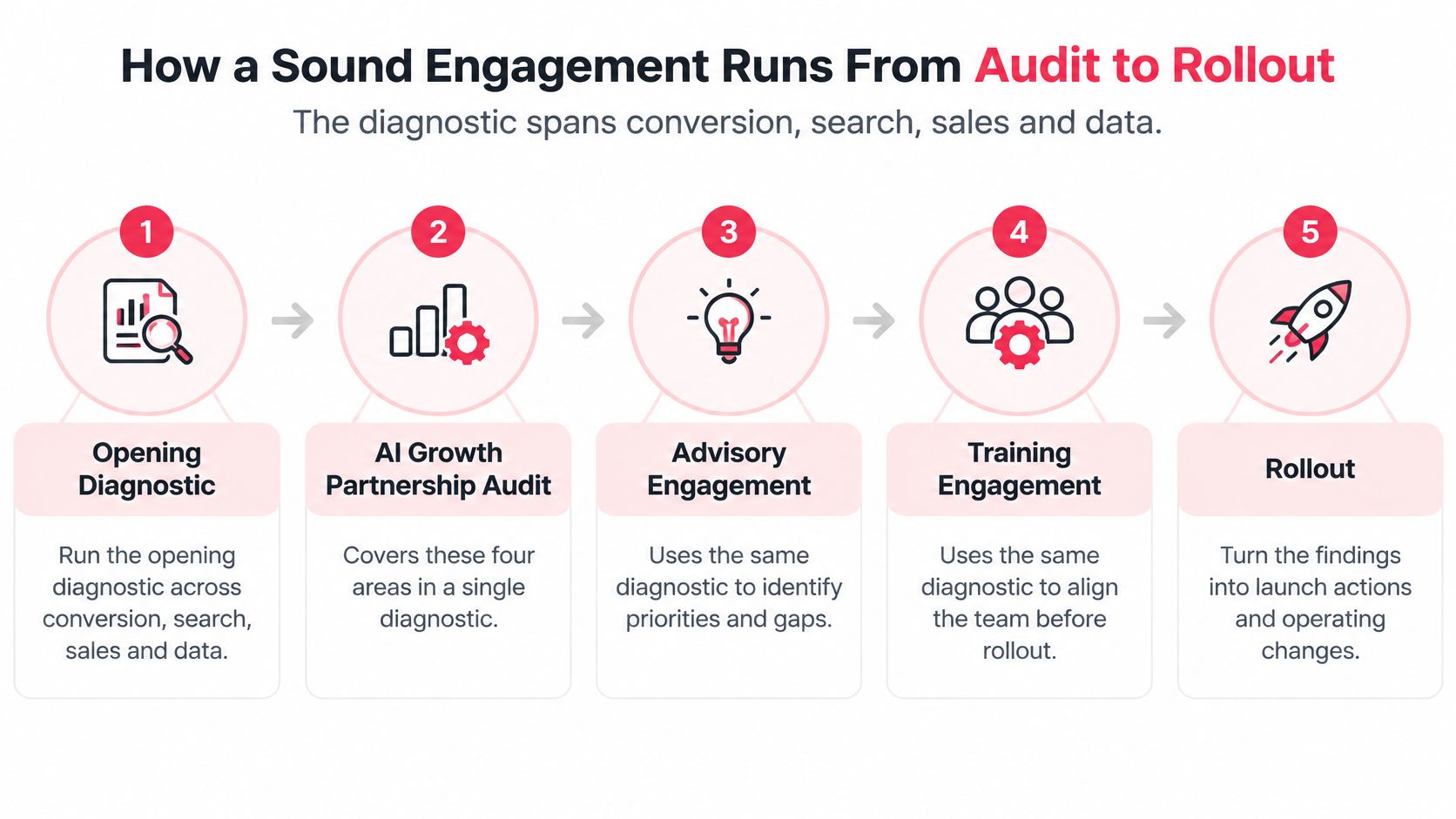
The operating sequence
Run the opening diagnostic. Inspect conversion paths, search visibility, sales workflows, and data quality together. In the AI Growth Partnership, this produces a prioritised roadmap with KPIs and implementation playbooks, including agent commerce readiness where relevant.
Select one bottleneck. Choose a constraint that's measurable, valuable, and governable, such as lead-response time or research hours per account. Reject a pilot whose commercial value requires several untested assumptions to hold.
Assign decision rights. Name a business owner, a data owner, and an approver for customer-facing output before evaluating tools. Record who can pause the workflow when sales or marketing finds an error.
Document the operating boundary. Use the NIST AI Risk Management Framework's GOVERN, MAP, MEASURE, and MANAGE functions to document business context, approved data, users, foreseeable harms, and an escalation path. NIST calls for testing before deployment and regularly during operation; its framework is voluntary guidance, not a certification.
Write the acceptance conditions. Capture the baseline and agree stop, scale, and redesign thresholds before launch. Use our go-to-market strategy template to organise the decision record, then add workflow-specific quality and risk checks.
Run a controlled pilot. For example, compare generic account messaging with individualised messaging based on approved account context, buying history, and behavioural signals. Define treatment and control groups, minimum sample size, attribution rules, and a fixed test window before assigning eligible accounts.
Integrate only after acceptance. Connect the accepted workflow to CRM, training, and the operating cadence after it clears its thresholds. For signal-based selling, specify which signals route to sales, which require corroboration, and which should never trigger automatic outreach.
Make the pilot reproducible
Keep an experiment record containing the eligible population, exclusions, message versions, and account assignment. Avoid placing contacts from the same account in competing groups when their interactions could contaminate the comparison.
McKinsey's B2B findings associate combined data-driven commercial execution, personalised experiences, and generative AI with a higher likelihood of market-share improvement. That association supports testing a coordinated workflow, but it doesn't establish the causal effect of your proposed personalisation.
A plausible output isn't an acceptance test. The owner must be able to reproduce the result and identify when the workflow should be paused.
This sequence is our recommended operating practice, not an industry standard. It preserves the ability to reject an attractive demonstration when the underlying workflow can't meet production requirements.
The accompanying video offers additional context for evaluating the engagement process.
Where Go to Market Engagements Fail and Why
A tool shortlist delivered before anyone names a bottleneck or baseline is the failure pattern we'd reject first. The provider has made a purchasing recommendation without establishing what would make the purchase worthwhile.
The patterns below are an advisory review of implementation risks, not measured failure rates from our client engagements. Use them to challenge a proposal before it becomes an operating commitment.
Failure patterns and their replacements
| Failure pattern | Why it fails | Replacement |
|---|---|---|
| Tool selection before diagnosis | Nobody has defined the decision the tool must improve | Require a bottleneck statement and acceptance test |
| AI added to an unchanged process | Local task savings leave downstream delays untouched | Redesign the complete workflow |
| Attribution on fragmented CRM records | Duplicate identities and conflicting ownership distort credit | Repair identity and ownership first |
| Campaigns designed for the first responder | Contact engagement is mistaken for account progression | Map buying-group coverage |
| Pilots without an exit decision | Activity continues without an investment judgment | Assign a decision date and decision owner |
McKinsey reports that fewer than 10% of companies had scaled AI in any given function, while high-performing companies were nearly three times more likely than peers to have redesigned individual workflows around AI. This is survey evidence of an association, not proof that workflow redesign alone causes better performance.
The practical replacement is to inspect the whole sequence. If AI shortens account research but approvals still hold every campaign, measure insight-to-launch time and tests shipped alongside research time.
Check the account, not only the contact
Gartner reports that the average enterprise B2B buying group contains five to 11 stakeholders spanning an average of five business functions. That finding applies to enterprise buying groups; don't automatically impose the same committee structure on every smaller deal.
For a complex account, a positive reply from a user doesn't establish technical approval or budget authority. Record which roles have engaged and what evidence each needs before the opportunity can advance.
CRM defects require equally concrete treatment. In HubSpot or Salesforce, resolve duplicate accounts, conflicting owner fields, and inconsistent lifecycle timestamps before asking an attribution model to allocate credit.
A pilot without an exit decision is an operating expense with an experimental label.
A calendar deadline alone isn't enough if the account sample is inadequate. The decision owner should close the pilot as inconclusive, authorise a bounded extension, or stop it, rather than leave it running indefinitely.
Most of the failure evidence available here comes from surveys. It can inform scrutiny, but it cannot supply a reliable failure probability for your company or predict the return on a particular consulting fee.
Book a Diagnostic Before Signing a Retainer
The next decision is whether a diagnostic and roadmap justify an ongoing commitment. For established companies with existing teams and agencies, our AI Growth Partnership makes that diagnostic the first decision point.
We sit above AI consultants and agencies: we set direction, decide which tools are production-ready, and write the specifications your existing partners act on. Those partners keep doing the building.
Run these checks this month
- Confirm the operating stage. Choose the model your current team can execute, rather than the model implied by your target.
- Name each internal owner. Put a person against every proposed workstream and confirm their capacity.
- Pull a usable baseline. Review the last two quarters for the proposed bottleneck, checking missing records before accepting the comparison.
- Require written thresholds. Put the stop, scale, and redesign conditions into the proposal before approving ongoing work.
A provider that refuses to write thresholds fails this test. The diagnostic must also be allowed to return a no-go when no measurable bottleneck warrants funding.
If paid acquisition is the suspected constraint, NotFair's wasted ad spend audit for agencies offers a focused example of investigating waste before expanding scope. If buyers research through AI assistants, make AI search optimization the next diagnostic topic rather than assuming website traffic captures consideration.
Book a diagnostic with Stimulead this month. Bring your funnel export, current agency scopes, and the internal owner who can act on the findings, then decide whether the evidence warrants a retainer.
