
Conversational AI earns investment only when it connects to the systems governing products, inventory, customers, orders, and payments. Integration depth determines whether the assistant can influence revenue or merely answer questions. Governance determines which recommendations and actions require approval, logging, or human review.
A shallow chatbot pilot generates activity without proving commercial value. A connected, governed commerce system can improve conversion, accelerate testing, and strengthen operational control, provided the team measures those outcomes and defines handoff points before launch.
Our recommendation to growth-stage CEOs, CMOs, and CROs is direct: treat conversational AI as a revenue and risk decision, not a customer-service widget purchase. Set clear boundaries for product advice, checkout, order changes, refunds, and exceptions. Then calculate ROI against implementation effort, support savings, conversion impact, and the cost of failures.
Table of Contents
- Why Evaluate Conversational AI for Ecommerce Now
- Understanding the Key Concepts
- High Value Use Cases
- Quantifying ROI and KPIs
- Implementation Roadmap
- Vendor Evaluation Criteria
- Common Mistakes and Human Handoff Points
- Tactical Examples and Next Decision
Why Evaluate Conversational AI for Ecommerce Now
AI chat users convert at 12.3%, compared with 3.1% for non-users, according to the conversational commerce statistics summary from Envive. That is roughly a fourfold difference, although leaders should treat it as a benchmark rather than a promise for their own funnel.
The board-level question is whether your company can capture similar value without creating inaccurate recommendations, uncontrolled actions, or expensive integration work. Conversational AI earns its place when it helps a buyer choose, compare, purchase, track, return, or modify an order inside a controlled workflow. A chat window that can't access current product or order data won't produce that outcome.
The market signal is strong. The same Envive summary places conversational commerce at $7.6 billion in 2024, with a projection of $34.4 billion by 2034 at a 16.3% CAGR, which implies more than a four-and-a-half-fold increase over the decade. It also reports that 89% of retail and CPG companies are using or piloting AI, while 97% plan to increase AI spending in the next fiscal year.
Our position is direct: integration depth and governance determine ROI more than conversational polish. If your team still treats chat as a helpdesk experiment, start by reviewing the operating model behind autonomous AI for online stores, especially how the system connects conversation to transaction execution and escalation.
Understanding the Key Concepts
Production conversational AI has four connected parts. Evaluating only the interface is how companies buy an articulate system that can't answer inventory questions or complete a purchase.
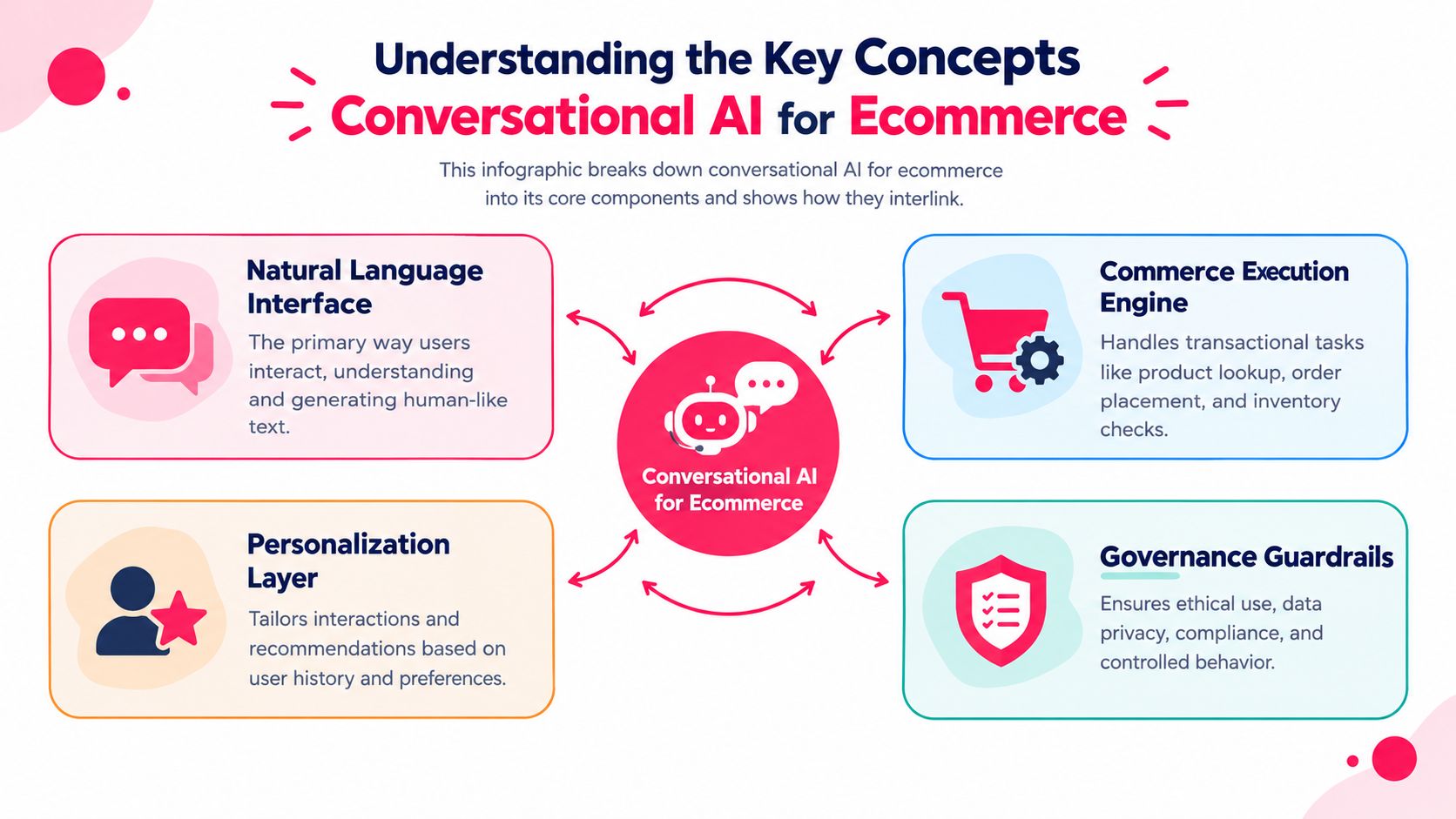
The four-part operating model
Natural language interface. This is the customer-facing conversation across a site, messaging channel, or voice experience. It interprets intent, attributes, constraints, and follow-up questions.
Commerce execution engine. This layer retrieves catalog and inventory data, checks order status, creates cart actions, and, when authorised, performs transactions or service actions.
Personalization layer. The system combines conversation signals with available customer context, such as browsing history, prior orders, preferences, and account data. Access should be limited to what the use case needs.
Governance guardrails. These controls define permitted actions, approval requirements, data retention, disclosures, escalation rules, and audit records. They also prevent the system from making unsupported claims about products or policies.
The architecture should look like a hierarchy, with the interface at the top, retrieval and execution beneath it, customer context connected across the workflow, and governance operating across every layer. A recommendation without reliable retrieval can be wrong. An accurate recommendation without a usable cart action creates friction. An autonomous refund without approval logic creates financial and compliance exposure.
The Shopping Reasoning Bench defines 525 expert-authored missions across 232 single-turn and 1,764 multi-turn shopping interactions spanning 293 scenarios. The value of that benchmark is its focus on task completion. A shopper may change colour, size, budget, delivery requirement, or product category during one conversation, and the system must preserve those constraints.
A separate OpenReview study of conversational shopping systems evaluates shopping execution, personalization, conversation quality, and safety as separate dimensions. It reports 91.3% average response accuracy, 87.1% personalization alignment, and more than 96% context retention in multi-turn dialogue. For a practical vendor comparison, teams can also review specialist options such as best AI customer service for Shopify, then test the underlying integrations rather than accepting feature lists.
High Value Use Cases
Conversational AI creates the most value where a buyer or service agent already encounters a measurable bottleneck. We rank the use cases by operational readiness, data requirements, and distance from a completed transaction.
Start with the bottleneck
Customer support deflection is the safest entry point when order status, delivery policy, returns, and product questions generate repetitive demand. The system should retrieve current answers, collect context, and transfer unresolved cases with the conversation history intact. Measure resolution quality and repeat contact, not the number of conversations the AI prevents from reaching an agent.
Commerce conversion assistance should be the priority when buyers abandon product pages because they can't compare options, interpret specifications, or assess fit. A guided assistant can ask for constraints, retrieve matching products, explain trade-offs, and add a selected item to the cart. This use case demands clean product attributes and a controlled experiment against your existing search or product discovery flow.
Hyper-personalization works when customer and behavioural data are accessible during the session. The assistant can adapt recommendations based on stated preferences and current intent rather than showing a static “frequently bought together” module. We don't recommend this first if customer records are fragmented or consent rules are unclear.
Agentic commerce execution sits at the frontier because the system must take action. Reordering, subscription changes, returns, refunds, and checkout orchestration require permissions, transaction logs, error handling, and clear approval boundaries.
Industry reporting says brands using AI-driven conversational commerce report increased sales in 79% of cases, while AI handles an average of 31% of ecommerce customer interactions, according to Sajedar's 2026 ecommerce AI insights. That evidence supports investment, but it doesn't tell you which use case deserves your first sprint. Your current funnel and system readiness should decide that.
A useful ordering is:
| Use case | Primary value | Required depth |
|---|---|---|
| Support deflection | Lower repetitive service demand | Knowledge base and escalation |
| Conversion assistance | Better product selection and purchase completion | Catalog, search, inventory, cart |
| Personalization | More relevant recommendations | Customer and behavioural data |
| Agentic execution | Completed service or commerce actions | Transaction APIs, permissions, audit logs |
For a broader view of how these capabilities fit into an ecommerce operating model, see Stimulead's guidance on AI for ecommerce.
Quantifying ROI and KPIs
ROI starts with exposed traffic, assisted sessions, conversion rate, average order value, and operating cost. Treat chatbot activity as a diagnostic, not a business result. Compare a defined group of buyers with a comparable baseline, then assign each metric to an accountable owner.
The Envive benchmark reports 12.3% conversion for AI chat users versus 3.1% for non-users. That gap suggests a roughly fourfold lift, but your finance model should rely on your own baseline and a controlled test.
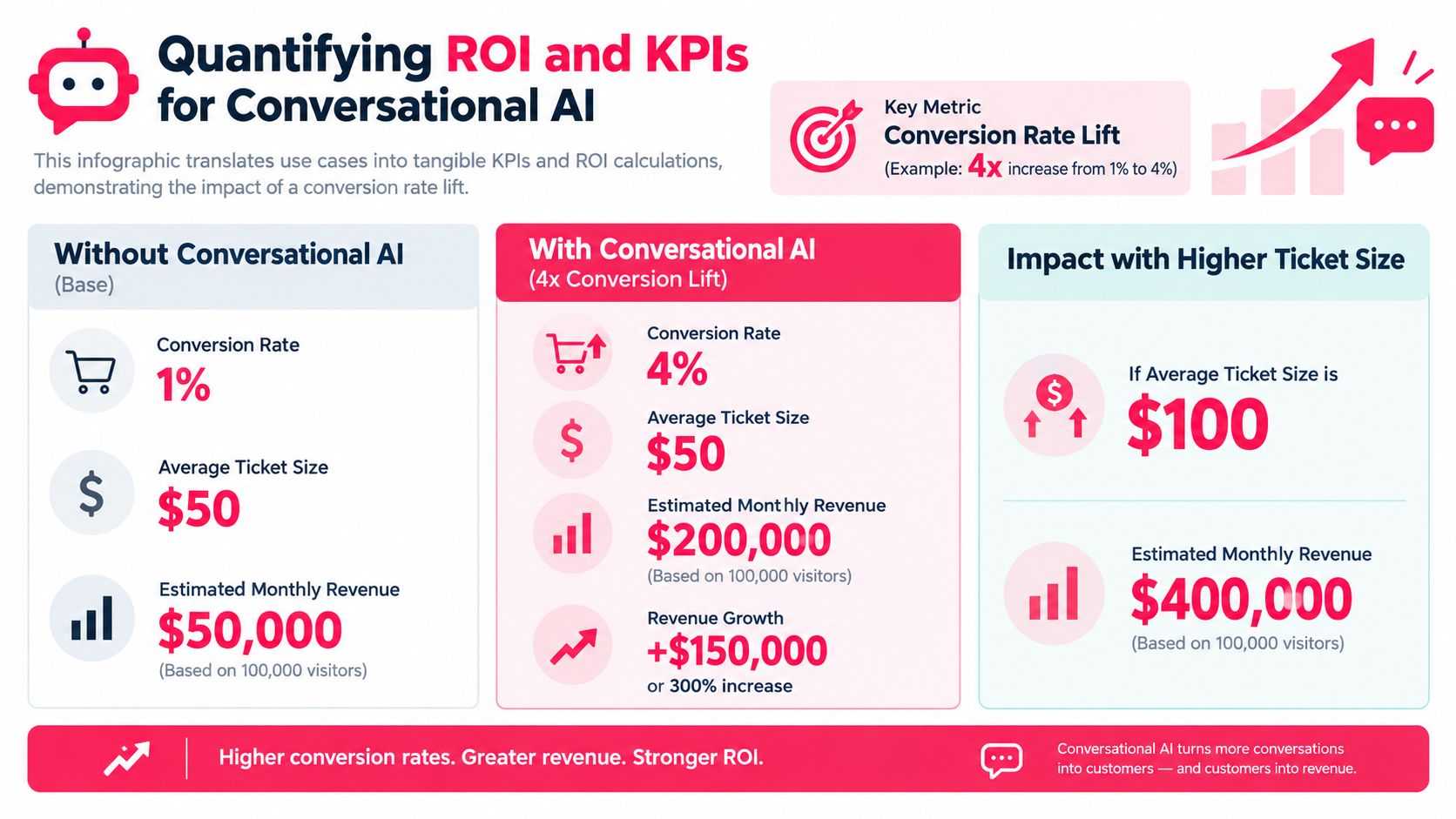
Use a transparent calculation
A basic assisted-commerce model is:
Incremental orders = exposed visitors × assisted conversion rate minus comparable baseline orders
Incremental revenue = incremental orders × average order value
Net contribution = incremental revenue × contribution margin minus software, implementation, and operating costs
Give every input an owner. The CRO owns experiment design. The ecommerce or product lead owns the assisted journey. Finance validates margin and attribution, while the data team owns event quality. This structure exposes whether weak ROI comes from poor conversion, shallow integration, weak attribution, or excessive operating cost.
Track these KPIs by use case:
- Assisted conversion rate: Purchases among sessions that interacted with the assistant.
- Incremental conversion: Difference between treatment and control, adjusted for the test design.
- Average order value: Change in basket value for assisted purchasers.
- Task completion: Percentage of conversations that complete the intended action.
- Human handoff rate: Percentage requiring an agent, segmented by reason.
- Repeat contact: Customers returning about the same issue after an AI interaction.
- Action error rate: Failed, reversed, or incorrectly initiated commerce actions.
- Contribution after cost: Financial result after vendor and operating expense.
Adobe's analysis provides an external benchmark. AI-referred shoppers converted 42% more often in March 2026 and 54% more often in May 2026, based on more than 1 trillion U.S. retail visits, as reported in this Adobe retail visit analysis. Use those figures to pressure-test a forecast, not to replace an experiment.
Integration depth changes the ceiling. A chatbot with catalog access can influence discovery, while connections to inventory, cart, order, and customer systems can complete revenue-producing actions. Human handoff should cover payment disputes, exceptions, uncertain intent, and actions with material customer or financial risk.
A good test isolates one use case, defines the eligible audience, records the pre-launch baseline, and measures commercial and service outcomes. The Stimulead AI implementation roadmap offers a related structure for connecting AI initiatives to owners, milestones, and measurement.
Implementation Roadmap
A production rollout needs a sequence that protects the customer experience while the team learns. We recommend six phases. The pilot can fit inside a defined sprint, but the exact duration depends on data condition, platform complexity, legal review, and the number of channels involved.
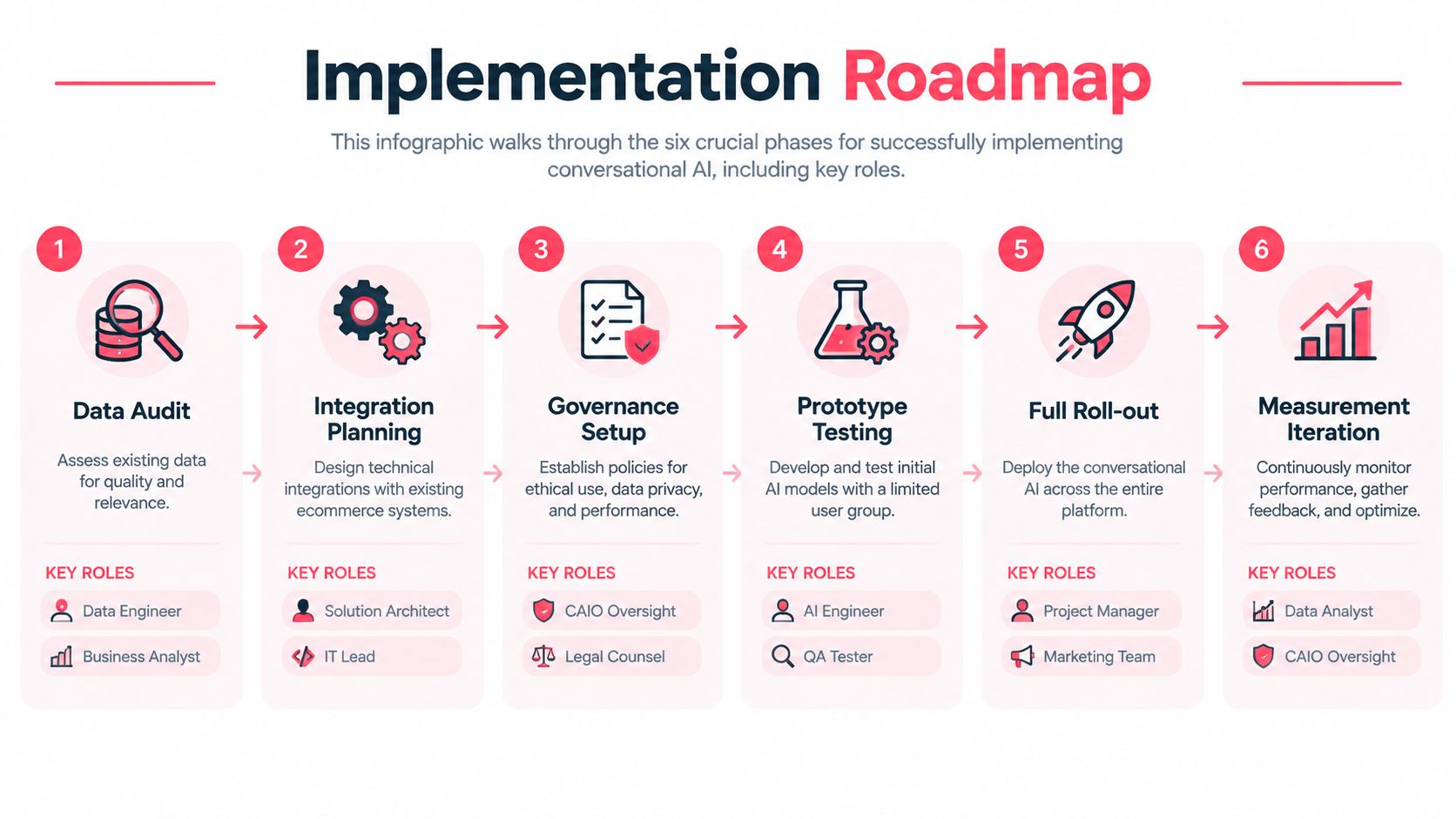
Phase one and two establish feasibility
Data audit. A data engineer and business analyst inspect product attributes, pricing, inventory freshness, customer identity, order records, policies, and conversation logs. The deliverable is a readiness register showing what the assistant can answer accurately and what requires remediation.
Integration planning. A solution architect and IT lead map the required read and write connections. Typical systems include Shopify, BigCommerce, or Adobe Commerce, alongside CRM, customer data, order management, payment, ERP, warehouse, and loyalty systems. The team should document API ownership, failure states, authentication, logging, and fallback behaviour.
Don't begin with a model selection workshop. Begin with the action map. If the first use case is product discovery, catalog and inventory access matter most. If it is a refund workflow, payment and order systems become part of the launch boundary.
Phase three and four control behaviour
Governance setup. CAIO oversight, legal counsel, security, and customer operations define permitted actions, disclosure language, consent, data retention, escalation triggers, and approval requirements. A standard in-policy return may follow an automated path, while an exception should pause for human review. Our AI governance best practices cover the operating controls leaders should establish before launch.
Prototype testing. An AI engineer and QA tester build a constrained experience against real customer language. Test cases must include incomplete requests, conflicting preferences, unavailable products, policy exceptions, angry customers, context changes, and failed API responses. The Shopping Reasoning Bench is useful here because it treats multi-turn completion as a first-class requirement.
Practical rule: A successful demo proves that the assistant can answer. A successful pilot proves that the assistant can complete the intended task safely.
Phase five and six create operating discipline
Full roll-out. The project manager and marketing team release the experience to a defined audience and channel set. Keep the original journey available during the ramp. Rollout decisions should follow performance by intent, product category, customer type, and handoff reason rather than one blended score.
Measurement iteration. A data analyst and CAIO owner review conversion, task completion, response accuracy, handoffs, repeat contacts, customer satisfaction, and action failures. The team should maintain a failure queue, prioritise high-value errors, update source data, and rerun the relevant tests.
Voice deserves separate planning. Gorgias reports that only 7% of brands currently use voice assistants for commerce, while 89% expect voice purchasing to be standard by 2030, a projection. That gap tells us to avoid announcing omnichannel ambition before the transaction and permission layers work in one channel.
Vendor Evaluation Criteria
Vendor selection should start with the workflow you need to run, not the most impressive demo. Ask each provider to show the same product lookup, inventory response, recommendation, cart action, escalation, and failure path against your data.
| Criterion | What to test | Warning sign |
|---|---|---|
| Integration depth | Live catalog, inventory, CRM, order, cart, and payment connections | The vendor relies on manual exports |
| Conversation quality | Multi-turn context, clarification, uncertainty, and recovery | The demo uses prepared questions only |
| Personalization | Consent-aware use of customer and session signals | Personalization is a generic recommendation feed |
| Governance | Permissions, approvals, logs, red-team testing, and retention controls | No audit trail for actions |
| Operations | Handoff, agent workspace, monitoring, and support SLA | Handoffs lose conversation history |
| Experimentation | Control groups, event instrumentation, and reporting | The vendor reports engagement as ROI |
| Commercial model | Subscription, usage, implementation, support, and change costs | Pricing excludes required integration work |
Price ranges vary widely by data scope, channels, action permissions, and service requirements. Don't present a generic price as a forecast. Request a total-cost model that separates platform fees, implementation, integration maintenance, analytics, security review, and human operations.
We use weighted scoring when advising buyers. Integration and governance should receive enough weight to disqualify a polished interface that can't execute safely. A vendor that wins on language quality but loses on inventory freshness may create more commercial risk than value.
For teams also assessing discoverability in AI-mediated buying, a specialist such as best AI visibility agency for SaaS may sit beside, rather than replace, the conversational commerce vendor. Keep the scopes separate. Visibility work helps buyers find and evaluate you, while a commerce agent must retrieve accurate product data and complete approved actions.
Common Mistakes and Human Handoff Points
Full automation is the wrong target. Around half of shoppers across the U.S., U.K., Canada, and Australia use GenAI for shopping tasks at least monthly, yet more than 85% report concerns including privacy, AI fatigue, or bad recommendations, and one in three still don't want AI handling checkout, according to the Omnisend GenAI shopping survey.
That preference should shape the workflow. Customers may welcome fast product comparison and order lookup while rejecting an automated payment decision or a sensitive exception.
Five failure patterns
- Skipping multi-turn testing: The assistant answers the first question but loses budget, size, colour, or compatibility constraints later.
- Underdefining handoff triggers: Frustration, repeated misunderstanding, policy exceptions, payment issues, and safety concerns should create an immediate path to a person.
- Ignoring privacy concerns: Explain what data the assistant uses, limit access, and give customers a clear route to human support.
- Optimising friendliness over accuracy: An agreeable answer that invents stock, delivery, or compatibility information damages trust. A peer-reviewed ecommerce chatbot study found responsiveness significantly influenced satisfaction, which then affected purchase decisions, while perceived usability and interactivity were not statistically significant in that study.
- Misconfiguring fallback flows: “Please try again” is not a recovery strategy. Transfer the full transcript, intent, account context, and failed action to the human agent.
A second peer-reviewed chatbot adoption study found that social influence and anthropomorphism affected attitudes toward chatbot use, while novelty did not show a significant effect. Human-like language can support acceptance, but it can't compensate for a wrong product, an unavailable item, or a payment failure.
Human handoff belongs at payment when the customer expresses uncertainty or the action falls outside policy. It belongs in returns when eligibility is ambiguous or the financial consequence is material. It belongs in sizing and compatibility when the available data can't support a confident recommendation. The assistant should make the transfer easy, explain why it is happening, and preserve context.
Tactical Examples and Next Decision
Use a cross-sell flow when the primary product and complementary inventory data are reliable.
Customer: “I'm buying this camera for travel. What else do I need?”
Assistant: “This camera is compatible with the listed battery and carry case. Do you want the lightest setup, maximum battery life, or protection for checked luggage?”
Customer: “Lightest setup.”
Assistant: “I recommend the spare battery and compact case. I can add both to your cart, or connect you with a specialist if you want compatibility advice.”
Track assisted conversion, attachment rate, average order value, recommendation accuracy, and handoff reason. Don't allow the assistant to recommend an item unless compatibility and availability are current.
For abandoned-cart recovery, use the conversation to identify hesitation rather than sending a generic reminder.
Assistant: “You left the travel camera in your cart. Are you still comparing models, checking delivery timing, or reviewing the return policy?”
If the customer asks about returns, retrieve the current policy. If they ask about delivery and the system can't verify it, route them to a person rather than guessing.
Choose one test this month. If support demand dominates and your order data is connected, run a support deflection pilot. If product discovery is the bottleneck and your catalog is structured, run a conversion-assistance test. Assign one owner, define the baseline, approve the handoff rules, and review the result before expanding the scope.
Book a working session with Stimulead to map your highest-value conversational workflow, audit the required integrations, and define the conversion, service, and governance metrics your team will use to approve or stop a pilot.