
The average B2B buyer now uses 10 interaction channels, twice the 2016 average of five. The core problem for growth-stage B2B firms isn't generating leads, but orchestrating those channels so the buying system doesn't collapse under its own noise.
At Stimulead, we see the same failure pattern across companies with $1M to $50M in revenue and 10 to 200 staff. Marketing adds another campaign, sales adds another sequence, and leadership buys another AI tool. Each activity may perform acceptably alone, yet the account experiences duplicated outreach, conflicting claims, broken handoffs, and no clear path to a decision.
A workable B2B marketing strategy is therefore an operating system for buying decisions. It connects evidence, channels, CRM events, sales actions, and governed AI around the account, then measures whether that system creates qualified pipeline and advances opportunities.
Table of Contents
- The B2B Buyer Journey Has Multiplied Channels
- Defining B2B Marketing Strategy as a Systems Problem
- Why the Funnel Model Fails Modern Buyers
- How Buyers Choose Between Digital, Remote, and In-Person
- The AI Trap Most B2B Companies Fall Into
- Measurement Discipline for Mid-Market Teams
- Building a 90-Day B2B Marketing Execution Plan
- The Next Decision for Growth Leaders
The B2B Buyer Journey Has Multiplied Channels
Growth leaders face a choice. They can keep adding channels to capture fragmented attention, or they can make the channels they already use behave like one buying system.
McKinsey's 2024 B2B Pulse research found that buyers use an average of 10 interaction channels, compared with five in 2016. The research covered nearly 4,000 B2B decision-makers across 34 sectors, eight industries, and 13 countries. Buyers move among websites, digital commerce, remote sales, email, meetings, and other touchpoints without caring which internal team owns each one. McKinsey's B2B research makes the operating implication clear: channel coordination now matters more than isolated campaign efficiency.
The cost of disconnected execution
Consider an account researching an AI roadmap. The website presents strategic advisory services, a paid advert promises a diagnostic, and an SDR sends a generic software message. The buyer hasn't seen three campaigns. They've seen one company that can't agree on what it sells or what should happen next.
That problem appears in the metrics too. Last-click reporting credits whichever channel happened to capture the form, while sales sees an account that has visited repeatedly, attended a webinar, and gone quiet after receiving irrelevant follow-up. The resulting budget decision rewards activity instead of decision progress.
Practical rule: If your CRM can't connect account activity to opportunity movement, channel optimisation is mostly guesswork.
We map every target account to an ICP tier, buying job, evidence requirement, and next action. The system then tells marketing what proof to publish, sales when human involvement adds value, and operations which events need to be captured. More channels can help, but only when the account receives consistent positioning and useful context.
Defining B2B Marketing Strategy as a Systems Problem
Many teams still treat strategy as a campaign calendar followed by a lead handoff. We define it more strictly: B2B marketing strategy is the operating system that coordinates account-level engagement across content, channels, CRM, sales, pricing, and measurement.
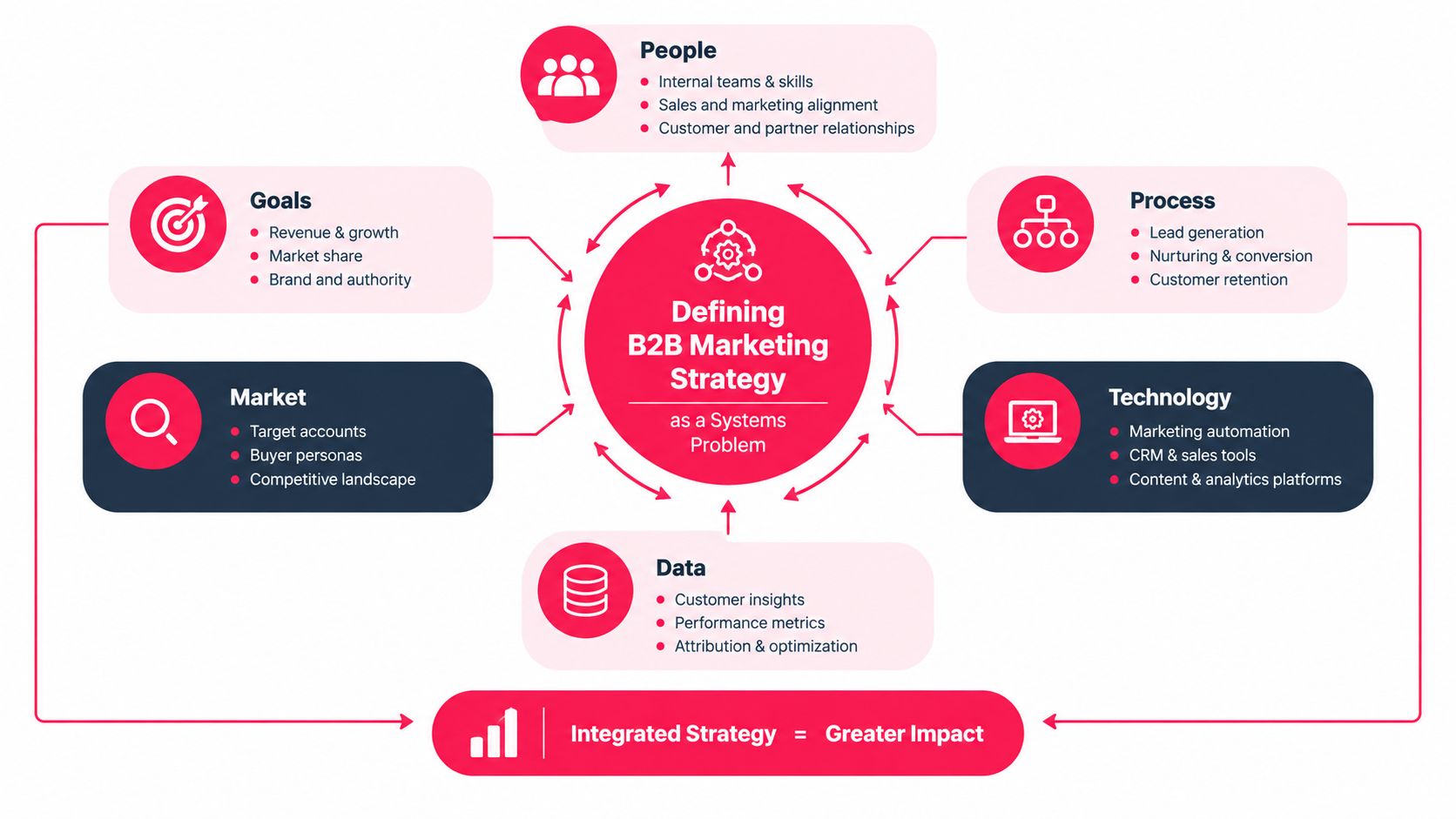
The distinction changes what gets built first. Content isn't the strategy. A blog post, webinar, landing page, or outbound sequence is an evidence unit inside a wider decision architecture. The architecture must answer four operational questions:
- Which account matters? Assign an ICP tier using firmographic, technographic, commercial, and fit signals.
- What decision is underway? Track problem identification, requirements, validation, supplier selection, and consensus work as account events.
- What evidence is missing? Decide whether the account needs technical proof, financial justification, implementation detail, or executive confidence.
- Who acts next? Route the next step to self-service, marketing, sales, customer success, or an internal approval owner.
A CRM such as HubSpot or Salesforce can hold the account and opportunity record. A CDP can help unify first-party events when the data quality and implementation budget justify it. Product analytics tools such as Amplitude can connect usage signals to expansion or qualification, while a warehouse and BI layer can preserve reporting flexibility. The exact stack matters less than the shared event definitions.
McKinsey's channel benchmark supports this systems view, while AdManage.ai's perspective on growth systems provides useful context for connecting acquisition work to broader operating processes. We also recommend formalising decision rights between marketing and sales through a sales and marketing alignment framework, especially when account ownership is unclear.
What the system must preserve
Use first-party identifiers and deterministic account matching where possible. Treat anonymous website activity as directional, not as proof that a named individual is ready for outreach. The system should preserve:
- Positioning: the same category claim and proof points across site, email, ads, and sales calls.
- Context: what the account has already seen, requested, rejected, or discussed.
- Qualification logic: consistent definitions for fit, intent, sales acceptance, and opportunity progression.
- Commercial evidence: pricing guidance, implementation constraints, security material, and customer proof in accessible formats.
The multi-channel buying-system research also supports evaluating channel performance at the account and opportunity level rather than by lead volume. A campaign that creates forms but fails to produce accepted opportunities is a cost centre with attractive reporting.
Why the Funnel Model Fails Modern Buyers
The funnel fails because buyers don't perform their work in the order the funnel assumes. Gartner identifies six recurring buying jobs: problem identification, solution exploration, requirements building, supplier selection, validation, and consensus creation. Buyers loop among these jobs as new stakeholders enter, requirements change, or evidence exposes risk. Gartner's B2B buying-journey research describes a decision process with repetition and backtracking rather than a clean descent toward purchase.
A technical lead may start with solution exploration, return to requirements after reviewing integrations, then pull finance into consensus creation. An executive sponsor may begin with problem identification after seeing a strategic risk, while procurement enters during supplier selection and reopens validation questions. One account can occupy several buying jobs at once.
Build assets that survive loops
A static content map assigns one asset to one stage. That approach breaks when a buyer returns to an earlier question. We build reusable decision assets that can serve several jobs without losing their purpose:
- Requirements guides help a team define what the solution must do before comparing vendors.
- Technical validation packs answer security, integration, data, and implementation questions.
- Business-case materials give an internal champion a defensible way to explain cost, risk, and expected value.
- Comparison pages clarify fit, exclusions, alternatives, and trade-offs without forcing a sales call.
- Consensus tools help several roles evaluate the same proposal through their own commercial or operational lens.
The asset should carry metadata in the CMS or content operations system, including target ICP tier, buying job, audience role, evidence type, owner, and review date. That lets marketing reuse material intelligently instead of producing another article because the editorial calendar has an empty slot.
The right question isn't “Which funnel stage does this lead occupy?” It's “Which buying job is blocked, and what evidence would remove the blockage?”
This changes the handoff to sales. A demo request after a pricing comparison means something different from a demo request after a broad educational article. The account record should retain those signals, while the seller decides whether the next interaction should clarify fit, address risk, or help create internal consensus.
How Buyers Choose Between Digital, Remote, and In-Person
Omnichannel doesn't mean forcing every buyer into the same path. McKinsey's 2024 research found an approximately equal split among preferences for in-person interaction, remote communication, and digital self-service. The commercial system must support all three without making the buyer repeat information when changing channels.
The financial evidence removes an old assumption about high-value deals. 73% of buyers were willing to spend more than $50,000 through self-service digital commerce or remote sales interactions, and digital self-service plus remote online sales generated 34% of B2B revenue among surveyed companies. Digital Commerce 360's coverage of the research explains why digital experience quality now affects commercial evaluation, not only early research.
Match channel to decision need
| Interaction channel | Willingness to spend >$50k | Willingness to spend >$500k | Willingness to spend >$1M |
|---|---|---|---|
| Self-service digital commerce or remote sales | 73% | 39% | 20% |
| In-person sales | Not stated in the verified data | Not stated in the verified data | Not stated in the verified data |
The thresholds above describe willingness through digital or remote interaction, not a complete preference breakdown by spend level. That distinction matters. Don't use the figures to eliminate field sales. Use them to decide whether your website, product information, pricing guidance, demo flow, and sales-assist handoff can support serious evaluation.
Digital self-service should handle general information, comparisons, documentation, and basic commercial orientation. Remote sales can add context when a buyer needs fit assessment, architecture discussion, or implementation judgment. In-person meetings remain valuable when the account needs executive confidence, complex consensus work, or relationship depth.
A practical routing model looks like this:
- Self-service: education, product detail, comparisons, documentation, and initial qualification.
- Remote sales: fit, solution design, risk questions, and commercial clarification.
- In-person: executive alignment, complex workshops, sensitive negotiations, and consensus repair.
Gartner's 2025 survey found that 61% of B2B buyers prefer an overall rep-free buying experience, while 73% avoid suppliers that send irrelevant outreach. Gartner's survey release supports a governed sequence: let buyers learn independently, then introduce people when judgment adds value.
The AI Trap Most B2B Companies Fall Into
The common AI project starts with a production target. The team asks an AI tool to generate more articles, social posts, emails, and ad variants. Output rises, but the company hasn't identified which bottleneck matters, what baseline exists, or whether the additional activity changes pipeline quality.
Adobe's 2025 B2B research found that only 38% of organisations had rolled out working AI solutions for marketing and customer experience. The same research found that 69% of marketing leaders said adoption was led by a self-trained marketing employee. Adobe's B2B research shows a governance gap, not an absence of enthusiasm.
Use AI where the feedback loop is short
At Stimulead, we treat AI as an execution layer inside a measured workflow. The first use case should have a clear owner, an observable baseline, an approval rule, and a commercial outcome. Good candidates include:
- Landing-page experimentation: generate and prioritise copy variants, then judge them by qualified conversion and opportunity quality.
- GTM engineering: research accounts, identify relevant triggers, and draft outreach that a seller reviews before sending.
- AI Search and AEO: structure product, comparison, and evidence content so answer systems can interpret it accurately.
- Agent-commerce readiness: prepare product data, eligibility rules, pricing logic, and fulfilment information for AI-mediated buying.
- Sales enablement: retrieve approved proof, objection handling, and technical documents without allowing unreviewed claims into customer conversations.
The metric hierarchy matters. Time saved and assets generated are productivity measures. Qualified landing-page conversion, sales acceptance, opportunity creation, win rate, margin, and customer value are commercial measures. An AI workflow earns expansion only when its incremental effect is visible in the second group.
AI adoption isn't strategic maturity. Strategic maturity means choosing fewer workflows, governing them properly, and stopping those that don't produce useful evidence.
A self-trained employee may discover an excellent workflow, but the company still needs data controls, prompt and output standards, human review, model access rules, and a documented owner. Otherwise the organisation creates shadow systems that sales, marketing, legal, and security can't audit.
Measurement Discipline for Mid-Market Teams
Orchestration fails when every team reports a different version of progress. A 2024 study of 487 marketing leaders found that only 23% could accurately measure campaign ROI across channels. The Starr Conspiracy's benchmark also places mid-market measurement around 22% pipeline contribution with 90-day cycles, while enterprise organisations commonly use longer than 180-day attribution windows and a 35% marketing-sourced pipeline target.
For a company in the $1M to $50M range, copying enterprise attribution often creates false precision. Lock the commercial metric and observation window before increasing campaign or AI-production velocity.
A workable measurement stack
- Sourced pipeline: opportunities where marketing created the first meaningful commercial entry.
- Influenced pipeline: opportunities where marketing evidence materially supported progression, with the influence rule documented before reporting.
- Opportunity win rate: compare account cohorts exposed to defined channel combinations, while recognising that cohort quality can differ.
- Sales-cycle duration: measure whether evidence and routing reduce avoidable waiting, not whether marketing gets credit for every day saved.
- Revenue per target account: assess whether priority accounts produce more commercial value than broad lead pools.
- Qualified conversion: connect landing-page action to sales acceptance and opportunity creation, rather than stopping at form completion.
The dashboard should show source, account tier, buying job, persona, channel combination, opportunity stage, and outcome. A data owner should audit CRM fields, campaign naming, account matching, and opportunity dates before each reporting cycle. We often pair this account view with controlled CRO experiments, because a higher form rate can conceal lower fit.
Teams evaluating advanced modelling can review modern MMM methods for 2026, but modelling won't repair missing event definitions. Our marketing effectiveness measurement guide covers the operating discipline required before advanced attribution becomes useful.
Building a 90-Day B2B Marketing Execution Plan
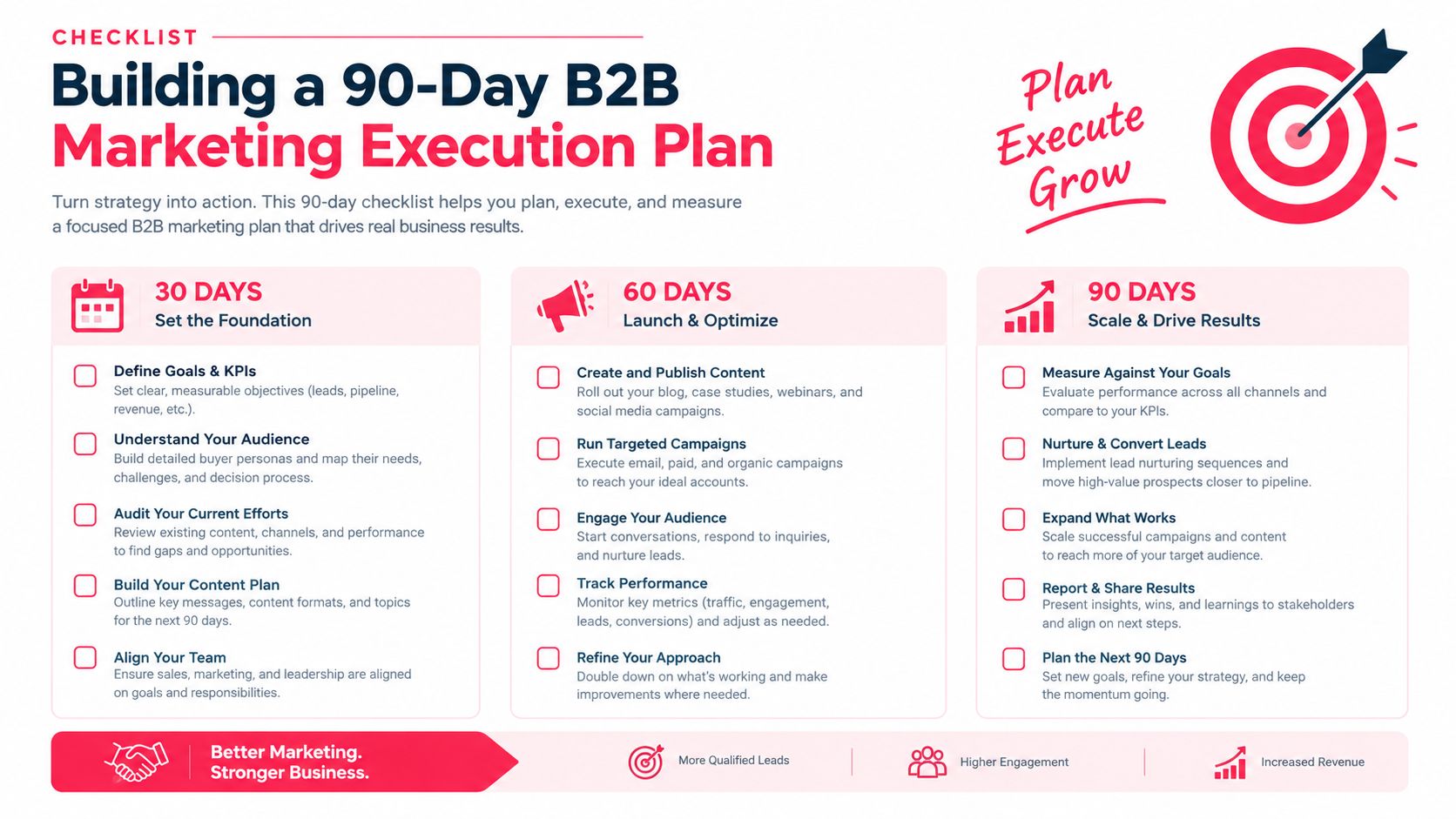
A 90-day plan should reduce uncertainty before it increases volume. We start with the data and decision architecture, then select a small group of revenue-linked workflows, and only afterward scale production or channel spend.
Days 1 to 30 establish the baseline
The first month belongs to diagnosis. Audit the website, CRM, marketing automation, analytics, paid accounts, sales sequences, content library, and account definitions. Interview sales and customer success to find where opportunities stall and where buyers repeatedly ask for missing evidence.
Document the current path from anonymous engagement to account match, accepted lead, opportunity, and closed outcome. Mark every break in context. If Salesforce records a contact but not the account's buying job, or HubSpot records a form but not the opportunity outcome, the team can't assess channel quality.
Select three AI workflows only. For a SaaS company, that might be landing-page optimisation, governed outbound intent sequences, and product-data preparation for AI Search and agent-commerce discovery. Give each workflow an owner, baseline, guardrail, review cadence, and stop condition.
Days 31 to 60 launch controlled tests
Create one decision brief per workflow. The brief should state the target account tier, evidence gap, user action, expected commercial signal, and data needed to evaluate the test. Keep the first CRO test narrow enough to isolate a headline, proof point, CTA, or form decision rather than redesigning the entire site.
For outbound, require an account trigger and a relevance check before an AI-assisted draft reaches a seller. For AI Search, prioritise pages that answer product, implementation, comparison, security, and commercial questions. For agent-commerce readiness, identify missing structured product information and approval rules before connecting an agent to live buying actions.
Track results weekly, but don't declare commercial success on early engagement alone. A workflow that saves time while lowering sales acceptance isn't ready to scale.
Days 61 to 90 tighten the operating model
By the third month, standardise the events and reports that survived review. Connect campaign, account, opportunity, and revenue data, then set the 90-day reporting window for the mid-market pipeline view. Publish a decision log showing which workflows continue, which require changes, and which stop.
Use the Stimulead go-to-market strategy template to assign owners, evidence requirements, channel rules, and measurement fields. The output should be a working system your existing marketing and sales teams can operate, not a slide deck waiting for a platform overhaul.
The Next Decision for Growth Leaders
You can keep adding channels and AI tools, or you can appoint ownership for the orchestration layer. The second choice requires someone with authority across marketing operations, sales process, data quality, content governance, and experimentation.
If AI, SEO, content, sales development, and CRM work remain separate projects, the strategy is incomplete. The buyer experiences one company, so the executive team must manage one commercial system.
The strategy-to-execution guidance for startups is useful for clarifying ownership and operating cadence, but the decision belongs with the CEO, CMO, and CRO. Assign an accountable owner, define the pipeline metric and 90-day window, and require every AI workflow to show its baseline and commercial outcome.
The next action is simple. Schedule a working session with your leadership team, map the account events you can currently measure, and choose the three workflows that deserve controlled testing. If you want an external operator to run that assessment, contact Stimulead to define the roadmap, governance, and first execution cycle.
