
Most advice says to hire an AI transformation consultant for a strategy deck. That's the fastest way to turn an operating problem into a presentation problem. The fee earns its place only when the consultant establishes baselines, redesigns workflows, assigns governance ownership, and produces evidence that the business now works differently.
McKinsey's 2025 State of AI survey found that 88% of organizations report regular AI use in at least one business function, while only 7% say AI is fully scaled across the enterprise. That gap is where advisory value either becomes measurable or disappears. At Stimulead, we advise CEOs, CMOs, and CROs to treat the consultant as a fractional operating leader, not another vendor supplying recommendations.
Table of Contents
- The Decision Behind Hiring an AI Transformation Consultant
- What an AI Transformation Consultant Actually Owns
- Which Engagement Model Fits the Operating Problem
- How to Prioritize AI Work That Can Scale
- What the Work Looks Like Across Business Models
- How to Sequence the First 90 Days
- How ROI and Governance Stay Under Control
- How to Hire the Right AI Transformation Consultant
The Decision Behind Hiring an AI Transformation Consultant
The executive decision is simple to state and difficult to make. You can keep funding disconnected pilots under existing owners, or you can give one accountable leader enough authority to connect AI work to conversion, pipeline, cost, and risk.
A company usually reaches this decision after several experiments have produced attractive demos without changing daily work. The common failure pattern is consistent: no baseline data, no workflow redesign, and no executive owner with authority to make adoption stick. A chatbot may exist, a sales assistant may generate drafts, and a marketing team may produce more content, yet finance still can't explain the effect on margin or pipeline quality.
The adoption gap makes the issue larger than internal frustration. McKinsey reports that 44% of respondents say AI is scaling across their enterprise, while 56% say they use AI in three or more functions. The same research found that 40% of respondents at organizations with more than $1 billion in revenue report scaling AI agents, up from 27% the previous year. Those figures describe broad activity, not proof of operating value.
Practical rule: Don't approve an AI initiative until someone can name the baseline, the workflow owner, the decision rule, and the condition for stopping.
For a growth-stage B2B company, the accountable role may be fractional. That doesn't make the mandate smaller. The consultant should coordinate marketing, RevOps, sales, finance, customer success, and engineering around a narrow set of owned changes.
The expensive mistake is granting strategic authority without implementation accountability. A consultant who can recommend tools but can't secure system access, define human review, instrument performance, or surface failed tests has sold advice. The operating investment begins when the consultant is responsible for evidence that the new process works.
What an AI Transformation Consultant Actually Owns
An effective AI transformation consultant owns the connection between opportunity selection and operating proof. The work spans seven deliverables, and each one needs an executive owner who can act when the evidence challenges the original plan.
The first deliverable is opportunity selection. The consultant filters the backlog against business metrics such as qualified pipeline, conversion rate, service cost, cycle time, or margin. Novelty isn't a valid selection criterion. A high-volume workflow with visible rework often deserves attention before an advanced agent with unclear ownership.
The second is baseline measurement. Before a model enters a workflow, the team records the existing output, time, error rate, cost, and quality measure. Without that record, a later improvement claim becomes opinion.
The third is workflow redesign. The consultant decides where model output enters the current process, who reviews it, what happens when confidence is low, and how the output reaches systems such as HubSpot, Salesforce, Intercom, or a data warehouse. Prompt quality matters, but process placement matters more.
Seven deliverables with accountable owners
Governance is the fourth responsibility. It covers data access, confidential information, model selection, prompt handling, audit trails, human review, vendor terms, and rollback procedures. A small company doesn't need a committee for every experiment, but it does need clear decision rights.
Implementation oversight is the fifth. The consultant coordinates internal builders and outside agencies, verifies that the workflow works inside production systems, and stops teams from declaring success after a demo.
Training and enablement form the sixth deliverable. Training should use the company's actual CRM fields, sales stages, content library, customer tickets, and approval rules. Generic prompt sessions rarely change behavior because they leave the operating context untouched.
The seventh is executive alignment and reporting. The consultant turns technical activity into a scorecard that leadership can inspect. McKinsey's AI value measurement framework points leaders toward revenue uplift, cost-to-serve reduction, margin improvement, and total cost of ownership, including cloud and token spend.
| Deliverable | Executive Owner | Proof Metric |
|---|---|---|
| Opportunity selection | CEO or functional executive | Approved use cases tied to business priorities |
| Baseline instrumentation | Finance or RevOps | Pre-change time, cost, conversion, or quality record |
| Workflow redesign | COO or functional leader | Documented process with human checkpoints |
| Governance framework | CEO, legal, security, or data owner | Risk register, review path, and rollback procedure |
| Implementation oversight | Engineering or operations leader | Production workflow accepted by the owner |
| Training and enablement | CMO, CRO, or people leader | Active use inside the defined process |
| Executive reporting | CEO and finance | Scorecard connecting activity to value and residual risk |
The consultant's coordination function is often the reason the role exists. Internal leaders can own their departments, but few can sustain cross-functional AI decisions alongside their normal operating load.
Which Engagement Model Fits the Operating Problem
The right engagement model depends on decision rights, internal capacity, and the evidence you need to produce. Price should follow the operating problem and the amount of implementation responsibility, not the consultant's preferred packaging.
| Model | Best Fit | Credible Evidence | Main Failure Risk |
|---|---|---|---|
| Advisory | Leaders with capable delivery teams | Prioritized roadmap and executive decisions | Roadmap sits unused |
| Team training | Teams with execution capacity and weak shared practice | Adoption inside defined workflows | Training becomes a one-off event |
| Ongoing partnership | Cross-functional change with immature governance | Baseline-to-post-change operating scorecard | Scope expands without decision rules |
Advisory works when the company already has builders, system owners, and a leader who can enforce prioritization. The consultant clarifies the roadmap, evaluates vendors, sets decision criteria, and supports executive decisions. This model underperforms when leadership expects the consultant to create change without giving anyone authority to implement it.
Team training fits a strong team that needs shared methods. A marketing group might need practical use of ChatGPT, Claude, HubSpot AI, or a content approval workflow. A sales team might need account research, call preparation, and CRM hygiene practices. Training should end with a working process and an owner, or it will be treated as professional development rather than operating infrastructure.
Ongoing partnership is the correct choice when marketing, sales, operations, and customer success depend on the same data or when governance is immature. It gives the consultant enough time to diagnose, redesign, test, document, and revisit decisions as evidence arrives. Stimulead offers executive advisory, hands-on team training, and an ongoing AI Growth Partnership, with the last model designed for continued fractional CAIO execution.
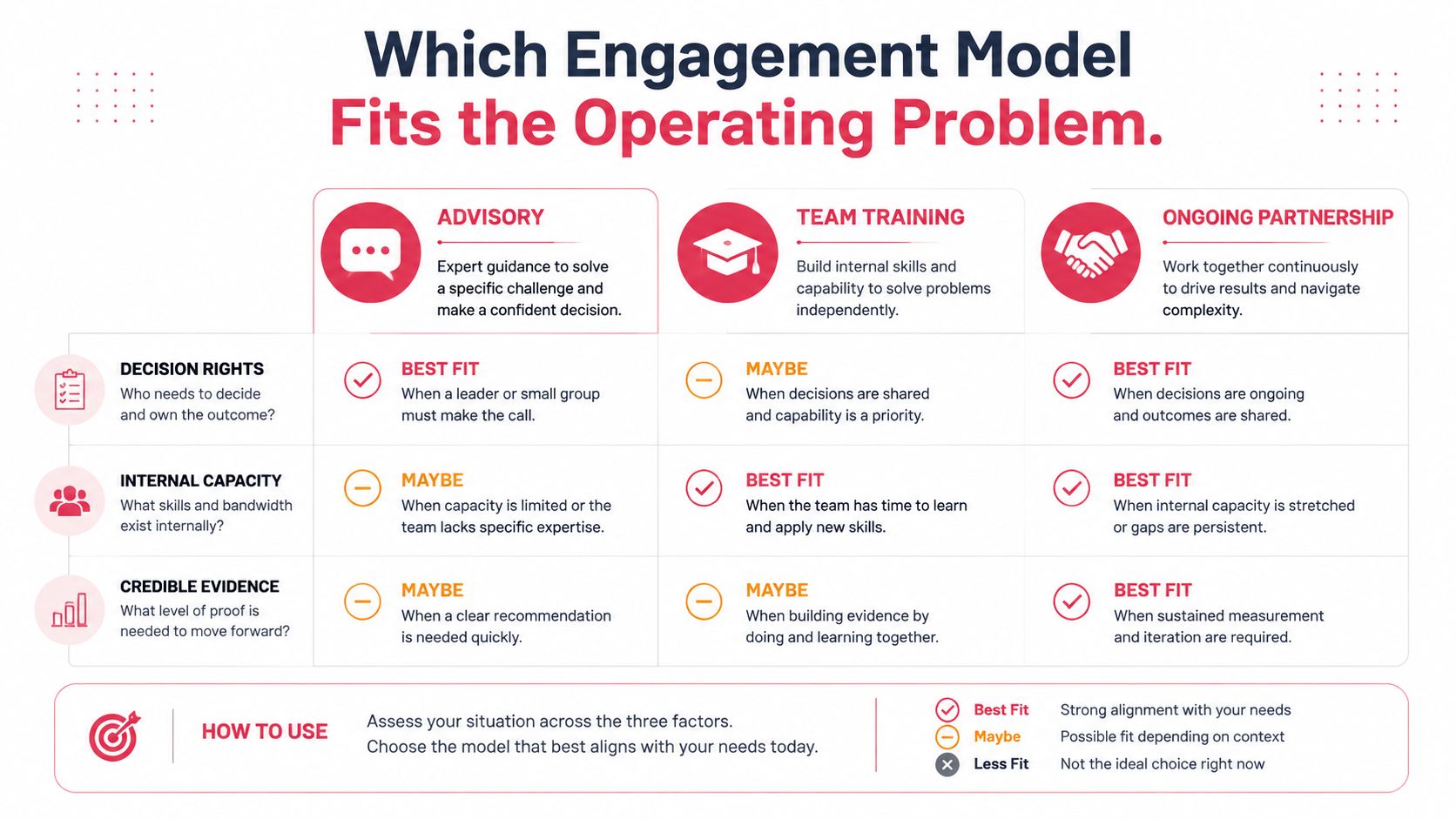
A buyer should ask one question before signing: What evidence can this model credibly produce? Advisory can produce better decisions. Training can produce team capability. Partnership can produce operating change, provided the client grants access and decision rights.
How to Prioritize AI Work That Can Scale
An AI backlog becomes expensive when leaders rank it by excitement. We recommend a weighted matrix that lets finance, operations, marketing, and engineering debate the same operating facts.
Start by auditing the workflow rather than the tool. Record volume, cycle time, error cost, rework, output per full-time employee, conversion contribution, and the proportion of the customer journey affected. If the team can't access those baselines, mark the initiative as measurement work before calling it an AI project.
A practical prioritization sequence
Describe the current workflow. Name each handoff, system, approval, exception, and human decision. Map what people do, not what the org chart says they do.
Assign one executive owner. A use case can involve several teams, but one leader must own the outcome. Shared ownership usually means delayed decisions.
Score the opportunity. Use business value, technical feasibility, risk burden, and adoption readiness. Give finance a seat in the scoring discussion because total cost includes implementation, operation, review, and retirement.
Define the redesign. Specify which task changes, what the model produces, where the output goes, and when a person must intervene.
Instrument before launch. Create the baseline dashboard, control condition, quality checks, and stop rule before the first production test.
Re-rank against observed evidence. Review the shortlist every 60 days against performance, adoption, pipeline signal, and operating cost. Retire weak candidates rather than protecting the original backlog.
Keep the active shortlist small enough for executives to inspect. A useful initiative brief contains the owner, baseline, target workflow, systems involved, governance burden, adoption plan, and decision date.
| Dimension | Question to Answer | Weight |
|---|---|---|
| Business value | Which financial or operating metric could change? | Set by leadership |
| Technical feasibility | Can the current systems support the workflow? | Set by engineering |
| Risk and governance | What data, model, process, or customer risk requires control? | Set by risk owners |
| Adoption readiness | Will the owning team use the process in daily work? | Set by the functional leader |
Don't allow a high novelty score to compensate for weak ownership. The best pilot is the one that can survive contact with a real queue, CRM record, approval path, customer interaction, or financial review.
What the Work Looks Like Across Business Models
An AI transformation consultant's remit changes with the operating model. The same model or automation pattern can create value in one company and add review work in another.
Growth-stage SaaS
The priority usually sits inside onboarding, activation, support deflection, and renewal motions. The consultant maps where users stall, where support agents repeat answers, and where customer success teams lack account context. Owners may include the VP of Customer Success, product leader, and RevOps lead, with activation rate, expansion ARR, ticket cost, and renewal quality serving as proof metrics.
B2B revenue organizations
The work centers on pipeline movement. An AI system might support account research, lead qualification, proposal preparation, call analysis, routing, or follow-up. The consultant must connect the workflow to CRM stages and inspect whether faster activity produces better opportunities, rather than counting generated emails as progress.
For conversion work, AI-powered experimentation has a more concrete testing case. A 2026 conversion benchmark report says AI-driven experimentation reaches statistical significance in an average of 14 days versus 21 days for traditional tools, and organizations running AI-powered testing report 2.7 times more tests per quarter. Those figures can support a testing-velocity case, but they don't replace a company-specific baseline or control design.
E-commerce
The consultant may focus on merchandising, lifecycle messaging, search assistance, product discovery, and returns reduction. The scorecard should connect the workflow to revenue per session, repeat purchase rate, contribution margin, and gross margin return on ad spend. Product recommendations that increase clicks while lowering margin don't qualify as a successful transformation.
Agencies and professional services
The transformation begins inside the delivery model. Leaders need to decide which AI-assisted services they can price, how teams will review outputs, and how quality control protects margin. Utilization, delivery time, revision load, and service-line margin matter more than the number of tools in the team's stack.
Across these models, we start with diagnosis, then redesign, instrumentation, and governance. We don't promise scale until the workflow owner can operate the process without constant consultant intervention.
How to Sequence the First 90 Days
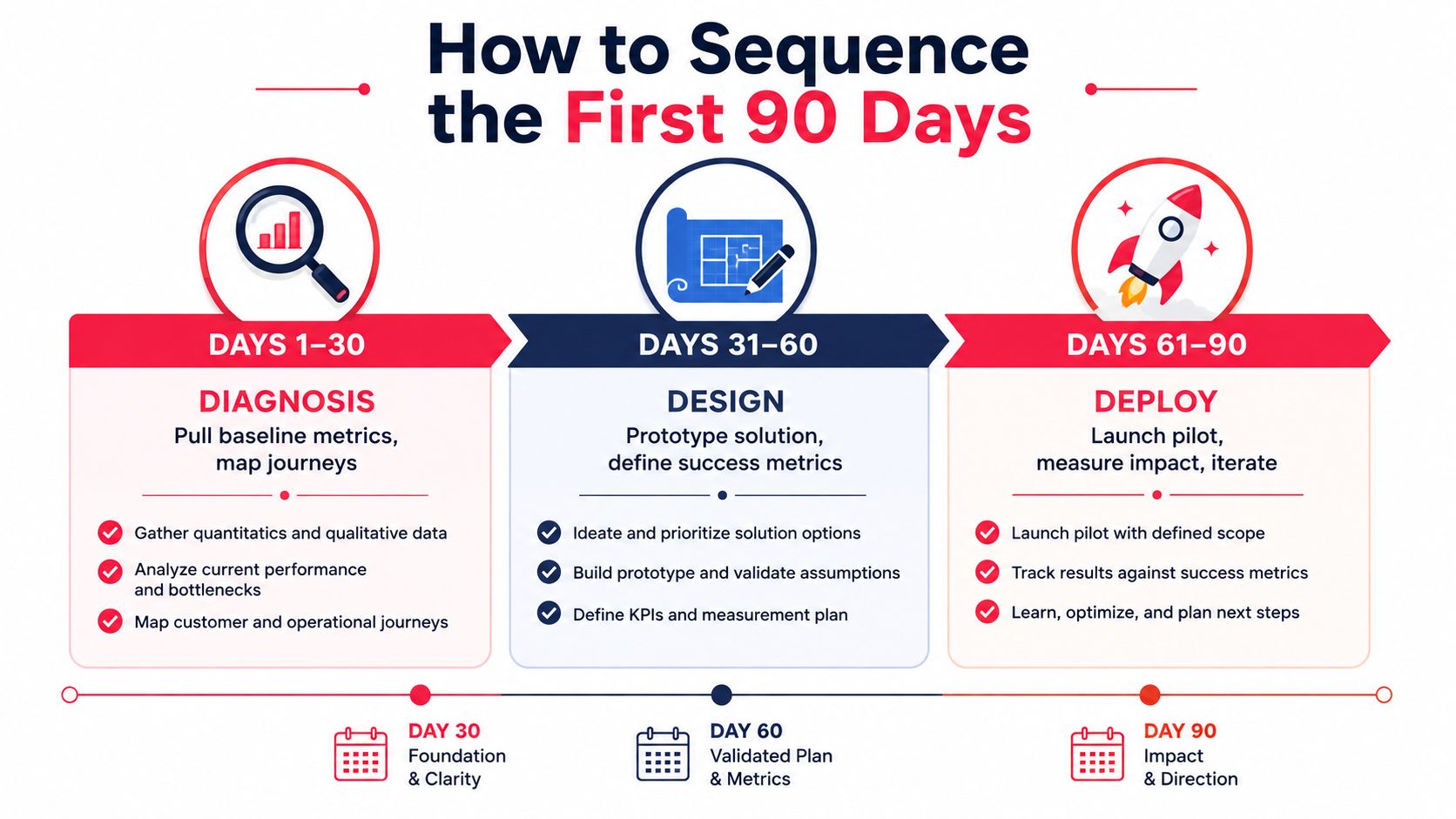
The first 90 days must produce a defensible operating record. The sequence is diagnosis, design, controlled deployment, and executive review. Treat the consultant's fee as an operating investment, and require evidence that workflows, ownership, and measurement are changing.
Days one through thirty: Diagnose
Pull baseline metrics for the priority journeys. Map handoffs, systems, data access, approval points, exceptions, and decision rights. Document where prompts, model outputs, customer data, and logs will live.
Interview the people doing the work. An executive-only process map usually misses manual reconciliation, hidden spreadsheets, and customer-specific exceptions that determine whether the workflow will function. Assign a process owner before testing begins.
Days thirty-one through sixty: Redesign and test
Choose the smallest credible workflow inside one clearly owned function, such as growth, RevOps, or customer success. Redesign the process before selecting the final tool. Define the control condition, quality threshold, human review, and failure response.
Test the workflow with production-like inputs. Record time, conversion, error, cost, and adoption measures. A failed test creates value when the team identifies the cause and changes the design. Hiding the result to protect a launch narrative wastes the investment.
Use Stimulead's AI implementation roadmap to structure the work around decisions, owners, and implementation evidence rather than a strategy deck.
Days sixty-one through ninety: Govern and decide
Lock model and vendor reviews, assign data and process owners, document human checkpoints, and establish rollback paths. Present a before-and-after scorecard that finance, executives, and the board can question.
Scale only what clears the agreed threshold. Redesign, recycle, or retire anything that does not. The 90-day endpoint is a decision point backed by evidence, not a permanent rollout.
The operating sequence also needs a clear explanation for the team responsible for execution:
Leadership should know whether to expand, redesign, pause, or stop.
How ROI and Governance Stay Under Control
AI ROI should sit on one executive scorecard. A conversion lift without implementation cost, a faster pipeline without quality checks, or lower ticket cost with rising customer risk gives leadership an incomplete answer.
McKinsey reports that more than 80% of organizations still aren't seeing tangible EBIT impact from generative AI efforts, and only 17% of respondents attribute 5% or more of EBIT to generative AI in the past 12 months in its measurement research. The implication for a consultant is direct: usage is an activity metric, not a financial result.
The scorecard leaders can interrogate
Set the baseline before deployment. For every weekly test, define the control group, the metric, the review date, and the decision rule. The rule might be to scale, revise, hold, or retire. Don't allow a team to declare success because users enjoyed the tool.
| Metric Category | KPI | Owner | Review Cadence |
|---|---|---|---|
| Conversion | Conversion rate and qualified opportunity rate | CRO or RevOps | Weekly |
| Pipeline | Stage velocity, response time, and forecast variance | CRO and finance | Weekly |
| Service cost | Cost per ticket, rework, and escalation rate | Customer success leader | Weekly |
| Financial value | Revenue uplift, cost-to-serve, margin change, and total cost of ownership | CFO | Monthly |
| Model risk | Data exposure, quality failures, drift, and review exceptions | Data, security, or legal owner | Monthly |
| Governance | Open risks, rollback readiness, and policy exceptions | CEO or designated AI owner | Quarterly |
Governance needs named ownership across data, model, and process risk. Review model behavior quarterly, set drift alerts where appropriate, and document what happens when the workflow produces an unsafe or low-quality output. Leaders can use this AI risk assessment and controls resource to structure the control discussion.
Public-company evidence shows why this work remains unfinished. ISS STOXX's analysis of 3,048 U.S. companies found that only 245 companies, or 8%, disclosed board-level AI oversight, while 275, or 9%, disclosed formal AI policies. PwC's board oversight guidance argues that oversight should cover strategy, capital allocation, operations, talent, culture, and risk, rather than technology alone.
Protiviti's 2026 Global Board Governance Survey found that 63% of boards in organizations with high AI ROI include AI on every board agenda, compared with 13% of boards in low-ROI organizations. Recurring executive attention doesn't guarantee value, but the comparison supports a practical conclusion: AI programs need a standing operating rhythm.
For a working governance structure, Stimulead's AI governance best practices provides a useful reference. The consultant should leave leadership with a dashboard that connects every initiative to financial impact, operating cost, and residual risk.
How to Hire the Right AI Transformation Consultant
Hire against the operating problem, not the consultant's fluency with AI terminology. A polished proposal can describe agents, copilots, and automation while avoiding the harder questions about ownership, instrumentation, and rollback.
Use this sequence:
Define the problem and decision rights. State the workflow, business metric, executive owner, systems involved, and authority the consultant will have.
Shortlist shipped implementation evidence. Ask for examples of workflows that reached production, the owner who operated them, and the evidence used to decide whether they stayed live.
Score the response. Assess measurement discipline, governance judgment, technical practicality, communication, and fit with the existing team. Wispra's guide to decision criteria for AI partners can help structure that review.
Buy a diagnostic. A paid diagnostic should produce workflow maps, baselines, prioritized initiatives, risks, decision rights, and a test plan. Don't select a partner because they supplied a free deck.
Contract for outcomes and evidence. Define deliverables around baselines, redesigned processes, tested workflows, governance ownership, and executive reporting. Hours can support the contract, but they shouldn't define success.
Questions that expose slideware
Ask candidates:
- Which baseline metrics did you instrument in a comparable engagement?
- What changed in the workflow after the model was introduced?
- Who owned the process after handoff?
- What failed, and what did you retire?
- How did you handle confidential data and human review?
- Which vendors and tools did you reject, and why?
- What will finance inspect at the first review?
Red flags include guaranteed financial results without access to baseline data, a roadmap that names tools without process owners, training detached from live workflows, and governance reduced to a generic policy document. Our explanation of what AI consulting involves gives buyers a useful reference for separating advisory work from implementation responsibility.
The right consultant behaves like a fractional operating leader. They should make decisions visible, expose weak tests, coordinate internal owners, and leave the company with a process it can run.
If your company has several AI pilots but no shared scorecard, schedule a working session with Stimulead. Bring your current tools, priority workflows, baseline metrics, and executive constraints. We'll help you decide which initiative deserves investment, which needs redesign, and which should be stopped before it consumes more budget.