
Most AI testing programs fail after adoption, not before it. A 2025 survey of more than 600 software developers found that three-quarters of teams using traditional, code-based automation had already adopted AI testing tools for test writing and maintenance, according to Rainforest QA's 2025 AI testing report. The decision for CEOs, CMOs, and CROs is whether to treat an AI testing framework as a benchmark utility or as production governance. We recommend the second option, because test coverage without release controls produces faster confidence in systems that can still fail in unfamiliar ways.
Table of Contents
- The Reliability Decision Most AI Testing Programs Skip
- The Four Test Layers a Framework Must Cover
- Metrics, Thresholds, and Probabilistic Evaluation
- Data Validation and Drift Control Across the Pipeline
- CI/CD Integration and Runtime Monitoring
- Governance, Roles, and the Skills Gap That Breaks Adoption
- What to Ship in the First 90 Days
The Reliability Decision Most AI Testing Programs Skip
Adoption is no longer the hard part. The AI-enabled testing market was estimated at USD 414.7 million in 2022, with a projection of USD 1.63 billion by 2030, representing an 18.4% compound annual growth rate from 2023 to 2030, according to Grand View Research's AI-enabled testing market analysis. A separate forecast estimated the market at USD 1.01 billion in 2025 and projected USD 4.64 billion by 2034, with an 18.30% CAGR over that period.
The business problem appears after procurement. Teams buy evaluation platforms, connect a model, generate a benchmark, and call the program operational. Then three signals expose the weakness:
- Flaky evaluations never become gates: Engineers watch unstable scores in dashboards but don't decide whether a release should stop.
- Prompts and retrieval corpora lack change windows: A prompt edit or document refresh reaches production without a recorded approval path.
- Production drift has no owner: Someone notices a refusal spike or irrelevant answer, yet nobody owns the response, rollback, or post-incident review.
This is why the adoption data matters. AI testing tools are being layered onto established QA stacks rather than replacing them, but layering software onto a pipeline doesn't create accountability. The framework must define what can ship, what requires review, and what triggers rollback.
Practical rule: Replace “did the model improve?” with “did the system become safer to deploy this week?”
For growth-stage B2B companies, reliability includes pipeline risk. A failed qualification agent can misroute an opportunity, a retrieval error can give sales the wrong account detail, and a prompt injection can expose internal context. Leaders who want a useful treatment of the trust problem can also read this analyst guide to AI trust.
The four layers below create the operating answer: component checks, full-chain checks, behavior preservation, and attack testing. Metrics make those layers enforceable. Data validation prevents contaminated evidence, CI/CD controls promotion, and governance assigns a human to every unresolved failure.
The Four Test Layers a Framework Must Cover
An AI testing framework should divide responsibilities between test layers. Repeating the same prompt check in four tools creates the appearance of coverage while leaving multi-agent behavior, retrieval errors, and policy bypasses untested.
| Layer | Catches | Example Assertion |
|---|---|---|
| Unit | Prompt construction, tool schemas, retrieval filters, guardrail logic | Retrieved records satisfy the required metadata filter |
| Integration | Orchestrator, model, tools, memory, and cost interaction | A multi-tool scenario stays below its approved spend cap |
| Regression | Behavior changes against known cases | A prompt revision doesn't change approved tone or edge-case handling |
| Adversarial | Prompt injection, jailbreaks, PII exposure, hallucinated citations, collusion | Mutated inputs can't bypass a policy block or trigger unauthorized tool use |
Unit tests isolate the components engineers change most often. Assert valid JSON schemas, required policy tags, allowed tool arguments, retrieval filters, and deterministic guardrail outcomes. A retrieval unit test should fail when a document from the wrong region or customer segment enters the context window.
Integration tests run the actual chain. Connect the orchestrator, model, tools, memory, and logging layer, then assert on tool-call order, refusal behavior, escalation routing, and cost ceilings for each scenario. A model may pass a tool-schema test and still call the wrong tool after a long conversation.
Regression tests preserve behavior that already works. Store frozen evaluation cases and golden transcripts, then compare semantic changes rather than relying only on exact strings. A regression diff should expose tone drift, missing qualification questions, or a new failure on an edge case that an earlier prompt handled correctly.
Adversarial tests attack the system deliberately. Mutate user inputs, insert hostile instructions into retrieved documents, request sensitive fields through indirect phrasing, and test whether multiple agents can pressure one another into violating policy. These cases belong in a separate suite because ordinary business prompts rarely expose them.
Skipping one layer creates a specific blind spot. Teams deciding how much manual review to retain should consult this comparison of manual checks and automation, then assign manual checks to ambiguous or high-impact cases rather than pretending automation can judge every output.
Metrics, Thresholds, and Probabilistic Evaluation
Exact assertions still form the spine of an AI testing framework. Schema validity, blocked tool calls, approved refusal behavior, and latency budgets should gate releases because they have clear pass and fail conditions.
Semantic quality needs a different approach. Faithfulness, answer relevance, task success, hallucination rate, and judge-model agreement vary across runs, especially when the same input can produce different outputs. The NIST-linked evaluation methodology requires a defined measurement target, an implemented evaluation, and result analysis, with reproducible evaluation code, data, prompts, or dynamic environments.
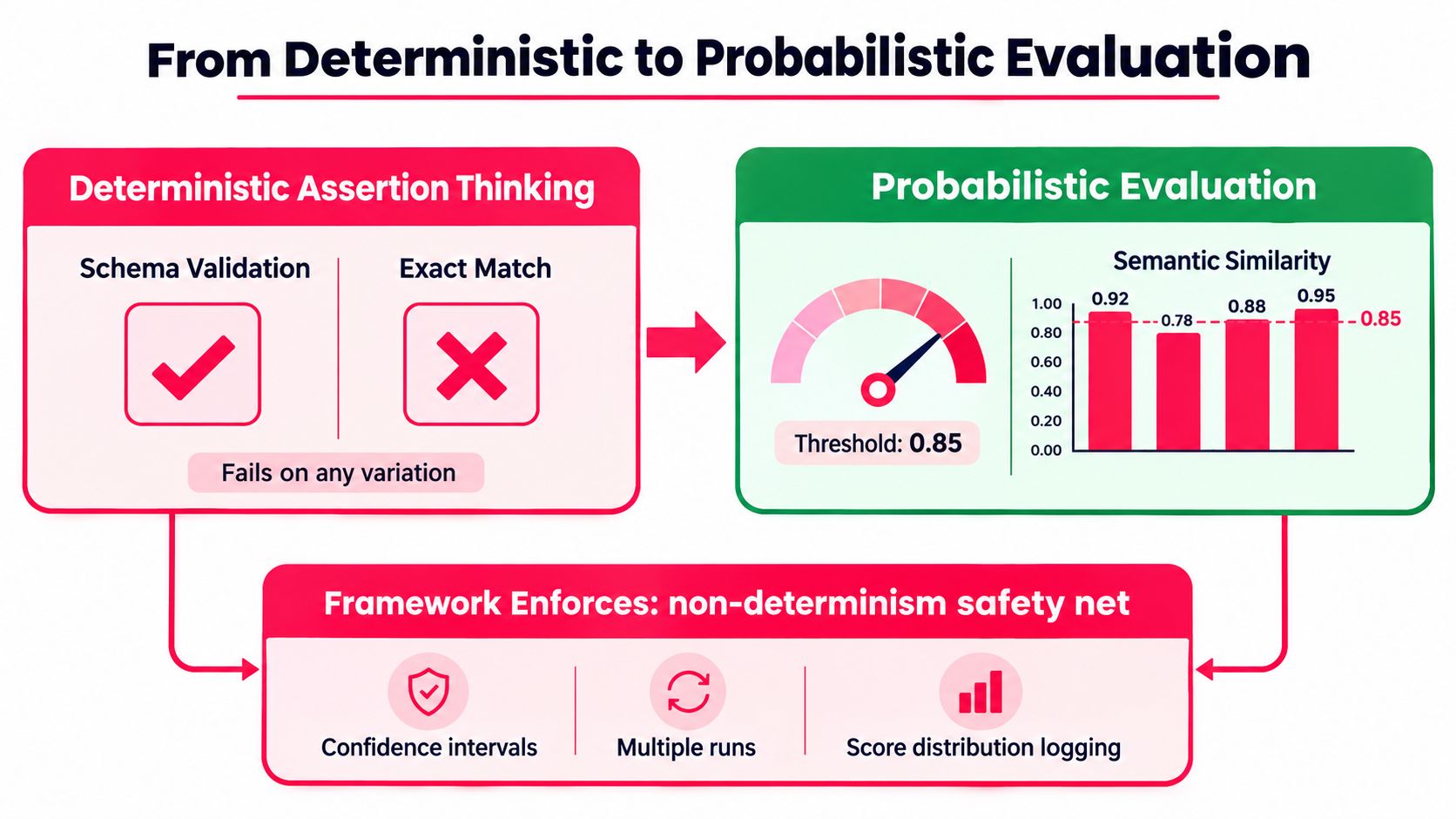
Run repeated trials and report the mean, p95, and run-to-run standard deviation. Separate warm and cold runs when latency matters, record excluded-run counts, and aggregate at the dataset level. A current methodology specifies three repeats per task, pass@1 scoring, and leaderboard results based on average pass rate across repeats, as described in the linked evaluation paper.
Threshold hygiene matters more than dashboard polish
Set a floor for each metric, with separate thresholds for hard prompts and long-tail cases. Add two-sided guardrails. A suspiciously large gain can indicate leakage, judge bias, or a broken evaluator, so “higher” shouldn't automatically mean “better.”
A single LLM judge isn't enough for a production decision. Use two judge models and define a Cohen's kappa floor, or conduct human spot audits on a sampled 5 percent slice. The sampling rule belongs in the framework configuration, not in an analyst's private spreadsheet.
Teams often celebrate a small metric lift while shipping a regression in tone, refusal quality, or factual grounding. For data teams establishing the upstream controls behind these metrics, monitoring data accuracy is a useful companion discipline. We also recommend documenting every metric's threshold, owner, dataset, judge, and escalation action in the same repository as the test.
A metric without a threshold and an owner is decoration. It may support a report, but it can't govern deployment. For teams designing controlled AI experiments, Stimulead's AI A/B testing guidance covers balanced control and treatment splits, experiment ID propagation, and production guardrails.
Data Validation and Drift Control Across the Pipeline
Bad evaluation data can make a reliable model look weak or an unreliable system look safe. An AI testing framework needs three checkpoints, each with a different failure target.
| Budget Band | Schema & Quality | Drift Monitoring | Annotation QA | Cadence |
|---|---|---|---|---|
| Lean | Great Expectations or Pandera | Basic distribution checks in existing observability | Internal review of sampled labels | Schema tests every PR |
| Managed | Great Expectations or Pandera with central reports | WhyLabs or Arize | Structured reviewer workflow | Eval refresh quarterly, drift review weekly |
| Six-figure program | Governed data contracts and audit trails | WhyLabs or Arize with incident routing | Labelbox or Scale | PR checks, quarterly refresh, weekly review |
The first checkpoint covers training and source data. Validate schemas, required fields, types, label distributions, and policy tags. The framework should catch schema skew and label rot before either enters training or evaluation.
The second checkpoint protects the evidence. Build hard holdouts that don't overlap with training or prompt-development material, probe for embedding overlap, and keep a signed manifest in controlled object storage. A frozen golden set is mandatory. Without one, the system is telemetry, not a framework.
The third checkpoint watches production traffic. Sample inputs and outputs, compare prompt and response distributions with the approved baseline, track refusal rates, and record vendor model identifiers. Silent vendor upgrades can alter behavior even when your application code hasn't changed.
Run schema tests on every pull request. Refresh the evaluation set quarterly, with a documented reason for each addition or removal. Review drift dashboards weekly, and route material changes to the model owner rather than leaving them in an analytics queue.
Data validation also needs business context. A drift signal in a low-value internal assistant may warrant observation, while the same shift in an agent that qualifies pipeline should trigger review. The threshold belongs to the user journey and its failure cost, not to a generic platform default.
CI/CD Integration and Runtime Monitoring
The framework should sit inside the delivery pipeline, with different failures assigned to different gates. If every signal blocks every release, engineers bypass the system. If nothing blocks promotion, the system becomes a reporting layer.

A practical gate policy looks like this:
- Commit: Run pre-commit linting and prompt unit tests.
- Pull request: Execute unit and integration tests. Block the merge on failure.
- Continuous integration: Run the golden-set regression suite. Block staging deployment when approved behavior regresses.
- Staging: Run adversarial probes and a shadow evaluation against a representative live-traffic sample. Alert on anomalies.
- Production promotion: Run judge-model evaluation. Require human review when the score falls below its threshold or cost per call rises beyond the approved ceiling.
- Runtime: Monitor latency, toxicity, refusal rates, tool errors, token cost, and sampled hallucination findings.
Use GitHub Actions or GitLab CI for orchestration. Promptfoo works well for regression cases, while OpenAI Evals can support hosted-model evaluation. LangSmith and Helicone provide trace and usage visibility, although trace visibility alone doesn't create a release decision.
Runtime evaluators should write structured events, not free-text notes. Route safety violations through PagerDuty, attach the prompt version and model identifier, and preserve the relevant trace for incident review.
The delivery pipeline also needs a warn-only category. Adversarial anomaly counts, judge disagreement, and mild distribution movement can warn while a human reviews them. Hard safety violations, invalid tool calls, broken schemas, and failed deterministic controls should stop the relevant gate.
The publishing layer can matter when teams expose AI-readable product information. Stimulead's guidance on LLMs.txt and machine-readable content is relevant for teams testing how AI systems interpret public product material.
The runtime signal should arrive after a substantive evaluation, not as a substitute for it.
Governance, Roles, and the Skills Gap That Breaks Adoption
Tooling doesn't solve an ownership problem. A working AI testing framework names the person who decides whether a failure is acceptable, who protects holdout integrity, and who responds when production behavior changes.
Assign three roles even if one person initially holds more than one:
- Model owner: Accountable for evaluation coverage, threshold proposals, model and prompt changes, and release evidence.
- Data steward: Signs off on holdout integrity, dataset lineage, label quality, access controls, and leakage investigations.
- AI risk reviewer: Owns incident response, safety exceptions, escalation criteria, and post-incident actions.
The skills gap is real. The 2026 coverage citing World Quality Report data says 50% of organizations lack AI and machine learning expertise, while generative AI was the most in-demand quality-engineering skill at 63%, as reported in this analysis of AI quality testing automation. The same coverage identifies data privacy risk at 67%, integration complexity at 64%, and hallucination or reliability concerns at 60% as leading QA adoption obstacles.
These constraints change the buying decision. A vendor can provide test runners and dashboards, but it can't supply your risk appetite, customer-specific holdouts, or escalation judgment. Senior ML engineers are difficult to hire, ML product managers are rarer, and red-team capability is thin in mid-market companies.
What the committee does each week
An internal AI testing committee shouldn't become a meeting that approves vague principles. It should review failed evaluations, ratify threshold changes, inspect drift incidents, approve vendor model swaps, and confirm that unresolved risks have named owners.
Governance is the control plane. Tooling without governance produces broken systems faster.
The procurement trap is replacing a two-week evaluation cycle with a one-shot vendor benchmark because the team lacks evaluation literacy. That saves calendar time while removing the evidence needed to compare behavior across prompts, datasets, and releases.
Our AI governance best practices provide a broader operating structure for ownership, review, and escalation. The principle is simple: the committee should make fewer decisions over time because the framework should turn repeated decisions into documented policy.
What to Ship in the First 90 Days
Don't begin by buying an evaluation platform. Begin by choosing the user journey where an AI failure would create the most serious operational or customer consequence, then build a thin vertical slice around that path.
| Period | Ship | Defer |
|---|---|---|
| Days 1 to 30 | One offline suite for the highest-volume prompt path, one deterministic guardrail test, a locked holdout dataset with signed manifest, and one regression job in CI | Broad platform procurement |
| Days 31 to 60 | Adversarial probes for the two failure modes with the greatest pipeline or customer cost, input drift monitoring, refusal-rate monitoring, and a weekly committee | Multi-agent simulation |
| Days 61 to 90 | Stable thresholds, production promotion gates, runtime alerting, and human review evidence | Synthetic data generation and formal model cards until baseline behavior is stable |
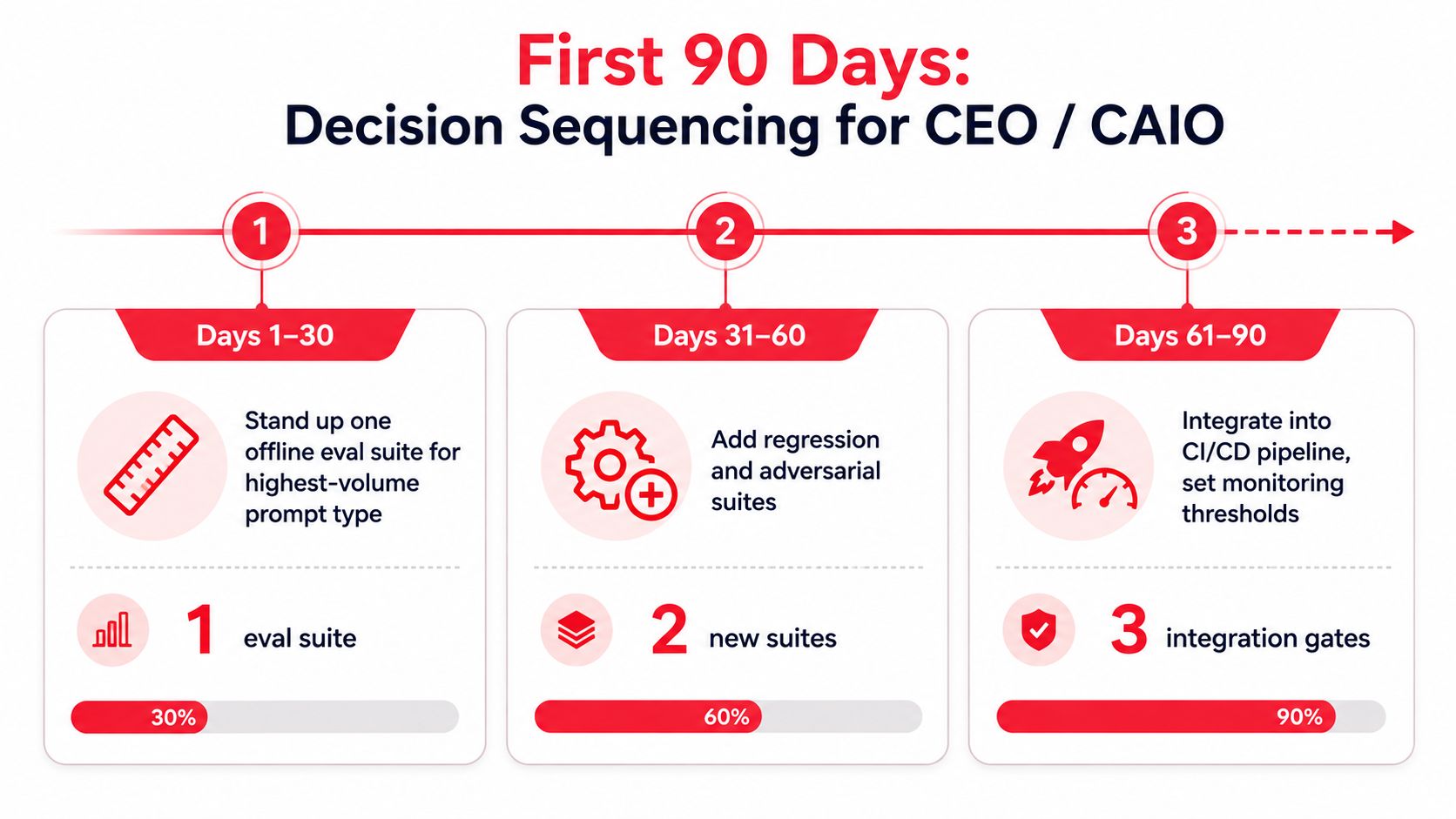
In the first month, keep the measurement surface narrow. A single well-instrumented journey teaches the team how to define pass conditions, preserve examples, review failures, and connect a test result to a release decision.
During the second month, attack the failure modes that matter most to the company. For a sales qualification agent, that may include incorrect routing or unsupported claims. For a customer-facing assistant, it may include prompt injection or disclosure of private account context. Use production-derived examples only when privacy controls permit it.
By the third month, connect stable evaluations to deployment and runtime monitoring. Don't add complex multi-agent simulation harnesses or synthetic data generation until the baseline is credible. A platform purchased before baseline ownership gives every future threshold a false sense of authority.
Pick the single user journey where an AI failure would trigger a Sev-1 incident. Instrument that journey end to end this week, including input, prompt version, retrieved context, tool calls, output, evaluator result, and release decision.
If your team needs an independent operating plan, Stimulead can map that journey, define the first evaluation suite, and assign the governance decisions your existing engineering and revenue teams can maintain. Book a working session through Stimulead's Fractional Chief AI Officer advisory and leave with a scoped first release rather than another disconnected AI tool.