
Most AI marketing advice starts in the wrong place. It begins with tools, content workflows, or trend watching. That's backward. If you can't prove AI changed revenue outcomes, you don't have a strategy, you have a spend line.
The market already says AI is moving from experimentation to operating practice. Statista-based reporting puts global AI marketing revenue at around $47 billion in 2025 and projects $107 billion by 2028. Independent 2026 research also reports 84% of marketing teams use at least one AI tool regularly, up from 61% in 2024 and 73% in 2025, with average AI marketing budget allocation rising to 14.8% of total marketing spend, from 8.3% in 2024 (Adobe research). That doesn't mean teams are managing AI well. It means the waste is now large enough to matter.
The useful question is simpler and harder. What changed in pipeline, conversion, CAC, or retention after AI touched the workflow? If you can't separate foundation spending from use-case spending, you can't answer that. That's where most programs stall.
Table of Contents
- Why Most AI Marketing Strategies Fail Before They Start
- Running an AI Readiness Audit Across Your Marketing Operation
- Prioritizing AI Use Cases That Move Revenue Metrics
- Designing KPIs That Prove AI Impact on Revenue Outcomes
- Building the Team and Vendor Model for AI Marketing Execution
- Executing a Phased Rollout With Testing and Governance Checkpoints
- Quick-Win Templates and Your First 30-Day Action Plan
Why Most AI Marketing Strategies Fail Before They Start
The failure usually starts in the operating model, not the model itself. Teams buy tools, automate a few assets, and label that an AI strategy for marketing. That creates motion, but motion does not prove revenue impact.
A stronger approach treats AI as a closed-loop operating system. The practical sequence is to define 2 to 3 revenue outcomes, map the marketing value chain, score use cases by impact, feasibility, and risk, then launch 2 to 3 instrumented pilots in 30 to 60 days and promote only the winners into playbooks (Pedowitz Group). That order matters because it forces the team to decide what AI is meant to change before a vendor demo shapes the plan.
Practical rule: if a use case cannot be tied to a metric you already review with finance or the board, keep it in the experimentation bucket, not the budget request.
The other failure is confusing adoption with improvement. A team can ship more campaigns, generate more copy, and still leave revenue flat. The true test is whether AI changed conversion rate, pipeline velocity, or cost per qualified action in a way you can isolate from baseline spending. McKinsey pushes leaders to work from diagnostics and track value creation in real time, while BCG emphasizes cross-functional governance and a small number of goals per quarter. That points to the core job: AI strategy is an accountability problem first, a tooling problem second.
The measurement piece is where many teams get sloppy. Foundation spending, data cleanup, taxonomy work, workflow integration, and model governance belongs in one bucket. Use-case spending, such as a personalized offer engine, a content workflow, or lead scoring, belongs in another. If those costs are blended together, nobody can tell whether the revenue lift came from the new capability or from the infrastructure required to run it. Stimulead AI readiness assessment is a useful way to separate those layers before you ask for a larger budget.
For teams that want a practical benchmark, Faberwork LLC's piece on Faberwork LLC on AI media workflows is a useful reminder that workflow design matters as much as output volume. The same logic applies in marketing. If your workflow does not measure impact at each step, faster production just means faster confusion.
Running an AI Readiness Audit Across Your Marketing Operation
Before you rank use cases, you need to know what can run. I've seen teams chase personalization and predictive segmentation while their source data was scattered across five systems and nobody trusted the event taxonomy. That's backwards. Audit first, then pick the workload.
Map the value chain before you touch the stack
Start with the full marketing path, from awareness through conversion and retention. For each stage, write down the current owner, core systems, handoffs, and the metric that defines success. Then ask where AI could reduce friction, speed a decision, or improve targeting.
IBM's definition is a good operating baseline. It frames AI in marketing as using data collection, data-driven analysis, NLP, and ML to produce customer insights and automate marketing decisions. IBM also says the first steps are to set goals, adhere to data privacy regulations, and test the quality of data before scaling (IBM). That sequence is sensible because weak data and unclear goals make every later decision expensive.
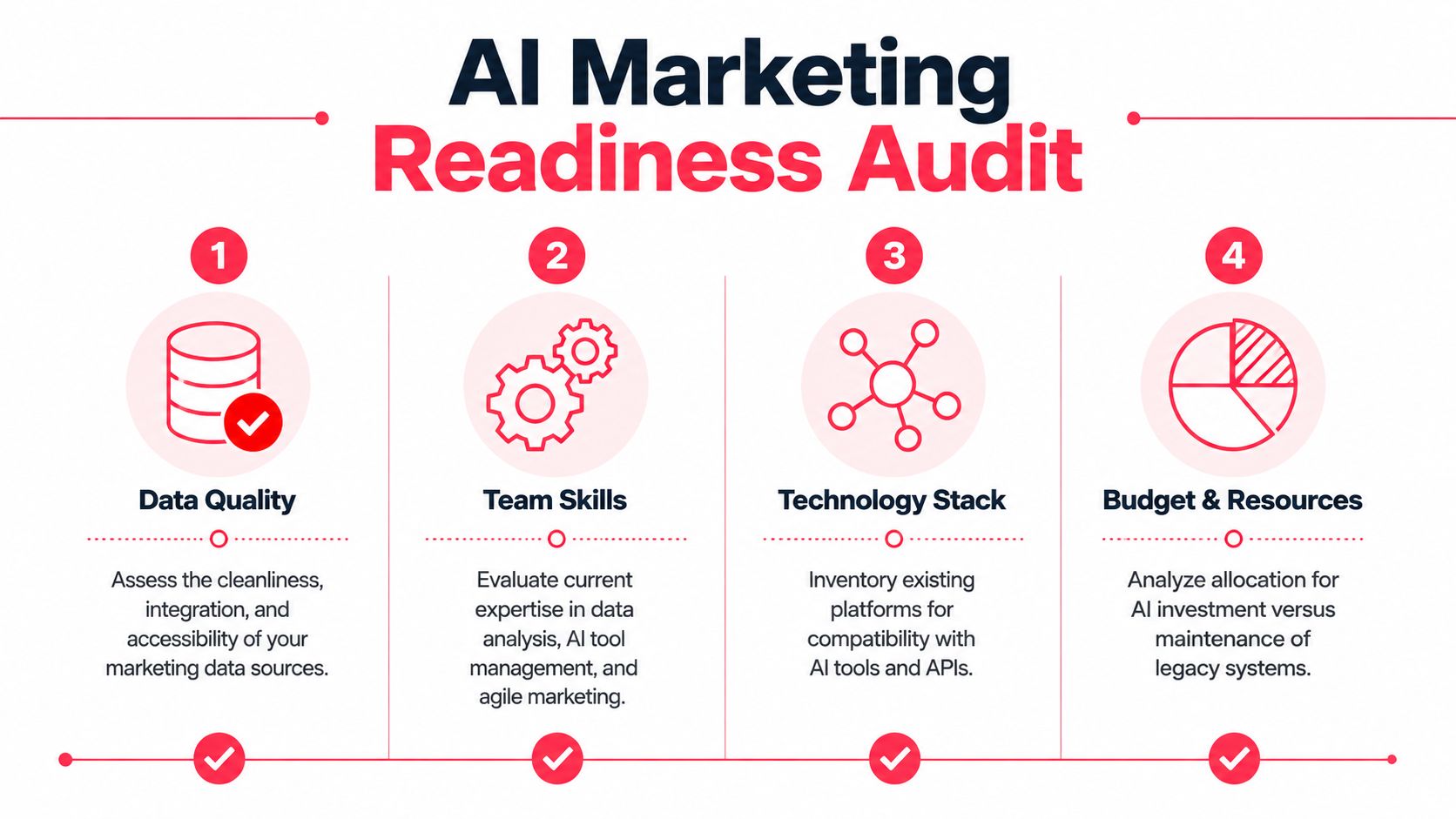
A useful audit has four dimensions.
- Data quality and accessibility: Are the key datasets clean, connected, and available without manual exports?
- Technology stack integration: Do your CRM, MAP, analytics, and content systems support automation and API-based workflows?
- Governance and compliance: Who approves use cases, reviews privacy risk, and documents model behavior?
- Team skills and capacity: Can the current team manage prompts, testing, analytics, and workflow change without burning out?
If you want a structured worksheet, compare your notes with the AI readiness assessment from Stimulead. It's a practical reference point for teams that need to move from opinion to decision. For a broader process view, AdStellar AI's marketer's guide to AI automation is also worth reading because it keeps the discussion tied to implementation instead of hype.
Present the audit as a decision memo
The output shouldn't be a colorful slide deck. It should be a readiness memo with three sections, what can launch now, what needs light cleanup, and what must wait for infrastructure work. That format pushes leadership toward action instead of debate.
The clearest signal is whether the team can support instrumented pilots quickly. If the answer is yes, move to use case selection. If the answer is no, the audit has already saved money by preventing a premature rollout.
Prioritizing AI Use Cases That Move Revenue Metrics
A useful AI strategy for marketing starts with a hard filter, revenue impact, feasibility, and risk. Growth-stage teams do not have room for projects that look impressive but never show up in conversion or pipeline math. A use case with weak attribution is a distraction. A smaller use case with clean measurement can fund the next one.
Rank by impact, then feasibility, then risk
The strongest candidates usually sit close to revenue motion. In practice, that means CRO with AI, GTM engineering, AI search optimization, and agent commerce readiness. These are the areas where a small gain in conversion quality, response speed, or discovery can change pipeline outcomes in a way leadership can see.
A workable prioritization rule is to cap the number of active goals and map them across the full workflow. That keeps the team from spreading budget across too many pilots at once. It also protects testing velocity, because each extra initiative adds noise to attribution and slows the learning loop. BCG points in the same direction with its emphasis on focused AI goals and end-to-end workflow mapping, and that ceiling is the right one for many teams.
Use a simple matrix in the review room.
| AI Use Case | Revenue Impact | Feasibility | Risk | Priority Score |
|---|---|---|---|---|
| CRO with AI | High | Medium to High | Medium | Highest |
| GTM engineering for hyper-personalized outreach | High | Medium | Medium | High |
| AI search optimization for LLM recommendations | Medium to High | Medium | Medium | High |
| Agent commerce readiness | Medium | Medium to Low | Higher | Selective |
| Broad content automation | Low to Medium | High | Medium | Lower unless tied to a funnel KPI |
The matrix matters because it forces a trade-off conversation. Content generation has its place, but the highest-priority work is usually where AI changes who gets reached, who converts, or how fast the team can test. Braze's staged adoption guidance follows the same logic, starting with lower-risk tasks, then moving into personalization and predictive segmentation, and only later into real-time journey optimization (Braze).
If you need a practical reference for deciding whether a use case is worth funding, the marketing effectiveness measurement framework is a useful companion. It helps teams separate a project that feels active from one that can be tied to outcome changes.
If you work with a vendor or partner in this space, keep the model narrow. Stimulead works across CRO with AI, GTM engineering, AI search optimization, and agent commerce readiness. That is a relevant fit for teams that need strategy connected to revenue work, not just more content output.
Kill visible projects that do not map to revenue
The most expensive mistake is funding an AI project because it looks modern. If it does not touch a KPI that leadership already owns, it belongs lower on the list. I have seen teams spend months on polished automation work that never changed conversion behavior.
Use the scoring review to force the decisions. If a use case scores high on impact but low on feasibility, narrow the scope until it can be tested cleanly. If it scores high on feasibility but low on revenue, keep it as a side experiment instead of a funded priority. That is how you protect testing velocity without pretending every AI idea deserves a launch.
Designing KPIs That Prove AI Impact on Revenue Outcomes
The hard part of AI strategy for marketing is not deployment. It is measurement. Teams can show asset volume, workflow automation, and prompt activity, then still fail to prove that AI changed revenue. If the KPI set does not separate motion from impact, the project looks busy and the business case stays weak.
Split foundation spend from use-case spend
Foundation spending pays for the plumbing. Use-case spending pays for tests that should move a business metric. Keep those two buckets separate, or you will blur infrastructure work with revenue work and call both progress.
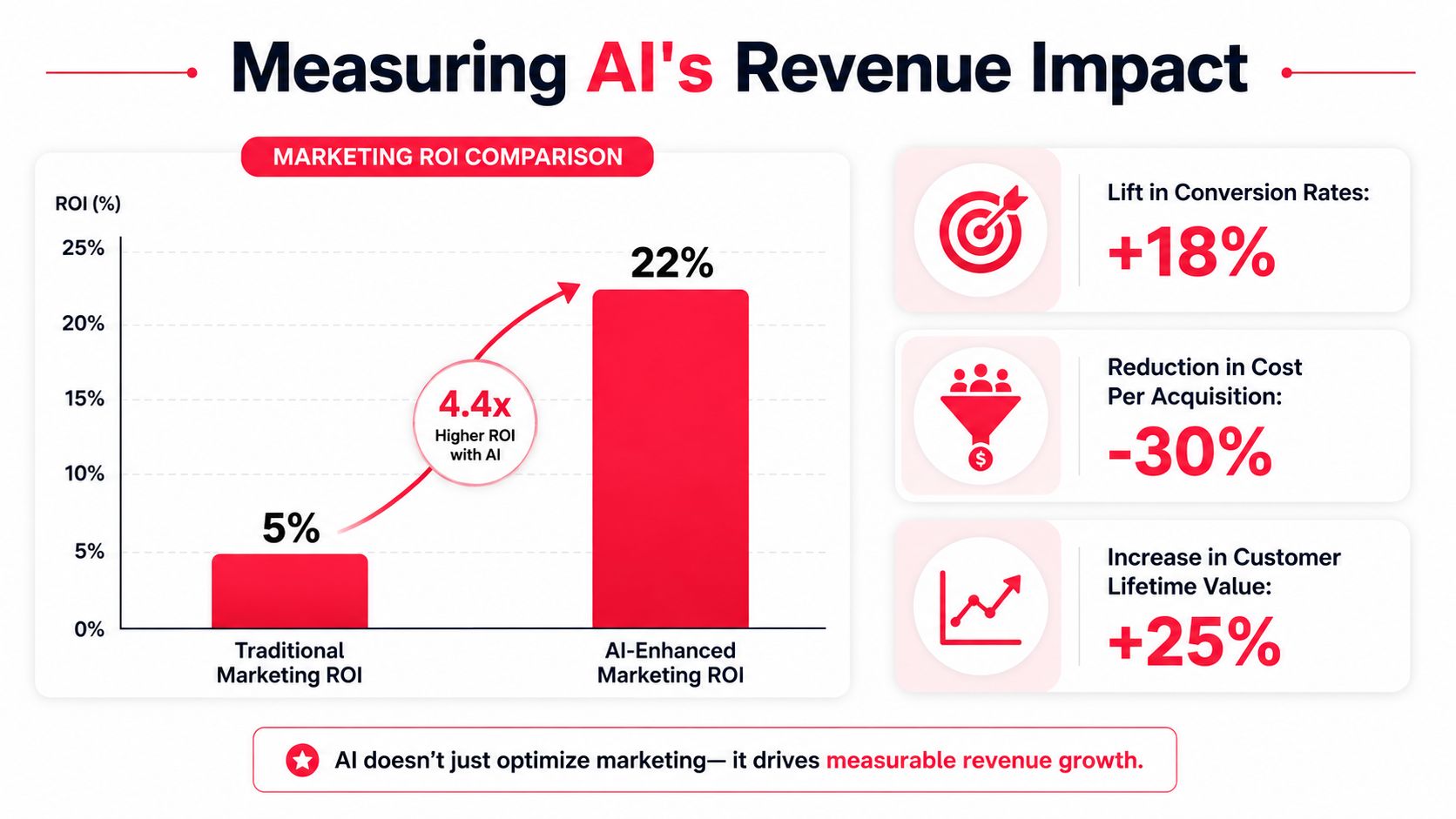
A clean KPI stack starts with that split. Track input metrics for the foundation layer, such as models configured, data connections established, and workflows in production. Track output metrics for the use-case layer, such as conversion rate lift, pipeline velocity, CAC reduction, and retention improvement.
The mistake is treating input metrics as proof of success. They only show that the team shipped something. Revenue owners need evidence that the intervention changed behavior, and that the change was not just random channel movement.
A board-ready measurement plan starts before rollout. Capture the baseline, define the target metric, set the experiment window, and name the owner for each data source. Then compare the result against a holdout, a control group, or a pre-post benchmark when a clean control is not available. If the channel cannot isolate the intervention, the result stays directional.
Do not ask whether AI was used. Ask whether a controlled test moved the metric, and whether the lift held when the test was repeated.
For teams building the measurement frame, the how to measure marketing effectiveness guide is a useful reference. It keeps the conversation on causality, business lift, and whether the result is real enough to fund again.
Make the review cadence finance can trust
Weekly channel reviews should focus on test quality, traffic volume, and directional movement. Monthly business reviews should focus on revenue contribution, pipeline influence, and cost efficiency. Those layers answer different questions, and mixing them creates false confidence.
A practical KPI rhythm keeps the experiment layer separate from the finance layer. The first layer tells you whether the test is clean enough to believe. The second layer tells you whether the result matters to the P&L. If a test lifts conversion but only in a tiny segment, it may be worth expanding. If it lifts activity but not revenue, it belongs back in the experiment queue.
The video below is useful for teams that need to explain the logic internally.
When leadership asks whether AI worked, the answer should be plain. We tested it, isolated the change, measured the result, and checked whether it scaled. Without that sequence, the numbers will not survive scrutiny.
Building the Team and Vendor Model for AI Marketing Execution
AI strategy breaks fast when ownership is fuzzy. Marketing owns the brief and the business goal, engineering owns the integration, finance owns the spend discipline, and legal owns the guardrails. If those lines are not explicit, the work drifts into review loops and no one is accountable for revenue impact.
Keep the operating core small and accountable
The strongest AI marketing teams I have seen do not look like standing committees. They work better as a small cross-functional core that can approve, test, and stop work without waiting on a long chain of meetings. That matters because the first sign of trouble is often not a model failure, it is a stalled workflow that never reaches a live audience.
A clean operating model usually gives each person one clear job.
- Core owner: owns the roadmap, KPI hierarchy, and priority order.
- Workflow operator: runs prompts, QA, and channel tests.
- Technical partner: handles data access, integrations, and logging.
- Commercial reviewer: checks budget fit, revenue logic, and whether the result is worth scaling.
That structure keeps the experiment tied to the P&L. It also prevents a common failure mode, where marketing waits on a vendor for every small change and the test velocity collapses.
Cross-functional gaps usually show up in capability, not enthusiasm. A team may have strong campaign instincts but weak AI workflow skills, or plenty of tool access but no one who can connect outputs to revenue reporting. Stimulead's AI skills gap resource is useful for pressure-testing where those gaps sit before you hire around them.
Choose vendors by fit with the stack, not by the pitch
Vendor selection goes wrong when teams buy a point solution before they define the integration requirements. The tool looks good in a demo, then it cannot talk to the CRM, the data warehouse, or the reporting layer that finance uses. Agency relationships fail for the same reason when the team can produce content but cannot instrument experiments or maintain the measurement system after launch.
A better way to buy is to match the partner to the job. Executive advisory fits roadmap and governance decisions. Hands-on training fits teams that need practical workflow adoption and better prompt discipline. A fractional CAIO model fits leaders who want ongoing execution oversight and a direct line between AI decisions and revenue outcomes.
The right partner should also be able to explain the measurement plan before the work starts. If they cannot describe how the workflow will be logged, tested, and reviewed after launch, they are selling activity, not execution.
Vendor rule: if the partner cannot explain how the system will be measured after launch, they are selling activity, not execution.
Build versus buy is narrower than many teams assume. Build when the workflow is a core competency and needs to stay differentiated. Buy when speed matters more than uniqueness. That is the trade-off that keeps the stack from filling up with tools no one uses, and it forces the team to spend foundation dollars only where they create reusable capability.
Executing a Phased Rollout With Testing and Governance Checkpoints
Big-bang AI rollouts usually fail because they ask too much of the data, the team, and the governance process at once. A phased rollout gives you a cleaner path. It also keeps the business from spending foundation money everywhere before the first pilot proves where the lift really comes from.
Start with low-risk work, then move up the stack
Start with tasks where a mistake is easy to contain, then move toward workflows that touch revenue more directly. Subject line generation, FAQ chat, and draft assistance are safer places to learn because they expose the team to model behavior without putting the entire customer journey at risk. Once the workflow is stable, move into personalization, predictive segmentation, and campaign tuning.
That sequence matters because adoption activity is not the same as revenue impact. A pilot can look busy and still do nothing for conversion rate, pipeline, or retention. The better test is whether the AI-assisted workflow changes the outcome compared with the old process, not whether people used the tool.
A practical 30, 60, 90 rhythm keeps the rollout honest.

- 30 days: finish the audit, align stakeholders, and launch one low-risk use case.
- 60 days: expand the pilot only if the baseline comparison is clear, connect it to a live workflow, and run A/B tests.
- 90 days: review performance, document the decision rules, and set the monitoring cadence for what stays in production.
That cadence fits the way phased programs reduce risk and make it easier to isolate incremental impact. It also helps separate foundation spending, things like data prep, logging, access controls, and evaluation setup, from use-case spending tied to a specific workflow. If the foundation is working, it should support more than one pilot. If the use case is working, it should show a lift that survives comparison against the control group.
Put governance in the calendar, not the slide deck
Governance works only when it is part of the operating rhythm. Quarterly reviews should examine risk incidents, model drift, performance lift, and operational savings, which is consistent with guidance on responsible AI oversight from Gartner and Forrester. That keeps the conversation tied to business results, not just output volume.
Weekly channel reviews catch issues early. Monthly business reviews tell you whether the pilot is still earning its place. Every experiment should have a kill switch so weak tests stop quickly instead of consuming attention and budget for another month.
If a pilot cannot show movement against the baseline, pause it. That is not a failure of AI adoption. It is a sign the use case, the data, or the measurement design needs work before the team puts more capital behind it.
The strongest rollout teams do one thing well before they add the next. They prove the workflow, verify the measurement, and only then expand the scope. That is how you keep the program tied to revenue outcomes instead of activity.
Quick-Win Templates and Your First 30-Day Action Plan
The fastest way to move is to make the first pilot painfully concrete. You need a scoring sheet, a baseline tracker, and a pilot charter. Without those three artifacts, the team will keep renegotiating the goal.
Use three templates, then force one decision
The scoring sheet should rank each use case by revenue impact, feasibility, and risk. The baseline tracker should capture the current metric, the comparison group, and the review cadence. The charter should name the owner, the goal, the guardrails, and the kill switch.
A simple first-month plan works well for growth-stage teams.
- Week 1: finish the audit, agree on the business outcome, and choose one pilot.
- Week 2: set the baseline, prepare the data, and confirm governance.
- Week 3: launch the pilot and inspect the first results.
- Week 4: review the lift, decide whether to scale, and document the lesson.
The key decision is scope. If privacy or stack limitations create friction, start with a narrower use case instead of delaying the whole program. If the team lacks the skill to run the pilot well, fix the process or bring in a partner before expanding. If leadership wants a faster path, the Stimulead Fractional Chief AI Officer advisory is one way to keep the roadmap, vendor choices, and KPI design tied to revenue rather than activity.
The next move is straightforward. Put 30 minutes on the calendar with your marketing, sales, and finance owner, review the audit, and choose the single AI use case most likely to change revenue in the next quarter. That meeting should end with one owner, one metric, and one pilot start date.