
Most advice about an ai search optimization agency starts in the wrong place. The decision that matters is whether you want a vendor that can change how your content, PR, and analytics teams work, or a vendor that can only redraw old SEO reports with new labels.
If you want to understand the work before you hire for it, our AI search optimization playbook walks through what a program covers.
Table of Contents
- Why Traditional SEO Vendors Struggle with AEO
- Technical and Content Criteria for Vendor Selection
- RFP Questions That Expose Repackaged Services
- Redefining KPIs for AI Search Visibility
- Integrating AEO into Existing GTM Workflows
- Governance and Implementation Oversight
Why Traditional SEO Vendors Struggle with AEO
Traditional SEO vendors often assume they can bolt Answer Engine Optimization onto the same workflow they use for blue links. That assumption breaks fast, because answer engines reward direct, self-contained answers, clear structure, and evidence the model can extract cleanly, not pages padded with filler and keyword repetition. Microsoft's guidance on content for AI search says the content has to be fresh, authoritative, structured, and semantically clear, and it also warns against long walls of text, hidden answers, and vague phrasing Microsoft on content for AI search.
A traditional agency often stops at technical hygiene. That's useful, but it isn't enough when the engine is selecting snippets, parsing entities, and citing only a small set of sources. If a vendor still treats schema as a box to tick instead of a way to mirror visible page content, they're probably still selling legacy SEO with a new acronym.
Practical rule: if the agency can't show how it turns one page into machine-readable answer blocks, it doesn't have an AEO process.
We see the same pattern in vendor pitches that lean on traffic graphs and keyword dashboards. Those artifacts matter less when the goal is citation eligibility inside generative answers, where the content structure itself is part of the ranking signal. If you want a live example of what answer-first presentation looks like in a real interface, review the WebinOne AI search beta and judge whether the output looks like a search result page or a repackaged content crawl.
Technical and Content Criteria for Vendor Selection

A serious vendor should be able to prove production discipline, not just creative taste. Ask how they run benchmark testing across answer engines, how they decide which pages to rewrite, and how they verify that schema reflects what users can clearly see on the page. For a practical comparator on implementation hygiene, the features of a reliable scraping API are a decent proxy, because an AEO team needs dependable collection, repeatability, and structured outputs.
What to inspect before you sign
Production workflow audit. Ask where drafts are created, reviewed, and shipped. If the agency can't describe the path from brief to live page, they're not set up for iterative AEO work.
Entity and schema coverage. Demand a map of topics, entities, and page types. Good vendors can explain why a page needs schema and when schema would be noise.
Citation tracking setup. They should be tracking which engines cite your brand, which competitors appear, and where citation gaps persist.
Content quality controls. You need a factual review step, not just an edit for tone. That matters because AEO fails when answers drift from the source material your sales team already uses.
Tooling integration. The vendor should plug into your CMS, analytics, and reporting stack without forcing a parallel process. If they rely on exports and manual spreadsheet cleanup, the workflow will slow down inside one quarter.
Practical rule: strong AEO vendors can show the last three content updates they shipped, the signals they changed, and the citation movement that followed.
A useful internal benchmark is our own content optimization for large language models guidance, which reflects the same operating standard we use when reviewing content architecture for clients. It's a better benchmark than a polished pitch deck because it tests whether the vendor can structure content for machines and humans at the same time. If they can't explain their prompt set, answer formatting, or review loop in concrete terms, they're still selling presentation, not implementation.
RFP Questions That Expose Repackaged Services
A good RFP should make a weak agency uncomfortable. Start with questions that force them to reveal how they test, measure, and revise, because repackaged SEO teams usually hide behind broad promises.
First, ask which 10 to 20 high-intent questions they test against multiple answer engines. HubSpot's AEO workflow recommends that fixed prompt set and says performance should be measured with brand mentions, citations, share of voice, and AI referral traffic, not classic rank alone HubSpot on answer engine optimization. If the vendor can't name the prompts or explain why those prompts matter to your pipeline, they probably haven't built a real testing system.
Second, ask how often they rerun those prompts. Testing velocity matters because citation gaps change quickly, and a slow vendor will miss the window where your pages are still eligible for selection. A third question should target hallucination risk, especially around product claims, integration details, or legal positioning.
Use these five questions in sequence:
What exact prompts are in your benchmark set, and why were they chosen?
A vague answer usually means the agency has no repeatable research process.How do you record citations by engine and competitor?
If they talk only about impressions or traffic, they're measuring the wrong layer.What changes do you make when the model misstates a fact?
A strong answer mentions source correction, content restructuring, and tighter page summaries.How do you handle sensitive claims in regulated or technical categories?
Weak agencies dodge this. Good ones talk about review gates and source control.What would make you pause or roll back a recommendation?
If they never admit to uncertainty, they're probably overconfident.
For a deeper screen on vendor risk, our AI vendor risk assessment framework is a useful internal reference point. The red flag isn't a missed answer, it's a vendor who treats every question as a branding exercise instead of an operational one. That kind of team usually disappears the moment the first content refresh is due.
Redefining KPIs for AI Search Visibility
Legacy SEO reporting still has a place, but it can't be the scoreboard for AEO. A page can rank well and still miss the answer box, while a cited source with modest traffic can influence a higher-intent visitor who arrives through an AI-generated answer. Industry benchmarking now treats visibility share and source citation as a separate performance layer, which is the right direction for board reporting Conductor on answer engine optimization.
| Legacy SEO Metric | AEO Performance Metric |
|---|---|
| Keyword ranking position | Brand citation inside AI answers |
| Organic sessions | AI-referred visits |
| Click-through rate | Share of voice in generative answers |
| Backlink count | Source inclusion by answer engine |
| Average session duration | Conversion quality of AI-referred traffic |
If you need a reporting stack that's simpler than the old enterprise SEO suites, the Raven Tools alternative discussion from Keyword Kick is a useful comparison point for modern reporting workflows. What matters is not the dashboard brand, it's whether the dashboard can separate cited, uncited, and competitor-owned answer space cleanly enough for executives to act on it. We have seen too many teams report “visibility” when they really mean unverified impressions.
Board rule: ask the agency to report citations by topic cluster and by page type, then pair that with AI-referred conversion quality, not raw visit volume.
The right KPI set forces discipline. If the vendor only brings organic traffic slides, they're still operating in the old model. If they can show citation movement, share of voice shifts, and how those signals relate to qualified pipeline, then they understand the measurement problem that matters.
Integrating AEO into Existing GTM Workflows
AEO fails when it sits outside revenue operations. The agency should sit close to product marketing, sales enablement, and PR, because the facts models ingest need to match what your teams already say in decks, pages, and outbound sequences. When those sources conflict, the model can surface the wrong version of your story and your sales team pays for it later.
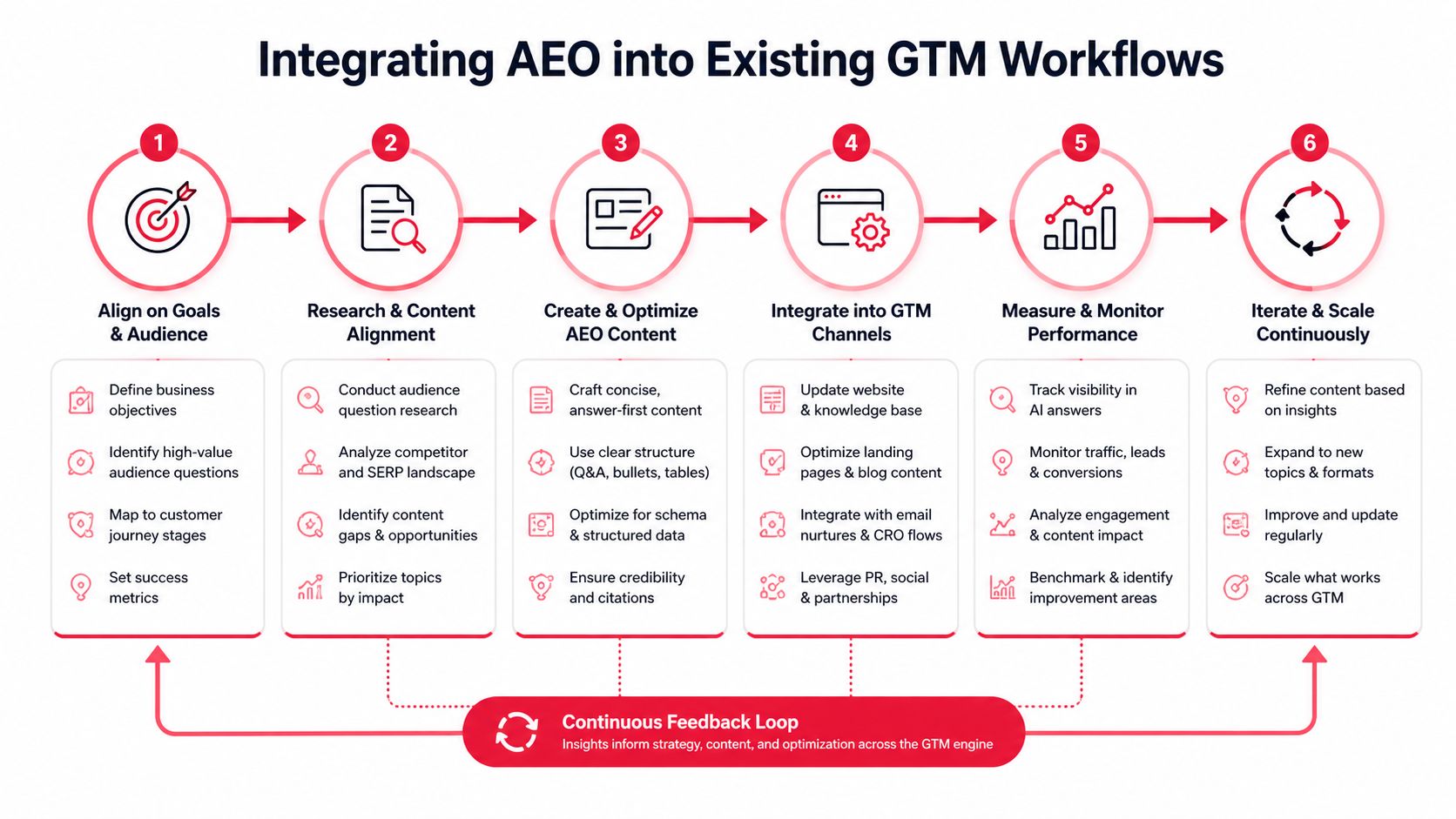
You also need a working rhythm, not a one-time project handoff. Product launches, pricing changes, case studies, and customer proof points should all flow through a single content source of truth before the agency rewrites pages for answer engines. If your PR team publishes one message and your website says something slightly different, the agency will spend its time cleaning up internal inconsistency instead of improving citation odds.
Here is the operating pattern we recommend:
Centralize source material. Keep approved claims, proof points, and product language in one place.
Assign owners. Product marketing owns messaging, SEO owns structure, PR owns external authority, and the agency coordinates execution.
Review before publish. Every page update should pass a factual check.
Sync with sales. Sales enablement should know which claims were changed so reps don't repeat stale language.
Track after release. AI answer appearance, citation quality, and referral behavior should be checked after every major update.
Feed back into planning. Use the results to decide what to rewrite next.
Stimulead's own AI Search & AEO work sits in this same operating model, with gap analysis across ChatGPT, Claude, Gemini, and Perplexity, plus content restructuring and citation strategy. That matters because the agency output only has value when your internal teams can keep the claims current and the messaging consistent. Without that integration, you get a detached content program that won't survive the next product change.
Governance and Implementation Oversight
The right agency still needs supervision. A fractional Chief AI Officer, or a senior internal owner with authority across marketing and operations, should control the review cadence, approve scope changes, and stop any tactic that creates brand or privacy risk. If nobody inside the company owns the system, the vendor will optimize for activity instead of accountability.
We recommend a tight governance loop with three decisions on the table at all times. First, what changed in the source material. Second, what the agency rewrote. Third, whether the new version is safe to publish across the website, sales materials, and external content. That cadence keeps the work tied to business reality rather than the agency's billable plan.
The biggest risk is drift. Once the agency starts producing more content and more structured data, small factual errors can spread across pages, summaries, and sales collateral. A good internal owner keeps that from happening by enforcing version control, reviewing high-risk claims, and asking for rollback when a page starts surfacing the wrong message.
For a practical governance framework, our AI governance best practices page lays out the type of oversight we use with clients who need board-level control. If your team can't define who approves claims, who owns privacy review, and who signs off on cadence, the engagement is too loose. The next move is to appoint the owner, set the review path, and make the agency work inside that system, not around it.
If you're evaluating an ai search optimization agency this quarter, start with the operating model, not the slide deck. Ask for their prompt set, their citation tracking method, and their governance process, then make them show how the work fits your GTM stack before you sign anything.
