
Grant Thornton found that 78% of business executives lacked strong confidence they could pass an independent AI governance audit within 90 days Grant Thornton AI impact survey. That is the decision in front of a growth-stage CEO right now, buy a polished policy deck, or buy an operating model that can survive scrutiny when the audit clock starts.
Table of Contents
- The 90-Day Audit Risk Most Governance Programs Miss
- What AI Governance Consulting Actually Does
- The Three Frameworks That Show Up in Every Engagement
- Engagement Scopes, Deliverables, and Price Ranges
- Where AI Governance Consulting Fails in Practice
- A Maturity Model Built for Growth-Stage Operators
- How To Select a Consultant Who Ships Controls
- The Next Decision To Make This Quarter
The 90-Day Audit Risk Most Governance Programs Miss
The biggest mistake we see is treating AI governance as a document project. A policy can look complete and still fail the first serious procurement review because nobody can show how it works in production.
Practical rule: if your team can't produce evidence, the governance program doesn't exist yet.
That is where ai governance consulting earns its keep. In real growth-stage SaaS and B2B tech environments, the failure mode is usually simple, there's no inventory of agents in production, no approved chain for high-risk actions, and no evidence trail tying decisions to deployed systems. Auditors don't fail companies for lacking slogans, they fail them for lacking controls.
The operating gap is bigger than most CEOs expect. A board can approve a principle set in one meeting, but a customer security review will ask for records, logs, owners, and escalation paths. If the consultant can't connect those items to live systems, the work is decorative.
Our own experience inside growth-stage teams has been consistent. The programs that hold up are the ones that start by naming the systems already shipping, then assigning accountable owners, then making approval and review part of the delivery process. The programs that collapse are the ones that leave those decisions for later.
A useful internal reference point is the difference between strategy and implementation. Stimulead's AI implementation roadmap is one example of how to turn a plan into execution steps, but governance needs the same discipline, except the output is evidence, not only speed. If the roadmap doesn't create traceable controls, it won't help when someone asks who approved the release.
What AI Governance Consulting Actually Does
AI governance consulting has three jobs in practice. Everything else is packaging.
It turns frameworks into controls
ISO/IEC 42001:2023 gives organizations an Artificial Intelligence Management System with policies, objectives, and processes, then runs it through Plan-Do-Check-Act cycles ISO/IEC 42001. The consultant's job is to convert that structure into controls a revenue team and engineering team can follow, including role definitions, documented development and deployment procedures, monitoring, and continual improvement.
That's the difference between a framework and an operating model. A framework tells you what good looks like. A consultant should tell you who does what on Monday morning.
It stress-tests board and auditor readiness
Board-level readiness is where many programs break. One recent survey found almost half of boards had not agreed on an AI position, and only 2% had a formal governance framework with clear accountability and regular reporting Grant Thornton AI impact survey. That gap matters because leadership can't defend what it can't document.
A serious consulting engagement includes tabletop exercises, evidence collection, and a gap map against incoming obligations. For growth-stage buyers, the best outside resource we've seen on board responsibility is governance responsibilities for AI systems, because it frames oversight as an accountability function, not a legal afterthought.
It installs mechanics in live production
The systems already shipping need inventories, monitoring, incident paths, and approval gates. The NIST AI RMF says organizations should have policies, processes, procedures, and practices across the business for mapping, measuring, and managing AI risks, and that legal and regulatory requirements involving AI must be understood, managed, and documented NIST AI RMF 1.0.
That matters because governance isn't a slide deck. It's a set of working habits attached to the AI lifecycle.
A useful adjacent resource for implementation-heavy teams is achieve CMMC compliance with automated testing, since it shows how control evidence gets operationalized in another audit-heavy domain. The pattern is similar, control design only matters if someone can prove it ran.
The Three Frameworks That Show Up in Every Engagement
The framework choice matters less than the operating decision behind it. Growth-stage teams usually need to decide what kind of evidence they must produce, who owns it, and how often the controls get reviewed.
| Framework | Primary Use | Forces You To Document | Owner Assignment Required | Re-Review Cycle |
|---|---|---|---|---|
| ISO/IEC 42001 | Auditable AI management system | Policies, objectives, processes, lifecycle controls | Yes, for roles, procedures, monitoring, improvement | PDCA cycle |
| NIST AI RMF | Risk management across AI systems | Mapping, measuring, managing, legal and regulatory handling | Yes, for risk ownership and documentation | Ongoing risk cycle |
| OECD AI framework | High-level governance and risk framing | Scope, context, actors, criteria, risk treatment, governance of the process | Yes, for risk ownership and escalation | Repeated risk process |
ISO/IEC 42001:2023 makes sense when leadership needs a certifiable management system and is willing to carry the documentation load that comes with it. In practice, that trade-off is about discipline. The stronger the external proof requirement, the more the work shifts toward lifecycle control, role clarity, and repeatable review.
NIST is the better fit when the company already has security, privacy, or risk routines and wants AI controls to fit inside them. The framework is useful because it pushes teams to connect mapping, measuring, and managing to legal and regulatory handling without forcing a full management-system program. For many growth-stage operators, that is the difference between a control set that gets used and one that sits in a folder.
The OECD framework helps most at the decision layer. It gives executives a way to define scope, context, risk criteria, and proportionate treatment before the team starts building controls. That makes it useful for board conversations and policy language, but it does not replace the practical work of inventorying agents, assigning owners, or setting approval gates.
A good consultant does not start by recommending a logo. They start by asking what you need to defend, who will ask for it, and where the evidence will live. If your team wants a practical operating baseline, our AI governance best practices resource is a useful companion to that choice process.
The right mix is usually contextual. Some teams use one framework as the control spine, then borrow language from the others to satisfy procurement, audit, and executive review. Others need a lighter decision matrix because their real gap is not framework selection, it is control ownership. The point is to choose the framework that matches the evidence burden, not the one that sounds cleanest in a slide deck.
A control-heavy team should also keep the evidence problem in view. The same lesson shows up in achieve CMMC compliance with automated testing, where proof matters more than policy intent. That pattern carries directly into AI governance when agents are already in production and someone has to show what was approved, what was monitored, and what changed.
Engagement Scopes, Deliverables, and Price Ranges
The right engagement depends on where the company is stuck. Growth-stage buyers usually purchase one of five scopes, and each should produce written artifacts, not vague workshop notes.
| Engagement Type | Typical Duration | Core Deliverables | Price Range (USD) |
|---|---|---|---|
| Audit-readiness sprint | 4 to 6 weeks | Gap report, prioritized remediation backlog, risk classification | $15K to $40K |
| Framework selection | 4 to 8 weeks | Decision matrix tied to geography, industry, procurement requirements | $20K to $60K |
| Policy and control build | 6 to 12 weeks | Control library mapped to ISO 42001 or NIST AI RMF, named owners, review cadence | $50K to $150K |
| Implementation oversight | 8 to 20 weeks | Approval matrix, agent inventory, model card templates, monitoring thresholds wired into ticketing | $75K to $250K |
| Fractional CAIO retainer | Monthly | Weekly cadence, board-level reporting, incident review, governance leadership | $8K to $15K monthly |
An audit-readiness sprint works when the company knows it has gaps and needs proof fast. The deliverable should be a prioritized backlog tied to actual systems, not a generic recommendations memo.
Framework selection is a narrower exercise. It should end with a decision matrix that accounts for customer geography, industry pressure, and procurement expectations. If a consultant can't explain why one framework fits your buyers better than another, they're selling familiarity, not judgment.
Policy and control build is where buyers often under-buy. It's tempting to stop at policy wording, but control libraries, named owners, and review cadences are what auditors inspect. That's where the work becomes operational.
Implementation oversight is the most underrated scope. It's the point at which someone has to wire approval logic, inventory processes, and monitoring into the systems engineers use. In our client work, this is usually where the governance program stops being theoretical.
Stimulead's own advisory model fits naturally here as one option for teams that want governance tied to execution, since the firm works as a fractional CAIO layer for strategy, implementation oversight, and board-ready reporting. The important point is fit, not prestige.
Where AI Governance Consulting Fails in Practice
Four failure patterns show up again and again in growth-stage engagements.
Policy-only deliverables
The glossy binder is the most common miss. It looks complete in a board meeting, but it doesn't tell engineering what to do, doesn't tell sales what's approved, and doesn't tell a customer security reviewer where the evidence lives.
Framework-first consulting
Some consultants recommend ISO 42001 or NIST AI RMF before they inventory what's already in production. That produces controls that sound impressive but cover nothing deployed. The company then discovers, too late, that the framework was chosen before the actual use cases were understood.
If the consultant starts with the standard before the inventory, the engagement is backward.
Over-governing low-risk work
A lot of teams waste time reviewing internal summarization tools as if they were customer-facing agents. NIST's playbook says organizations typically apply a risk-tolerance approach where higher-risk systems receive larger allocations of risk-management resources and lower-risk systems receive fewer resources NIST AI RMF Playbook. That sequencing rule matters because governance capacity is finite.
No evidence of control execution
This is the one that sinks programs in procurement. If the consultant can't produce approval logs, tested incident playbooks, or model performance baselines, the program exists only in workshops. It may sound compliant, but it won't survive scrutiny after an incident or during a vendor review.
The good news is that these failures are easy to screen for if you ask for operational proof up front. Ask to see how they connect policy to production, and watch what happens.
A Maturity Model Built for Growth-Stage Operators
Most companies don't need a “best in class” AI governance program. They need the right next step for the stage they are in.
Tier 0 through Tier 4 in practice
| Tier | Current State | Matching Consulting Engagement |
|---|---|---|
| Tier 0, Ad Hoc | AI ships without formal review, founder approves informally, no inventory | Audit-readiness sprint |
| Tier 1, Documented | Written acceptable use policy, rough feature list, no control execution | Framework selection or audit-readiness sprint |
| Tier 2, Controlled | Inventory maintained, approval matrix enforced, risk tiering applied, model cards required | Policy and control build |
| Tier 3, Operational | Controls integrated into SDLC and incident response, monitoring thresholds active, quarterly internal audit | Implementation oversight or fractional CAIO |
| Tier 4, Assured | External audit passed, board reporting in place, continuous control monitoring, certified against ISO 42001 or equivalent | Fractional CAIO retainer with assurance support |
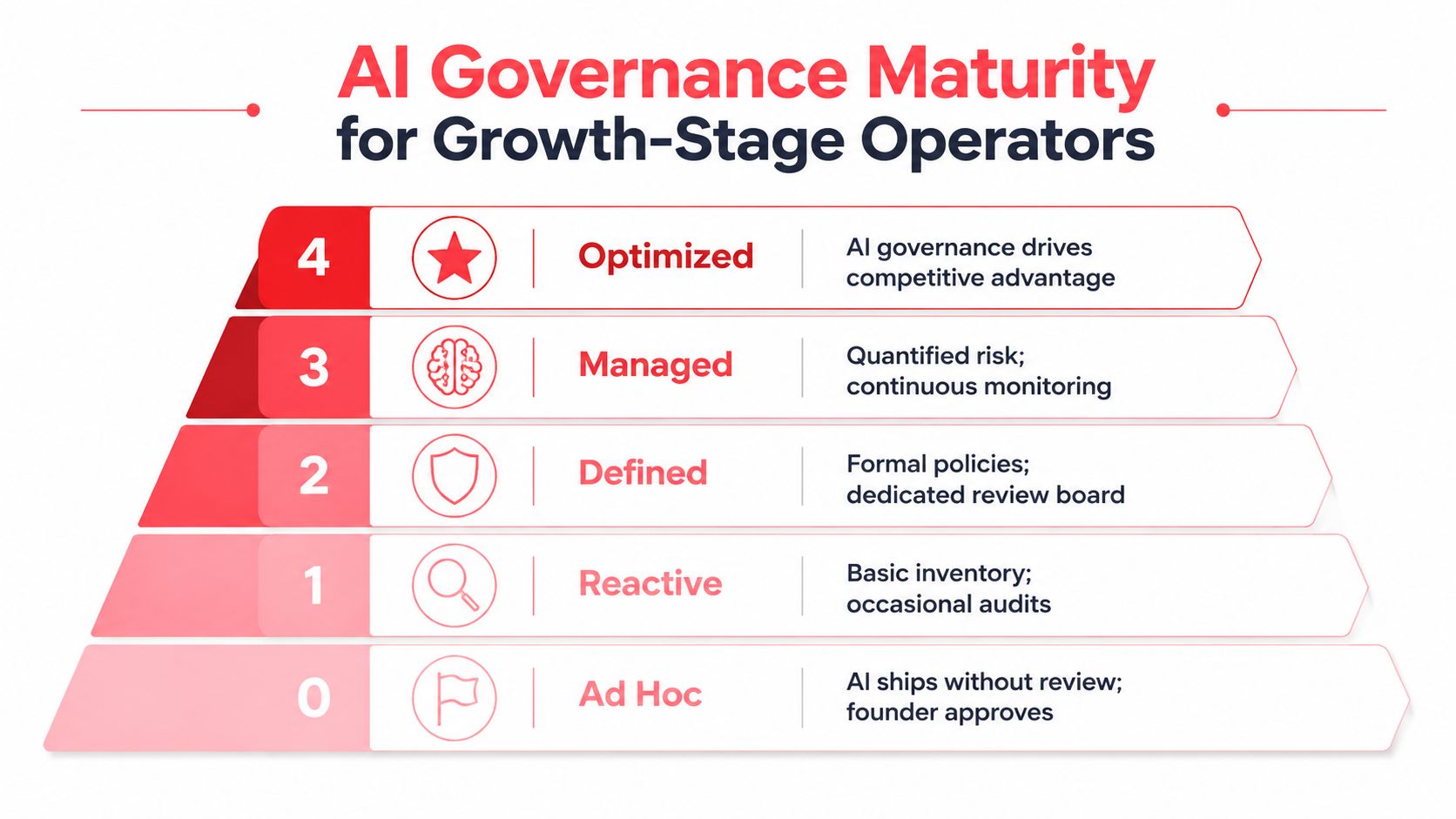
The most common mismatch we see is Tier 2 buyers purchasing Tier 4 leadership. They want a fractional CAIO before they've built an inventory, which usually means the company pays for strategy while the basics stay unfinished.
For teams with an internal operating hub, our AI Center of Excellence resource is useful because it separates coordination from actual control ownership. That distinction matters when governance starts crossing marketing, sales, product, and engineering.
How To Select a Consultant Who Ships Controls
Selection should be operational, not reputational. A beautiful slide deck won't help when you need logs, approvals, and a model-risk register.
Ask for four things before you sign anything.
- An inventory of agents in production at past clients. If they can't show what they helped govern, they probably haven't governed live systems.
- A redacted approval matrix with named approvers and SLAs. This tells you whether they build decision rights or just talk about them.
- Audit-ready evidence packs. Look for logs, model cards, DPIAs, incident artifacts, and change records.
- References from companies in your size band. A team that works with $1M to $50M revenue companies understands the trade-offs between speed, headcount, and control burden.
Disqualify firms that lead with a policy binder. Disqualify firms that can't name the frameworks they've implemented. Disqualify firms that have never sat inside an engineering org shipping LLM features.
Practical rule: ask what an auditor would accept on day 31, then see whether they can produce that on day one.
A good way to de-risk the choice is a 30-day paid pilot with a clear exit clause tied to auditable output. The output should include a RACI, a change-management log, and a model-risk register. If the consultant focuses on hours burned instead of evidence produced, you're buying effort, not control.
The Next Decision To Make This Quarter
The right next move depends on where the company sits today.
| Maturity Tier | Current State | This Quarter's Action | Indicative Price |
|---|---|---|---|
| Tier 1 | No inventory, no policy | Commission a 90-day audit-readiness sprint, produce an agent inventory, risk classification, and a gap report against the EU AI Act and NIST AI RMF | $25K to $60K |
| Tier 2 | Policy exists, no production controls | Run framework selection and implementation scoping, end with a 12-month roadmap | $40K to $90K |
| Tier 3 | Controls exist, agentic systems are scaling | Retain a fractional CAIO to run governance as an operating function, review incidents quarterly, and interface with the board | $8K to $18K monthly |
Tier 1 companies should not buy a full operating model yet. They need visibility first. Tier 2 companies should stop polishing policy language and decide which framework will fit procurement, legal, and engineering. Tier 3 companies should stop treating governance as a project and start running it as a recurring function.
The wrong move at every tier is buying the engagement designed for the tier above it. Pick the action that closes your largest audit gap this quarter, and make the consultant prove it can be evidenced in writing.