
87% of sales organizations use AI, yet only 24% have restructured revenue workflows around agentic systems. The decision is whether to keep adding copilots to a flawed funnel or rebuild one revenue motion around controlled autonomy.
For CEOs, CMOs, and CROs at growth-stage B2B companies, agentic AI for sales is no longer a tool-selection exercise. It's an operating-model decision. Agents can research accounts, qualify leads, route work, draft outreach, update CRM records, and inspect deals across several systems. They can also create compliance exposure, damage buyer trust, and inflate software costs when nobody defines the boundaries.
We've shipped agentic sales workflows inside B2B teams. Our view is direct: don't automate the whole funnel. Pick one or two motions where latency and handoff friction visibly suppress conversion, instrument them properly, and grant autonomy only after the system proves it can operate within cost, quality, and approval limits.
Table of Contents
- The Adoption Versus Execution Gap Sales Leaders Face in 2026
- What Agentic AI for Sales Actually Means Beyond Copilots and Chatbots
- High-Value Use Cases and the Conversion Math Behind Each
- How a Revenue Workflow Gets Rebuilt With Sales Agents
- Where Agentic AI for Sales Breaks in Practice
- Governance, KPIs, and a 90-Day Rollout
- The Decision That Should Sit on Your Desk This Week
The Adoption Versus Execution Gap Sales Leaders Face in 2026
The adoption figure is high, but it does not show whether revenue teams have changed how work gets done. Salesforce data cited in a 2026 analysis of AI agent adoption and ROI says 87% of sales organizations use AI for prospecting, forecasting, lead scoring, and email drafting. A separate benchmark reports that only 24% of B2B suppliers run agentic AI that restructures how revenue is found, prioritized, and validated (2-DATA analysis).
The gap between those two numbers, 87% using AI versus 24% running agentic workflows, is 63 points. That calculation is simple subtraction, not a separate benchmark. It still exposes the operating decision: many teams have added assistants to existing steps, while fewer have redesigned sequence, ownership, data writes, approvals, and measurement around autonomous work.

The cost of stopping halfway
A typical half-built workflow looks familiar. A rep asks ChatGPT to summarize an account, copies the result into Salesforce, drafts an email in another tool, waits for approval in Slack, and manually updates the opportunity after the call. AI appears throughout the process, yet human movement between disconnected systems still determines speed and data quality.
The financial case requires the same discipline. One 2026 industry summary reports that only 33% of AI initiatives meet expected ROI, while 62% of organizations worry about unpredictable AI-related costs and only 21% strongly agree that governance structures are ready for agentic AI (2-DATA's ROI analysis). Buyer confidence limits the operating model too. A B2B trust report found that 69% of buyers still rely on sales representatives to validate what they discovered, and more than half reported receiving misleading information from AI tools (MarTech's buyer trust report).
Our operating rule: An agent earns more autonomy only when its workflow outcomes, costs, and failure modes are visible.
This quarter, the CRO should choose two motions an agent can own, specify which work remains human-owned, and name the revenue line exposed if the test fails. Prospecting research and inbound qualification offer practical starting points. Pricing exceptions, executive negotiations, and customer-outcome claims should require explicit human approval until performance evidence supports broader autonomy.
What Agentic AI for Sales Actually Means Beyond Copilots and Chatbots
A sales agent should have a goal, access to approved tools, permission to act, and a way to evaluate the result. It can plan a sequence, retrieve account data, call enrichment or CRM APIs, execute the next step, and stop or escalate when a condition fails.
That definition separates agentic systems from two products that are often placed in the same category:
- Copilots wait for a seller's instruction and return suggestions, summaries, or drafts.
- Chatbots handle a defined conversational interaction, usually through scripted paths or bounded retrieval.
- Agents manage a multi-step workflow, make tool calls, write results into systems, and respond to outcomes.
The SpendLens AI framework analysis is useful when comparing the planning, tool-use, memory, and orchestration layers behind agent systems. Buyers should examine those layers before comparing model names.

Five autonomy levels for revenue teams
Use this hierarchy in vendor reviews and operating meetings:
- Suggestion. The system recommends an account, next step, or forecast risk. A seller decides what happens.
- Co-drafting. The system prepares an email, call brief, or CRM summary. A seller edits and sends.
- Approved execution. The system enriches a record, assigns a lead, or schedules a meeting after a human checkpoint.
- Workflow ownership. The system runs research, qualification, routing, and follow-up across several tools, with defined exceptions.
- Closed-loop optimization. The system adjusts workflow decisions against a commercial KPI such as qualified meetings or sourced pipeline, subject to governance.
Prospecting can move from suggestion to workflow ownership when source data is approved and messaging claims are constrained. Qualification can reach approved execution before it reaches autonomous routing. Forecasting should begin with recommendations and evidence packets, because the cost of a bad commit decision exceeds the convenience of automatic stage movement.
A Stimulead guide to AI agents provides related context on how these systems fit into broader business workflows. The important vocabulary is autonomy, not branding. If a human must prompt every step, you have an assistant. If the system can plan, act, inspect, and escalate across a bounded process, you have an agent.
High-Value Use Cases and the Conversion Math Behind Each
Choose the first use case by conversion economics, not demo appeal. The strongest candidates have a measurable baseline, repeated handoffs, and failure costs the team can contain. Response time, research quality, and inspection coverage usually expose the clearest bottlenecks.
| Use Case | Baseline Conversion | Agentic Lift | Payback Window | Representative Tooling |
|---|---|---|---|---|
| Account research and prospecting | MQL-to-SQL baseline from your CRM | Run a controlled test against static lists and measure qualified-conversion lift | Validate against your existing ACV and sales-cycle data | Clay, 11x |
| Qualification and booking | Lead-to-meeting and meeting show rate | Set a response-time target under 5 minutes, then compare show rates with the current process | Compare incremental qualified meetings with fully loaded seller cost | Relevance AI, Lindy, Salesforce Agentforce |
| Personalized outbound | Sequence-to-reply and reply-to-meeting rate | Compare agent-generated sequences with templated sequences using the same list and sending controls | Size against your ACV, list quality, and sending costs | Clay, Regie, 11x |
| Forecasting and deal inspection | Forecast accuracy and stage-to-stage movement | Measure accuracy improvement against historical periods with comparable pipeline data | Tie value to planning accuracy and manager time | Gong, BoostUp |
Treat every lift as a test hypothesis, not a promise. The Stimulead AI agent use-case guide offers a practical reference for connecting workflows to measurable sales outcomes. Define the control group, attribution window, quality threshold, and rollback rule before deployment.
How to size the first bet
High-volume inbound teams should usually start with qualification rather than autonomous cold outreach. The data is easier to validate, the buyer has already raised a hand, and a human can review edge cases before an agent changes a lifecycle stage. Measure speed-to-lead, qualified-meeting rate, show rate, and downstream opportunity rate together. A faster response that produces weak meetings is not a win.
Teams with strong account data but weak outbound relevance can prioritize research and personalization. Clay can assemble structured account context, Regie can support message generation, and 11x can provide a more autonomous outbound layer. Keep the agent away from unsupported claims about funding, personnel, product usage, or a prospect's former employer. Review a sample of messages for factual accuracy and relevance before increasing volume.
Forecasting has a different economic profile. Gong can capture conversation signals, while BoostUp can support pipeline inspection and forecast workflows. Start with evidence-backed risk alerts, missing next steps, and stage inconsistencies. Do not let the agent rewrite every opportunity probability before managers trust its evidence and exception handling.
ACV determines whether the build makes sense. Use representative contract value, gross margin, conversion rates, and sales capacity from your own funnel. One additional qualified opportunity per period may justify a build for a high-ACV company. A lower-ACV motion needs greater volume and lower action costs, so automate only after the measurement model is reliable.
How a Revenue Workflow Gets Rebuilt With Sales Agents
A workable inbound flow begins when a lead enters HubSpot or Salesforce. The system should move information between tools through explicit contracts, rather than asking a general model to improvise the entire process.
- Inbound lead. A routing trigger fires within seconds. The enrichment agent checks approved sources through Clay or an enrichment API, then creates a structured account brief.
- Qualification. A qualification agent scores fit, intent, and disqualifiers. It routes the lead through Salesforce Agentforce or HubSpot rules, with a RevOps approval checkpoint for ambiguous records.
- Outreach. An outreach agent drafts or sequences a response through Regie, Lindy, or a controlled engagement platform. The calendar link and sender identity come from the CRM, not from model-generated text.
- Meeting preparation. A meeting agent books the available calendar slot, creates a briefing note, and posts a summary to Slack. The AE reviews the brief before the call.
- Pipeline inspection. A forecasting agent uses Gong signals and CRM activity to identify missing next steps, stalled deals, or inconsistent stages. It updates fields only where the policy permits, then sends exceptions to the manager.

We typically use n8n or Relevance AI for orchestration when the workflow needs visible branching and custom controls. Lindy can work well for lighter operational flows, while Salesforce Agentforce is a natural option where permissions, objects, and seller context already live in Salesforce. The model is only one component. Handoff rules, idempotency keys, retry limits, schema validation, and fallback ownership decide whether the workflow survives production.
A latency budget should exist at every hop. Research may take seconds to minutes, qualification should operate quickly enough to preserve buyer intent, and meeting preparation can happen after booking without blocking the first response. If an agent times out, the system should assign the record to a human queue. If the output fails validation, it should not write to the CRM.
For broader market scanning, teams can browse AI sales agent subcategories before narrowing the vendor list. We recommend measuring meeting-to-opportunity conversion, time to first touch, qualified pipeline per SDR hour, and the number of seller hours returned to active selling. We don't publish a universal lift from client engagements because the answer depends on the baseline funnel, data quality, and workflow scope.
Where Agentic AI for Sales Breaks in Practice
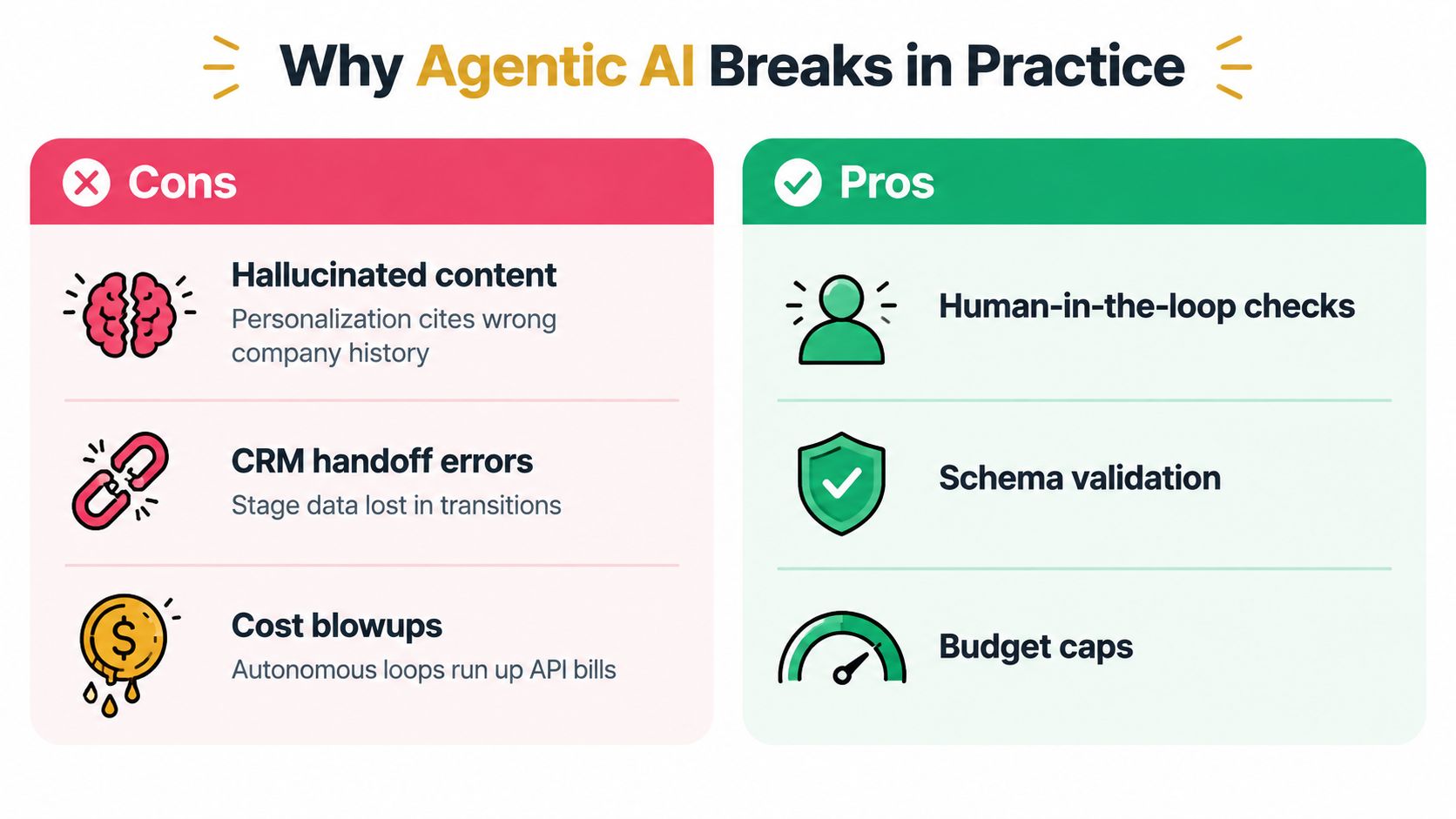
The first failure is usually bad context. An agent sees an executive's name, finds an old company association, and inserts it into a supposedly personal email. The seller may miss the error, but the buyer sees it immediately.
The second failure is a broken handoff. An enrichment agent writes a value into the wrong CRM field, the qualification step reads a stale stage, and the routing system sends the lead to the wrong team. A workflow that appears intelligent at each step can still produce a bad commercial result when the data contract between steps is loose.
The predictable failure modes
- Hallucinated personalization: The agent cites company history, technology, or priorities that the approved sources don't support.
- CRM handoff errors: A workflow loses stage, owner, consent, or qualification data between systems.
- Autonomous cost loops: An agent retries enrichment or research calls without a per-record budget.
- Trust erosion: Reps stop using the system after repeated garbage reaches their queues or buyers.
One industry summary reports that only 33% of AI initiatives meet expected ROI (2-DATA's ROI analysis). The trust problem is also concrete. A separate B2B survey reports that more than 80% of buyers use AI tools alongside traditional search, while 32.23% trust AI-curated vendor lists more than established analyst rankings and 55.81% give them equal weight (ZeroClick Labs buyer survey). Discovery can move through AI, but validation still sits with people.
Cheap prevention beats heroic cleanup
Set the autonomy level per action. Reading public company information may be low risk. Sending an outbound message, changing a qualification stage, or applying a forecast category requires stricter controls.
Use hard limits:
- Source restrictions: Permit only approved CRM fields, enrichment providers, internal content, and validated public sources.
- Cost ceilings: Set a maximum action cost per record and stop retries after a defined threshold.
- Write approval: Route sensitive CRM changes and outbound messages through a human checkpoint.
- Regression tests: Run fixed examples against every prompt, model, and workflow change.
- Kill switch: Give RevOps authority to stop the workflow without waiting for engineering or a vendor.
The right stress test isn't whether the demo succeeds. It's whether the system fails safely when a source is stale, an API is unavailable, a field is empty, or a buyer asks a question outside the policy.
Governance, KPIs, and a 90-Day Rollout
Agent autonomy needs named owners, approval boundaries, and an operating cadence. The CRO owns commercial policy. RevOps owns workflow behavior, monitoring, and the kill switch. Legal owns disclosure and data-use rules. Security owns access, vendor review, and incident response.
Before launch, record approved data sources, PII handling rules, model and vendor allowlists, prompt versions, audit-log retention, escalation paths, and actions that require approval. Maintain a runbook for hallucinations, unauthorized CRM writes, incorrect routing, vendor outages, and unexpected spend. The agent should fail into a review queue, not continue without logging.
Measure the commercial process
Tie every agent action to a funnel outcome. Track:
- Meeting-to-opportunity conversion
- Pipeline velocity
- Time to first touch
- Qualified pipeline per SDR hour
- Forecast accuracy
- AI cost per sourced meeting
Set the baseline before changing the workflow. Compare the agent-assisted motion with the current process across seller time, data quality, conversion, cost, and buyer complaints. Use sales candidate assessment metrics as a practical reference for seller and enablement measurement, then keep your own revenue definitions as the source of truth.
Review metrics weekly during the pilot. A high activity count does not justify expansion if qualification quality falls, exception rates rise, or cost per sourced meeting exceeds the value of the resulting pipeline. Give one owner authority to pause the workflow when quality or spend crosses the agreed threshold.
A 90-day sequence
- Weeks 1 to 2: Audit the current stack, map handoffs, document baseline funnel metrics, and select two workflows.
- Weeks 3 to 6: Ship a copilot-grade pilot with one human checkpoint. Keep every output reviewable and log each action.
- Weeks 7 to 10: Move only the narrowest reliable steps to bounded autonomy. Monitor quality, latency, cost, and exception rates.
- Weeks 11 to 13: Add one use case, formalize ownership, and write operating procedures for ongoing review.
The prompt library should specify structured tasks, not open-ended creative requests. For enrichment, require source URLs, confidence, date, and a null value when evidence is missing. For qualification, require fit criteria, disqualifiers, reason codes, and a routing recommendation. For outreach, require approved claims, persona context, evidence links, and a human-edit state.
| Platform | Autonomy Controls | Observability & Audit | Integration Footprint | Pricing Model |
|---|---|---|---|---|
| Salesforce Agentforce | Salesforce permissions, action boundaries, approval rules | CRM activity and platform logs | Salesforce objects and connected systems | Vendor-specific, commonly platform or usage based |
| Relevance AI | Workflow-level controls and human checkpoints | Run histories, task outputs, error review | APIs, webhooks, CRM and enrichment tools | Vendor-specific, commonly usage based |
| n8n | Deterministic branches, credentials, retry settings | Execution logs and workflow history | Broad API and webhook footprint | Vendor-specific, commonly hosted or usage based |
| Lindy | Task permissions and approval steps | Workflow history and task status | Calendar, email, CRM, and collaboration tools | Vendor-specific, commonly tier or usage based |
| Gong | Signal access and workflow permissions | Conversation records and activity evidence | CRM and revenue intelligence integrations | Vendor-specific, commonly seat or platform based |
Request current vendor pricing before approval. Compare like with like by modeling records, retries, enrichment calls, messages, and human reviews rather than comparing seat costs with action-based pricing. The Stimulead AI implementation roadmap provides a planning reference for sequencing the audit, pilot, and expansion work.
The Decision That Should Sit on Your Desk This Week
The executive team needs one signed decision this week: one workflow, one owner, one budget, and one measurement window.
Use this matrix to set the operating posture:
| Path | Trigger Conditions | Primary KPI | Timeline | Budget Range |
|---|---|---|---|---|
| Hold and instrument | Funnel data is incomplete, pipeline coverage is unclear, or ownership is disputed | Baseline quality, pipeline coverage ratio, and sequence-to-meeting conversion | Immediate measurement period | Use existing tooling before buying new autonomy |
| Pilot one workflow | One motion has clear volume, repeatable steps, and a measurable bottleneck | Time to first touch, qualified meetings, or forecast accuracy | 90-day pilot | Scoped vendor, integration, and RevOps allocation |
| Rebuild one GTM motion | Data is reliable, governance is approved, and the team can monitor autonomous actions | Agent-completed workflow steps, meeting-to-opportunity conversion, and cost per sourced meeting | 90-day rebuild | Budget for orchestration, vendor usage, integration, and ongoing ownership |
Base the gate on funnel evidence. Pull pipeline coverage ratio, CAC payback, sequence-to-meeting conversion, meeting-to-opportunity conversion, and the share of revenue workflow steps an agent can complete without human touch. Unreliable fields mean the team should instrument the funnel before granting autonomy.
For most growth-stage B2B teams, choose a bounded pilot before approving a full rebuild. Select inbound qualification when response delay limits conversion. Select outbound personalization when account research consumes seller time. Select forecasting when managers spend too much time reconciling inconsistent deal evidence.
Schedule a 60-minute meeting with the CEO, CMO, CRO, and RevOps leader this week. Bring the latest funnel export, workflow map, tool spend, routing errors, and seller time estimates. Leave with a named workflow owner, a baseline KPI sheet, and an initial vendor evaluation covering autonomy controls, auditability, integration depth, and per-action cost.
If your team needs an outside operator to run the audit, compare vendors, and govern the first production workflow, contact Stimulead to schedule a fractional CAIO working session. Bring the CRM export and one revenue motion ready for redesign.